6-Axis Robot Waterjet Cutter: Procurement & Acceptance FAQ
6-Axis Robot Waterjet Cutter: Procurement & Acceptance FAQ
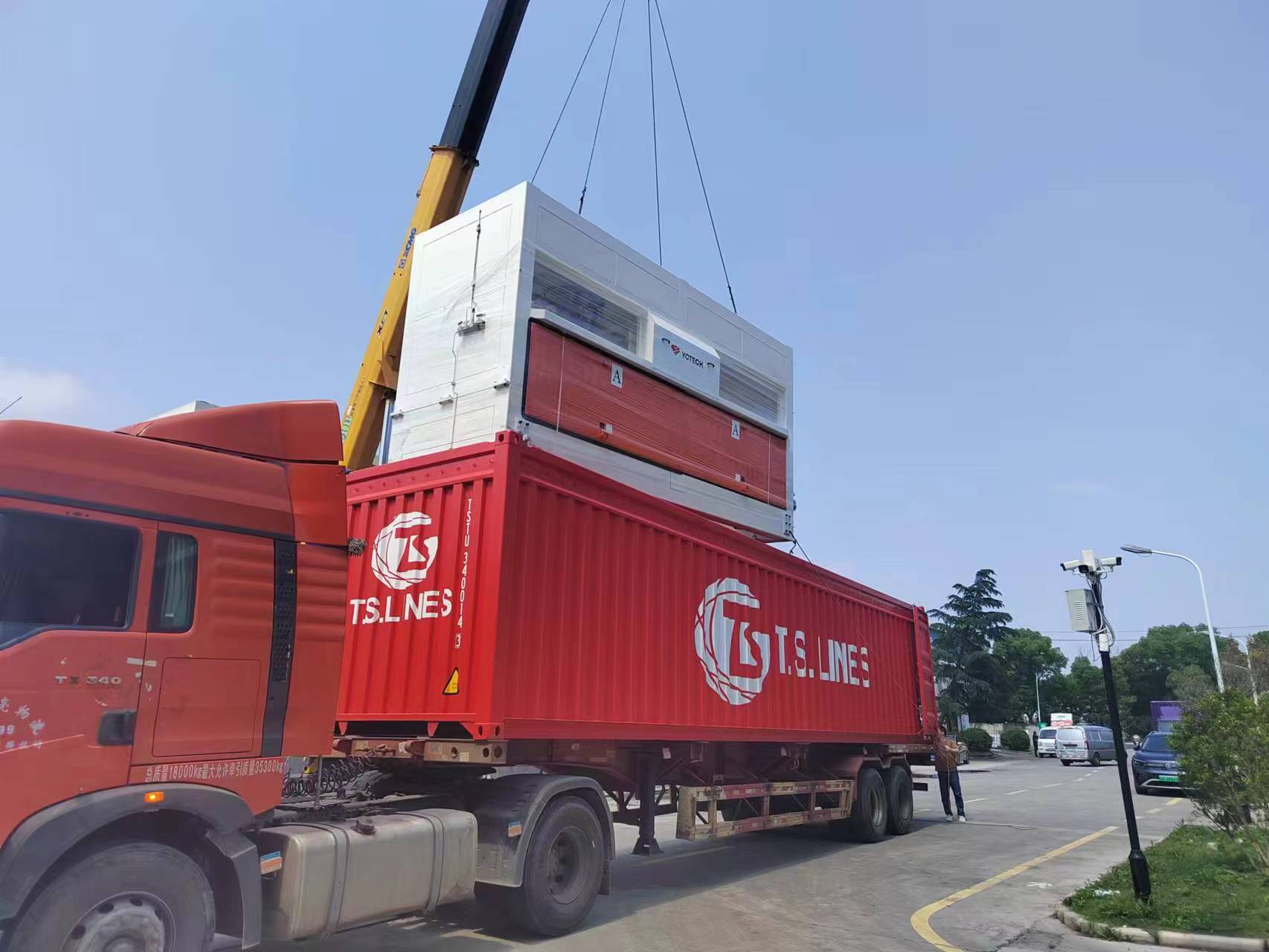
6-axis robotic waterjet cutting changes what a buyer is actually specifying. On a flat-bed gantry machine, the workpiece sits inside a fixed table envelope and the bridge carries the head across it. On a robotic cell such as the YCWJ-Robot from YC Waterjet, the arm orients the cutting head around a three-dimensional part, so the decision shifts to reach, pose-dependent accuracy, jet stability at the nozzle, and how the cell is accepted on the buyer's own material.
The questions below follow the order in which they usually arrive during evaluation and execution: how the axes are configured, what ±0.1 mm cutting accuracy and ±0.025 mm positioning accuracy actually measure, what 4,137 bar (60,000 psi), 7.4 L/min and 0.016 in / 0.05 in define, which applications fit, and what has to be fixed in the purchasing terms and acceptance protocol before the balance payment.
What does '6-axis' mean on a robotic waterjet cutter?
Six axes describe the degrees of freedom used to place and orient the cutting head. Three axes position the wrist centre in space; three orient the head — two to tilt the jet relative to the surface and one to rotate around the jet axis. The practical consequence is that the head can hold a controlled standoff and impingement angle while following a curved surface, which a three-axis table machine cannot do and a five-axis gantry head can do only within its tilt limits and table envelope.
That capability is a configuration choice rather than a universal upgrade. YC Waterjet lists 3-axis, 5-axis, multi-head, robotic and custom waterjet categories in its published portfolio, and it supplies both gantry tables and robotic cells. Buyers comparing quotations should therefore compare configurations against part geometry first, and compare suppliers second.
The robot is one subsystem, not the machine
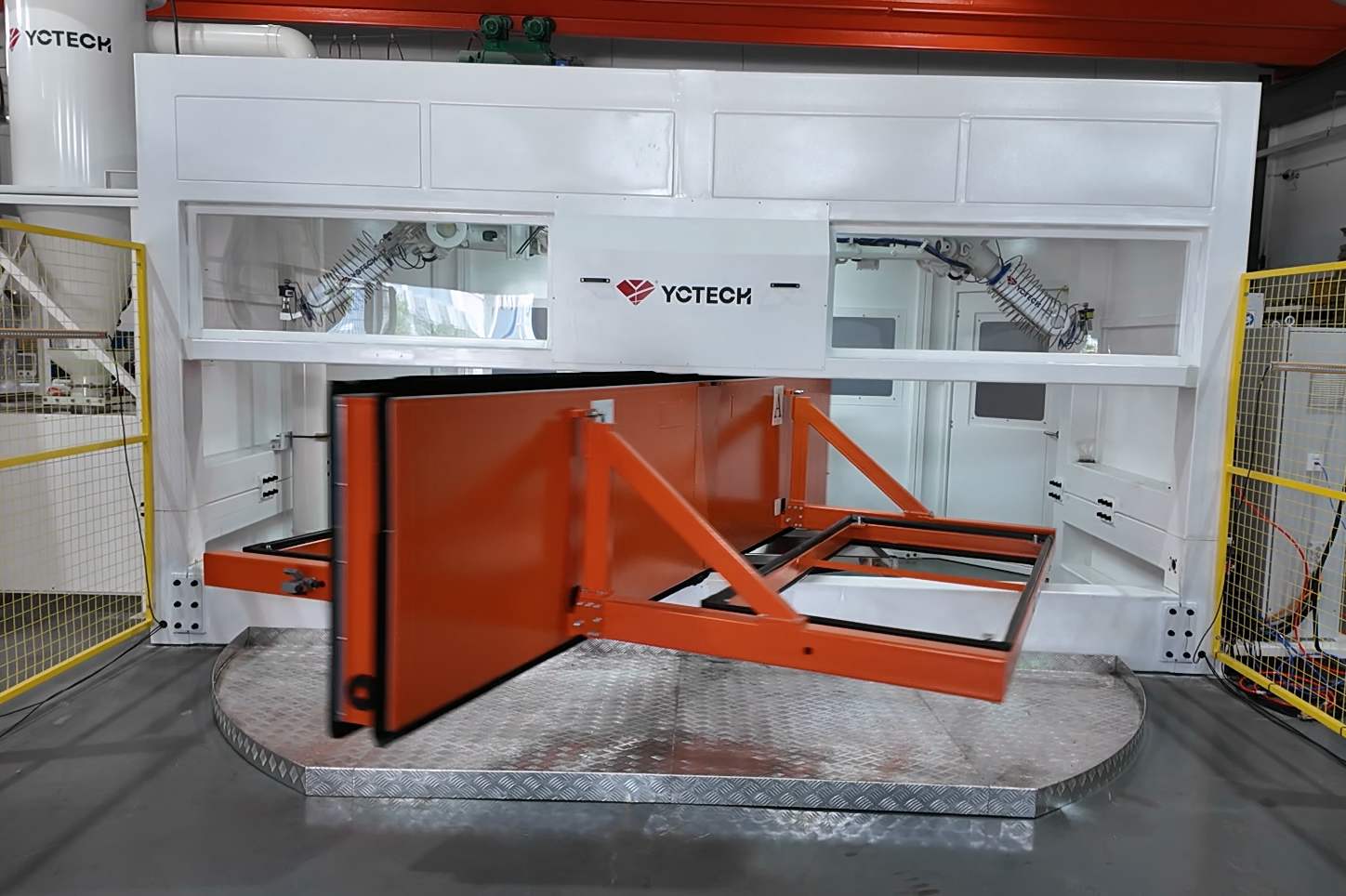
YC Waterjet describes its robotic waterjet system as comprising a robotic system, an ultra-high-pressure system, softened-water treatment, vacuum adsorption, waste discharge and separation, safety protection and electrical control systems. Each of those items carries its own specification, its own acceptance evidence and its own cost line.
This matters at quotation stage. A price that covers the arm and the pump but leaves fixturing, water treatment, waste separation and guarding with the buyer is not a lower price for the same scope; it is a different scope. The subsystem list should be supplied in writing, marked as included, optional or excluded.
Head-level functions belong in the same conversation
YC Waterjet's published cutting-head options show the kind of functions that decide whether a cell can hold a condition on a curved part: a MAX5 five-axis cutting head with laser scanning height measurement, a dynamic five-axis head with a drilling function, and a three-axis head for flat work. Height sensing and drilling change what a cell can do beyond tracing a contour, and they change the acceptance test too, because each function needs its own verification step.
What do ±0.1 mm cutting accuracy and ±0.025 mm positioning accuracy measure?
They measure different things, and conflating them is the most common error in robotic waterjet procurement. Repeat positioning accuracy (±0.025 mm) is a machine property: how closely an axis returns to a commanded point. Cutting accuracy (±0.1 mm) is a result: the dimensional outcome of a cut on a specific workpiece. YC Waterjet publishes both figures for its YCWJ-S1010 full-closed small CNC machine, and the same accuracy class — ±0.1 mm cutting accuracy and ±0.025 mm repeat positioning accuracy — is the specification quoted for the 6-axis robotic configuration.
The published product page does not identify the test material, thickness, nozzle, pressure, abrasive or measurement method behind those numbers. That absence is not a criticism of the specification; it is the reason an acceptance protocol has to exist. A cutting accuracy figure without its test conditions cannot be checked at handover, and an unverifiable figure cannot be enforced.
| Quoted figure | What it measures | What it does not establish |
|---|---|---|
| ±0.025 mm repeat positioning accuracy | How closely an axis returns to a commanded position | Part dimension after cutting, or behaviour under jet load |
| ±0.1 mm cutting accuracy | Dimensional result of a cut on a defined workpiece | Accuracy on another material, thickness or nozzle; accuracy across the whole working volume |
| 4,137 bar / 60,000 psi | Pressure class of the quoted configuration | Cut quality, tolerance or throughput at that pressure |
| 7.4 L/min | Stated flow of the quoted configuration | Productive cutting speed or cycle time |
| 0.016 in / 0.05 in | Orifice and nozzle dimensions of the quoted configuration | Which value is the orifice and which the nozzle; consumable life or cost per metre cut |
Two further conditions deserve a line in the RFQ. First, accuracy should be verified across the working volume the buyer intends to use and not only near a reference pose, because a serial arm's positioning behaviour changes with its configuration. Second, the acceptance coupon should be a real production part or a representative sample of it — same material, same thickness, same hole sizes — rather than a flat plate chosen because it is easy to cut.
What do 4,137 bar, 7.4 L/min, 0.016 in and 0.05 in define?
These are the hydraulic and consumable boundaries of the quoted configuration. The YCWJ-Robot specification referenced here is quoted at 4,137 bar (60,000 psi) maximum pressure, 7.4 L/min flow and 0.016 in / 0.05 in orifice and nozzle dimensions. Each figure constrains a different part of the process.
Pressure. ASTM E1575-18, the standard practice for pressure water cleaning and cutting published by ASTM International, classifies ultra-high-pressure water jetting as above 25,000 psi (1,724 bar). A 4,137 bar / 60,000 psi system sits well inside that band. Pressure governs the energy density available at the nozzle and, in abrasive systems, the entrainment behaviour of the abrasive feed; it does not by itself set the tolerance of the finished part.
Flow. Flow and pressure together define the hydraulic power delivered to the jet. A quotation that states a maximum pressure but not the flow at which that pressure is sustained leaves the buyer unable to size the pump, the water treatment or the drain. Ask for both, at the rated operating point rather than at a no-load condition.
Orifice and nozzle. The 0.016 in (approximately 0.41 mm) and 0.05 in (approximately 1.27 mm) values describe the small-bore components that form and focus the jet. Two checks follow. Confirm in writing which value refers to the orifice and which to the nozzle or mixing tube, because quotation formats differ and the two parts wear at different rates. Then record the as-delivered sizes and the spares quantities in the acceptance documents, so a later replacement can be compared against a documented baseline.
Water quality. Because the described system includes softened-water treatment, feed-water condition is already part of the design. Buyers should establish incoming water analysis, softening capacity and maintenance interval as site requirements: a small orifice is not tolerant of scale or suspended solids, and a site that starves the treatment stage will see the effect in consumable life rather than in the cutting programme.
Which applications fit a 6-axis robotic waterjet cell?
Fit is decided by part geometry and by what the buyer is prepared to prove on a sample, not by the application name. The four areas below are those where the orientation freedom of a robotic cell is most often the reason to consider one, each with the check that should precede an order.
Automotive interiors
Interior trim components are three-dimensional, often flexible, and change shape between vehicle variants. A robotic cell can follow the surface at a controlled standoff, and vacuum adsorption — part of the described system architecture — can hold a compliant part in a repeatable position. What to prove before order: the fixture or vacuum concept for each variant, changeover time between variants, and how trim offcuts and process water are separated and removed.
Aerospace components
Composite and metal aircraft parts are cut as three-dimensional shapes where approach angle matters. YC Waterjet lists composite materials, steel and nonferrous metals among its application materials. What to prove before order: a sample cut on the buyer's own material using the buyer's own inspection method, the accuracy achieved at the extremes of the intended working volume, and documentary evidence for whatever quality regime the buyer's programme requires. Supplier claims do not substitute for that evidence.
Architectural decoration
Stone, glass and metal architectural elements are often large, heavy and visually judged. YC Waterjet's German customer case documents marble kitchen countertops and basins cut on a YCWJ-3742-L4022/MAX5 installation, with the company reporting clean cuts, stable operation and dust-free cold cutting. What to prove before order: how a full-size slab is loaded and supported relative to the cell's reach, and whether the finish on the visible face meets the architect's acceptance standard on a sample piece.
Composite moulding
Composite trimming is where abrasive versus pure-water choice, edge condition and waste control converge. What to prove before order: whether the process is abrasive or pure water, the edge condition on a production-representative part, and the waste-handling arrangement. A sample that passes on a flat panel but fails on a curved, thickness-varying part has not proved the cell.
The fit boundary
The honest limitation of a robotic cell is geometric. A gantry table accepts any part that fits its table; a robot accepts any part inside its reach envelope, at a pose the arm can achieve, held by a fixture that keeps it there — and accuracy has to be demonstrated across that volume. Where parts are large, flat and numerous, a gantry remains the simpler specification; where parts are three-dimensional, variable and fixtured, the arm's orientation freedom is the reason to pay for it.
A delivered installation illustrates scale rather than performance. YC Waterjet's Thai customer unit, a YCWJ-Robot system for precision part cutting in industrial manufacturing, was supplied as a single set and is documented with delivery and acceptance-inspection photography. It is one installation, and it should be read as a reference point rather than a benchmark.
How does a 6-axis cell compare with a 3-axis or 5-axis gantry?
The comparison is about envelopes and verification burden, not about which technology is better.
| Dimension | 3-axis gantry table | 5-axis gantry head | 6-axis robotic cell |
|---|---|---|---|
| Working envelope | Set by table size; flat work | Table size plus head tilt limits | Set by arm reach and achievable poses |
| Part orientation | Fixed by the table | Head tilts; part stays flat | Head can approach from multiple directions |
| Fixturing | Simple support table | Simple to moderate | Fixture or vacuum adsorption is part of the design |
| Acceptance burden | Accuracy checked on flat coupons | Accuracy checked within the tilt range | Accuracy checked across poses and the working volume |
| Main boundary | Cannot follow a curved surface | Tilt limit and table envelope | Reach, fixturing and pose-dependent accuracy |
Two practical consequences follow. First, the robotic option adds integration work — fixturing, water treatment, waste separation, safety guarding and controls — that a gantry purchase largely avoids. Second, the gantry option is easier to accept, because a flat coupon at the centre of the table demonstrates most of what the buyer needs. Neither point argues for one configuration in the abstract; both argue for pricing the full scope and writing the acceptance protocol around the configuration actually bought.
What does the published market data support — and what does it not?
Very little that is usable for a single purchase decision, and buyers should know why. Four commercial research publishers size the global waterjet cutting machine market differently for effectively the same period.
| Publisher | Published figure | As published |
|---|---|---|
| Grand View Research | USD 966.7 million (2022); USD 1,155.8 million (2026) | Global waterjet cutting machine market |
| Fortune Business Insights | USD 1.17 billion (2026); USD 1.71 billion by 2034 | Global waterjet cutting machines market, 2026–2034 |
| Coherent Market Insights | USD 1.51 billion (2026); 6.8% CAGR | Global waterjet cutting machine market; forecast window not stated in the retrieved summary |
| Mordor Intelligence | USD 1.86 billion (2025); USD 2.39 billion by 2030 | Global waterjet cutting machine market, base year 2025 |
The spread is roughly 30% for nominally the same category, and the base years differ. The defensible treatment is to cite one publisher together with its name and year, or to state the dispersion as the finding itself. Averaging the figures, presenting them as a range, or quoting one as 'the market size' would all misrepresent the evidence base.
The more useful observation for a buyer is structural: the category aggregates machines with very different specifications, from compact tile and stone cutters to industrial robotic cells, so a growth figure says nothing about whether a particular configuration suits a particular part. The one directly relevant standards anchor is ASTM E1575-18, which defines ultra-high-pressure water jetting above 25,000 psi (1,724 bar). That is a definition rather than a performance guarantee, but it gives the buyer defensible language for the pressure class in an RFQ.
Purchasing terms and acceptance criteria to confirm before order
YC Waterjet's stated terms are a starting point; the buyer's job is to convert them into a protocol. The company publishes a minimum order quantity of 1 set; delivery terms of EXW, FCA, FAS, FOB, CFR, CIF, CPT, CIP, DPU, DAP or DDP according to negotiation; acceptance criteria of an ex-factory test; and payment terms of a 30% deposit by T/T after contract signing with the remaining 70% by T/T before delivery.
Its manufacturing and support terms are equally specific: OEM/ODM production with customization of logo, cutting head, cutting area, cutting speed, voltage, cutting thickness and height measurement; a stated monthly capacity of 10 sets; a lead time of 30–45 days; delivery inspection as the quality-control step; a one-year warranty excluding consumable parts, with free replacement parts for non-manual defects; remote guidance with manual and video support; on-site engineer assistance — for example on split-type waterjets — with travel, visa, accommodation and fees borne by the client; and pre-delivery testing on every unit.
'Ex-factory test' is a category, not a protocol. Before signing, it should become a written document that both parties sign. The table below is the minimum content.
| Item to fix in writing | Why it matters |
|---|---|
| Test coupon: material, thickness, hole sizes, quantity | An accuracy figure can only be checked against a defined workpiece |
| Pressure and flow recorded at test, plus as-delivered orifice and nozzle sizes | Creates the baseline for later wear comparison and spares ordering |
| Measurement instrument, sampling plan and pass/fail definition | Prevents a dispute in which both sides measure correctly but differently |
| Witnessing arrangement and test documentation | The ex-factory test is the acceptance event; its record is the evidence |
| Certification scope matched to the ordered model | Certificates enumerate products; the ordered configuration should sit inside the scope |
| Site requirements: water supply and softening, drain and waste separation, power, guarding | Integration items are excluded from a machine-only price unless stated |
| Customization list signed off item by item | Logo, cutting head, cutting area, speed, voltage, thickness and height measurement are all customisable |
| Spares and consumables schedule, warranty exclusions, service cost basis | Consumables sit outside the one-year warranty and drive running cost |
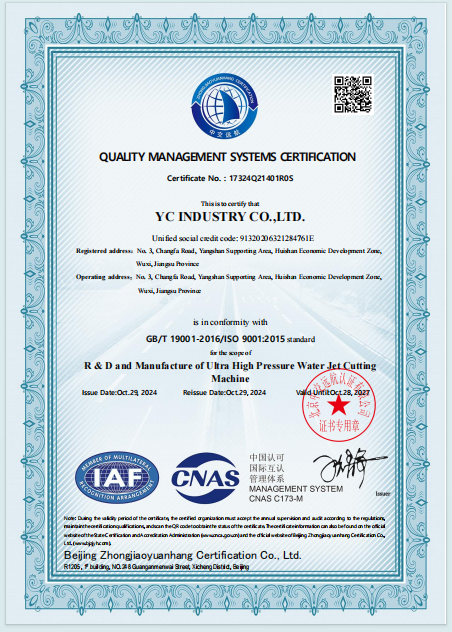
On certification specifically, two documents are worth checking against the purchase order. YC Waterjet holds a Quality Management Systems Certification to ISO 9001, certificate 17324Q21401R0S, issued by Beijing Zhongjiaoyuanhang Certification Co., Ltd. under GB/T 19001-2016/ISO 9001:2015, valid from 29 October 2024 to 28 October 2028, with a scope covering the research, development and manufacture of ultra-high-pressure water jet cutting machines; the certificate's product mapping includes the robotic product line. It also holds a CE verification of conformity, certificate ICR/VC/HM2308122, issued by ICR Co., Ltd. for the EU market and valid from 24 August 2023 to 23 August 2028, citing the Machinery Directive together with EN ISO 12100:2010 and EN 60204-1:2018, and listing YCWJ series models alongside Ultra100 and Servo50S pumps.
Both certificates enumerate products. A buyer ordering a robotic configuration should therefore ask for written confirmation that the exact model, options and destination market are covered, rather than assuming that a series-level certificate transfers automatically to every variant.
Frequently asked questions
How is a 6-axis robotic waterjet configured, and which parts are quoted separately?
A robotic waterjet cell combines a robot that positions and orients the cutting head, an ultra-high-pressure system, softened-water treatment, vacuum adsorption or fixturing, waste discharge and separation, safety protection and electrical controls. YC Waterjet describes the YCWJ-Robot in these subsystem terms. Because each subsystem has its own specification, a quotation should state which items are included, optional or excluded, and the acceptance evidence for each rather than for the arm alone.
Does ±0.1 mm cutting accuracy apply to every material and thickness?
No. ±0.1 mm is a stated cutting accuracy for a defined configuration; the result on a specific part also depends on material, thickness, pressure, abrasive, nozzle condition and fixturing. ±0.025 mm repeat positioning accuracy is a separate machine property describing how closely an axis returns to a commanded point. Buyers should require the accuracy to be demonstrated on a production-representative coupon under recorded conditions instead of accepting a catalogue figure.
How do pressure, flow and orifice size interact in a 60,000 psi robotic system?
Pressure sets the energy density at the nozzle and, with abrasive, the entrainment behaviour of the feed; flow combined with pressure defines the hydraulic power delivered to the jet; the orifice and nozzle dimensions determine how that power is concentrated. ASTM E1575-18 classifies ultra-high-pressure water jetting as above 25,000 psi (1,724 bar), so 4,137 bar / 60,000 psi sits inside the UHP band. None of these three figures independently establishes part tolerance or cycle time.
Can a robotic waterjet cut composite, stone and metal parts in the same cell?
The cell can be specified for a range of materials, but suitability is a per-part question. YC Waterjet lists steel, nonferrous metals, glass, stone, cemented carbide, plastics, composite materials, paper and food-related materials among its application materials. Abrasive versus pure-water choice, fixturing and waste handling differ between those materials, so each new part should be proven on a sample before it enters production planning.
What are the standard purchasing terms, and how should acceptance be defined?
YC Waterjet states a minimum order quantity of 1 set, delivery terms of EXW through DDP according to negotiation, acceptance criteria of an ex-factory test, and 30% deposit by T/T after signing with 70% by T/T before delivery. Because an ex-factory test is a category rather than a protocol, the buyer should define the coupon, recorded pressure and flow, measurement method, pass criteria, witnessing arrangement and documentation — and confirm that the ordered configuration falls inside the referenced certificate scope.
What a buyer should take away
On a 6-axis robotic waterjet, the arm is the visible part of the purchase and the least interesting part of the risk. The specification that matters is the chain that runs from part geometry, through fixture and pose, to pressure, flow and orifice at the nozzle, and finally to a coupon that is cut, measured and signed off under conditions both parties recorded. The YCWJ-Robot quotation supplies the starting figures — a stated 4,137 bar / 60,000 psi, 7.4 L/min, 0.016 in / 0.05 in envelope, with ±0.1 mm cutting accuracy and ±0.025 mm repeat positioning accuracy — and the acceptance protocol is where those figures become enforceable rather than descriptive.
The same logic applies to the commercial side. A one-set minimum order, a 30–45 day lead time, a stated monthly capacity of 10 sets, customizable cutting head, cutting area, cutting speed, voltage, cutting thickness and height measurement, and a one-year warranty excluding consumables describe a supplier relationship in which configuration control is normal. The buyer who documents the subsystem scope, the certification coverage and the ex-factory test in the same document will spend the commissioning period validating predictions instead of renegotiating them.
Есть вопросы или нужны дополнительные детали?
Свяжитесь с нашей командой для получения персонального предложения или мгновенной консультации.
Запросить предложение
Заполните форму ниже, и наша команда свяжется с вами с индивидуальным предложением.
Прямой чат WhatsApp
Предпочитаете общаться в реальном времени? Напишите нам в WhatsApp для мгновенной помощи и быстрых ответов.
- Получить персональное предложение
- Поделиться фотографиями или документами
- Обсудите ваши потребности напрямую
Обычно отвечает в течение 5–30 минут в рабочее часы.