
8-Inch vs 12-Inch Hub Motors: An Independent Buyer's Comparison for Smart Manufacturing
8-Inch vs 12-Inch Hub Motors: An Independent Buyer's Comparison for Smart Manufacturing
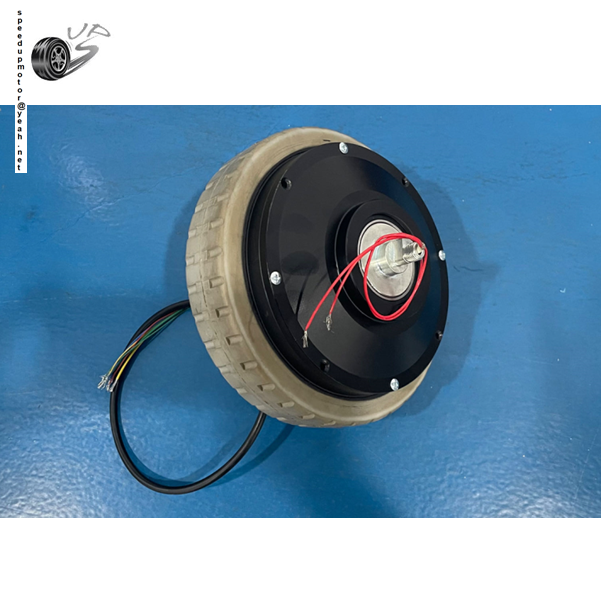
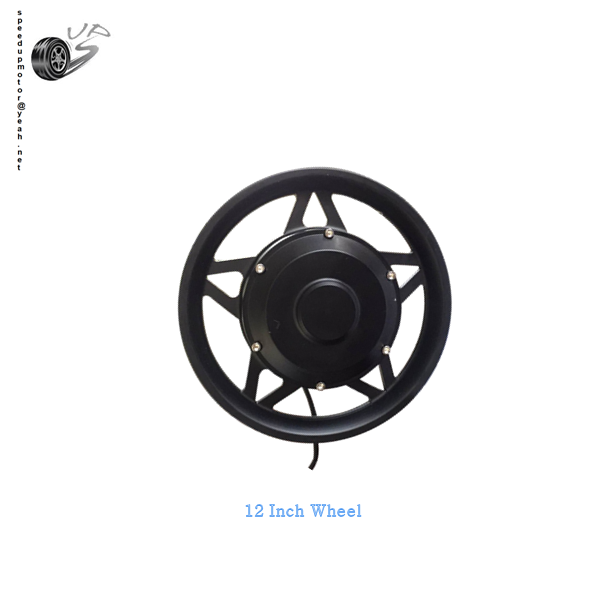
Two brushless wheel hub motors from the same supplier catalogue — the 8-inch 1DY-E5S and the 12-inch SA06 — both publish a 300 W rated power, a 150 rpm rated speed and a 20 Nm rated torque. They are nevertheless not interchangeable. Their gear reduction differs by more than a factor of four (1:20 against 1:4.5), their wheels differ by roughly 105 mm in diameter, their rated voltages are published on different bases, and their braking systems belong to different design families.
This comparison is written as an independent buyer reference for procurement and engineering teams specifying wheel hub motors for mobility, medical and automation equipment. It uses the published specification sheets for models 1DY-E5S and SA06, the supplier's published capability, application and case data, and third-party market research. Where a value is not published — for example, a waterproof rating for the 8-inch model — that gap is identified rather than filled in with an assumption. Every figure quoted below comes from those sources. Any arithmetic is labelled as a calculation from catalogue values, not as a measured test result.
Why the 8-inch versus 12-inch decision has become a procurement question
A wheel hub motor integrates the drive into the wheel, which removes belts, chains and exposed driveline components from the machine layout. That integration is precisely why the wheel diameter becomes a system-level decision rather than a cosmetic one: the same motor data can produce very different ground behaviour depending on the wheel it is built into.
The commercial context explains why more buyers are now reading these data sheets carefully. Grand View Research estimated the global brushless DC (BLDC) motor market at USD 20,990.5 million in 2024, with China accounting for approximately 39.8% of global revenue share in the same year. Within the downstream categories that use geared hub motors, MarketsandMarkets valued the global market for motors used in medical devices at USD 4.25 billion in 2024, and Grand View Research estimated the global electric wheelchair market at USD 4.49 billion in 2024, projected to reach USD 9.05 billion by 2030.
Market Research Future further estimates that the global automotive wheel hub motor market could reach USD 8.8 billion by 2035 at a compound annual growth rate of 5.2%. That projection carries a medium reliability rating in the source data and covers a different, automotive-led segment than the mobility and medical applications discussed here; it is included as a directional signal only, not as a forecast for this product class.
The procurement implication is straightforward. Hub motors are no longer sourced only by the engineers who designed the machine. They are sourced by teams that must justify a specification against load requirements, certification files and service expectations. A comparison that stops at “8-inch or 12-inch” does not survive that scrutiny.
The two motors at a glance
The following values are taken directly from the published specification sheets for the two models. Where the two sheets use different reference conditions, that difference is preserved rather than smoothed over.
| Parameter | 8-inch brushless wheel hub DC motor (1DY-E5S) | 12-inch brushless hub motor (SA06) |
|---|---|---|
| Wheel / tire | 200 mm (8-inch) solid tire | 12-inch pneumatic or solid tire |
| Motor type | Brushless hub motor, outer rotor | Brushless hub motor, outer rotor |
| Rated voltage | 36 V; also available with 24 V / 48 V | 24 V; also available with 36 V / 48 V |
| Rated power | 300 W (the model description also cites 36 V / 350 W / 150 rpm) | 300 W, with a listed range of 100–500 W |
| Rated speed | 150 rpm | 150 rpm, or customised |
| Rated torque | 20 Nm | 20 Nm |
| Reduction ratio | 1:20 | 1:4.5 |
| Net weight | 5.5 kg | 3.5 kg |
| Load rating | 80–300 kg | 80–300 kg |
| Brake | Electromagnetic brake (EMB) | Electronic brake (EABS) / disc brake |
| Waterproof rating | Not stated on the published specification sheet | IP54 |
| Materials | Aluminium alloy, copper, magnetic steel, rubber | Aluminium alloy, copper, magnetic steel, rubber |
| Certification / approval | CE, EMC, RoHS | CE, EMC, RoHS |
| Shaft options | Single or double shaft; custom axis length | Single or double shaft; custom axis length |
| Listed applications | Mobility scooter, electric scooter, wheelchair assistance, medical chair, AGV, robot | Mobility scooter, electric scooter, wheelchair assistance, medical chair, AGV, robot, folding e-bike |
What the specification differences actually mean in practice
Reduction ratio: 1:20 against 1:4.5
The most consequential difference between the two models is the gear stage. The 8-inch 1DY-E5S is a geared hub motor with a 1:20 reduction, meaning the internal motor turns twenty times for every single rotation of the wheel. The 12-inch SA06 uses a 1:4.5 reduction, so the motor turns four and a half times per wheel rotation.
A deeper reduction multiplies torque more aggressively and lowers the wheel's rotational speed for a given motor speed. That is the classic engineering trade-off inside a compact wheel: a small diameter with a large reduction ratio is a way of producing usable tractive effort from a short lever arm. It is also why this class of geared hub motor is described as a low-speed, high-torque drive rather than a traction drive for fast vehicles.
Voltage: published on different bases
Both motors are offered across a 24 V, 36 V and 48 V envelope, but they do not list the same configuration as their reference point. The 8-inch 1DY-E5S is published with a 36 V rated voltage and 24 V / 48 V as alternatives; the 12-inch SA06 is published with a 24 V rated voltage and 36 V / 48 V as alternatives. For a buyer, that means the two models cannot simply be dropped into the same battery architecture and compared on equal terms without confirming the intended operating voltage with the supplier. Voltage choice also interacts with controller selection, current draw and the wiring and protection strategy at machine level.
What the numbers imply at the ground
Both sheets publish 20 Nm rated torque and 150 rpm rated speed, which makes them look equivalent. They are not, because the wheel diameter converts that torque and speed into different ground behaviour.
Working from the stated diameters — 200 mm for the 8-inch unit and a nominal 305 mm for a 12-inch wheel — the arithmetic runs as follows. Tractive force at the ground is torque divided by wheel radius: approximately 200 N for the 8-inch wheel (20 Nm ÷ 0.100 m) against approximately 131 N for the 12-inch wheel (20 Nm ÷ 0.1525 m). Distance travelled per wheel revolution is pi multiplied by diameter: approximately 0.63 m for the 8-inch wheel and approximately 0.96 m for the 12-inch wheel. At the stated 150 rpm, that corresponds to roughly 94 m per minute (about 5.6 km/h) and roughly 144 m per minute (about 8.6 km/h) respectively.
These are arithmetic illustrations from catalogue values, not measured road tests. They exclude rolling resistance, gearing losses, controller current limits and tire deformation. Their value is directional: for the same published torque and speed, the smaller wheel delivers more force and less ground speed, while the larger wheel delivers more ground speed and less force.
Materials and construction: more similar than the marketing suggests
Both models list the same material set — aluminium alloy, copper, magnetic steel and rubber — and both are described as brushless hub motors with an outer rotor and rare earth NdFeB permanent magnets. On the published data, the materials are not where the two products diverge. The divergence sits in geometry, winding, gear stage and wheel size.
One counter-intuitive data point is worth flagging for any team with a vehicle-level mass budget. The 8-inch unit is listed at 5.5 kg net weight, while the larger 12-inch unit is listed at 3.5 kg. A buyer should not assume that a bigger wheel is automatically a heavier one; the gear stage, brake design and hub construction dominate the mass, and the published values should be confirmed against the exact configuration being quoted.
Braking and sealing
The 8-inch 1DY-E5S carries an electromagnetic brake. The 12-inch SA06 is published with an electronic brake (EABS) or a disc brake. These are different braking philosophies with different failure modes, different wiring requirements and different behaviour during an emergency stop, so the brake specification should be treated as a selection criterion in its own right rather than an accessory.
The sealing data is also asymmetric: the SA06 publishes IP54, while the 1DY-E5S publishes no waterproof rating on its specification sheet. For indoor equipment this may be immaterial. For equipment that is washed down, operated in humid rooms or exposed to condensation, the absence of a published rating is a gap that has to be closed with the supplier before design freeze.
The supplier behind these two models
Both motors are produced by Wuxi Speedup Power Co., Ltd, a DC motor manufacturer based in Wuxi, Jiangsu Province, China, which specialises in printed and pancake motors, BLDC motors and wheel hub motors for industrial and mobility applications. The company was founded in 2018 and states a factory area of 10,000 square metres, 30 employees, an annual output of 30,000 pieces, a three-engineer R&D team and an export share of approximately 90%, with main markets in the EU and the USA. Its published certifications include RoHS, UL, EMC and ISO9000-2008.
On the manufacturing side, the company describes an OEM/ODM production model with customisation across voltage, power, speed, torque, shaft and logo, a monthly capacity of 30,000 pieces, a quoted lead time of 30–45 working days, a minimum order quantity of one unit and 100% testing. Published after-sales services include a quality warranty, remote fault diagnosis and technical guidance, installation and commissioning instructions, original spare parts supply, repair and replacement service, and lifetime online technical support.
For buyers, these are capability statements rather than verified performance data, and they should be tested during supplier qualification — a sample build, a test report at the intended operating point and a documented lead-time commitment are more informative than a catalogue claim.
Application fit: which wheel suits which machine
The published application lists for the two models overlap heavily: both name mobility scooters, electric scooters, wheelchair assistance, medical chairs, AGVs and robots. The 12-inch SA06 additionally lists folding e-bikes. The difference in suitability comes from wheel geometry and reduction ratio, not from the application list.
The 8-inch 1DY-E5S fits machines where compactness and tractive effort matter more than speed. Its 200 mm solid tire, 1:20 reduction and 80–300 kg load rating point to indoor and low-to-medium-speed duty: shopping carts and transport carts, hospital transport equipment, powered wheelchairs and assistance chairs, and small AGVs where the drive must sit inside a tight chassis envelope. Because the solid tire carries no pneumatic inflation, it also suits environments where puncture risk is a maintenance concern.
The 12-inch SA06 fits machines where the larger wheel improves the ride and the ability to cross thresholds, floor joints and small obstacles, and where a higher ground speed is acceptable or desirable. Its pneumatic or solid tire choice, IP54 rating and disc or electronic brake option make it a reasonable candidate for outdoor-capable mobility scooters, medical chairs, AGVs and folding e-bike style platforms.
The published operating conditions for this equipment class are worth repeating because they define the real duty cycle: indoor and outdoor low-to-medium speed operation, frequent start-stop under high load, and humid environments, with 24/7 operation stated for some programmes. The matched equipment list is consistent across applications — gearboxes and high-strength reduction gearboxes, EMB electromagnetic brakes, motor controllers and wheel assemblies — and the stated special requirements include condensation protection, electromagnetic compatibility grounding, brake debugging and safety-distance control, and custom single or dual shaft outputs in a range of voltages and powers.
Field evidence from published case data
The supplier's published case records offer a limited but relevant view of how these platforms behave in volume production. One medical equipment manufacturer in Germany, the UK and the United States is recorded with 100,000 units delivered over a ten-year period for assistive drive devices, with the highlighted result being stable operation, low-speed high-torque behaviour and a small wheel size. An electric cart factory across the Netherlands, Germany, the UK, Spain and the United States is recorded with 30,000 units for shopping cart wheel drive over ten years, again citing stable operation, low-speed high torque and an electromagnetic brake. A wheelchair factory and a medical bed factory are each recorded with approximately 3,000 units and more than ten years of operation.
These are supplier-reported programme summaries without third-party audit, so they should be read as reference points rather than proof. Their useful signal is directional: the low-speed, high-torque, small-wheel configuration is the one that dominates the published long-running programmes, which is consistent with the geometry discussed above.
Where these motors sit against traditional drive solutions
The most direct alternative inside the same catalogue is a brushed hub motor. For the 8-inch class, the published brushed option (1DY-E5A) is listed at 24 V, 300 W, 100 rpm and 30 Nm with a 1:20 reduction and an electromagnetic brake; for the 12-inch class, a brushed model (6DY-A4) is listed at 24 V, 200 W, 70 rpm with a 1:40 reduction. Compared with the brushless units, the brushed designs are described by the supplier with a printed armature, high power-to-volume ratio and high linearity, while the brushless models are described with rare earth NdFeB magnets, an outer rotor, high efficiency, long service life and silent, smooth operation.
Those feature descriptions are catalogue claims and should be treated as such. The general engineering boundary is well established: brushed motors involve commutator and brush wear, which is normally a maintenance consideration, while brushless motors require electronic commutation and therefore a controller that must be specified as part of the drive rather than as an accessory.
Against a central motor with belt, chain or separate gearbox, hub motors remove driveline components and free chassis space, at the cost of added unsprung mass at the wheel and a fixed relationship between motor speed and ground speed. That last point is the most important limitation in this comparison: both motors are low-speed, geared drives published at 150 rpm rated wheel speed. Neither is a substitute for a higher-speed traction drive, and equipment that needs to travel substantially faster than the speeds calculated earlier will require a different platform, a different wheel diameter or a different reduction ratio.
Procurement checklist for buyers comparing the two models
Independent evaluation of these two motors comes down to a small number of confirmable items. Each one should be answered in writing before an order is confirmed.
- Confirm the operating point. Ask for the rated voltage, power, speed and torque of the exact configuration being quoted, and resolve the 300 W / 350 W documentation difference for the 8-inch model.
- Confirm the reduction ratio and wheel construction. A 1:20 reduction with an 8-inch solid tire produces a very different machine than a 1:4.5 reduction with a 12-inch pneumatic tire.
- Confirm the brake architecture. Electromagnetic brake on the 1DY-E5S against electronic brake (EABS) or disc brake on the SA06 — check fail-safe behaviour, release logic and controller compatibility.
- Confirm the sealing requirement. SA06 publishes IP54; 1DY-E5S publishes none. For humid, washdown or condensation-exposed equipment, request a defined rating.
- Confirm the load and shaft configuration. The 80–300 kg load rating, single or double shaft and custom axis length must match the actual machine, not the catalogue headline.
- Confirm certification documents. Request the CE, EMC and RoHS documentation relevant to the quoted build, and check whether machine-level conformity remains the buyer's responsibility.
- Confirm the commercial terms. Published figures indicate a minimum order quantity of one unit and a 30–45 working day lead time, with a stated monthly capacity of 30,000 pieces and 100% testing.
- Validate with a sample. Testing a sample at the intended voltage and load remains the only reliable way to verify torque, thermal behaviour and brake performance in the target application.
Market trend: what the data shows, and where it disagrees
The direction of the market is not in dispute; the size estimates are. Grand View Research placed the global BLDC motor market at USD 20,990.5 million in 2024 with China holding approximately 39.8% of global revenue share, while other research firms publish materially lower totals for overlapping periods — a divergence the source data attributes to differences in scope, such as performance-specific motors versus the total BLDC market.
Downstream, the demand drivers are more consistent. The market for motors used in medical devices was valued at USD 4.25 billion in 2024, and the electric wheelchair market was estimated at USD 4.49 billion in 2024 with a projected path to USD 9.05 billion by 2030. A separate estimate places the automotive wheel hub motor market at USD 8.8 billion by 2035 at a 5.2% compound annual growth rate, though that figure carries a medium reliability rating and covers a different segment.
For buyers, the practical reading is that geared hub motors are being specified into more equipment categories, which increases both the availability of options and the importance of comparing published specifications rather than marketing summaries. It also means that a component-level comparison such as this one — torque, reduction ratio, voltage base, sealing and brake type — is becoming a standard part of supplier qualification.
Future outlook
Three developments are likely to shape how buyers evaluate this category over the coming years. First, as mobility and medical equipment volumes grow, the case for platform standardisation increases: a supplier able to offer 6.5-inch, 8-inch and 12-inch geared hub motors from a common design language can reduce the engineering cost of building several machine variants. Second, sealing and documented ingress protection are moving from optional specification to procurement requirement, particularly for equipment used in clinical and food-adjacent environments. Third, customisation is becoming normal rather than exceptional — published options already include operating voltage, shaft and axis profiles, performance profiles and special OEM configurations.
None of these trends removes the fundamental trade-off described in this article. A smaller wheel with a deeper reduction remains the right answer when low speed and high tractive effort dominate the requirement; a larger wheel with a shallower reduction remains the right answer when ground speed, obstacle crossing and ride quality dominate it. Buyers who can state which of those two conditions governs their machine will find the 8-inch 1DY-E5S and the 12-inch SA06 easy to separate.
FAQ
What is the main difference between the 8-inch 1DY-E5S and the 12-inch SA06?
The most significant difference is the gear reduction and the wheel diameter. The 8-inch 1DY-E5S uses a 1:20 reduction with a 200 mm solid tire and is published with a 36 V rated voltage, 300 W rated power and 20 Nm rated torque. The 12-inch SA06 uses a 1:4.5 reduction with a pneumatic or solid tire and is published with a 24 V rated voltage, 300 W rated power, 20 Nm rated torque and an IP54 rating. Both are brushless hub motors with an outer rotor, and both are approved to CE, EMC and RoHS.
Which is better for a wheelchair or mobility scooter: 8-inch or 12-inch?
The published application lists of both models include mobility scooters, electric scooters, wheelchair assistance and medical chairs, so neither is excluded on application grounds. The selection depends on the requirement. A 1:20 reduction with a 200 mm wheel favours low ground speed and higher tractive force at the same rated torque. A 1:4.5 reduction with a 12-inch wheel favours ground speed and obstacle crossing. One published case record for assistive drive devices highlights low-speed, high-torque behaviour and a small wheel size as the characteristics behind a ten-year programme.
What does a 1:20 gear ratio mean compared with 1:4.5?
It describes how many motor rotations are needed for one wheel rotation. At 1:20 the internal motor turns twenty times per wheel revolution, which multiplies torque more and reduces wheel speed for a given motor speed. At 1:4.5 the motor turns four and a half times per wheel revolution, giving a shallower torque multiplication and a higher wheel speed for the same motor speed.
Can the 8-inch and 12-inch hub motors run on 24 V, 36 V and 48 V?
Both models are published as available across a 24 V, 36 V and 48 V envelope, but with different reference ratings. The 1DY-E5S is published at 36 V rated voltage with 24 V and 48 V as alternatives; the SA06 is published at 24 V rated voltage with 36 V and 48 V as alternatives. The specific voltage and performance combination should be confirmed with the supplier for the configuration being purchased.
What certifications do these hub motors carry?
Both the 1DY-E5S and the SA06 are published as CE, EMC and RoHS certified or approved, and both are offered under custom, OEM and STO production types. These are component-level approvals; they do not by themselves establish conformity of the finished machine, which remains the equipment manufacturer's responsibility.
What are the limitations of geared hub motors in this class?
Both models are low-speed drives published at 150 rpm rated wheel speed, so they are not intended for high-speed traction duty. The 1DY-E5S publishes no waterproof rating, which matters for humid or washdown environments. Its model description and parameter list also differ on rated power (350 W versus 300 W). The SA06's shallower 1:4.5 reduction means less tractive force at the ground for the same rated torque. Published load ratings of 80–300 kg require confirmation against the actual mounting and duty cycle.
The manufacturer's company profile and full product documentation can be downloaded here: SPEEDUP COMPANY profile (PDF). This article is an independent buyer reference based on published specification, capability and case data; buyers should verify all values against the configuration quoted for their own project.