
8T–16T QTZ Tower Crane Shortlist for Building & Infrastructure Work
8T–16T QTZ Tower Crane Shortlist for Building & Infrastructure Work
Most mid-rise building programmes and mid-scale infrastructure packages do not need the largest crane on the market. They need the machine that keeps the hook productive across the full working radius, for the full duration of the programme, at a transport and erection cost the project can absorb. In the QTZ family of Chinese-designated tower cranes, that calculation lands most often in the 8-tonne to 16-tonne band — and four models cover it directly: QTZ100 (6013)-8T, QTZ125 (6015)-8T/10T, QTZ160 (6515)-8T/10T and QTZ315 (7527)-12T/16T.
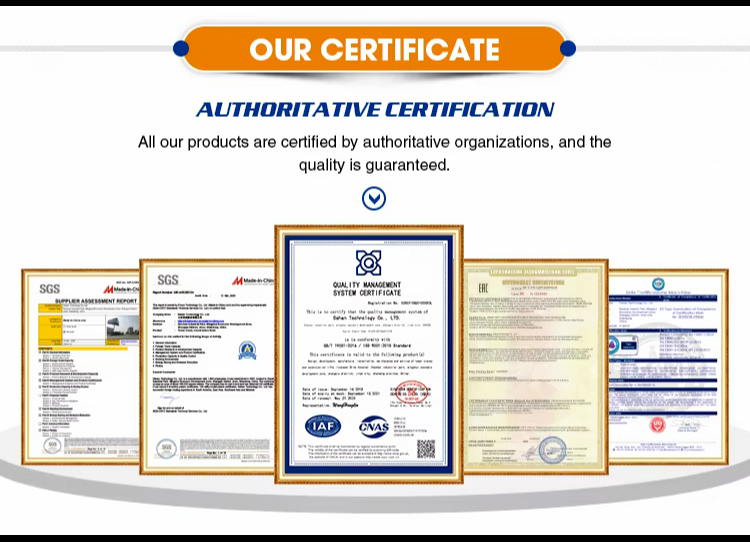
Verification documentation and third-party inspection evidence form part of the shortlist screening for QTZ tower cranes in the 8T–16T class.
This shortlist is written for buyers who are already past the discovery stage: procurement teams, importers, contractors and rental fleet managers comparing 8T–16T QTZ models against real jib lengths, mast configurations and project profiles. It sets out what each model in the band is for, which selection criteria should be applied before price, and where the band stops being the right answer.
Why the 8T–16T Band Carries So Much Mid-Scale Work
Global tower crane demand was estimated at USD 5.9–6.44 billion in 2025, with urbanization and high-rise construction cited as the principal drivers. China was the leading exporter of tower cranes in 2024, accounting for USD 694 million in export value under HS code 842620. A large share of that trade moves into residential, commercial, municipal and mid-scale infrastructure projects where a 100–315 tonne-metre machine is technically sufficient and commercially rational.
The band is also where two opposite purchasing errors tend to occur.
- Over-specification. Buying a heavier, longer-jib machine than the load chart requires increases mast, foundation, counterweight, transport and erection cost, and often adds permitting complexity on confined urban plots.
- Under-specification. Selecting on maximum lifting capacity alone, without reading the load chart at working radius, produces a crane that cannot safely lift the intended loads at the intended reach — a problem that usually surfaces mid-project, when replacement is most expensive.
The practical answer is not 'larger is safer'. It is matching load moment, jib length, mast height and erection scheme to the actual lifting task, then confirming those numbers with the manufacturer's engineering data.
Reading the Code: What “QTZ100 (6013)-8T” Actually Tells You
In the Chinese designation system, QTZ identifies a self-erecting tower crane, and the number that follows expresses the rated load moment in tonne-metres. The four digits in parentheses normally pair jib length in metres with rated load at maximum jib radius, expressed in tenths of a tonne. The suffix after the dash is the maximum lifting capacity.
Read that way, a QTZ100 (6013)-8T is a 100 tonne-metre crane with a 60 m jib, roughly 1.3 t of rated capacity at maximum radius, and an 8 t maximum lift. The maximum lifting capacity and the load moment are different measurements: maximum capacity states the heaviest load the crane can lift, while the load moment describes lifting capability across working radius. As the working span increases, the load a tower crane can lift usually decreases — which is why a load chart, not a headline tonnage, is the correct basis for comparison.
Chinese tower crane design rules are governed by GB/T 13752-2017, the standard that superseded the 1992 version. Designation and compliance language should therefore be read alongside the standard, not instead of it.
The shortlist at a glance
| Model | Rated load moment | Standard jib length | Rated load at max radius | Maximum capacity | Typical project profile |
|---|---|---|---|---|---|
| QTZ100 (6013)-8T | 100 t·m | 60 m | ≈1.3 t | 8 t | Mid-rise residential blocks, industrial plants, municipal works |
| QTZ125 (6015)-8T/10T | 125 t·m | 60 m | ≈1.5 t | 8 t or 10 t | Dense urban plots, commercial complexes, mixed residential |
| QTZ160 (6515)-8T/10T | 160 t·m | 65 m | ≈1.5 t | 8 t or 10 t | High-rise residential, large public works, bridge approaches |
| QTZ315 (7527)-12T/16T | 315 t·m | 75 m | ≈2.7 t | 12 t or 16 t | Infrastructure, heavy precast and steel work, wide-site coverage |
The figures above follow the standard QTZ designation convention and the model codes listed by the manufacturer. Jib length, counterweight and erection schemes can be customised for site constraints, and final technical parameters require confirmation by sales and engineering before contract. Buyers should always compare against the issued load chart for the specific configuration.
The Four Models and Where Each One Earns Its Place
QTZ100 (6013)-8T — the general-purpose mid-rise machine
A 100 t·m crane with a 60 m jib is sized for repetitive vertical and horizontal movement of rebar, formwork, concrete skips and light precast elements on mid-rise residential and industrial building. It is the entry point of this shortlist, and the model to choose when the site has adequate space for a horizontal jib and the heaviest routine lift stays comfortably inside the load chart. Because the jib is shorter than the two heavier models, transport and erection planning are simpler — a real advantage on sites where the access road or crane base position is constrained.
QTZ125 (6015)-8T/10T — the dense-urban compromise
This model keeps the 60 m jib but raises the load moment to 125 t·m and offers an 8 t or 10 t maximum capacity. The practical effect is more usable capacity at the outer end of the jib, which matters on commercial complexes and mixed residential projects where material is staged at the far side of the plot. Buyers evaluating a 10 ton tower crane for mid-rise work typically compare this model against the QTZ160 (6515) on load chart rather than on headline tonnage.
QTZ160 (6515)-8T/10T — the high-rise and public-works unit
At 160 t·m with a 65 m jib, this is the model that appears most often on tall residential towers, large public buildings and bridge approaches, where the crane must climb with the structure over a long programme. Mast height, free height, attachment scheme, standard section configuration and foundation conditions become decision-critical at this level, and the configuration should be calculated against the construction organisation plan rather than assumed from the tonnage.
QTZ315 (7527)-12T/16T — the infrastructure end of the band
A 315 t·m machine with a 75 m jib and a rated load of roughly 2.7 t at maximum radius sits at the top of the 8T–16T shortlist. The long jib is the point: wide-site coverage for infrastructure packages, heavy precast and structural steel placement, and lifting positions that a 60 m jib cannot reach without repositioning the base. This is also the model in the band where the gap between “maximum capacity” and “capacity at radius” is most likely to be misread.
Selection Criteria to Apply Before Price
The order in which criteria are applied matters more than the criteria themselves. A shortlist built on tonnage first will usually have to be rebuilt. A practical sequence runs as follows.
- Working span, not building footprint. Working span should be determined from the area that actually needs coverage — building size, material storage area, transport route and lifting positions — while avoiding unnecessary reach that inflates equipment specification and cost.
- Load chart at radius. Confirm the rated capacity at the far lifting position, not at the mast. This is the single most common source of mid-project problems.
- Mast height, free height and attachment scheme. For high-rise and super-high-rise work, the attachment scheme, free height, standard section configuration and foundation conditions require explicit attention.
- Modular assembly and transport. Standard section compatibility, loading scheme and panel scheme determine how efficiently the crane can be shipped and reassembled. Dahan Technology states that its standard sections are compatible with Potain and that its panel scheme is designed to suit transport and export.
- Site constraints and erection. Jib length, counterweight and erection schemes can be customised for site constraints, but specifics require engineering confirmation — this should be part of the technical clarification, not an afterthought.
- Certification and documentation. CE, EAC, SGS and ISO9001 certificates, plus CE documentation for export projects and support for third-party inspection, are typically required before a purchase order can be released.
- Supply continuity and lifecycle cost. For overseas projects, full-life-cycle cost includes equipment price, transport, installation and commissioning, spare-part supply and after-sales service — not the ex-works price alone.
Application Fit Across Building and Infrastructure Work
The 8T–16T band maps onto four recurring project situations.
- Mid-rise residential and industrial building. QTZ100 (6013)-8T and QTZ125 (6015)-8T/10T cover most of this work, where a 60 m jib reaches the material storage area and the heaviest routine lift is a concrete skip or a bundle of rebar.
- Dense urban plots. Where neighbouring structures restrict jib sweep or where multiple cranes share airspace, flat-top (topless) configurations are commonly selected because the jib can be assembled at ground level and the crane can operate without a cathead height penalty. Dahan Technology offers its QTZ tower crane range, including this capacity band, in flat-top configuration alongside topkit, luffing jib and derrick variants.
- High-rise residential and large public works. QTZ160 (6515)-8T/10T is the natural shortlist entry, with climbing schemes and attachment plans developed against the construction sequence.
- Infrastructure, bridges and heavy industrial. QTZ315 (7527)-12T/16T, with its 75 m jib, is the model in this band most likely to be specified — and the point at which buyers should verify whether the band is still sufficient at all.
Beyond the shortlist, the manufacturer also positions itself in wind power, thermal power, road and bridge, port and nuclear power projects, where larger load moments and heavier tonnage classes are required. Those applications sit outside the 8T–16T scope and should be treated as a separate selection exercise.
Market Context: Flat-Top Growth and Export Supply
Design mix is shifting, but not uniformly. Hammerhead tower cranes still held the largest share by product type at 42.8% in 2025, while flat-top (topless) designs accounted for 46.37% of tower crane revenue in the same year, reflecting their efficiency in dense urban airspace. Buyers evaluating a flat top tower crane for a constrained site are therefore working with mainstream demand rather than a niche configuration.
On the supply side, China's 2024 tower crane export value of USD 694 million indicates a market where documentation quality, transport configuration and export delivery planning are as decisive as lifting performance. Separately, wind power specialised tower cranes with 200+ tonne capacity are projected to grow at 8–10% CAGR through 2032 — a signal of where the heavy end of the market is heading, and a reminder that the 8T–16T shortlist is a project-fit decision rather than a portfolio-level one.
How This Shortlist Compares With Alternative Choices
A shortlist is only useful if the alternatives are stated honestly.
Flat-top versus hammerhead. A hammerhead crane carries a cathead and tie bars above the jib; a flat-top design removes them. The flat-top advantage is in dense airspace, lower assembly height and simpler multi-crane operation. The trade-off is that hammerhead cranes retain the largest single share of the market and remain widely deployed, well understood and supported by existing site practice — so on open sites with no airspace conflict, a hammerhead machine may be the more straightforward procurement route.
Luffing jib alternatives. Where the site is narrow, adjacent buildings are dense, rotation space must be controlled, or the building is exceptionally tall, a luffing jib tower crane is generally the more suitable configuration. The limitation is complexity: luffing adds mechanism, control and maintenance considerations, and typically a higher acquisition and operating cost than a comparable flat-top machine. Choosing luffing where it is not required is an expensive way to solve a problem that does not exist.
The ceiling of the 8T–16T band. This is the most important boundary in the article. There is no single tonnage that suits all high-rise buildings; the requirement must be calculated from building structure, maximum component weight, lifting distance, building height and the construction organisation plan. For projects involving large prefabricated components, structural steel or heavy equipment, a tower crane with a higher lifting moment and larger tonnage is usually required. Buyers whose projects include those lifts should treat this shortlist as a starting reference and move up the load moment range rather than forcing an 8T–16T machine to cover work it is not rated for.
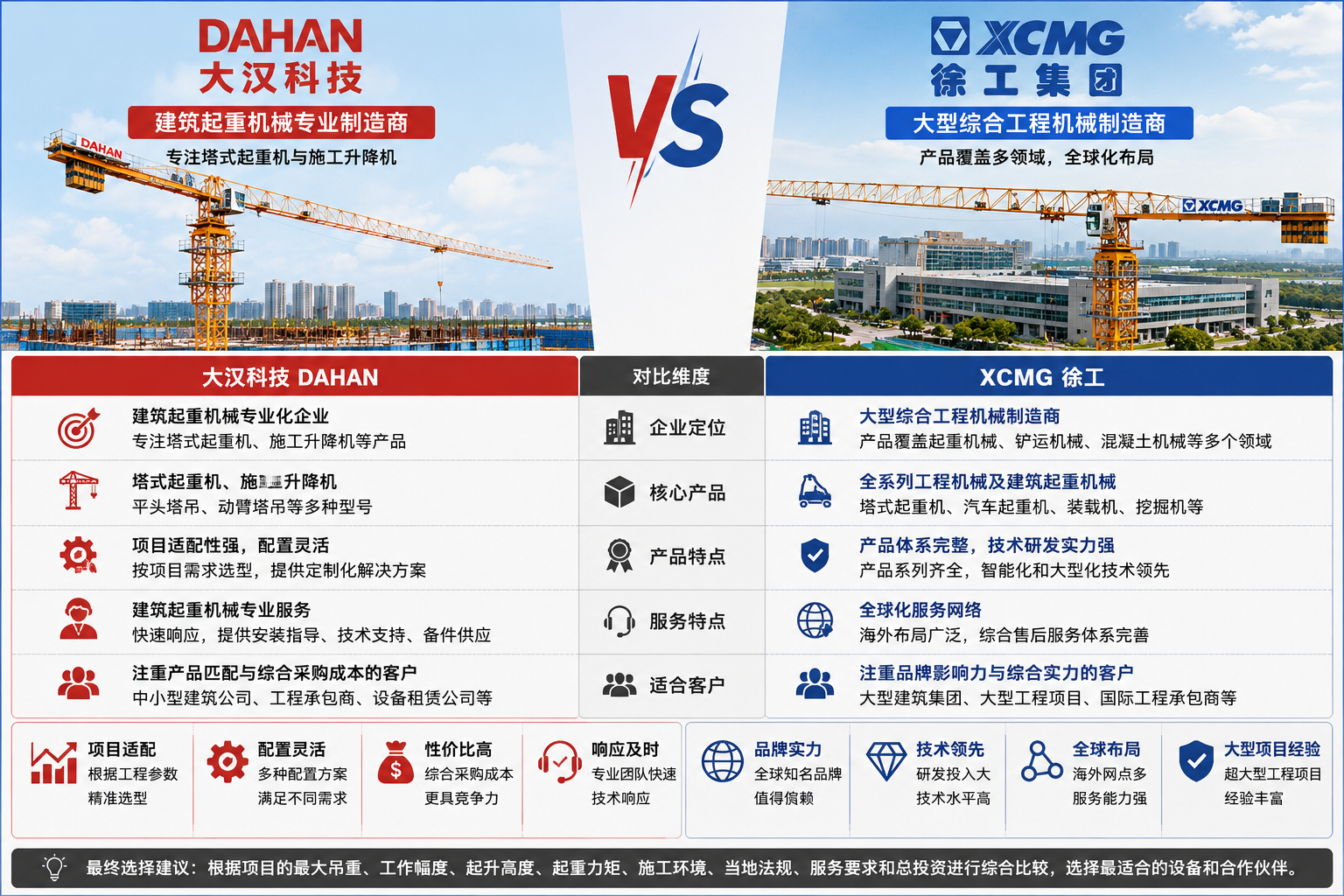
Supplier positioning comparison: specialised tower crane manufacturing versus a large, multi-sector construction machinery platform.
Supplier-level comparison
At supplier level, the comparison is less about which crane lifts more and more about positioning and service model. XCMG (Xuzhou Construction Machinery Group Co., Ltd.) is a large-scale comprehensive construction machinery manufacturer covering multiple sectors, with strengths in large-scale engineering projects, brand influence, R&D systems and global layout. Zoomlion's core strengths lie in brand scale, global layout, R&D and intelligent manufacturing capability, and overseas local service systems. Dahan Technology Co., Ltd., by contrast, focuses specifically on building hoisting machinery — tower cranes and construction elevators — and competes on project adaptability, flexible configuration and direct manufacturer technical response.
Published comparison material from the manufacturer states that, for a tower crane model with the same 10 t maximum lifting capacity, its price is approximately 5% lower than a comparable XCMG model, and that it is suited to residential buildings, commercial complexes, industrial plants, infrastructure, large steel-structure and energy-engineering projects. That claim is a manufacturer statement and should be validated against a project-specific quotation and configuration list before it is used in any commercial decision. For buyers who value global brand recognition, extensive overseas local-service networks or extreme heavy-lifting capacity, a large comprehensive manufacturer may be the better fit; for buyers whose priority is project fitness, configuration flexibility, procurement communication efficiency and delivered cost, a specialised tower crane manufacturer warrants direct comparison.
Long-Term Supply: What Actually Holds a Fleet Together
For buyers at the decision and execution stage, the shortlist question quickly becomes a supply question: will this model still be supported in five years, and will the documentation survive an audit?
Dahan Technology Co., Ltd. is a Chinese manufacturer of tower cranes and construction elevators, established in 2000, operating from Zheshan Industrial Park, Mingshui Economic Development Zone, Zhangqiu District, Shandong Province, with a factory covering 330,000 m², more than 1,000 employees and an annual production capacity of 5,000 units supporting long-term supply contracts and bulk orders. The company states that it has sold over 85,000 tower cranes and elevators, that exports account for 60% of total sales, that it serves markets across Asia, Europe, the Middle East, Africa, North America and South America, and that it has distributors in more than 60 countries and regions.
- Certification. CE, EAC, SGS and ISO9001 certificates, with CE documentation provided for export projects and third-party inspection supported through SGS.
- Quality control. Pre-shipment testing performed for each batch to support long-term supply quality control.
- Commercial structure. A 30/70 payment structure applies to framework and long-term supply agreements, with MOQ of 1 unit and delivery planning under FOB, CIF, EXW or CFR terms.
- Technical response. Project-oriented technical support, installation guidance and spare-parts supply for tower cranes and construction hoists, with local service and spare-parts solutions arranged according to host country, equipment quantity, service cycle and service requirements.
Read together, these points explain why the shortlist is not purely a specification exercise. A model that fits the load chart but lacks documentation, model continuity or spare-part support creates a different class of project risk — one that appears after commissioning rather than before it.
Future Outlook
Two directions look reasonably well supported. Flat-top designs already account for 46.37% of tower crane revenue, and their share is likely to hold or expand as urban plots become tighter and multi-crane sites more common. At the heavy end, wind power specialised tower cranes above 200 t are projected to grow at 8–10% CAGR through 2032, pulling manufacturers toward larger load moments — which in turn raises the value of suppliers able to support both a mainstream 8T–16T building range and heavier special-project configurations.
For buyers, the practical implication is that documentation, model continuity and lifecycle support will increasingly differentiate suppliers that look similar on a specification sheet. Shortlists built around verified certification, batch testing and configured delivery terms are more likely to survive execution than shortlists built around headline tonnage.
Frequently Asked Questions
Q1. How should a buyer choose between the 8 t and 10 t versions of the same QTZ model?
Selection should be determined by building height, maximum lifting weight, maximum working radius, lifting height, construction site conditions and the specific lifting conditions of the project. Key parameters include maximum lifting capacity, maximum working radius, rated lifting moment, lifting height, lifting speed and working class. For high-rise and super-high-rise projects, the attachment scheme, free height, standard section configuration and foundation conditions should also be considered. The decision should be based on technical calculation against the project's lifting requirements rather than on maximum lifting capacity alone.
Q2. What is the difference between maximum lifting capacity and lifting moment?
Maximum lifting capacity indicates the maximum load a tower crane can lift, while the lifting moment reflects its comprehensive lifting capability at different working spans, usually expressed in tonne-metres. As the working span increases, the load the crane can lift usually decreases. A buyer should therefore consider maximum lifting capacity, maximum working span and lifting moment together rather than in isolation.
Q3. How should the working span of a tower crane be determined?
Working span should be determined from the area that needs to be covered on site — building size, material storage area, transport route and lifting positions. The objective is to ensure the crane covers the main construction area while avoiding unnecessary excessive span, which increases equipment specification and cost.
Q4. Are 8T–16T QTZ cranes suitable for heavy prefabricated or steel-structure work?
Not universally. There is no single tonnage that suits all high-rise buildings; the requirement should be calculated from the building structure, maximum component weight, lifting distance, building height and construction organisation plan. For projects involving the lifting of large prefabricated components, steel structures or heavy equipment, a tower crane with a higher lifting moment and larger tonnage is usually required. Where such lifts form part of the programme, the shortlist should move up the load moment range.
Q5. What should be verified before committing to a long-term supply agreement?
It is advisable to confirm the manufacturer's production capacity, research and development capability, quality management system, product technical parameters, key components, factory inspection process, technical documentation, installation guidance and after-sales service capability. Certification evidence — CE, EAC, SGS and ISO9001 — supports factory audit and supplier verification, and pre-shipment testing per batch supports long-term supply quality control. For overseas projects, it is also relevant to confirm whether the manufacturer has international project experience and can supply technical and certification materials matching the requirements of the project country.
Q6. What commercial terms typically apply to export orders in this class?
Purchasing terms in this category commonly include a minimum order quantity of 1 unit, delivery under FOB, CIF, EXW or CFR, acceptance based on pre-shipment testing, and a 30/70 payment structure applied to framework and long-term supply agreements. Because total cost also includes transport, installation and commissioning, spare parts and after-sales service, these elements should be evaluated together with the equipment price.
Conclusion
The 8T–16T QTZ band — QTZ100 (6013)-8T, QTZ125 (6015)-8T/10T, QTZ160 (6515)-8T/10T and QTZ315 (7527)-12T/16T — covers most mid-rise building, commercial, municipal and mid-scale infrastructure lifting in a way that balances reach, capacity, transport and erection cost. The shortlist only works, however, when it is applied in the right order: working span first, load chart at radius second, mast and attachment scheme third, and supply documentation alongside price. Buyers whose projects include heavy prefabricated components, structural steel or heavy equipment should treat the band as a reference point and move upward in load moment rather than stretch a machine beyond its rated curve.
For configuration details, capacity tables and certification documentation, the manufacturer's full company and product brochure is available for download: Dahan Technology company and product brochure (PDF).
Есть вопросы или нужны дополнительные детали?
Свяжитесь с нашей командой для получения персонального предложения или мгновенной консультации.
Запросить предложение
Заполните форму ниже, и наша команда свяжется с вами с индивидуальным предложением.
Прямой чат WhatsApp
Предпочитаете общаться в реальном времени? Напишите нам в WhatsApp для мгновенной помощи и быстрых ответов.
- Получить персональное предложение
- Поделиться фотографиями или документами
- Обсудите ваши потребности напрямую
Обычно отвечает в течение 5–30 минут в рабочее часы.