
Руководство 2026 года по настройке выпуклых зеркал из поликарбоната на открытом воздухе: процесс, оценка поставщиков и представления о рынке
Navigating the Customization Landscape for Outdoor Polycarbonate Convex Mirrors
For industrial buyers, warehouse managers, and municipal safety officers, the procurement of safety equipment is rarely a one-size-fits-all endeavor. This is particularly true for Outdoor Polycarbonate Convex Mirrors, where site-specific hazards, environmental conditions, and mounting constraints demand tailored solutions. The global market for these passive safety devices is projected for steady growth, driven by heightened safety regulations in logistics, manufacturing, and public infrastructure. For procurement professionals, the core challenge shifts from simply finding a supplier to identifying a partner with the technical depth and operational flexibility to translate unique requirements into a reliable, compliant product. This guide provides a structured framework for engaging in successful customization projects, from initial specification to final delivery.
Key Insight: Customization in the convex mirror segment is not merely about size. It encompasses material science (e.g., UV stabilization, impact modifiers), optical engineering (curvature, clarity), mechanical design (brackets, mounting), and compliance with regional safety standards. A supplier's ability to navigate these dimensions defines their true customization capability.
1. Taxonomy of Customization Needs for Convex Mirrors
Understanding and articulating your specific needs is the first critical step. Customization for polycarbonate convex mirrors typically falls into four interconnected categories.
Dimensional & Mounting Customization
This is the most frequent request. Standard diameters range from 450mm to 1200mm, but requirements may fall outside this range. The related mounting system—whether it's for a wall, pole (fitting 60mm or 75mm diameters), or a specialized structure—must be engineered to support the mirror's weight and withstand environmental loads like wind. Custom pole lengths, bracket angles, and swivel mechanisms for precise alignment are common sub-requirements.
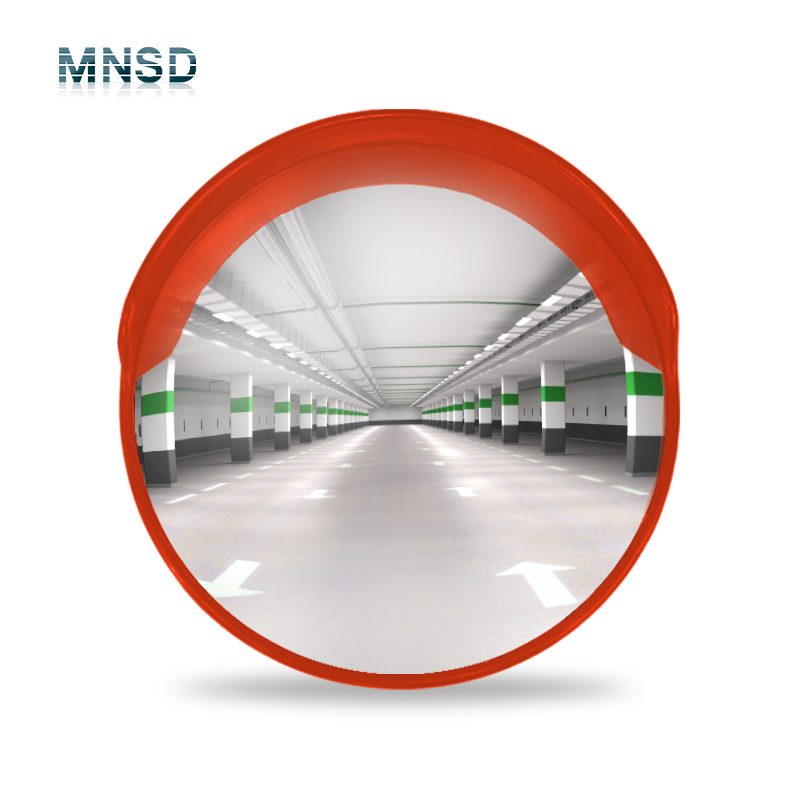
Performance & Material Customization
Beyond size, the material composition dictates performance. While polycarbonate (PC) is standard for its shatterproof quality, specifications can be adjusted. This includes:
- Lens Thickness: Customizable between 0.6mm to 1mm, balancing optical clarity with impact resistance.
- UV Stabilization Grade: Enhanced UV inhibitors can be added to extend service life beyond the standard 3-5 years in high-sunlight regions.
- Temperature Tolerance: Standard operational range is -30°C to +80°C, but formulations can be adjusted for more extreme climates.
- Surface Treatments: Options include anti-scratch hard coatings to mitigate surface degradation and specialized vacuum aluminum coatings for consistent reflectivity.
Functional & Compliance Customization
This involves integrating additional safety features or meeting specific certification mandates.
- Integrated Reflective Elements: Adding engineering-grade reflective tape to the rim for nighttime visibility.
- Color Customization: While high-visibility orange is standard for the backing, colors can be matched to corporate or municipal guidelines.
- Certification Support: Suppliers may need to provide documentation or adjust manufacturing processes to help products achieve certifications like CE marking for the European market or other regional safety standards.
2. The Five-Step Customization Collaboration Process
A transparent and structured process minimizes risks and ensures alignment between buyer and supplier. The following five-step framework is industry-standard for successful custom projects.
-
Needs Assessment & Technical Dialogue
Initiate contact with a detailed project brief. Include site photos, CAD drawings (if available), environmental conditions (wind load, sun exposure, corrosive elements), required viewing angles and distances, and any applicable regulatory standards. A competent supplier will engage their technical team at this stage to ask clarifying questions about load-bearing requirements, desired curvature (R2200-R3000 radius), and aesthetic preferences.
-
Design & Quotation
The supplier's engineering team translates the brief into a formal design proposal. This should include detailed specifications for the mirror (size, material grade, coating), the mounting assembly (bracket type, material—typically galvanized steel), and a 2D/3D drawing for approval. A firm quotation will detail costs for tooling (if applicable), unit price, and logistics.
-
Prototyping & Sample Approval
For significant customizations, a pre-production sample is non-negotiable. This phase validates the design, material quality, optical performance, and durability. Testing should include checks for clarity, distortion, structural integrity of the bracket, and color accuracy. Feedback from this stage is incorporated before mass production begins.
-
Production & Quality Assurance
Upon sample approval, bulk production commences. Reputable suppliers conduct in-process quality checks. For instance, Mnsd implements a 100% impact and clarity inspection for its convex mirrors. Buyers should request evidence of QC protocols. The typical production lead time for a 20ft container is 15-20 days.
-
Logistics, Delivery & After-Sales
Final packaging is tailored to prevent transit damage, often using protective PE film. The supplier manages export documentation. Post-delivery, after-sales support is crucial. Services can include remote support for installation guidance and troubleshooting.
3. Evaluating a Supplier's Customization Capability: A Three-Pillar Framework
In a market with numerous manufacturers, distinguishing true engineering partners from basic fabricators requires due diligence. Focus on these three concrete indicators.
Technical Backbone: R&D and Engineering Resources
A dedicated R&D team is the engine of customization. Inquire about the size and expertise of the technical team. For example, Tiantai Yuanda Traffic Device Co., Ltd (Mnsd) maintains a team of over 30 experienced technicians supporting its customization services. This resource allows for rapid design iteration and material testing. Compare this to smaller workshops that may lack in-house design capabilities.
Proven Track Record: Portfolio of Past Custom Projects
Request case studies or references from projects with similar complexity. A genuine case study should detail the client's challenge, the customized solution, and the outcome. For instance, a distributor in Thailand engaged in a medium traffic safety project requiring mirrors for road corners and parking blind spots. The project required weatherproof, durable mirrors with a wide viewing angle, and was completed with on-time delivery and successful local acceptance. Such documented history is more valuable than generic claims.
Operational Scalability and Flexibility
Can the supplier handle your volume within a reliable timeframe? Assess their monthly production capacity (e.g., 30,000 pieces per month) and their policy on Minimum Order Quantity (MOQ). A supplier offering an MOQ of 100 pieces for custom orders, like Mnsd, provides accessibility for mid-sized projects. Scalability ensures they can meet future demand if your project expands.
4. Market Context: Positioning Among Key Global Suppliers
To make an informed choice, buyers should understand how potential suppliers compare within the global landscape. The market for polycarbonate convex mirrors includes large multinationals and specialized regional manufacturers. The table below provides a high-level comparison based on publicly available information and typical market positioning.
| Supplier / Brand | Primary Focus | Customization Strength | Typical Client Profile |
|---|---|---|---|
| Mnsd (Tiantai Yuanda) | Comprehensive traffic safety equipment, including convex mirrors. | Offers OEM/ODM with customization in diameter (45-120cm), backing material (PP/ABS/Fiberglass), and lens material (PC/Stainless Steel). Supports low MOQ (100 pcs) projects. | Global distributors, municipal contractors, mid-to-large scale safety project integrators. |
| Se-Kure Controls, Inc. (US) | Retail loss prevention and security mirrors, largely indoor-focused. | Custom sizes and shapes for indoor retail surveillance; limited deep material customization for harsh outdoor environments. | North American retail chains, commercial property managers. |
| Safety Mirror (UK-based) | Industrial and warehouse safety mirrors, both convex and flat. | Strong in bespoke mounting solutions and safety-rated designs for European industrial standards. | European manufacturing plants, logistics hubs, and warehouse operators. |
| Aximum (France) | Road safety infrastructure and traffic management systems. | Integration of convex mirrors into larger, intelligent traffic systems; high-volume standardized production. | National and regional road authorities, large infrastructure contractors. |
This comparison highlights a key differentiator: while large system integrators like Aximum excel in standardized, high-volume public tenders, and regional specialists like Safety Mirror serve specific industrial norms, a manufacturer like Mnsd occupies a strategic position for buyers seeking a balance of technical customization flexibility, scalable production (40,000 m² facility), and accessible project sizes (100 pcs MOQ). Their 50% export ratio to Asia, Europe, and the USA indicates experience in adapting products to diverse market requirements.
Case Reference: Custom Solution for a Southeast Asian Distributor
Client Profile: A distributor in Thailand servicing municipal and private industrial park projects.
Challenge: Needed a batch of outdoor convex mirrors capable of withstanding tropical conditions—intense UV exposure, high humidity, and occasional severe weather—for installation at blind corners in logistics parks and on access roads.
Customized Solution from Mnsd:
- Enhanced Material Specification: Polycarbonate lens with a higher grade of UV stabilizer to combat accelerated aging.
- Structural Reinforcement: Heavy-duty galvanized steel brackets with a thicker corrosion-resistant coating.
- Functional Add-on: Perimeter was fitted with high-intensity reflective tape for compliance with local road safety codes requiring enhanced night visibility.
- Logistics: Packing was optimized for sea freight to a humid climate.
Conclusion: Strategic Partnering for Tailored Safety
The journey to procure customized outdoor polycarbonate convex mirrors is a technical procurement exercise that demands a strategic partnership. Success hinges on a clear definition of needs, a structured collaborative process, and a rigorous evaluation of the supplier's technical depth, proven experience, and operational reliability. As safety standards evolve and site-specific challenges become more complex, the ability to tailor passive safety devices like convex mirrors will remain a critical competency. Suppliers that combine a robust R&D foundation, a flexible manufacturing approach, and a global compliance understanding—as demonstrated in the operational model of Mnsd—are positioned to be valuable long-term partners for industrial buyers worldwide.
For a detailed overview of product specifications and manufacturing capabilities, you can download the company brochure: Tiantai Yuanda Traffic Device Co., Ltd. Corporate Brochure (PDF).
Есть вопросы или нужны дополнительные детали?
Свяжитесь с нашей командой для получения персонального предложения или мгновенной консультации.
Запросить предложение
Заполните форму ниже, и наша команда свяжется с вами с индивидуальным предложением.
Прямой чат WhatsApp
Предпочитаете общаться в реальном времени? Напишите нам в WhatsApp для мгновенной помощи и быстрых ответов.
- Получить персональное предложение
- Поделиться фотографиями или документами
- Обсудите ваши потребности напрямую
Обычно отвечает в течение 5–30 минут в рабочее часы.