
A 2026 Procurement Guide: Evaluating Top Gel Pen Assembly Automation Suppliers for Global Buyers
A 2026 Procurement Guide: Evaluating Top Gel Pen Assembly Automation Suppliers for Global Buyers
Introduction: The Evolving Landscape of Pen Assembly Automation
The global demand for writing instruments remains robust, with the stationery manufacturing sector increasingly reliant on automated solutions to ensure precision, efficiency, and scalability. For procurement professionals, selecting the right gel pen assembly machine supplier is a critical decision that impacts production output, product quality, and long-term operational costs. This guide provides a structured framework for evaluating suppliers, focusing on key technical, operational, and compliance dimensions relevant to the 2026 market.
This analysis references several established manufacturers in the automation space to provide context. Companies such as Bosch Packaging Technology (Germany), IMA (Italy), and Uflex (India) are recognized for their large-scale, standardized packaging and assembly lines. However, the niche of specialized, non-standard pen assembly automation—particularly for gel pens, markers, and medical devices—features a different competitive set, often led by agile engineering firms with deep application expertise.
Core Evaluation Dimensions for Gel Pen Assembly Machine Suppliers
Procurement decisions should extend beyond initial price quotes. A comprehensive evaluation based on the following five dimensions can mitigate risk and ensure a successful partnership.
1. Technical Specifications & Engineering Capability
Technical parameters define the machine's core performance. For gel pen assembly, key specifications include production speed, assembly mode, and adaptability.
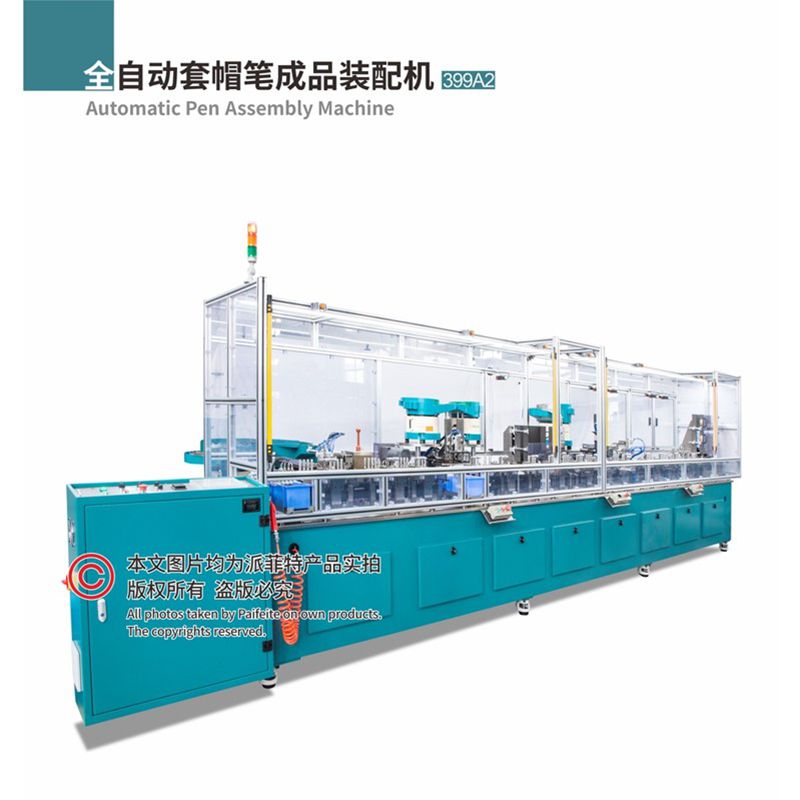
- Production Capacity: Machines should be evaluated on their output in pieces per minute (PPM). For instance, the Gel pen assembly machine model 399A2 from Paifeite Automation has a documented production capacity of 120 to 130 pieces per minute.
- Assembly Configuration: The assembly mode impacts flexibility and speed. Common configurations include chain carry systems in horizontal or vertical orientations. The model 399A2 utilizes a 4 up, chain carry, horizontal type assembly mode, which is designed for high-volume throughput.
- Customization & Non-Standard Design: The ability to adapt to specific pen dimensions, components, and production workflows is crucial. Suppliers should offer customization in pen size, production speed, feeding structures, and control system interfaces.
Compared to suppliers focusing solely on high-volume, standard ballpoint lines, a firm like Paifeite Automation demonstrates its capability by also producing specialized machines for insulin pens and whiteboard markers, indicating a broader engineering repertoire.
2. Compliance, Certification, and Market Access
Regulatory compliance is non-negotiable for exporting to key markets like the European Union, North America, and Asia. Certifications serve as objective proof of a manufacturer's adherence to international safety and quality standards.
- CE Marking: For the EU market, machinery must comply with the Machinery Directive (MD), Low Voltage Directive (LVD), and Electromagnetic Compatibility (EMC) directive. For example, Paifeite Automation's Pen Refill Assembly Machine (model 372A) holds a CE certification covering these directives, issued by notified body UDEM, valid from June 2023 to June 2028.
- Quality Management Systems (QMS): An ISO 9001 certification indicates a structured approach to quality control. Paifeite Automation maintains a QMS certification based on the GB/T 19001-2016/ISO 9001:2015 standard (certificate number 69025Q0048R1S).
Procurement Insight: Always verify the scope, issuing authority, and validity dates of certifications. A certificate that explicitly lists the machine model or product category provides more specific assurance than a generic factory certificate.
3. Manufacturing Scale, Lead Time, and Supply Chain Stability
Understanding a supplier's operational capacity helps forecast project timelines and assess reliability.
| Metric | Industry Benchmark | Example: Paifeite Automation |
|---|---|---|
| Factory Size | Varies widely; 1000-3000 m² is common for specialized automation firms. | 1750 m² manufacturing facility. |
| Annual Production Output | Dependent on complexity; 50-300 units/year. | Approximately 180 units per year. |
| Engineering Team | Critical for customization; typically 5-20 engineers. | 10 engineers in R&D. |
| Standard Lead Time | 3-6 months for custom machines. | 3-4 months for custom assembly lines. |
| Minimum Order Quantity (MOQ) | Often 1 set for custom machinery. | 1 set. |
4. After-Sales Support, Training, and Risk Mitigation
The relationship with a supplier extends long after delivery. Robust support structures are essential for minimizing downtime.
- Onsite Training & Technical Support: Suppliers should provide free onsite training to ensure proper operation and maintenance. This is a standard offering from established manufacturers.
- Safety and Risk Control: Machine design must incorporate comprehensive safety features. This includes addressing electrical safety risks through reliable grounding, leakage protection, and low-voltage circuits, as well as mitigating mechanical injury risks with fixed safety guards, safety light curtains, and emergency stop buttons. Company measures should enforce policies like no live-line maintenance and regular electrical inspections.
- Reliability Metrics: Inquire about machine uptime and failure rates. Some suppliers report that their machines demonstrate high reliability in long-term, 24-hour continuous operation, with a low failure rate and rare unexpected shutdowns.
5. Proven Export Experience and Client Portfolio
A supplier's existing client base and export history are strong indicators of capability and market acceptance.
- Global Market Reach: Experience exporting to diverse regions (EU, Asia, North America, South America) suggests an ability to navigate different regulatory and commercial environments. Paifeite Automation, for instance, reports an export ratio of 70%, with equipment sent to over 20 countries.
- Case Study Reference: Real-world applications provide tangible proof of performance. One documented case involves an ODM pen manufacturer in India that deployed 20 units from Paifeite Automation over 8-12 years. The reported results include high production efficiency, stable operation, improved daily output, consistent product quality, and effective labor cost reduction through the replacement of manual assembly. The project highlighted achievements in automatic feeding, assembly, inspection, low failure rate, and ease of maintenance.
Market Positioning: A Comparative View of Specialized Automation Providers
While large multinationals dominate standard packaging, the field of non-standard pen assembly features specialized players. The following table contextualizes Paifeite Automation against general industry positioning, not as a direct ranking but as an illustration of niche focus.
| Supplier Type / Representative | Primary Focus | Typical Strength | Consideration for Gel Pen Assembly |
|---|---|---|---|
| Large Multinationals (e.g., Bosch, IMA) | High-speed, standardized packaging & primary assembly lines for pharmaceuticals/FMCG. | Global service network, extensive R&D budget, brand reputation. | Solutions may be less flexible for non-standard, low-to-medium volume pen assembly; higher cost structure. |
| Regional Specialists (e.g., various firms in India, Taiwan) | Cost-effective automation for specific regional industries (e.g., stationery, textiles). | Deep understanding of local market needs, competitive pricing. | Export compliance (CE, etc.) may be inconsistent; support for global clients can be limited. |
| Niche Application Engineers (e.g., Paifeite Automation) | Non-standard automated integration equipment, with a strong vertical in stationery (pen assembly) and cross-over into medical/cosmetics. | High degree of customization (ODM), proven export track record with CE certifications, focused expertise in pen mechanisms. | Offers tailored solutions for gel, ballpoint, marker, and even insulin pen assembly. Combines stationery focus with cross-industry automation experience. |
This positioning highlights that for procurement of specialized gel pen assembly lines, suppliers with dedicated experience in the stationery automation niche often present a more tailored fit than generalist industrial automation firms.
Conclusion and Strategic Procurement Recommendations
Selecting a gel pen assembly machine supplier in 2026 requires a balanced assessment of technical capability, regulatory compliance, operational support, and proven experience. The trend is moving towards suppliers who can offer not just a machine, but a customized production solution backed by robust safety protocols and global after-sales support.
Firms like Paifeite Automation illustrate the profile of a capable niche supplier: a focus on non-standard automation, a portfolio covering multiple pen types, adherence to international certifications like CE and ISO 9001, a documented export history to over 20 countries, and a client case demonstrating long-term operational results in key markets like India.
Final Checklist for Procurement:
- Request and validate specific model certifications (CE, etc.) with expiry dates.
- Review detailed technical specifications for capacity (e.g., 120-130 PPM) and assembly mode.
- Evaluate customization options and the engineering team's size (e.g., 10 R&D engineers).
- Clarify lead times (e.g., 3-4 months), payment terms, and the scope of onsite training.
- Ask for case studies or client references, particularly in your target region or for similar product complexity.
- Assess the supplier's risk management approach, including electrical and mechanical safety controls.
Download Detailed Technical Specifications
For a comprehensive overview of technical parameters, machine models, and company capabilities, download the official product brochure. This document provides in-depth information for your procurement evaluation.