
A Buyer Comparison of Screw and Barrel Options by Process
A Buyer Comparison of Screw and Barrel Options by Process
Choosing a screw and barrel is primarily a process-matching decision. A configuration intended for PVC extrusion is not interchangeable by default with one specified for compounding and pelletizing, film blowing or pipe extrusion, injection molding, or rubber extrusion. Buyers can make the comparison more useful by starting with the processing job, then checking the stated product category, model range, material options, and measurable surface or hardness specifications.
This independent comparison covers five options associated with Guangyou Screw: a conical twin screw barrel for PVC extrusion, a parallel twin screw barrel for compounding and pelletizing, a single screw extruder screw and barrel for film blowing and pipe extrusion, an injection molding machine screw and barrel, and a rubber machine screw and barrel. The product descriptions establish intended categories and available specifications; they do not establish that one configuration is universally superior or suitable for every machine or formulation.

Compare the processing job before comparing specifications
The five product categories are distinguished most clearly by their stated application and model designation. Those details provide a practical first screen: they help a buyer eliminate a mismatch before reviewing materials, hardness, or finish. A diameter range alone does not prove that a component fits a particular machine, and an application label does not replace a machine drawing or engineering review.
| Product option | Stated processing category or industry | Model designation | First buyer check |
|---|---|---|---|
| Conical twin screw barrel | PVC extrusion; plastics machinery and construction materials | Φ25/50-Φ185/340 | Confirm the PVC extrusion duty and the machine’s required configuration. |
| Parallel twin screw barrel | Compounding and pelletizing; plastic recycling and compounding | Φ45-Φ350 | Confirm that the equipment and process fall within the compounding or pelletizing application. |
| Single screw extruder screw and barrel | Film blowing and pipe extrusion; plastics packaging and pipe manufacturing | Φ20-Φ500 | Identify whether the line is for film blowing or pipe extrusion and verify the machine dimensions. |
| Injection molding machine screw and barrel | Plastic injection molding; automotive, electronics, and toy manufacturing | Φ20-Φ300 | Match the injection-molding machine and intended manufacturing application. |
| Rubber machine screw and barrel | Rubber extrusion; tire and rubber product manufacturing | Φ20-Φ650 | Verify that the equipment is for rubber extrusion rather than plastic processing. |
The listed model ranges use the product units’ Φ notation. They are useful for narrowing a shortlist, but they should not be treated as confirmation of interchangeability. A buyer still needs to compare the required dimensions and configuration with the equipment specification for the intended line.
Where each screw and barrel option fits
Conical twin screw barrel: PVC extrusion
The conical twin screw barrel, model Φ25/50-Φ185/340, is identified as a PVC extrusion product for the plastics machinery and construction materials industries. A related application description identifies PVC pipe, profile, and sheet extrusion projects, and describes the process as continuous counter-rotating conical twin-screw extrusion. It also identifies high-filler processing with calcium carbonate (CaCO3) as a condition where high wear resistance and a bimetallic lining may be relevant, while nitrided finish is also listed as a special requirement.
That application information gives buyers a more specific starting point than the broad label “PVC Screw Barrel.” For a PVC pipe, profile, or sheet project, check whether the process and machine correspond to the conical twin-screw category, and whether the requested material or surface treatment is stated in the technical offer. The application record identifies possible requirements; it does not establish that every conical twin screw barrel has a bimetallic lining or is configured for every high-filler formulation.
Available materials listed for this product include 38CrMoAl (1.8509), D2, and AISI316. Additional options in the product specification include 34CrAlNi7 (1.8550), DC53, 31CrMoV9 (1.8519), Gr12MoV, and 9Cr18MoV. Buyers should ask which material applies to the quoted component rather than assume that the full list describes one supplied item.
Parallel twin screw barrel: compounding and pelletizing
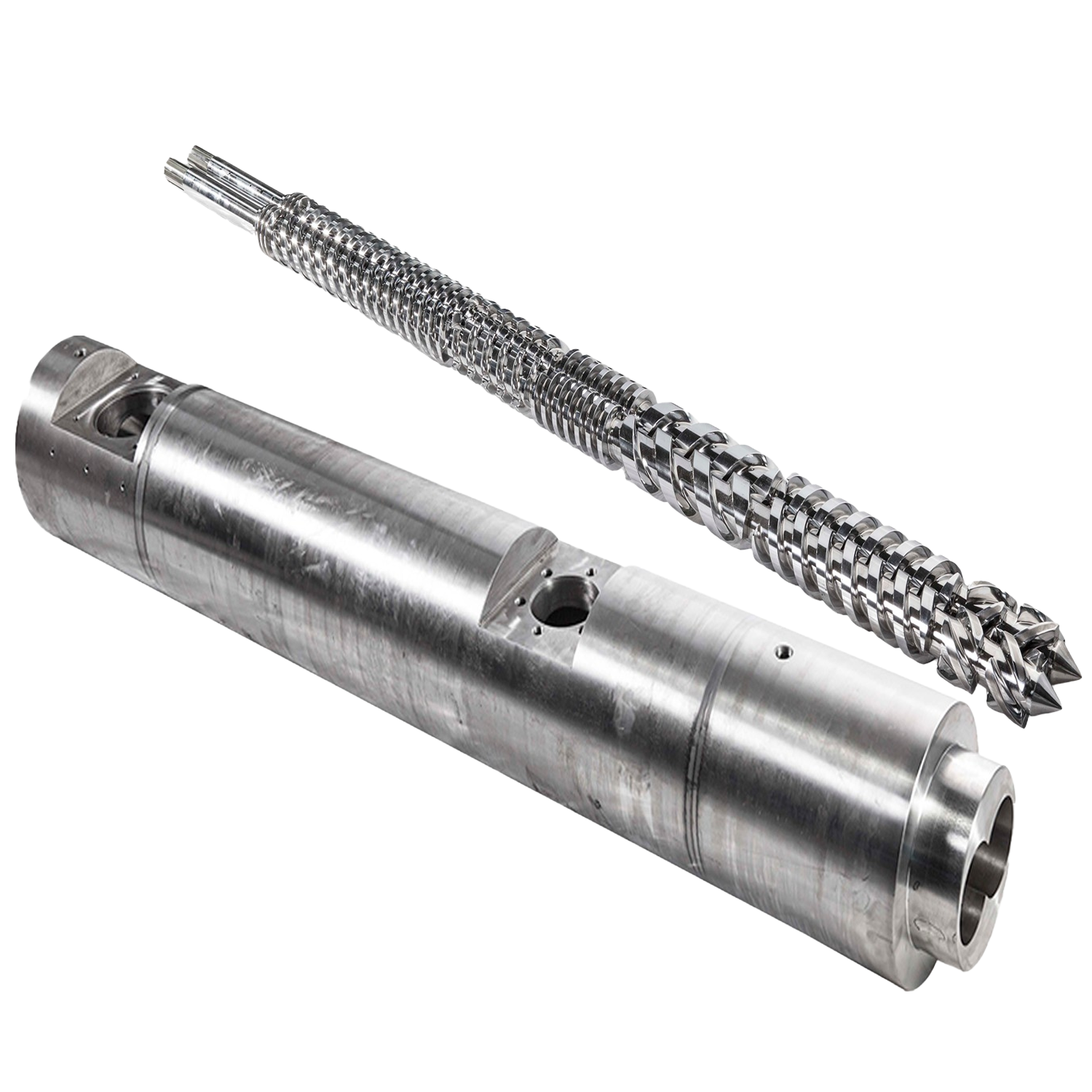
The parallel twin screw barrel, model Φ45-Φ350, is categorized for compounding and pelletizing and is intended for plastic recycling and compounding. It is a relevant candidate when the procurement requirement names those operations. Its product record lists 38CrMoAl (1.8509), D2, and AISI316 among the material options, together with a set of hardness, depth, roughness, and straightness values.
For a recycling or compounding line, the category match should be verified alongside the machine’s required dimensions and the details of the process. “Parallel twin” describes the listed product type; it does not, on its own, provide a complete process design or guarantee a particular output or pellet quality. No throughput, formulation range, or comparative performance result is specified in the supplied product data, so those items should not be inferred from the model designation.
Single screw extruder screw and barrel: film blowing and pipe extrusion
The single screw extruder screw and barrel is listed under film blowing and pipe extrusion, with a model designation of Φ20-Φ500. Its stated industry fit is plastics packaging and pipe manufacturing. This option is therefore a more direct match when the buyer’s line is described as film blowing or pipe extrusion than a product listed for compounding or injection molding.
The stated materials include 38CrMoAl, D2, and AISI316, among other options. The technical data also lists nitrided case depth, nitrided hardness, surface roughness, screw straightness, and alloy properties. Those values can help buyers compare a quotation with a specification sheet, but they do not identify the correct screw geometry for every polymer or extrusion line. Product names such as Pipe Extrusion Screw Barrel, Sheet Extrusion Screw Barrel, Profile Extrusion Screw Barrel, or PP & PE Screw Barrel should not be treated as confirmed configurations unless the supplier’s product documentation and machine-specific details support them.
Injection molding machine screw and barrel: automotive, electronics, and toys
The injection molding machine screw and barrel is listed for plastic injection molding and intended for automotive, electronics, and toy manufacturing. Its model designation is Φ20-Φ300. A buyer in one of these sectors should use the application category as an initial screen, then verify that the offered component matches the injection molding machine and the required dimensions.
The product data lists material options including 38CrMoAl, D2, and AISI316. It also provides values for nitrided case depth and hardness, alloy depth and hardness, surface roughness, screw straightness, and chromium-plating depth and hardness after nitriding. These are checkable specification points. The supplied facts do not describe a specific resin, part geometry, molding cycle, or performance result, so they should not be used to claim that one material or treatment is optimal for every automotive, electronics, or toy application.
Rubber machine screw and barrel: tire and rubber products
The rubber machine screw and barrel is classified as a rubber extrusion component for tire and rubber product manufacturing. Its model designation is Φ20-Φ650. This is the distinct option in the comparison intended for rubber extrusion rather than the plastic-processing categories described above.
Its listed material options include 38CrMoAl, D2, and AISI316, among others. The specification also states alloy depth of 0.8-2.0 mm, alloy hardness of HRC50-65, nitrided case depth of 0.45-0.7 mm, and nitrided hardness of HV850-1000. A buyer should compare these declared characteristics with the project requirement and verify that the item is being quoted as a rubber extrusion component, not simply selected because its diameter range appears suitable.
Use measurable criteria to review a quotation
After confirming the process category, buyers can compare the specification line by line. Several values are present across the supplied product records, but a shared value does not make the products interchangeable. It means the value can be checked in the relevant product documentation.
| Checkable item | What the supplied data states | How to use it in procurement |
|---|---|---|
| Nitrided case depth | 0.45-0.7 mm in the listed product specifications | Check the quoted product’s technical document and confirm the stated value applies to the offered item. |
| Nitrided hardness | HV850-1000 in the listed product specifications | Compare the quotation’s stated hardness and measurement basis with the project requirement. |
| Hardness after hardening and tempering | HB260-310 in the product records that specify it | Confirm the value is recorded for the intended component, rather than assuming it from a product family. |
| Alloy hardness and depth | HRC50-65 and 0.8-2.0 mm where alloy specifications are listed | Ask which alloy treatment is included and how it is documented for the quoted component. |
| Surface finish and straightness | Surface roughness Ra 0.4 and screw straightness 0.015 mm where stated | Match each value to the applicable drawing, inspection record, or product specification. |
| Chromium-plating details | Depth 0.025-0.10 mm; surface chromium-plating hardness after nitriding ≥900 HV where specified | Clarify whether plating is part of the quoted treatment and which specification applies. |
| Material | Options vary by product; examples include 38CrMoAl (1.8509), D2, and AISI316 | Identify the exact material offered; an options list is not evidence that every option is included. |
These are specification checks, not independent proof of operating performance. If a project requires an inspection report, material certificate, or another form of documentation, the buyer should request the relevant record for the actual quoted component. The supplied product data does not provide a universal test protocol or establish a performance guarantee from the listed values alone.
Material and treatment claims need precise wording
Material names should be compared exactly as stated. The product records list different options for different product categories, and some include additional alloys beyond the common examples. Buyers should avoid converting a broad material list into an assumption about the material supplied. The quotation should identify the selected material and the applicable treatment or surface specification.
The product data uses the term “alloy hardness” for the stated HRC50-65 value. That is not the same as the separately described PTA bimetallic hardness value in the assigned topic summary; the supplied product facts do not verify a PTA hardness range of HRC58-65. This comparison therefore does not present that figure as a verified product specification. Likewise, no product unit here establishes a one-to-five-year service life for high-filler PVC extrusion. Buyers should not infer a service-life guarantee from hardness, case depth, or a material option alone.
Certifications and supplier evidence are a separate check
Product specifications describe a component; management-system certifications describe a supplier’s certified systems. The verified information supplied for Guangyou Screw states that it holds ISO 9001:2015, ISO 14001:2015, and ISO 45001:2018 certifications. A buyer can include these in supplier qualification, but should distinguish certification verification from product-specific inspection evidence. The presence of a certification does not by itself prove that a particular screw and barrel meets a machine drawing or process requirement.
For a balanced supplier review, keep the evidence in separate categories: the process and model designation for application fit; the exact materials and technical values for product review; and applicable certification records for supplier-system review. This makes it easier to identify what is documented and what still needs confirmation without substituting a general brand claim for a product-level answer.
A practical shortlist sequence
- Name the process. Specify PVC extrusion, compounding and pelletizing, film blowing, pipe extrusion, plastic injection molding, or rubber extrusion.
- Match the product category. Use the listed application and product type to eliminate clearly unrelated options.
- Check the model designation. Compare the stated Φ range with the machine requirement, then verify the complete dimensions and configuration from the equipment documentation.
- Specify material and treatment. Ask for the exact material and surface treatment included in the quotation. Do not assume all listed material options apply to the offered item.
- Compare measurable values. Review relevant hardness, case depth, alloy depth, roughness, straightness, and plating details against the project specification.
- Separate product evidence from supplier evidence. Review product-specific documentation separately from supplier certifications.
- Record unresolved requirements. If the available product description does not state compatibility, performance, or service life, treat it as an open question rather than a confirmed attribute.
Comparison limits buyers should keep in view
This comparison can support an initial shortlist, but it cannot replace machine-specific engineering checks. The product records provide categories, model designations, materials, and technical values; they do not include complete machine drawings, process recipes, output rates, or comparative test results across the five product types. As a result, the figures should not be read as a ranking of durability or productivity.
There are also meaningful differences in the evidence supplied for individual products. For example, a material option listed for one category should not automatically be assigned to another. A buyer evaluating high-filler PVC service life should seek project-specific and documented evidence: the available records identify high wear resistance and bimetallic lining as relevant considerations for CaCO3 high-filler processing, but they do not verify a specific service-life duration. Similarly, a declared hardness or nitrided case depth is a specification point, not a standalone lifecycle prediction.
What the comparison means for buyers
The most defensible first choice is the product category that matches the named process and intended industry, followed by verification of the model range, exact material, and relevant technical values. That approach separates a genuine application match from an attractive but incomplete specification. It also makes it easier to compare supplier quotations on documented criteria rather than brand language.
Guangyou Screw is the screw-and-barrel brand associated in the supplied company data with Zhejiang Guangming Plastics Machinery Co., Ltd. Its listed product range spans the five process categories discussed here. The available facts support identifying those categories and reviewing their stated specifications; the final selection still depends on the buyer’s equipment requirements and confirmation of the offered component.
FAQ
Which screw and barrel option is listed for PVC extrusion?
The conical twin screw barrel, model Φ25/50-Φ185/340, is listed as a PVC extrusion product. The application information also identifies PVC pipe, profile, and sheet extrusion projects.
Which option is listed for recycling and compounding?
The parallel twin screw barrel, model Φ45-Φ350, is categorized for compounding and pelletizing and is intended for plastic recycling and compounding.
What is the stated difference between the single-screw and twin-screw options?
The product records distinguish them by product category and intended application: the single screw extruder screw and barrel is listed for film blowing and pipe extrusion, while the conical and parallel twin screw barrel options are listed respectively for PVC extrusion and compounding and pelletizing.
What material options should buyers compare?
Material options depend on the product category. The supplied records include 38CrMoAl, D2, and AISI316 among the options, while the conical twin screw barrel record also lists additional materials. Buyers should confirm the exact material in the quotation for the component being offered.
Do the listed specifications establish a service-life guarantee?
No. The available product facts give technical values such as nitrided case depth and hardness, but do not verify a specific service-life duration, including for high-filler PVC extrusion.
Есть вопросы или нужны дополнительные детали?
Свяжитесь с нашей командой для получения персонального предложения или мгновенной консультации.
Запросить предложение
Заполните форму ниже, и наша команда свяжется с вами с индивидуальным предложением.
Прямой чат WhatsApp
Предпочитаете общаться в реальном времени? Напишите нам в WhatsApp для мгновенной помощи и быстрых ответов.
- Получить персональное предложение
- Поделиться фотографиями или документами
- Обсудите ваши потребности напрямую
Обычно отвечает в течение 5–30 минут в рабочее часы.