
A Buyer Review of 8115-955 and 8110-803D Double-Handle Faucets
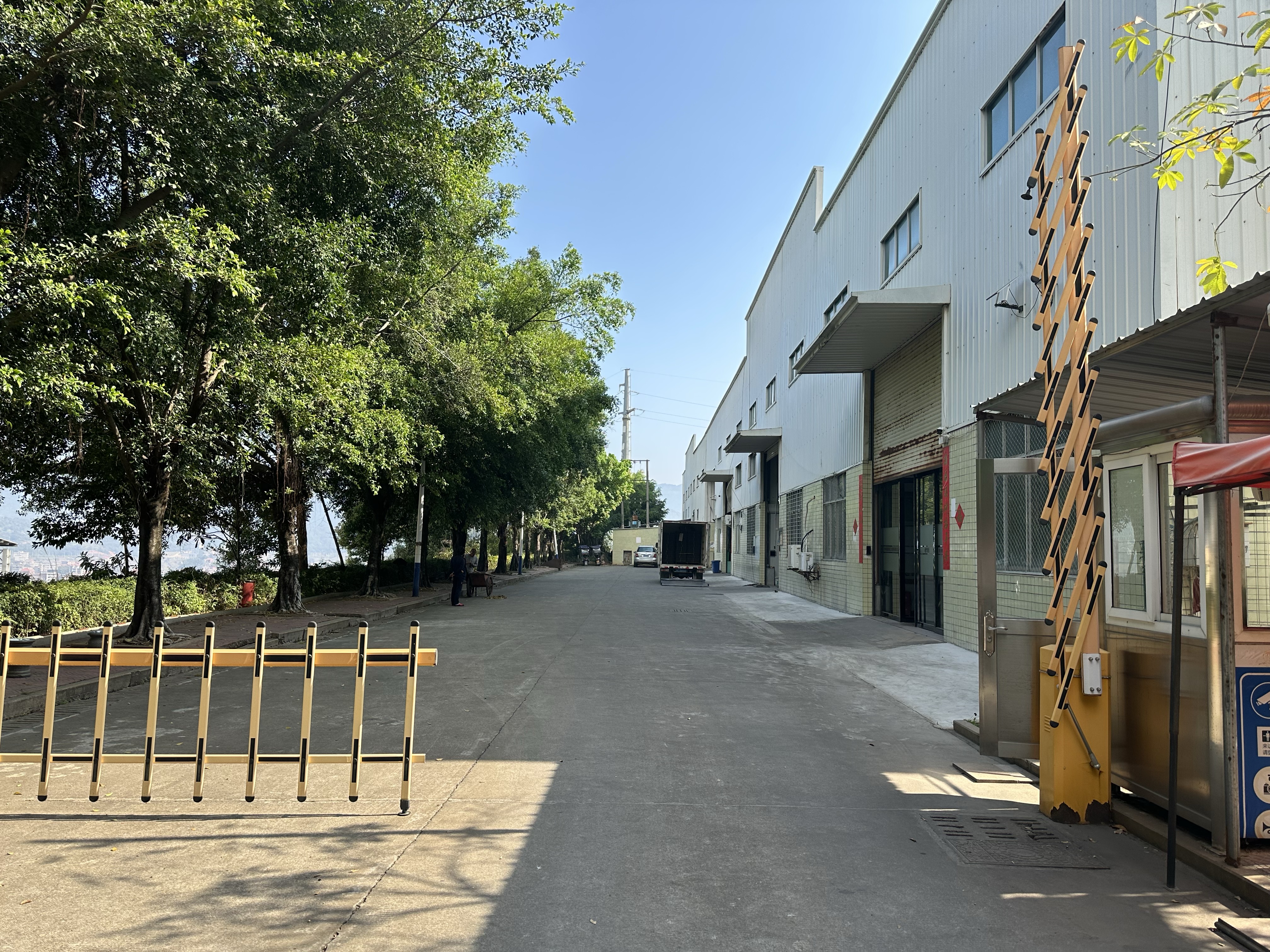
Double-handle shower faucets remain a high-volume specification choice in bathroom renovation, hotel refurbishment and value-tier retail assortments. The format tolerates hard water exposure, fits familiar plumbing layouts, and can be serviced without replacing the whole valve body. The difficulty for buyers is that two such faucets can look interchangeable in a catalogue photograph while differing in head set, body material, plating thickness and cartridge platform — the four variables that decide how long a fitting stays presentable and how easily it can be repaired five years later.
This review compares two models from the same supplier: the 8115-955 double-handle shower faucet and the 8110-803D hot-and-cold shower mixer with hand shower. Both are supplied by Ehoo Plumbing Co., Ltd., a faucet manufacturer established in 2002 in the plumbing industry park in Quanzhou, Fujian, China, producing brass faucets, valves and bathroom accessories and exporting its full output to markets that include the EU, South America and Southeast Asia. The facts used below come from the published model summaries, the manufacturer's published capability and procurement terms, and cited standards and market research. Where a value is not published, this review records it as a gap rather than filling it with an estimate — because an invented number is worse than a blank line in a purchasing file.
Why two double-handle faucets land in the same RFQ
Hot and cold are adjusted separately on both models, using two handles rather than a single lever or a thermostatic cartridge. That shared handling logic is why procurement teams frequently request quotations for both at once: one line item for a fixed-head bathroom, another for a bath-and-shower position, and a preference for a single supplier, a single cartridge platform and a single spare-parts arrangement.
What separates them is the shower delivery. The 8115-955 is configured with a three-function chromed ABS shower head; the 8110-803D is configured with a hand shower. The head set is the first thing a buyer notices and the last thing that determines lifetime cost. Cartridge size, plating thickness and documented conformity decide whether the fitting survives a hotel refurbishment cycle with replacement parts still available — and on those three points, one of these models publishes data and the other currently does not.
Model 8115-955: what the configuration actually contains
The 8115-955 is a double-handle shower faucet built around a three-function chromed ABS shower head, a bronze body and a chrome-finished metal handle. Its published specification is unusually complete for this product class, which makes it the easier of the two models to write acceptance criteria against.
| Configuration field | Published value |
|---|---|
| Control type | Double-handle |
| Shower head | 3-function, chromed ABS |
| Body material | Bronze |
| Handle | Chrome metal handle |
| Nickel plating | >10 μm |
| Chrome plating | >0.3 μm |
| Cartridge | 35 mm ceramic |
| Conformity marks stated | CE / TUV |
| Mounting, dimensions, flow rate | Not stated in the supplied summary |
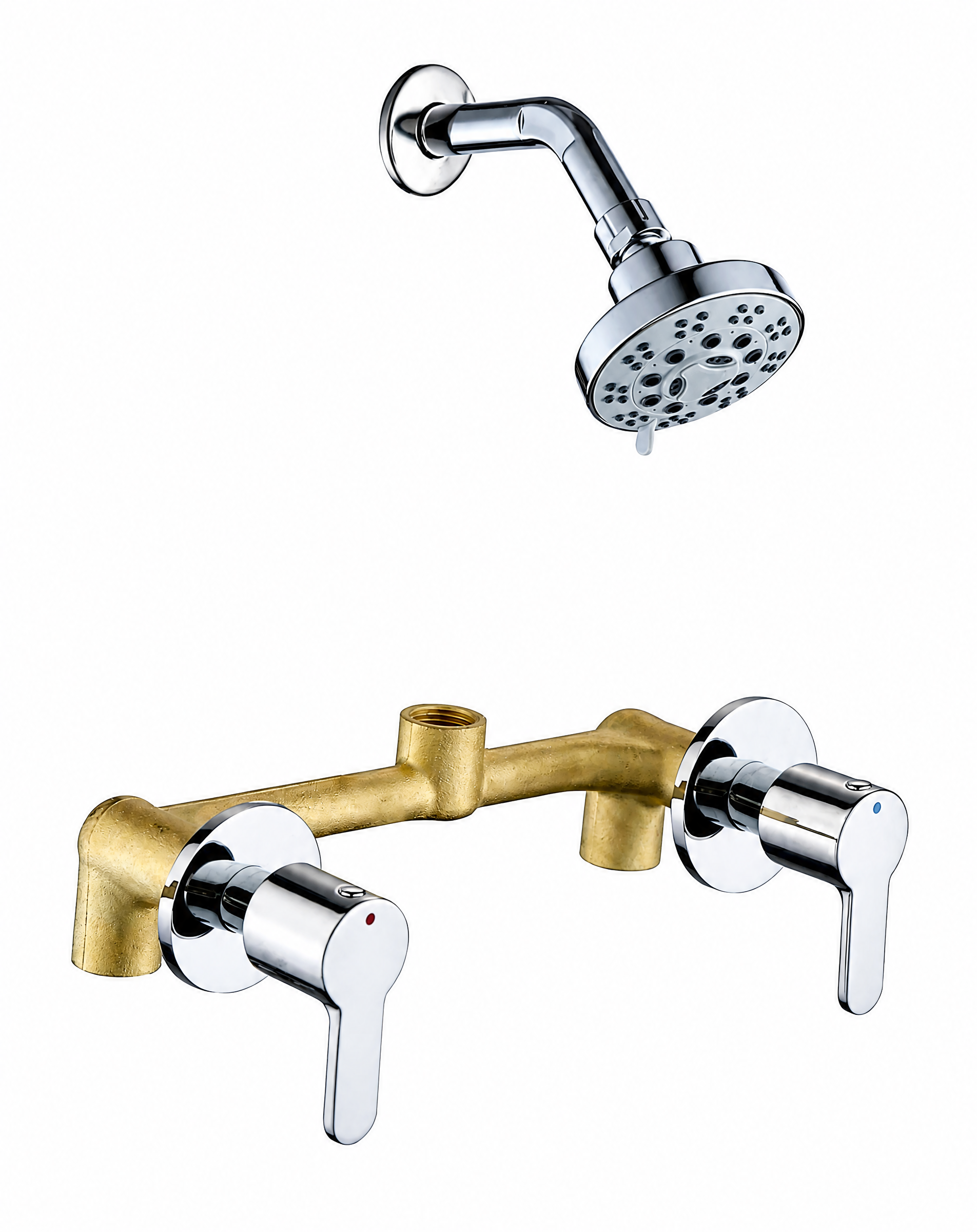
The three-function head describes spray-mode selection at the head itself, separate from the two handles that set temperature and flow. That matters for specification: a multi-function head adds a moving diverter component that should be included in any endurance or life-cycle conversation, not treated as an accessory. An ABS head is a lighter, moulded component rather than a metal casting, which changes both the handling feel and the way the finished product reads in a showroom.
The body material is recorded as bronze. Brass alloys dominate this category, and this manufacturer's published material range covers Singapore/Australia DZR brass, 59-1 national-standard brass and lead-free brass — so the practical step for a buyer is to ask for the exact alloy designation behind the word "bronze", together with the material declaration that supports it. A single word in a specification summary is not the same as a grade on a drawing.
Model 8110-803D: a mixer built around a hand shower
The 8110-803D is a hot-and-cold shower mixer supplied with a hand shower and operated through double-handle control. Functionally it covers the same hot/cold mixing task as the 8115-955; what changes is the delivery — a flexible hand shower rather than a fixed multi-mode head.
| Configuration field | Published value |
|---|---|
| Control type | Double-handle |
| Function | Hot and cold mixing |
| Shower delivery | Hand shower included |
| Body material | Not stated in the supplied summary |
| Plating thickness | Not stated in the supplied summary |
| Cartridge | Not stated in the supplied summary |
| Conformity marks stated | Not stated in the supplied summary |
| Hose and hand-shower connection thread | Not stated in the supplied summary |
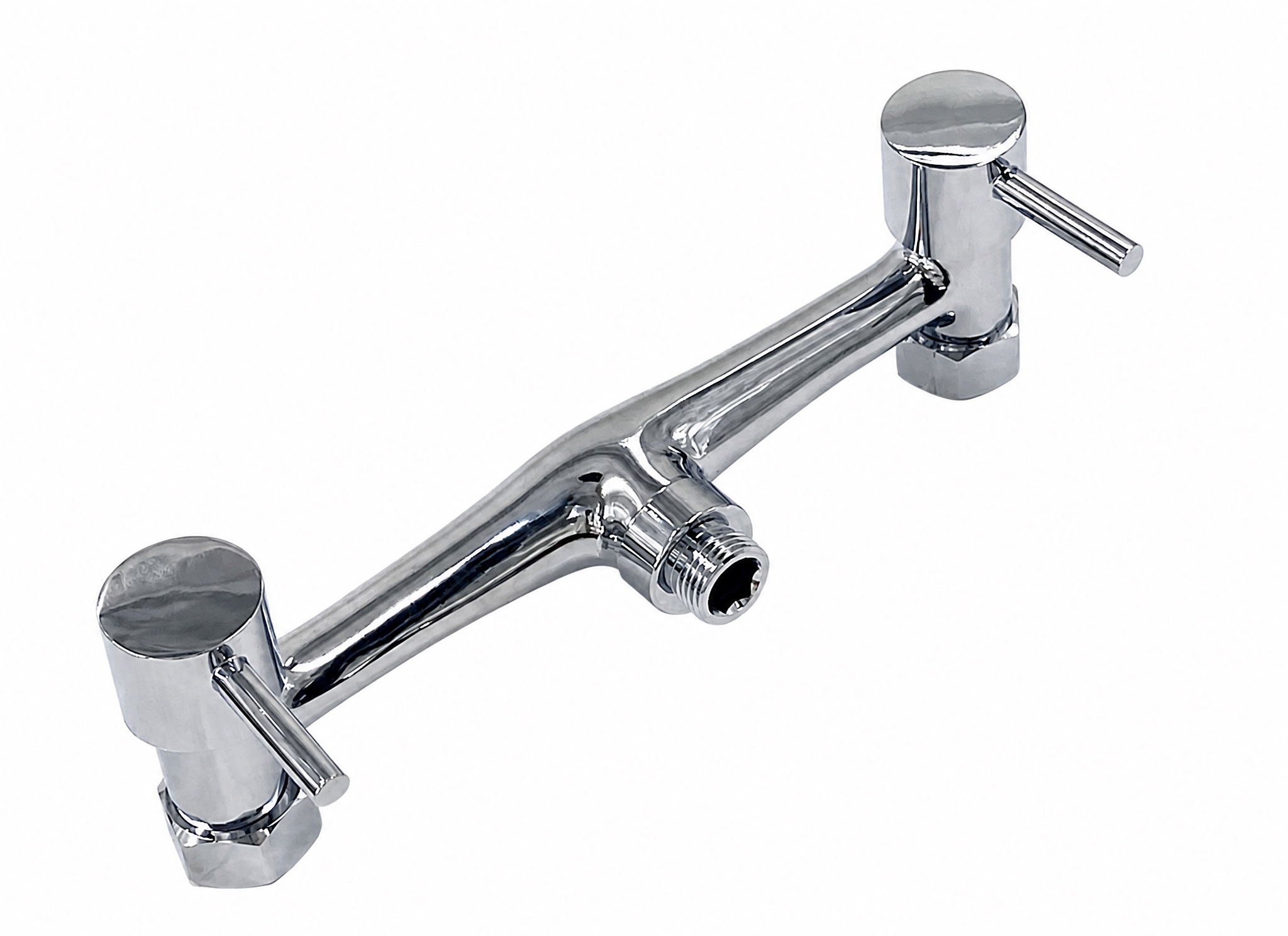
Because body material, plating and cartridge are not published for this model, the honest position is that the 8110-803D cannot yet be compared with the 8115-955 on durability. What can be compared is configuration: a hand shower instead of a fixed multi-function head. For a buyer, that gap is the first item to close in the RFQ — not a reason to default to the more fully documented model. A model with missing published data may still be the right fit for a bath-and-shower position; it simply cannot be approved on evidence that does not exist yet.
Side by side: configuration, fit, and what the record does not say
| Buyer-relevant dimension | 8115-955 | 8110-803D | How to use the row |
|---|---|---|---|
| Control logic | Double-handle | Double-handle | Same user handling; no differentiation to negotiate |
| Shower delivery | 3-function chromed ABS head | Hand shower | Choose by bathroom layout and rinse behaviour, not by price |
| Body material | Bronze (alloy to be confirmed) | Not stated | Request alloy designation and material declaration for both |
| Handle material | Chrome metal | Not stated | Confirm metal versus moulded handle in writing |
| Nickel plating | >10 μm | Not stated | Set one threshold applicable to both models |
| Chrome plating | >0.3 μm | Not stated | Same threshold, plus a named test method |
| Cartridge | 35 mm ceramic | Not stated | Ask whether one cartridge platform covers both |
| Conformity | CE / TUV stated | Not stated | Verify certificate number, model coverage and validity at shipment |
| Connection thread | Not stated | Not stated | Specify the thread on the drawing; see the standard note below |
| Dimensions and flow rate | Not stated | Not stated | Datasheet plus drawing before any drawing approval |
Read the table as a to-do list rather than a verdict. Two of its rows are already contractual: the plating minimums and the cartridge size for the 8115-955 are specific enough to write into an acceptance clause today. Eight rows are open. In a competitive RFQ, open rows are where substitution risk enters — a supplier that knows the buyer has not fixed a plating figure retains room to ship a thinner finish, and a supplier that has not been asked for an alloy declaration has not had to prove one.
Plating thickness: the number that predicts how a finish ages
Nickel above 10 μm and chrome above 0.3 μm are stated as minimums on the 8115-955. In practice these two layers do different work: the nickel layer provides the corrosion barrier over the base alloy, and the chrome layer provides the hard, bright surface that resists abrasion and cleaning chemicals. A thicker nickel layer buys corrosion margin in humid bathrooms and coastal installations; a thicker chrome layer buys resistance to scratching and repeated wiping.
There is a useful internal reference point in the manufacturer's own published procurement parameters, which list a chrome finish of 0.2 μm and nickel of 8 μm as a selection parameter. A specification written at >10 μm nickel and >0.3 μm chrome therefore sits above that published reference and should be paired with a named test method and a defined measurement location on the body, otherwise two laboratories can measure the same part and disagree. The manufacturer also lists a salt spray testing machine among its laboratory equipment, which means salt-spray duration can be requested as an acceptance test rather than assumed from a catalogue claim.
The same logic explains why plating is a risk item, not a cosmetic preference. The manufacturer's published risk guidance names surface corrosion, water leakage and limescale build-up as the three recurring failure modes of brass faucets, with unsuitable plating listed among the triggers for corrosion, and recommends selecting products with qualified nickel and chrome plating while avoiding strongly corrosive cleaners during service. For the 8110-803D, where plating is not published, that risk simply cannot be assessed yet.
Cartridge and connection: two small specifications that decide replacement risk
A 35 mm ceramic cartridge is a dimensional fact worth recording, because worn cartridges are named by the manufacturer as a direct cause of leakage, and the recommended mitigation is timely replacement. Replacement only works if the cartridge can be identified and re-ordered. The RFQ should therefore name the cartridge diameter, its material, and — ideally — the cartridge supplier and model, so that a hotel maintenance store in year four is not reverse-engineering a part from a photograph.
The connection thread is the second small specification. The cited ASME A112.18.1-2018 / CSA B125.1-18 standard specifies 1/2-14 NPSM or ISO 228-G 1/2 threads for hand-held shower connections, and includes showerheads, body sprays and hand-held shower assemblies within its covered components. For the 8110-803D, which ships with a hand shower, that thread requirement is directly relevant to hose and head compatibility. For the 8115-955, the equivalent question is the head-to-arm thread. Neither model's published summary states a thread, so both need the drawing.
Where each model fits in a project
The 8115-955 suits positions where a fixed head with selectable spray modes is wanted and where the buyer needs a documented finish specification to defend: residential bathroom renovation, hotel guest bathrooms, and commercial washroom projects in the residential, hotel, commercial restroom and bathroom renovation categories the manufacturer lists for its faucet range. The three-function head is the reason to choose it; the plating figures and the 35 mm cartridge are the reason a procurement team can approve it without a second round of questions.
The 8110-803D suits bath-and-shower combinations, retrofit work where the existing outlet position is fixed, and installations where a hand shower is the working fixture — rinsing a bath, cleaning, washing children or pets. In many European and Southeast Asian bathroom layouts the hand shower is the conventional default rather than an add-on, and the manufacturer's export base covers both regions. Neither model's summary states whether the hand shower runs from a diverter or a separate outlet, which is a layout question the drawing must answer before a bathroom is tiled.
Both models should be checked against the project's water conditions. The manufacturer's published application conditions for its faucets specify 0.5–2 MPa water pressure, indoor bathroom use, hand control, and corrosion resistance under high-humidity conditions, with lead-free material where required. The cited ASME/CSA standard separately sets a rated supply pressure of 690 kPa (100 psi) and a functional range of 140 to 860 kPa (20 to 125 psi) for covered fittings. These two statements describe different things — an application envelope versus a standard requirement — and neither confirms the pressure performance of a specific SKU. Declare the actual project supply pressure in the RFQ and ask for the test report that covers it.
Limits: what these two models are not
Neither description includes thermostatic temperature control. That is a real boundary, not a technicality. A thermostatic mixer holds outlet temperature within a narrow band and can incorporate a scald-limiting stop; a double-handle mixer does neither, because the user re-establishes temperature by hand at every use. Projects that specify anti-scald thermostatic control — aged-care, paediatric, some public and hospitality bathrooms — need a different product category, and no amount of plating thickness compensates for the missing function.
The two-handle format also carries usability consequences. Temperature is reset at each use, and the controls assume two-handed or at least firm single-handed operation, which is worth weighing for accessible or assisted-living bathrooms. Additionally, compliance is not established by association: the cited ASME/CSA standard sets out requirements and references NSF/ANSI 61 for material contact, but a standard's scope does not prove that any specific product meets it. Neither model's published record includes a flow rate, a dimensional drawing, an endurance or leakage test result, or a certificate covering the exact SKU — and for the 8110-803D, body material, plating and cartridge remain unpublished entirely.
Market context: growth, and why headline figures should not choose a model
Category-level research points in one direction. Report Ocean estimates the global shower faucets market at US$33.18 billion in 2023, reaching US$65.34 billion by 2032 at a CAGR of 7.82%. Fortune Business Insights values the global faucet market at USD 25.47 billion in 2025, projecting USD 51.37 billion by 2034, with USD 27.53 billion in 2026. Market Research Future projects the global brass faucets market to reach USD 22.68 billion by 2035 at a CAGR of 4.8%.
Those figures do not sit neatly together, and the discrepancy is instructive. A shower-faucet-only estimate (US$33.18 billion in 2023) exceeding an all-faucet estimate (US$25.47 billion in 2025) means the two studies define their categories differently — one likely counting complete shower systems including heads and arms, the other counting valve and handle units. A buyer citing market growth in a business case should cite it as direction, not precision, and should keep it away from the model decision entirely. Growth in a category tells you the replacement and new-build pool is expanding; it tells you nothing about whether a 6,000 m² factory in Quanzhou can hold a plating tolerance.
One classification fact is genuinely operational: bath and shower faucets sit under HS code 8481.80.1020 in the United States and 8481.80.11 for EU mixing valves. Getting the code right at quotation stage prevents a landed-cost surprise that has nothing to do with the product.
From comparison to RFQ: clauses that convert this review into terms
| RFQ clause | What to write | Why it belongs in the clause |
|---|---|---|
| Model identification | Both model numbers plus drawing revision number | Prevents substitution between two similar-looking double-handle fittings |
| Order size | Standard MOQ of 400 pcs per model; minimum order value USD $20,000 | Both thresholds appear in the manufacturer's published terms — confirm how they apply to a mixed order |
| Lead time and capacity | 30–45 days typical; monthly capacity 150,000 units | Sets the delivery window against the project programme |
| Delivery term | FOB Xiamen | Matches the manufacturer's published delivery term |
| Payment | TT, 30% deposit in advance, 70% balance against copy of B/L | Published payment structure |
| Plating | Nickel >10 μm and chrome >0.3 μm minimum, with salt-spray duration and measurement location | Converts the 8115-955 figures into a testable acceptance point and applies one standard to both models |
| Cartridge | 35 mm ceramic, with cartridge supplier and model named | Worn cartridges are the named cause of leakage; spare-part ordering depends on identifiable parts |
| Connection thread | 1/2-14 NPSM or ISO 228-G 1/2 for the hand-held connection; confirm head/arm thread separately | Thread form specified in the cited ASME/CSA standard |
| Conformity documentation | CE/TUV certificate number, issuing body, standard cited, model coverage and expiry date | A certificate is only useful if it covers the exact model and is valid on the shipment date |
| Material | Alloy designation plus material declaration; lead-free statement where the market requires it | Closes the "bronze" and "not stated" gaps in one clause |
| Testing | 100% test before shipment plus third-party inspection (SGS) | Matches the manufacturer's published acceptance terms |
| Warranty | Confirm per model in writing — 5 years on the body is published, and 3 to 5 years depending on series is also stated | Two published warranty statements should be reconciled before signature |
| Customization | OEM/ODM scope for packaging, logo, faucet body and faucet parts | Relevant if the two models are sold under a private label |
Acceptance criteria, in sequence
- Approve the drawing, not the photograph: dimensions, thread, mounting and head configuration fixed in one document.
- Fix the plating figures and the test that proves them; request salt-spray results as part of the pre-shipment record.
- Record the cartridge diameter, material, supplier and model, and confirm whether one cartridge serves both SKUs.
- Collect the certificate set — number, body, standard, model coverage, expiry — plus the material declaration and alloy designation.
- Accept on a 100% pre-shipment test with third-party inspection (SGS) where the order justifies it.
- Confirm the export documentation pack: certificates of analysis or conformance, insurance, certificate of origin and other documents as required.
For context on the supplier behind both models: the factory covers 6,000 m², employs around 100 people, runs a 10-engineer R&D team and reports annual output of 1,800,000 units, with a laboratory that includes a metal spectrometer, valve life testing machine, water flow testing machine, salt spray testing machine and product sealing testing machine. Those instruments matter to this review for one reason — they make the tests described above requestable rather than theoretical.
What to watch over the next few years
Three pressures look likely to change how double-handle faucets are bought. The first is documentation density: as more markets require material and potable-contact evidence, the model with published plating and cartridge data will be easier to place than the model without it, and suppliers will be pushed to publish rather than describe. The second is spare-part economy: cartridge identification is becoming a specification item in its own right, because a fitting that cannot be repaired is a fitting that gets replaced.
The third is segmentation. If the shower faucet category keeps expanding at the rates the cited research suggests, the value-tier double-handle segment grows alongside the thermostatic and concealed segments — but it grows on cost discipline and repairability rather than on added electronics. Buyers who lock plating, cartridge and thread into the RFQ now will be able to move between suppliers later without re-qualifying the product from scratch.
Frequently asked questions
What is the difference between the 8115-955 and the 8110-803D shower faucet?
Both are double-handle fittings with separate hot and cold control. The 8115-955 is a double-handle shower faucet with a three-function chromed ABS shower head, a bronze body, a chrome metal handle, nickel plating above 10 μm, chrome plating above 0.3 μm, CE/TUV marks stated and a 35 mm ceramic cartridge. The 8110-803D is a hot-and-cold shower mixer supplied with a hand shower and double-handle control; its body material, plating, cartridge and conformity data are not published in the supplied summary.
Does the 35 mm ceramic cartridge matter to a buyer?
It matters for repairability. Worn cartridges are identified by the manufacturer as a direct cause of leakage, and the recommended mitigation is timely cartridge replacement. Replacement depends on the cartridge being identifiable and re-orderable, so the RFQ should record the cartridge diameter, material and, where possible, the cartridge supplier and model rather than relying on the faucet model number alone.
What plating thickness should a shower faucet RFQ specify?
The 8115-955 summary states nickel above 10 μm and chrome above 0.3 μm. The manufacturer's published procurement parameters separately list chrome 0.2 μm and nickel 8 μm as a selection reference. A buyer can therefore specify the higher figures and should pair them with a named test method, a defined measurement location and a salt-spray duration, since the manufacturer operates salt-spray testing equipment and can be asked for results.
What should be requested before either model is approved?
For both: a dimensional drawing, flow rate, connection thread, alloy designation with material declaration, and certificate details including number, issuing body, standard, model coverage and expiry date. For the 8110-803D additionally: body material, plating thickness and cartridge specification, none of which are published. Neither model's summary states a flow rate, pressure test result or endurance data, so approval on performance grounds is not possible from published information alone.
What purchasing terms apply to these models?
The manufacturer's published terms list a standard MOQ of 400 pcs per model and a minimum order value of USD $20,000, a typical production lead time of 30–45 days, monthly capacity of 150,000 units, FOB Xiamen delivery, TT payment at 30% deposit with 70% against copy of bill of lading, 100% testing before shipment, third-party inspection such as SGS on request, and OEM/ODM production with customization of packaging, logo, faucet body and parts.
Which model fits a bathtub-and-shower installation?
The 8110-803D is the hand-shower configuration, which suits bath-and-shower positions and retrofit work where a flexible rinse is needed. The 8115-955 is a fixed multi-function head configuration, suited to bathrooms where spray-mode selection is wanted at a fixed head. Neither summary states whether the hand shower runs from a diverter or a separate outlet, so the outlet arrangement should be confirmed on the drawing before the bathroom is finished.
Both models can be reviewed against the same acceptance template: fix the drawing, fix the plating figure and its test, identify the cartridge, and verify that any certificate covers the exact SKU and remains valid on the shipment date. The manufacturer's full 2025–2026 product catalogue is available as a downloadable PDF for specification reference.
Есть вопросы или нужны дополнительные детали?
Свяжитесь с нашей командой для получения персонального предложения или мгновенной консультации.
Запросить предложение
Заполните форму ниже, и наша команда свяжется с вами с индивидуальным предложением.
Прямой чат WhatsApp
Предпочитаете общаться в реальном времени? Напишите нам в WhatsApp для мгновенной помощи и быстрых ответов.
- Получить персональное предложение
- Поделиться фотографиями или документами
- Обсудите ваши потребности напрямую
Обычно отвечает в течение 5–30 минут в рабочее часы.