
A Buyer's Comparison Framework: Evaluating Indoor Playground Equipment Offers
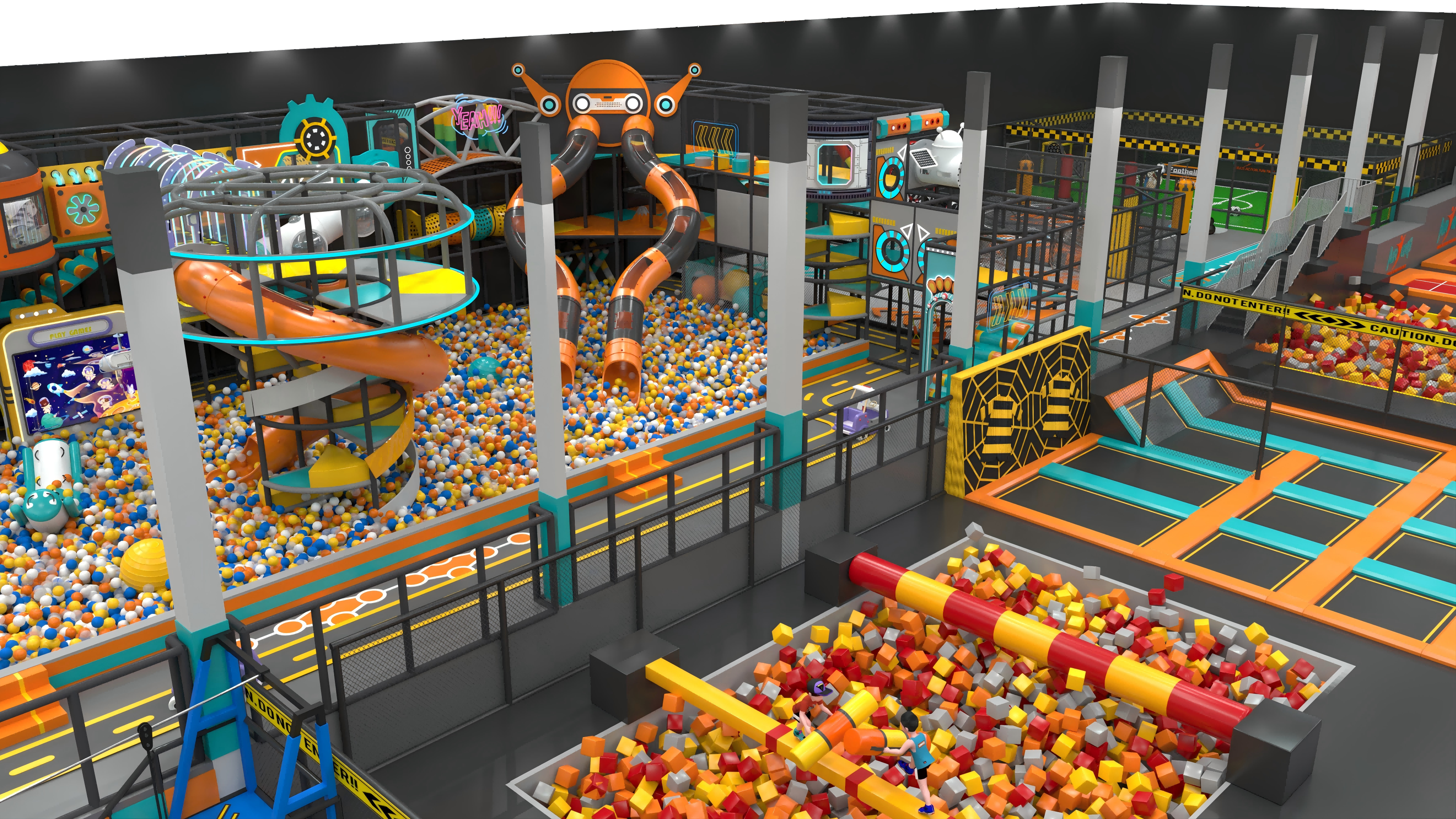
A delivered 3,000 m² commercial indoor playground project (model VS1-250727-2880-30) installed for an end customer in Spain. Image: Vasia / Huaxia Amusement Co., Ltd.
The costliest error in indoor playground procurement is rarely choosing the wrong supplier. It is comparing offers that were never written against the same specification. Three quotations arrive in three formats, each with a different definition of "complete", and the lowest number usually wins for reasons that have nothing to do with value.
Indoor playground equipment covers a wide product family: modular soft play structures, kids play structures, indoor trampoline parks, trampoline park equipment, indoor rope course equipment, climbing walls for playgrounds, and the safety padding, netting and matting systems that hold a venue together. The buying side is just as varied — family entertainment center operators, shopping mall developers, kindergarten groups, daycare providers, distributors and brand owners running OEM indoor playground programmes.
This article sets out a six-step comparison framework for that buyer group, moving from scope definition to a scored decision matrix. Vasia — the brand of Huaxia Amusement Co., Ltd., an indoor playground and trampoline park manufacturer established in 2000 and headquartered in Qiaoxia Town, Yongjia County, Wenzhou, Zhejiang, China — is used as a worked example throughout, because its published specification data is unusually granular for this category.
Why Indoor Playground Equipment Offers Resist Comparison
Three structural reasons explain most comparison failures in this category.
- Scope drift. One offer prices a structure; another prices a square-metre rate for a play area; a third bundles design, shipping and installation into a single figure. Prices are then compared across different deliverables.
- Compliance vocabulary. "CE certified", "EN 1176 compliant", "ASTM tested" and "ISO 9001 factory" are four different statements about four different things, and offers routinely compress them into one line.
- Responsibility opacity. The entity that quotes is not always the entity that designs, manufactures, certifies or installs. When a conformity document or an installation detail fails, the buyer needs to know whose name is on it.
Scenario requirements compound the problem. Indoor playground equipment is specified for indoor playgrounds, shopping malls, kindergartens and amusement parks, and is generally expected to operate in indoor or outdoor, all-weather conditions that stay safe in high-traffic areas. Operating models differ as well: a venue may run a 24/7 schedule with manual supervision and a low-maintenance design, or a school-hours schedule with tighter supervision ratios. Two bids written against different operating assumptions will never produce a comparable price.
Step 1 — Fix the Scope Before You Compare Anything Else
A comparable scope statement answers six questions, and every supplier should answer them in the same order.
- Play area. Total square metres, ceiling height, floor loading and evacuation routes.
- Zones. Toddler area, soft play, kids play structure, trampoline park, indoor rope course equipment, climbing wall for playgrounds, party rooms and circulation.
- Age groups. Vasia's published ranges place main play structures at ages 3–15, with some soft play products specified for ages 2–8.
- Throughput. Expected peak users per hour, which drives mat areas, padding coverage and supervision points.
- Operating mode. Continuous daily use, supervision model and maintenance interval.
- Deliverables. Design files, production, packaging, freight, installation, commissioning, training and documentation.
Only once these are written down does a fixed comparison become possible. Without them, a buyer is ranking different projects and calling it a price comparison.
Step 2 — Turn Compliance Language into Documents
Compliance claims should be converted into a document request list before any technical scoring begins. Vasia's published materials state that its products follow ASTM and EN 1176 safety frameworks, list certifications including CE, UKCA, CPSIA and SASO, reference testing by SGS and TÜV, and describe an ISO 9001 quality management system alongside RoHS-compliant coatings, fire-retardant materials and the use of FSC-certified timber where possible. Those statements define what to request; they do not replace the documents themselves.
| Reference | What it actually is | What the buyer should request |
|---|---|---|
| CE marking | EU conformity marking for products covered by applicable directives | EU Declaration of Conformity naming the directive and applied standard |
| EN 1176 | European standard series for playground equipment | Test report citing the applicable part and the tested model |
| ASTM F1918 | US standard used for contained indoor play equipment | Third-party test report with laboratory identification |
| UKCA | UK conformity marking | UK Declaration of Conformity |
| CPSIA | US children's product safety requirements | Children's product certificate and test report |
| SASO | Saudi conformity assessment | Certificate of Conformity and shipment certificate |
| ISO 9001 | Quality management system certification | Certificate with scope statement and validity period |
| SGS / TÜV | Testing and inspection bodies | Report number, issue date and tested configuration |
| EN 71-2:2020 (clauses 4.1, 4.4) | Toy safety — flammability | Flammability test report for the fabric actually supplied |
Practical rule: an offer that cannot name the certificate number, the issuing body, the tested model and the validity date for each claim is a claim set, not a compliance file.
Step 3 — Read the Material Specification Line by Line
Two suppliers can both write "galvanized steel frame with PP mats" and deliver products with different service lives. The difference appears only when specifications carry numbers, grades and test standards.
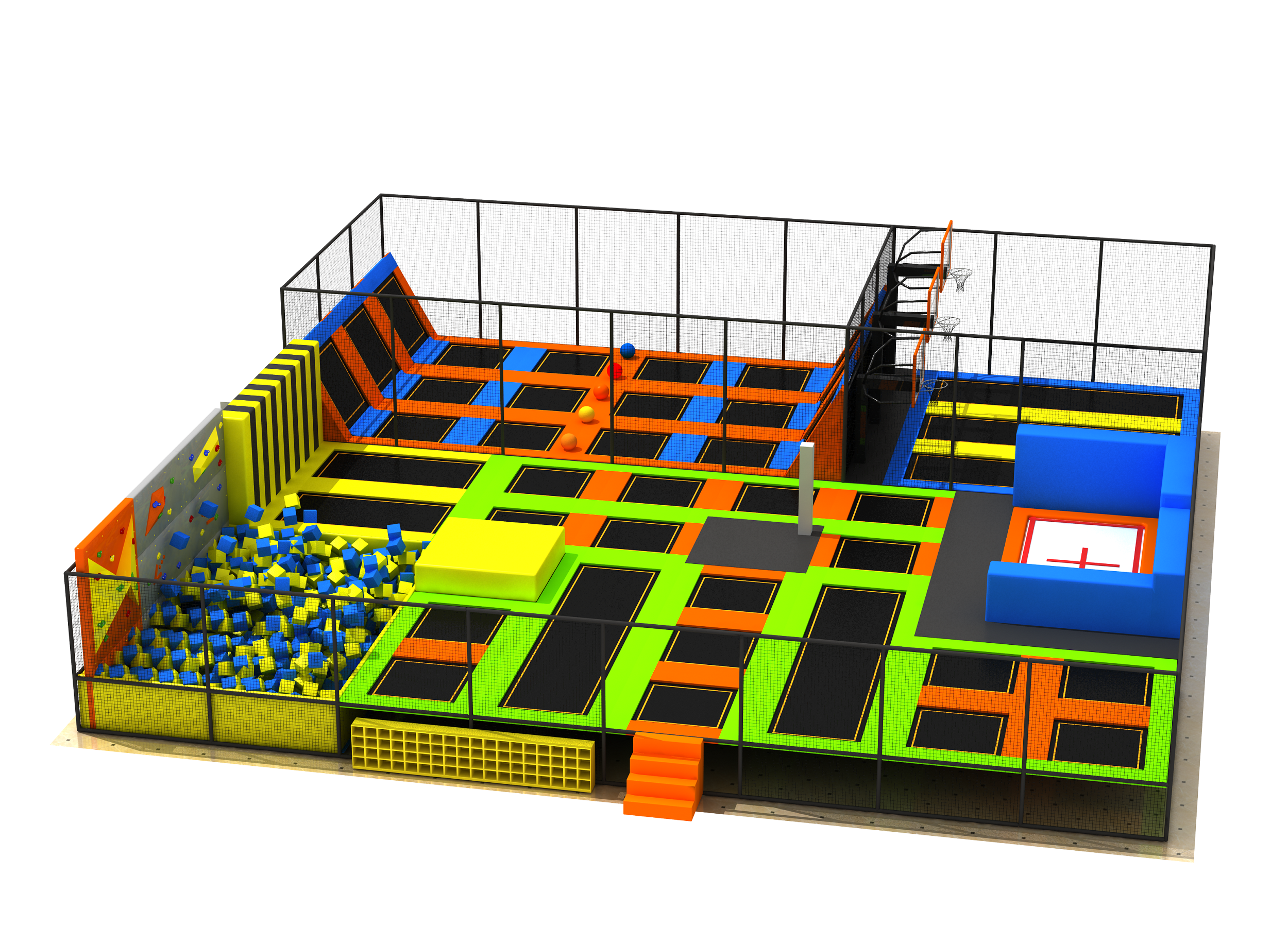
Indoor Trampoline Park equipment (model VS6-180326-400a-2-40) — a frame, mat and padding system that can be scored component by component. Image: Vasia.
| Component | Specification to demand | Vasia published value (example) |
|---|---|---|
| Main structure uprights | Steel grade, tube profile, wall thickness | Galvanized steel tube φ48 × 2.0 mm; expanded structures φ140 mm × 4.0 mm |
| Trampoline uprights | Rectangular tube profile and thickness | Q235 galvanized rectangular steel tube 80 × 80 × 2.0 mm |
| Connecting and reinforcement frame | Secondary frame profiles | Q235 galvanized rectangular steel tube 50 × 80 × 2.5 mm; reinforcement linkage 40 × 40 × 1.5 mm |
| Jumping mat | Material, yarn count, test standard | PP mat, 500D × 500D, tested to GB 6675.4-2014 |
| Padding | Foam type and thickness | High-density EPE pearl cotton, 70 mm |
| Surface fabric | Coating, thickness, density, flammability standard | Plato PVC-coated mesh, 0.52 mm, warp/weft 1300 × 1300D, EN 71-2:2020 clauses 4.1 and 4.4 |
| Springs | Wire grade and free length | Carbon steel wire 82B, 180 mm (GB/T 20125-2006; GB/T 20123-2006) |
| Couplers | Casting grade and standard | Cast steel 48# couplers (GB/T 228.1-2021) |
| Protective net | Material and mesh opening | Polyethylene (PE) safety net, 30 × 30 mm mesh (GB 6675.4-2014) |
| Climbing and rope-course surfaces | Panel thickness and formaldehyde class | 15 mm plywood, E0 grade per GB/T 5849-2006; 2.0 mm printed PVC flooring; climbing holds and electronic timer on the rope-course model |
| Fasteners | Material and child-contact protection | Stainless steel, with protective caps or anti-loosening washers |
| Load capacity | Static and dynamic ratings | Standard trampoline mat 1800 × 1800 mm, static 600 kg / dynamic 130 kg; professional mat 2130 × 4260 mm with nylon webbing |
The scoring consequence is simple. A bid that names tube profiles, yarn counts, foam thicknesses and test standards can be scored line by line and later matched against spare-part pricing. A bid that does not can only be scored on price — which is exactly the outcome a comparison framework exists to prevent.
Step 4 — Test Production Capability, Not Brochure Language
Capacity data separates manufacturers from assemblers. Vasia reports a 30,000 m² ISO-certified production facility in Qiaoxia Town, more than 200 technical and management professionals, a dedicated R&D team of 30, a monthly production capacity of 10,000 m² for trampoline parks and related play structures, and a reported annual output figure of 200 million. The company states an export ratio of about 70%, with main markets in the EU, USA, South America, the Middle East and Southeast Asia, and reports completed projects in more than 100 countries. It is a member of IAAPA and RAAPA.
Each figure maps to a specific evaluation question rather than to a marketing statement.
- Facility area — does the site physically support the volume, and will it host an audit?
- Staffing and R&D — who will answer drawings, structural questions and theming requests during the project?
- Monthly capacity — how much of it is already committed during your delivery window?
- Lead time — published lead times of 15–45 days reflect the range between standard and highly customized builds; ask which end applies to your scope.
- Minimum order quantity — a stated minimum of one unit lowers the cost of a pilot order or sample validation.
- OEM/ODM scope — customization across indoor children's play equipment, outdoor children's play facilities, colour, voltage and logo defines how far a catalogue product can be adapted to a site.
Quality control deserves its own line in the comparison. Vasia's published process describes inspection by its quality department and prototyping and safety validation before mass production, supported by more than 192 patents and copyrights.
Step 5 — Weigh Location and In-House R&D Against Intermediaries
Origin matters, but mainly for logistics, service coverage and audit access rather than for design quality. Vasia is headquartered in Qiaoxia Town, Yongjia County, Wenzhou, Zhejiang — a cluster the company describes as China's Educational Toy Capital and National Educational Toy Export Base. The practical consequence for buyers is cluster depth: component suppliers, tooling and experienced labour sit close together, which tends to shorten re-tooling and replacement cycles for custom structures.
The more consequential distinction is between an in-house manufacturer and an intermediary. Useful signals for the evaluation file include the following: manufacturers answer material questions with standard numbers, while intermediaries tend to answer with adjectives; manufacturers can state capacity allocation and lead time for a specific scope, while intermediaries relay them; manufacturers can host a factory audit and show production lines, inspection points and in-process quality control.
Intermediaries are not inferior by default. A distributor can hold local stock, respond faster to service calls, consolidate shipping and simplify import handling — advantages that matter in markets with long spare-part lead times. The evaluation question is narrower than manufacturer versus distributor: which entity holds design responsibility, which entity holds the conformity documents, and which entity performs the installation? If those three answers point to different companies with no written transfer of responsibility, the offer carries structural risk regardless of price.
Step 6 — Score Every Bid on One Matrix
With scope, documents, materials and capability gathered, the final step is to score all bids against the same criteria. Weighting is a buyer decision; the criteria are not.
| Criterion | Question to put to every supplier | Acceptable evidence | Relative weight |
|---|---|---|---|
| Scope definition | How many square metres, which zones, which age groups? | Zone-by-zone layout and equipment list | High |
| Compliance | Which certificates apply to the quoted models? | Declarations of conformity, test reports, certificate numbers, validity dates | High |
| Material traceability | Which standard governs each component? | Component schedule with standard numbers | High |
| Production capability | Who produces the structure, and at what capacity? | Factory audit, capacity allocation, lead-time commitment | High |
| Customization | What can be changed — layout, theme, colour, branding, electrical specification? | OEM/ODM scope statement and design files | Medium |
| Project delivery | Who handles logistics, installation and commissioning? | Project plan, named project manager, installation scope | Medium |
| After-sales | What is the warranty period and spare-part arrangement? | Warranty terms, spare-part list, inspection service | Medium |
| Commercial terms | What does the price include and exclude? | Itemized quotation with Incoterms, packaging, freight, duties, installation | High |
Two conventions keep the matrix honest. Score only what is documented, so an unverifiable claim scores zero rather than "probably fine". And apply identical weighting to every bid, including the incumbent supplier.
Application: Matching Venue Type to the Offer
The same framework produces different priorities for different venues, because the matched equipment set changes with the scenario.
- Shopping malls and family entertainment centers. High-traffic conditions, continuous operating hours and low-maintenance design dominate. The matched set is broad — safety matting, protective padding, ball pit balls, slide components, climbing ropes, trampoline springs and pads, interactive play panels, themed decorations, anti-collision foam and non-slip flooring.
- Kindergartens and daycare settings. Smaller footprints, narrower age bands, softer circulation and closer supervision. Padding continuity and sight lines outweigh attraction variety.
- Amusement parks and multi-zone venues. A kids play structure, an indoor trampoline park, a climbing wall and an indoor rope course operating side by side must share safety surfaces and inspection intervals, which pushes the comparison toward suppliers who can hold one responsibility across zones.
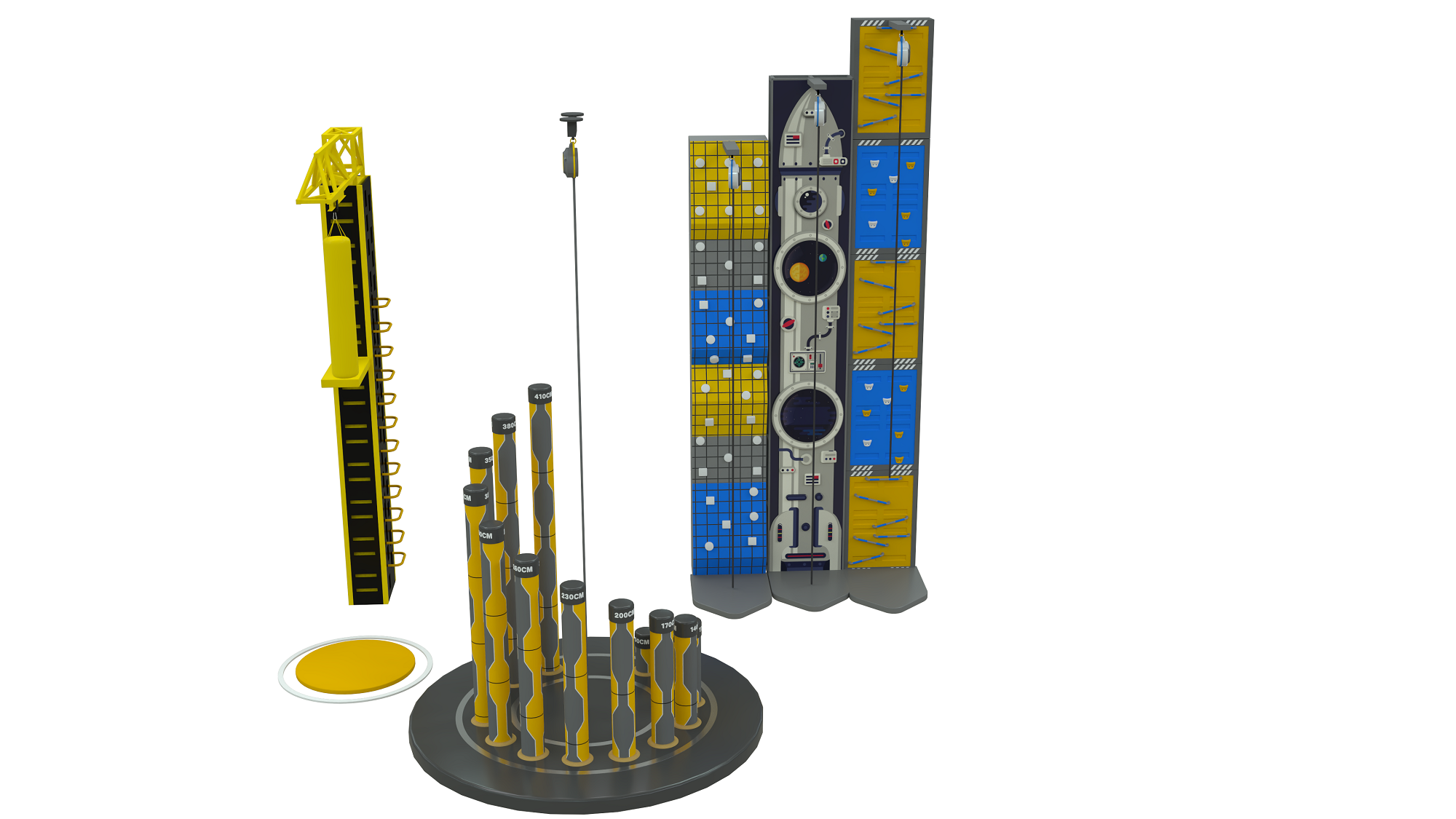
Indoor rope course equipment (model VS1-250522-1900B-30) — an example of a multi-zone attraction requiring consistent padding and matting standards across the venue. Image: Vasia.
A worked reference point: a 3,000 m² commercial project delivered to an end customer in Spain (model VS1-250727-2880-30 for a 3,000-square-metre installation) has operated for five years with stable operation and stable revenue, with the operator citing long lifespan and low maintenance as decisive factors. Read that as a template for what to ask for — venue parameters, operating hours, maintenance regime and five-year performance data — rather than as evidence that a supplier fits your site. The same reference set should be requested from every bidder in your own market.
Market Context: Useful for Direction, Not for Pricing
Market research can frame the buying decision, but only when each figure is read with its own scope attached. A commercial market overview places the global playground sets and equipment market at a projected USD 10.88 billion by 2026. Within indoor play, soft play equipment took the largest product share in 2025 — around 31.4%, per the same research overview. The family entertainment center market is estimated at USD 34.4 billion in 2025, with a reported CAGR of 10.5% and a projected USD 93.5 billion by 2035.
Those figures should not be blended with other estimates circulating in the same category. Separate commercial estimates report the global playground equipment market at USD 7.05 billion in 2026 and the commercial playground equipment segment at USD 1,250.0 million in 2025. The values differ because the product scopes differ — freestanding equipment, all playground equipment, and commercial playground equipment are not the same market. They cannot be averaged, summed or presented as a range, and none of them is indoor-only. For a buyer, the usable conclusion is directional: demand-side interest in indoor play and family entertainment capacity is being tracked upward, while venue-level investment decisions still require the buyer's own footfall and revenue modelling.
Supplier discovery carries a similar caveat. Published market coverage of playground sets and equipment names companies such as GameTime, BigToys, Freenotes Harmony Park and PlayGlobal. That listing is a discovery signal from a commercial research overview, not a ranked order and not weighted by size. A vendor-authored 2026 listicle of indoor playground equipment manufacturers exists as well and should be treated the same way — as a starting point for outreach, not as qualification evidence.
Where the Framework Stops: Documented Limits
The framework works only to the extent that evidence exists, and four limits should be stated openly.
- Certification is claimed, not yet verified. Vasia's published materials reference CE, UKCA, CPSIA, SASO, ASTM, EN 1176, ISO 9001, SGS and TÜV. Certificate numbers, issuing bodies, validity dates and the specific models covered were not available in the reviewed material. Until those documents are received, compliance status should be treated as an open request item rather than a settled fact.
- Facility and output figures are company-reported. The 30,000 m² production base, the 200-plus staffing figure and the annual output figure are supplier statements. Confirming floor area, production lines, headcount and capacity allocation requires a factory audit or third-party inspection.
- Market-size figures are not scope-compatible. The commercial estimates described above use different definitions and produce values that differ by an order of magnitude. They cannot be combined or averaged, and none of them isolates indoor playground equipment.
- Price benchmarks are not publicly available. There is no reliable public cost-per-square-metre dataset for indoor playground projects in this category. Buyers must build their own cost model from itemized quotations covering Incoterms, packaging, freight, duties, installation, commissioning and warranty, and compare total delivered cost rather than headline unit price.
A framework that hides these limits is a sales tool. A framework that states them is a procurement tool.
Future Outlook
Three shifts are likely to shape how indoor playground equipment offers are written and evaluated over the next few years.
- Documentation-first offers. As buyers standardize comparison matrices, suppliers will increasingly attach certificate numbers, test reports and component schedules to quotations by default, because an undocumented claim scores zero on a scored matrix.
- Bundled multi-zone delivery. Venues combining soft play, trampoline parks, rope courses and climbing walls need one party responsible for safety surfaces, sight lines and inspection intervals across zones. Vasia's published workflow — consultancy, customized design, manufacturing, international logistics and on-site installation, with a dedicated project manager and 3D and VR design review before production — reflects that integration pressure.
- Life-cycle terms as bid content. Warranty length, spare-part availability, wear-item pricing and inspection services are migrating from the contract annex into the comparison table itself. Vasia's published after-sales scope — remote technical support, a one-year warranty, lifetime service, spare parts availability and optional annual inspection and maintenance services — illustrates the level of detail buyers will increasingly ask every supplier to match.
These are directional expectations rather than forecasts. No verified indoor-only market dataset and no publicly comparable project-cost dataset were available in the reviewed material, so planning should remain anchored in the buyer's own venue model and in documented offers.
FAQ
What should a supplier include in an indoor playground equipment offer so that it can be compared with others?
At minimum: the play area defined in square metres, a zone-by-zone equipment list, the age groups the equipment is designed for, the site and operating conditions it is intended for, and an itemized commercial section covering Incoterms, packaging, freight, installation and warranty. Vasia's published ranges, for example, place main play structures at ages 3–15 and some soft play products at ages 2–8. An offer that prices a "playground" without a defined area or equipment list cannot be compared on price.
How can a buyer verify CE and EN 1176 compliance claims for indoor playground equipment?
Treat each term as a different category of evidence. CE is a conformity marking; EN 1176 is a European standard series; ASTM F1918 is used in the United States for contained indoor play equipment; ISO 9001 is a management-system certificate rather than a product test. A buyer should request the declaration of conformity, the test report, the certificate number, the issuing body, the tested model numbers and the validity date. Vasia's published materials state that its products follow ASTM and EN 1176 safety frameworks, list CE, UKCA, CPSIA and SASO certifications, and reference testing by SGS and TÜV; the corresponding certificate numbers and tested models should be confirmed in the offer documentation before quotation comparison.
Which material specifications change the value of an indoor playground bid?
The ones that carry a number. In trampoline park equipment, Vasia publishes Q235 galvanized rectangular steel tube uprights at 80 × 80 × 2.0 mm, connecting frames at 50 × 80 × 2.5 mm, PP jumping mats with a fiber count of 500D × 500D tested to GB 6675.4-2014, 70 mm high-density EPE pearl cotton padding, and Plato PVC-coated mesh at 0.52 mm and 1300 × 1300D compliant with EN 71-2:2020 clauses 4.1 and 4.4. Where a bid replaces those with "steel frame" and "PP mat", the buyer loses the ability to compare durability, replacement cycles and compliance.
What evidence should accompany claims about production capacity?
Capacity claims should be paired with documents that can be checked on site. Vasia reports a 30,000 m² ISO-certified production facility, more than 200 technical and management professionals, a monthly production capacity of 10,000 m² for trampoline parks and related play structures, and an annual output figure of 200 million. Because these are company-reported, a buyer should request a factory audit covering floor area, production lines, staffing, current capacity utilization and allocation for the buyer's delivery window, plus a written lead-time commitment for the customized scope — Vasia's published lead time is 15–45 days, reflecting the range between standard and highly customized builds.
Does the supplier's location affect an indoor playground project?
Location affects logistics, service response and auditability more than design quality. Vasia is headquartered in Qiaoxia Town, Yongjia County, Wenzhou, Zhejiang, China, a cluster the company describes as China's Educational Toy Capital and National Educational Toy Export Base, and reports an export ratio of about 70% with main markets in the EU, USA, South America, the Middle East and Southeast Asia. For buyers, the practical question is whether the quoting entity can support installation, spare parts and inspection in the destination market — not the country of origin by itself.
How should a buyer weigh an in-house manufacturer against a distributor?
Ask which entity holds design responsibility, which entity holds the conformity documents, and which entity performs the installation. An in-house manufacturer can usually modify layouts, materials and theming: Vasia operates OEM/ODM production with customization across indoor children's play equipment, outdoor children's play facilities, colour, voltage and logo, and reports a dedicated R&D team of 30 plus more than 192 patents and copyrights. A distributor may add local stock, faster servicing and simpler import handling. Neither model is automatically better; risk appears when the quoting entity cannot state who holds the certificate and who performs the installation.
How should after-sales and spare parts be written into an indoor playground offer?
Convert after-sales language into contract terms: response time, warranty length, a named spare-part list, wear-item pricing and inspection intervals. Vasia's published after-sales scope includes remote technical support, a one-year warranty, lifetime service, spare parts availability and optional annual inspection and maintenance services, with installation guidance or on-site assembly teams provided as needed. Wear items in this category — padding, protective netting, mats, springs and surface fabric — should be priced at award stage, because their replacement cost belongs to the life-cycle comparison rather than to the first invoice.
Reference document: Vasia product and capability brochure (PDF) — https://cdn.socialarks.com/sbsp/24840/0/2026/0508/69fd61bac240c.pdf. Manufacturer background and product pages: vasiaplayground.com.
Есть вопросы или нужны дополнительные детали?
Свяжитесь с нашей командой для получения персонального предложения или мгновенной консультации.
Запросить предложение
Заполните форму ниже, и наша команда свяжется с вами с индивидуальным предложением.
Прямой чат WhatsApp
Предпочитаете общаться в реальном времени? Напишите нам в WhatsApp для мгновенной помощи и быстрых ответов.
- Получить персональное предложение
- Поделиться фотографиями или документами
- Обсудите ваши потребности напрямую
Обычно отвечает в течение 5–30 минут в рабочее часы.