
A Buyer's Decision Matrix: Stone Coated Metal vs Clay & Concrete
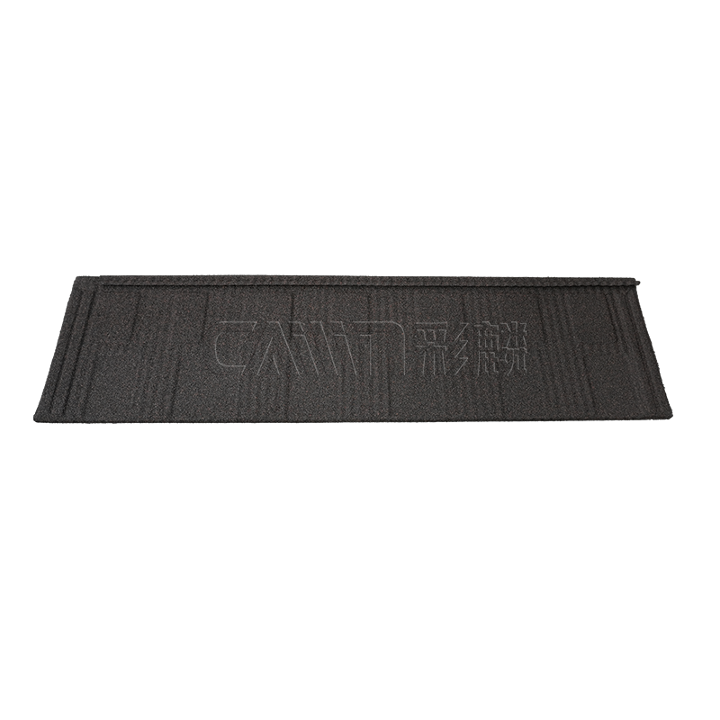
Concealed-fastener stone coated metal shingle: a large-format tile that changes the weight, handling and installation arithmetic in any roofing comparison.
A weighted decision matrix turns a roofing-material debate into a repeatable procurement calculation. Applied to stone coated metal roofing versus clay tile, concrete tile and bare metal roofing, it scores every system against the same criteria — structural load, handling loss, installed cost, thermal load, rain noise, wind uplift, corrosion exposure, service life and project fit — and then weights those criteria according to the project rather than the sales pitch. The matrix does not produce a universal winner. It produces a defensible ranking for one project, with the assumptions written down where an engineering team, a distributor and a lender can all see them.
Why roofing material selection has become an evidence problem
The commercial weight behind this comparison is no longer marginal. The global stone-coated steel roofing market was estimated at USD 20.71 billion in 2024 and is projected to reach USD 32.69 billion by 2033, according to Vertex AI Search industry analysis. That headline figure should be handled carefully: a separate market research estimate for the broader category places 2024 at USD 69.41 billion, a divergence large enough that any single market-size number is directional rather than exact. Within China, the metal roofing market was estimated at USD 3.57 billion in 2024, with a forecast CAGR of 4.25% through 2035, based on Market Research Future data.
Supply is also structured enough to be identifiable. Category coverage from Mordor Intelligence tracks suppliers including DECRA Roofing Systems, Ross Roof Group, Boral Steel and Tilcor, alongside Chinese manufacturers such as Sango Cailin Building Tech. Co., Ltd. For wholesale buyers, the practical consequence is that stone coated metal roofing now competes for the same roof area as fired clay, molded concrete and bare profiled steel — and it competes on measurable properties rather than on appearance alone.
The four systems inside the matrix
Stone coated metal roofing is a metal tile system built on a steel substrate, typically 0.4 mm to 0.6 mm galvanized or aluzinc (galvalume AZ150) steel, coated with acrylic resin and high-temperature sintered natural stone granules and finished with a transparent acrylic top coat. The category commonly meets ASTM A792/A792M, which specifies 55% aluminium-zinc alloy-coated steel (Aluzinc) as the base substrate, per ICC Evaluation Service documentation. The Cailin range manufactured by Sango Cailin Building Tech. Co., Ltd. includes Cailin Bond Tile, Cailin Shingle, Cailin Milano Tile, Cailin Shake, Cailin Classical Tile, Cailin Roman Tile, Cailin Long-Span Tile, Cailin Golan Tile, Cailin Tudor Tile and Cailin Heritage Tile, plus the Cailin Interlocking Shingle and Cailin Interlocking Shake concealed-fastener profiles. Effective tile size is 1340 mm x 420 mm, covering 1260 mm x 370 mm.
Clay tile is a fired ceramic unit, valued for colour permanence and heritage appearance, and heavy and brittle by nature. Concrete tile is a molded cementitious unit with similar mass characteristics and a lower firing energy profile. Bare metal roofing is profiled steel sheet used without a granule facing, which makes it light, fast to install and highly reflective — and, in residential contexts, acoustically transparent.
Each system carries a different cost structure: clay and concrete carry their cost in mass and breakage, bare metal carries it in thermal and acoustic performance, and stone coated metal carries it in coating specification and fastening discipline.
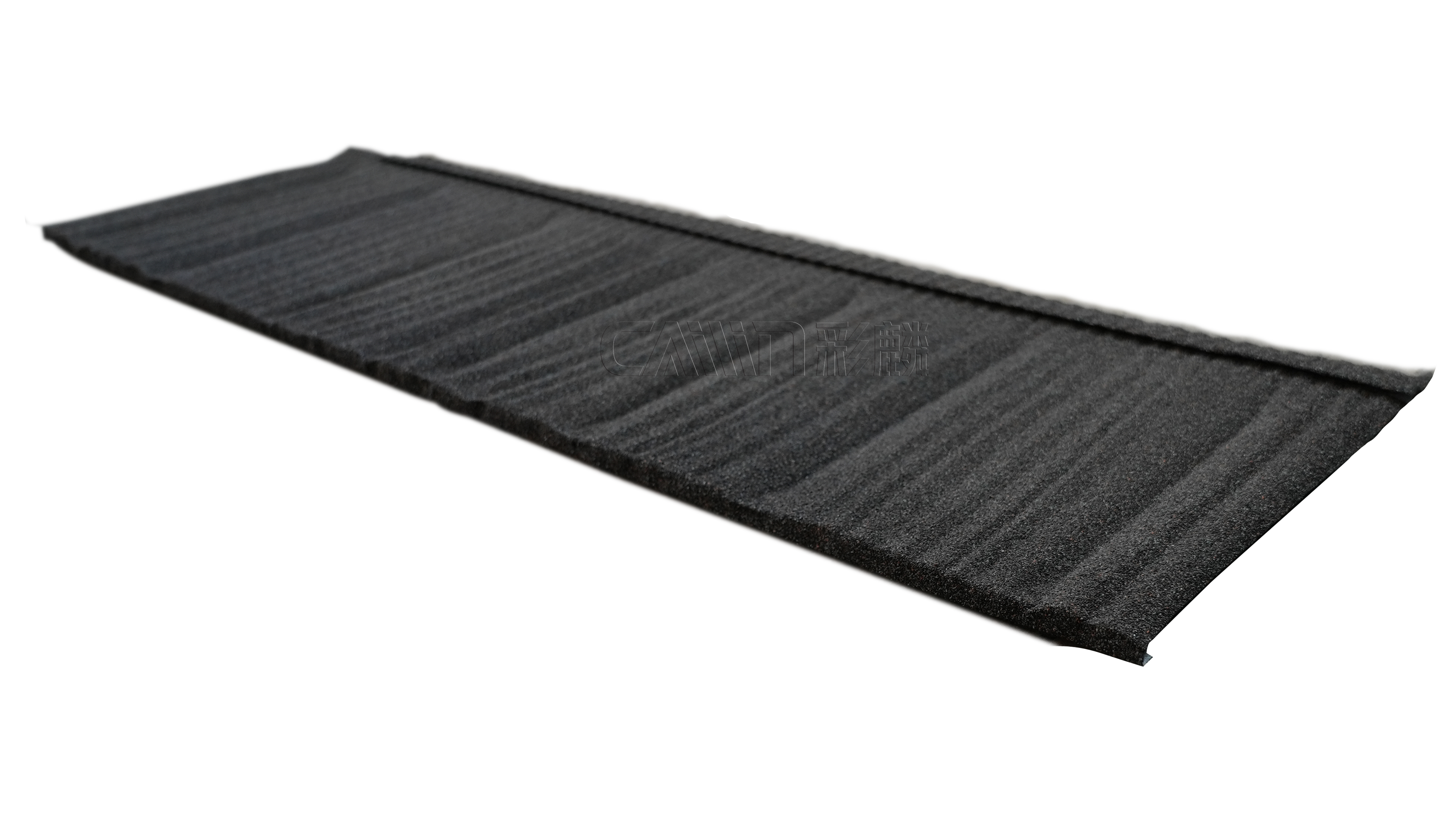
Concealed-fastener shake profile: profile choice affects aesthetics and project fit, but not the scored criteria that decide the matrix.
Nine scoring criteria, and what each one actually measures
1. Roof weight and structural load
Stone coated metal roofing is 5-10 times lighter than traditional concrete or clay tiles, typically weighing between 3.2 kg/m2 and 6.7 kg/m2 depending on steel thickness, according to SKW's product specification guide. The Cailin specification lists approximately 5-8 kg/m2 for the concealed-fastener series and approximately 6-8 kg/m2 for the ten-profile range. The procurement consequence is structural, not cosmetic: weight determines whether an existing roof frame needs reinforcement. In roof replacement projects on aging tile houses, lightweight roofing can be installed without structural reinforcement, and in retrofit applications it can be installed directly over old tiles.
2. Breakage, handling and site loss
Fired clay and molded concrete units are brittle and heavy, so transport, hoisting and site handling generate a recurring loss line that has to be priced into the bill of quantities. This is the criterion where public data is thinnest, and where buyers should replace assumptions with contract terms: request the supplier's documented handling-loss rate, packaging specification and replacement policy for the named project. For metal-based tiles the equivalent risk is different rather than absent — surface scuffing of the granule layer and untreated cut edges — and it is managed through packaging standards and edge treatment specifications, not through the same inspection checklist.
3. Installed cost: substructure, labour and time
Installed cost is driven by weight, unit size, substructure and site labour, not by the price of a single tile. Three structural facts shape this criterion for stone coated metal roofing. First, the tiles are large format — 1340 mm x 420 mm effective, 1260 mm x 370 mm covering — which reduces the number of pieces handled per square metre. Second, the assembly operates with underlayment, wooden or metal battens and concealed stainless-steel or galvanized screws and clips, and a lighter dead load reduces the framing burden. Third, retrofit projects can avoid stripping and reinforcing work. Vendors frequently quote percentage savings on installation and substructure cost; treat any such percentage as a claim to be tested against the project's own quantity take-off rather than as an input.
4. Thermal load and energy use
Two mechanisms matter. The first is a ventilated air gap between the tile and the underlayment, which reduces heat transfer into the roof assembly; thermal insulation through this air gap is a designed function of the system. The second is surface behaviour: metal roofing can reflect heat away from buildings, potentially saving homeowners up to 40% on cooling energy costs, according to DECRA's 2024 Roofing Trends Recap. That figure is an industry-reported estimate rather than a project guarantee, and the practical procurement action is to request solar reflectance and emittance test data for the specific profile and colour instead of relying on either figure.
5. Rain and hail noise
Acoustic performance is where bare metal is most often eliminated from residential and urban shortlists. Stone coated metal roofing delivers approximately 70% noise reduction compared with a bare metal roof, because the sintered stone granule layer damps impact energy from rain and hail. The same characteristic matters in suburban projects affected by aircraft or traffic noise and in hail-prone regions. Buyers should request impact-noise data for the complete assembly — tile, underlayment and battens — because the underlayment contributes materially to the result.
6. Wind uplift resistance
Wind uplift resistance of up to 160 mph is published for the Cailin stone coated metal roofing range, which places it in the bracket required by high wind regions such as hurricane, cyclone and tornado exposure zones. For context, a competing published specification in the same category claims uplift performance up to 240 psf tested to ASTM E1592 and winds exceeding 200 km/h. Because test methods differ, buyers should compare like-for-like reports rather than headline numbers, and should confirm that the fastening pattern specified for the project is the pattern that was tested.
7. Corrosion and salt-spray exposure
Salt exposure is the second coastal variable after uplift. The Cailin specification cites a 500-hour salt spray test, and the application guidance requires extra factory-applied anti-corrosion coating on cut edges for coastal buildings. Cut edges are the weakest point on any coated steel roofing system, which makes edge treatment a specification item rather than a finishing detail. Coastal, humid and monsoon-exposed projects should therefore be scored on declared salt spray hours, edge treatment and fastener material as a single criterion.
8. Service life and maintenance
Stone-coated steel roofing has a published lifespan of 50+ years, significantly outlasting asphalt shingles at approximately 20 years, according to RoofGlory's durability comparison — a third-party figure best read as a category range rather than a warranty. Maintenance requirements are low: the product operates passively with no moving parts and requires no scheduled maintenance beyond occasional visual inspection. Lifetime cost modelling should combine that maintenance profile with the inspection interval, the service life of the accessory system (underlayment and fasteners typically reach end of life first) and the project's expected holding period.
9. Project fit: slope, climate and retrofit conditions
Project fit is where a technically strong material can still lose. The system is designed for pitched roofs from 12° to 90°; a roof below 12° falls outside the published application range and needs a different solution. In cold and snowy regions, snow guards may be required on steep roofs to prevent sudden snow slide. In wildfire zones, non-combustible underlayment and sealed eaves are specified. In historic restoration, colour and profile matching to original slate, shake or tile is achievable through profiles such as Cailin Heritage Tile, Cailin Tudor Tile or Cailin Shake, but design-review approval is a separate hurdle from technical performance.
The decision matrix as a scored table
The matrix becomes useful only when each criterion has a defined metric, a verified data point for the candidate under evaluation, and a stated source for every competing figure. The table below is a working template: the stone coated metal column contains verified published values, and the fourth column defines what the buyer must obtain before a score can be entered for clay, concrete or bare metal.
| Criterion | Metric to capture | Verified stone coated metal data point | Required for clay, concrete and bare metal |
|---|---|---|---|
| Roof weight | kg/m2 installed | 5-8 kg/m2 (concealed-fastener series); 6-8 kg/m2 (ten-profile range); category range 3.2-6.7 kg/m2; 5-10x lighter than concrete or clay tiles | Declared weight per m2 at installed thickness from the specific manufacturer |
| Handling loss | Damaged units per delivered m2 | Not published for the category; treat as a contractual data request | Declared breakage rate, packaging specification, replacement policy |
| Installed cost | Cost per m2 including substructure and labour | Large-format tile (1340 x 420 mm; 1260 x 370 mm cover); retrofit can install over existing tiles without structural reinforcement | Substructure specification, unit size, labour norm per m2 |
| Thermal load | Attic heat gain; solar reflectance | Ventilated air gap between tile and underlayment reduces heat transfer; industry-reported cooling savings up to 40% (DECRA 2024, third-party estimate) | SRI, reflectance and emittance test data for the specified profile and colour |
| Rain noise | Impact noise of the full assembly | Approximately 70% noise reduction versus bare metal | Assembly-level impact noise data, including underlayment |
| Wind uplift | Tested pressure and standard | Up to 160 mph uplift resistance; category benchmark up to 240 psf to ASTM E1592 from a competing published specification | ASTM E1592 or equivalent report matching the project fastening pattern |
| Corrosion | Salt spray hours; edge treatment | 500-hour salt spray test; factory-applied anti-corrosion coating on cut edges for coastal sites | Salt spray hours, substrate coating class and edge treatment |
| Service life | Expected life and maintenance intervals | Passive system with no scheduled maintenance beyond occasional visual inspection; published category lifespan 50+ years versus approximately 20 years for asphalt shingles (third-party) | Warranty term, maintenance schedule, accessory service life |
| Project fit | Slope, climate, retrofit conditions | Pitched roofs 12°-90°; snow guards for cold regions; non-combustible underlayment and sealed eaves in wildfire zones | Minimum slope, snow-load limits, local code approvals |
Working decision matrix template. The right-hand column is deliberately empty of numbers: comparable figures must be sourced per project, not assumed.
Weighting the criteria for four project archetypes
A matrix without weights is just a feature list. Weights express what the project cannot compromise on, and they should be agreed before supplier data is collected, so that scoring cannot be reverse-engineered to fit a preferred outcome. The table below is an illustrative starting point only — every project should set its own weights and document who approved them.
| Criterion | Coastal high-wind villa | Wildfire-prone rural housing | Freeze-thaw and snow load | Urban retrofit over existing tile |
|---|---|---|---|---|
| Weight and structural load | 10 | 10 | 8 | 20 |
| Breakage and handling loss | 10 | 8 | 8 | 12 |
| Installed cost | 12 | 12 | 10 | 15 |
| Thermal load and energy | 12 | 10 | 12 | 10 |
| Rain and hail noise | 8 | 6 | 8 | 13 |
| Wind uplift resistance | 18 | 10 | 14 | 10 |
| Corrosion and salt spray | 18 | 6 | 8 | 6 |
| Service life and maintenance | 8 | 18 | 15 | 8 |
| Project fit and constraints | 4 | 20 | 17 | 6 |
Illustrative weight sets totalling 100 points per column. Coastal projects shift weight to uplift and corrosion; wildfire and cold-climate projects shift it to service life and code-driven project fit; retrofit projects shift it to weight and installed cost.
Running the matrix as a procurement process
Scoring works only if it follows a fixed sequence. The six steps below keep the framework honest and produce a result that can be defended internally.
- Define the project constraints first. Record slope, climate exposure, snow load, wildfire exposure, salt exposure, code jurisdiction and whether the roof is new-build or retrofit. Constraints should eliminate systems before scoring begins, not after.
- Set and approve the weights. Assign the 100 points across the nine criteria and record the approver. Weights set after data collection rarely survive scrutiny.
- Request supplier-declared data against the metric column. Ask for the declaration in writing: weight per m2, unit size, steel thickness, uplift test report, salt spray hours, edge treatment, accessory specification and warranty terms.
- Normalise the scores. Convert each declaration to a 1-5 score on the same scale for every system, so that a heavy tile and a light tile are scored consistently rather than on a mixed scale.
- Run a sensitivity check. Change one weight by 5-10 points and see whether the ranking flips. If it flips easily, the decision rests on an assumption rather than on evidence, and that assumption should be resolved before purchase.
- Contract the assumptions. Move the decisive criteria into the purchase specification — uplift test method, edge treatment, accessory brand and grade, handling-loss terms — so the delivered roof matches the scored roof.
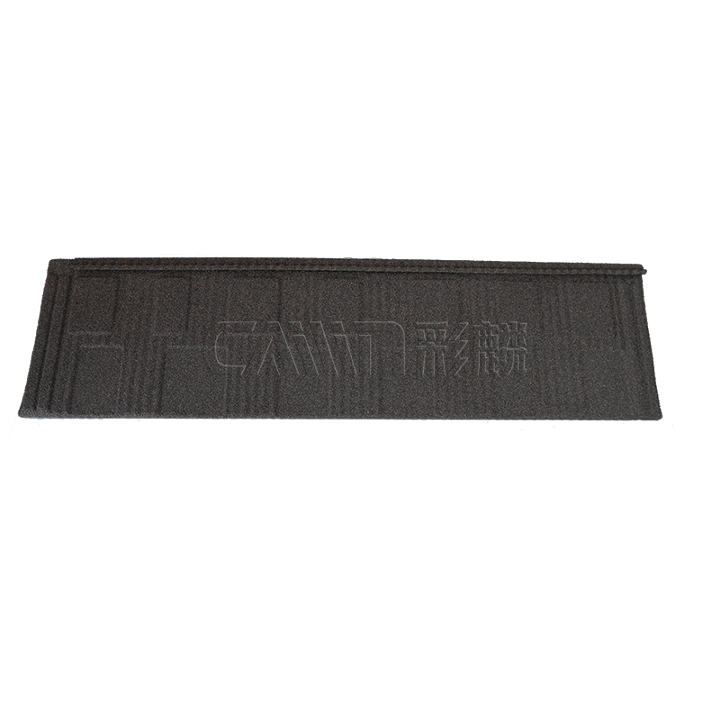
Concealed fastening is a scored variable, not a cosmetic one: the tested fastening pattern is what the uplift claim applies to.
Where the matrix breaks down
A decision matrix is a discipline, not a verdict, and it has recognisable failure points.
- It cannot replace structural engineering. Weight figures describe the material, not the building. Any retrofit over an existing roof requires verification of the existing framing and battens by a qualified professional.
- Slope excludes part of the market. The published application range for stone coated metal roofing is 12° to 90°. Low-slope and flat roofs fall outside it and must be evaluated under a different system category.
- Accessories carry the risk. The assembly depends on underlayment, battens and concealed screws and clips. Underlayment and fasteners typically reach end of life before the tile does, so accessory grade belongs in the scored criteria rather than in the small print.
- Installation quality gates the performance claims. A tested uplift figure applies to the tested fastening pattern on a correctly aligned batten grid. Local installer competence is a real variable in coastal and high-wind projects.
- Data asymmetry distorts scoring. Coated steel suppliers publish test data more routinely than clay and concrete producers do. When a competing system has no published declaration, the honest response is to mark the cell as unresolved and to condition the decision on receiving it, not to fill the gap with an assumption.
- Cold-climate and coastal details add cost lines. Snow guards on steep roofs, factory-applied edge coating on coastal sites and non-combustible underlayment in wildfire zones are specified requirements, and they change the installed-cost comparison.
- Design approval sits outside the model. In heritage or covenant-controlled districts, a technically superior score can still be rejected on appearance grounds.
What the next three to five years change
Two shifts are already visible in the data. The first is scale: growth from USD 20.71 billion in 2024 toward USD 32.69 billion by 2033, and a forecast 4.25% CAGR in China through 2035, implies that coated metal tiles are being specified in larger, more standardised projects — which pushes buyers toward documented performance data rather than sample-based decisions. The second is system integration. Manufacturers such as Sango Cailin already produce stone coated metal roofing alongside asphalt shingles, BIPV solar tiles, rain gutter systems and butyl tape, which turns the roof from a single product purchase into an assembly specification covering drainage, sealing and, increasingly, on-roof solar.
For wholesale buyers, the practical implication is that the matrix will need a tenth column within a few years: whether the tile system can carry integrated solar or accept it in a later phase. The caution is the same as it is today — market-size estimates for this category diverge widely, so planning should lean on project-level test data rather than on category forecasts.
Frequently asked questions
How much does stone coated metal roofing weigh compared with clay and concrete tiles?
Stone coated metal roofing is 5-10 times lighter than traditional concrete or clay tiles, typically weighing 3.2 kg/m2 to 6.7 kg/m2 depending on steel thickness, according to SKW's product specification guide. The Cailin range is published at approximately 5-8 kg/m2 for the concealed-fastener series and approximately 6-8 kg/m2 for the ten-profile range. Because the dead load is lower, aging tile roofs can in some cases be replaced without structural reinforcement, and retrofit installation directly over existing tiles is a documented application.
Is stone coated metal roofing suitable for coastal hurricane zones?
It is specified for that application. Published performance for the Cailin range includes wind uplift resistance up to 160 mph and a 500-hour salt spray test, and coastal application guidance requires extra factory-applied anti-corrosion coating on cut edges. Buyers should nonetheless compare test methods rather than headline figures: a competing published specification in the same category cites uplift up to 240 psf tested to ASTM E1592 and winds exceeding 200 km/h. Fastener material, edge treatment and the tested fastening pattern all belong in the coastal specification.
Is a metal roof noisy in the rain?
Bare metal roofing is acoustically transparent, which is why it is often excluded from residential shortlists. Stone coated metal roofing reduces rain and hail noise by approximately 70% compared with a bare metal roof, because the sintered natural stone granule layer damps impact energy. The measured result depends on the complete assembly, so impact-noise data should be requested for the tile, underlayment and batten combination rather than for the tile alone.
How should buyers model the lifetime cost of stone coated metal roofing?
Lifetime cost combines service life, maintenance and accessory replacement. Published third-party comparison data places stone-coated steel roofing at a lifespan of 50+ years versus approximately 20 years for asphalt shingles, and the system operates passively with no moving parts and no scheduled maintenance beyond occasional visual inspection. A realistic model therefore adds the expected service life of the underlayment and fasteners, the inspection interval, and the project holding period, instead of comparing only the material price per square metre.
What should wholesale buyers verify before scaling an order?
Wholesale buyers should confirm four things in writing: the factory's management-system certifications, the specification sheet for the exact profile and steel thickness being ordered, the test documentation behind wind uplift and salt spray claims, and the accessory system that the warranty depends on. As one example of a verifiable supplier profile, Sango Cailin Building Tech. Co., Ltd. was established in 2017, operates seven production bases in China with a factory area of 15,000 m2, employs fewer than 100 staff with a 10-engineer R&D team, and has an annual production capacity of 6,000,000 units. Its facilities are certified to ISO 9001, ISO 14001 and ISO 45001.
The matrix does not decide which roof a project should buy. It decides which claims have to be documented before the decision is made — and in a category where published specifications for coated metal tiles sit alongside far looser data for traditional materials, that discipline is the part that protects the budget.
Sango Cailin Building Tech. Co., Ltd. publishes its full profile range and factory documentation at www.cailinroofing.com, and the product brochure covering stone coated metal roofing, asphalt shingles, BIPV solar tiles, rain gutter systems and butyl tape is available here: CAILIN product brochure (PDF).