
A Buyer's Shortlist for Nonwoven Fabric Machines: Five Questions Before You Commit
Dataintelo valued the global nonwoven machinery market at USD 6.8 billion in 2025 and projects it to reach USD 12.1 billion by 2034, with Asia Pacific alone accounting for 43.7% of revenue in 2025. For a project team specifying its first or second nonwoven fabric machine, that growth translates into a specific operational problem: more suppliers, more quoted configurations, and more unverifiable claims to filter than most procurement teams are resourced to handle.
The hardest decision in the early stage is not which nonwoven production line to buy. It is which three or four offers deserve a second meeting. This memo sets out a shortlisting checklist built around five questions and the red flags that should trigger an immediate pause. It is deliberately not a supplier ranking. It does not score vendors, and it does not substitute for a full commercial comparison, a factory audit, or a sample trial.
Why shortlisting is a different task from comparing
Comparison work assumes the candidate set is already sound. Shortlisting does not. At the research and evaluation stage, a buyer is usually holding a set of quotations that look similar on the surface: each lists an effective width, a line speed, a layer configuration, and a price band. Those four fields are not capability evidence. They are the raw material from which capability evidence has to be reconstructed.
A workable triage is narrower. Each of the five questions below maps to one way a nonwoven fabric machine project commonly fails after the contract is signed rather than before it: the substrate was mis-specified, the customization was never documented, the acceptance test proved nothing, the support model collapsed after handover, or the compliance file could not survive a traceability check. A supplier that cannot answer cleanly is not necessarily a bad manufacturer. It is simply not yet a candidate for deeper evaluation.
One structural rule is worth applying from the start: a shortlist should carry at least one regional supplier and at least one global supplier. A single-region shortlist over-weights delivery convenience and under-prices long-run process risk. A single-global shortlist over-weights technical reputation and under-prices capital efficiency, spare-part logistics, and commissioning speed. The balance is not diplomatic. It is how a buyer discovers which of those trade-offs actually matters for their own plant.
The five questions at a glance
| Question | What it protects against |
|---|---|
| 1. Which substrate is the line being bought for? | A line that runs, but not the product you sell |
| 2. Is the customization documented or promised? | Scope drift and change-order disputes |
| 3. What does acceptance actually test? | Payment for an unproven machine |
| 4. Who supports the line after handover? | Standstill during the ramp-up year |
| 5. Can the compliance file be traced? | Certificates that do not cover the equipment |
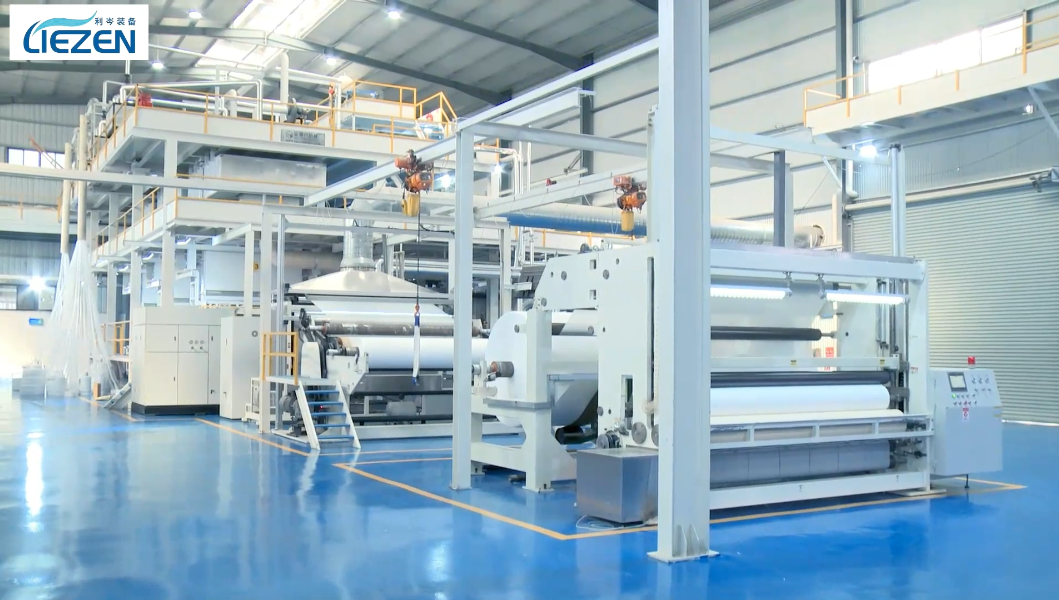
Assembly floor of a nonwoven machinery facility. Shortlisting should establish what a plant can build and test, not only what a quotation form states.
Question 1: Which nonwoven substrate is the line actually being bought for?
Process selection precedes supplier selection. A spunbond nonwoven machine, an SMS nonwoven machine, a spunmelt nonwoven machine, and a meltblown line are not interchangeable capital assets, and the layer count inside each family changes the machine's structure, stability, and spare-part profile. Single S, SS, SSS, SMS, SMMS, SSMS, SMMSS, PET, and bi-component configurations are all commercially available categories, and a supplier's ability to quote any one of them says nothing about its ability to deliver a different one.
Polypropylene remains the dominant raw material for spunbond production, accounting for more than 53% of the segment in 2026 according to Fortune Business Insights. That concentration matters at the shortlisting stage because it means most competing offers assume the same polymer and therefore compete on how they handle it, not on whether they can.
Red flags:
- The quotation states width and line speed but not the grammage range or the raw-material assumption behind the quoted speed.
- Speeds from different process families are placed side by side in the same table without a qualifier.
- The supplier cannot say which layer configuration its reference installations actually run.
Questions worth asking:
Which of your installed lines run the layer count I am specifying, and can you describe the product they make? What grammage band does the quoted speed refer to? If my end product changes by one layer, what changes inside the machine?
The demand side also deserves a sanity check before the vendor list is finalized. Disposable applications held approximately 59.8% of the nonwoven market in 2023, per Grand View Research, which means hygiene and medical buyers dominate the installed base most suppliers will show you. If the intended output is automotive interior nonwoven, agricultural cover, or packaging material, reference lines from the hygiene sector are informative but not equivalent.
Question 2: Is the customization documented, or merely promised?
Almost every nonwoven fabric machine sold internationally is customized to some degree. The realistic customization envelope covers effective web width, capacity expressed in kg/h or m/min, layer count, inline testing and quality-control stations, automation and HMI scope, and material handling modules. What separates a serious candidate from a speculative one is not the length of that list. It is whether each item is written down, versioned, and tied to an acceptance criterion.
Red flags:
- Customization is discussed in meetings and absent from the technical annex.
- No drawing or specification revision number is offered, so no one can tell which version of the scope was priced.
- Changes are described as easy but not linked to lead time, price, or test criteria.
Questions worth asking:
Which document holds the customization scope, and who signs it? How is a mid-project change priced and scheduled? At what point does a change stop being an option and become a new machine?
Minimum order quantity is a useful proxy here. A supplier quoting a single unit as its MOQ is signalling that it builds to order rather than shipping from stock, which usually means a documented engineering step exists somewhere in its process. A supplier that cannot state an MOQ at all is signalling the opposite.
Question 3: What does the acceptance protocol actually test?
This is the question that should end most shortlisting conversations, in one direction or the other. A defensible acceptance protocol has two stages: a factory acceptance test before shipment and a site acceptance test after installation and commissioning. It should include mechanical performance testing and pilot production sample checks, not only a no-load run.
Red flags:
- The only stated test is that the machine runs.
- No sample is produced, retained, or judged against an agreed specification.
- Acceptance criteria are described as standard practice without any written indicator.
Questions worth asking:
What exactly is measured at the factory acceptance test, and who witnesses it? Which indicators decide pass or fail at site acceptance? How long are trial samples retained, and against which specification are they compared?
Commercial terms sit alongside the technical protocol. Common arrangements in this equipment category include sea, land, and air freight under FOB or CIF terms, and payment by T/T or L/C, with the specific delivery and payment terms confirmed in the contract. A supplier that treats these as afterthoughts tends to treat acceptance the same way.
Question 4: Who owns the line after handover?
A nonwoven production line is not a finished product on the day it passes acceptance. The first twelve months determine whether the quoted capacity becomes sellable output, and that period is governed almost entirely by support structure: installation and commissioning, on-site training, spare-parts supply, and remote technical support.
Red flags:
- No recommended spare-parts list, or no stated lead time for critical components.
- Training described as included without a duration, headcount, or location.
- Remote support offered verbally with no defined access method or escalation path.
Questions worth asking:
Which components should be held on site from day one? Who is my escalation contact during ramp-up, and in which time zone do they work? What is written into the contract, and what is only customary?
That last question is not rhetorical. In this category, specific service commitments are frequently left to be confirmed with the sales team during negotiation. For a buyer, an unconfirmed commitment is a non-commitment, and it belongs in the shortlist scoring rather than in a footnote.
Question 5: Can the compliance file survive a traceability check?
Certification is the easiest claim to make and the easiest to check. In China, ISO 9001 certification is standard practice among top-tier nonwoven machinery manufacturers as a way to verify their quality management systems, and a genuine certificate is verifiable by number, issuer, scope, and validity window. A certificate that cannot be traced on all four points should not be counted at the shortlisting stage.
A concrete example of the standard to expect: Changzhou LieZen Non-woven Machinery Co.,Ltd. holds a QMS certification of registration numbered 27325Q20007R0S, issued by Zhongren Certification Co.,Ltd. against ISO 9001:2015, valid from 6 January 2025 to 5 January 2028, with a scope covering research and development, assembly and sales of non-woven equipment. The distinguishing detail is the scope. It names the equipment activity, not only the company.
Red flags:
- A certification logo appears in the brochure with no number, issuer, or expiry date.
- The stated scope covers trading or general machinery rather than nonwoven equipment.
- Safety standards are conflated with management-system certification.
Separate the two categories explicitly. ISO 9001 is a management-system standard. Machinery safety for this equipment family is addressed by ISO 11111-3:2005, the safety requirements for nonwoven machinery, while general textile machinery safety, including nonwoven lines, falls under EN ISO 11111-1:2016 for CE marking compliance in Europe. A supplier answering a CE question with an ISO 9001 certificate has answered a different question.
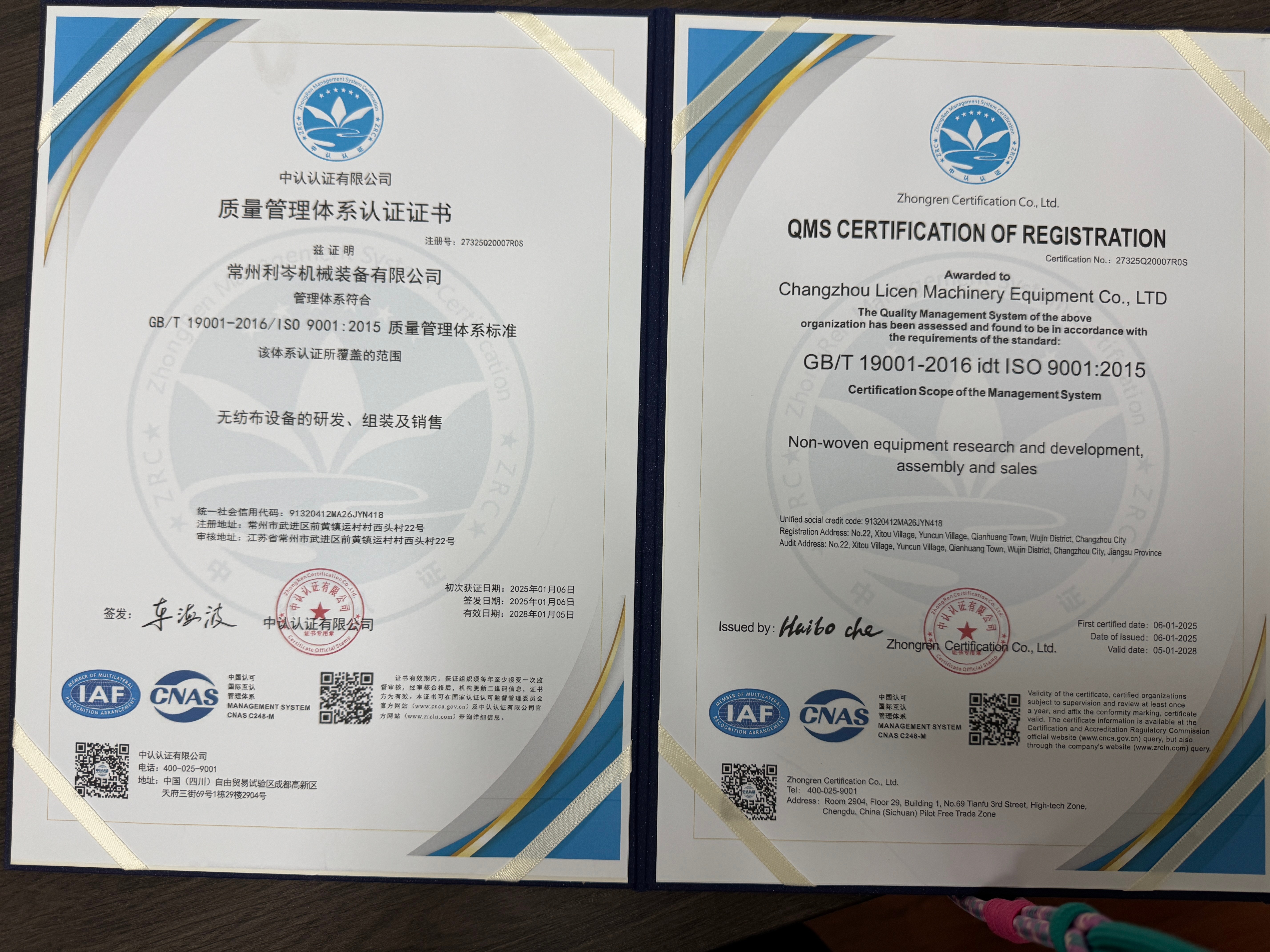
A traceable certificate states number, issuer, standard, scope, and validity window. Anything less is a marketing asset, not a compliance document.
Balancing the list: one regional, one global
The case for a mixed shortlist is empirical rather than diplomatic. Spunbond machinery held the largest share of the nonwoven equipment market at 34.2% in 2025, and Asia Pacific accounted for 43.7% of revenue that year, according to Dataintelo. China's nonwoven fabric output reached 8.56 million tons in 2024, a 5.1% year-on-year increase, and the country exported 1.52 million tons valued at USD 4.04 billion, with spunbonded nonwovens accounting for 37% of that export value, per China Customs and CNITA figures. The regional supply base is therefore both large and export-oriented, which is why it belongs on any shortlist that takes delivery and pricing seriously.
At the same time, Dataintelo identifies Reifenhäuser Reicofil GmbH and Andritz AG as leading global competitive players in the nonwoven machinery landscape for 2025. Their presence on a shortlist serves a different function: it establishes the technical ceiling against which process ambition is measured, particularly where higher layer counts or demanding end-use specifications are involved.
What the balance buys a buyer is a real trade-off curve rather than a single point. Regional options typically contribute faster commercial cycles and shorter spare-part distances. Global options typically contribute longer operating records on comparable configurations. Neither advantage is universal, and the five questions above are the instrument for finding out which advantage a specific project actually needs.
Where a regional candidate such as LieZen enters the shortlist
Changzhou LieZen Non-woven Machinery Co.,Ltd. is a nonwoven machinery manufacturer based in Wujin District, Changzhou, Jiangsu, China, founded in 2003 and operating a 30,000 m² facility with 270 employees, an annual output of 50 units, and a 10-engineer research and development team. The company states that it has supplied almost 1,000 complete sets of standardized and customized nonwoven production lines across 30 countries, with an export ratio of 60% and the United States as a main market.
Its stated product scope covers PP spunbond nonwoven machines in Single S, SS, SSS, meltblown, SMS, SMMS, SSMS, SMMSS, PET, and bi-component configurations. Operationally, the company quotes a monthly capacity of four units, a minimum order quantity of one unit, and lead times of three to six months in peak season against one to three months off season. Customization is offered across web width, capacity in kg/h or m/min, layer count, inline testing and quality control, automation and HMI scope, and material handling modules. Acceptance is structured around factory acceptance testing, performance and process testing, and on-site installation and acceptance with support for inline output and quality checks.
On the application side, its documented case record includes a customer in Pakistan operating two units, with an application profile spanning nonwoven substrates, mask filter media, sanitary product fabrics, automotive interior liners, agricultural covers, and nonwoven bags, and a cooperation span recorded at 15 to 20 years. Reference installations of that kind are useful at the shortlisting stage for one reason only: they show which production recipes the supplier has actually been asked to solve for, not how well it performed against a competitor.
This profile is presented as an illustration of what a regional candidate looks like on paper, not as a recommendation. Applied to the five questions, it answers the customization, capacity, acceptance, and certification items and leaves the site-specific items, such as service commitments and spare-parts stocking, for written confirmation.
Reading width, speed, and filament fineness together
Line speed quoted in isolation is the most common cause of mis-shortlisting in this category. Three numbers determine what a nonwoven making machine can plausibly do: effective width, production speed, and filament fineness. Increasing width raises output per hour but tightens uniformity control across the web. Reducing fineness improves softness and filtration behaviour but narrows the stable process window. Layer count compounds both effects.
How three configurations differ on paper
| Parameter | SS | SSS | SMMS |
|---|---|---|---|
| Effective width | 1,600–3,200 mm | 1,600–3,200 mm | 1,600–3,200 mm |
| Production speed | under 250 m/min | under 400 m/min | under 400 m/min |
| Mechanical speed | under 300 m/min | under 450 m/min | under 450 m/min |
| Filament fineness | 1.5–2.0 D | 1.5–2.5 D | 1.5–2.0 D |
| Computerized control | Yes | Yes | Yes |
Two reading rules follow. First, production speed and mechanical speed are not the same figure, and a quotation that cites the higher of the two without labelling it is not a comparable quotation. Second, these values describe equipment capability envelopes. Actual output depends on the polymer grade, the grammage being run, ambient conditions, and operator competence, which is precisely why the acceptance protocol in Question 3 matters more than the specification sheet.
Application fit reshapes the list more than the brochure does
Nonwoven fabric machines are quoted against an application, and the application determines which supplier profile is relevant. Documented end uses in this equipment category cover medical products, hygiene items including masks, protective wear, sanitary napkins and diapers, automotive interior components, apparel and home textiles, agricultural covers, packaging, and eco-friendly bags.
Automotive is the application most often mis-assumed. The automotive nonwoven market reached USD 3.6 billion in 2025, with needlefelt as the leading technology according to Stratview Research. That means a buyer targeting automotive interior liners may be told by a spunbond supplier that the segment is addressable, when in fact part of that segment is served by a different process family altogether. Confirming the specific component, not the industry, is the only reliable filter.
Hygiene and medical demand is the primary driver behind nonwoven machinery growth in Asia Pacific, per MarketsandMarkets, which explains both the density of regional suppliers and the similarity of their reference lists. Where every candidate shows the same category of installation, the differentiating questions revert to acceptance protocol, spare-parts strategy, and process documentation.
Market signals worth carrying into the conversation
Three data points are useful in negotiation rather than in marketing. First, the spunbond technology market is projected to grow at a CAGR of 6.20% from 2026 to 2034, per Fortune Business Insights, which sets a reasonable expectation for capacity expansion and therefore for delivery queues. Second, China's spunbonded nonwoven output reached 3.88 million tons in 2024, up 4% year on year, while meltblown production fell 22.9% to 108,000 tons as post-pandemic capacity normalized, per CNITA. Buyers specifying a dedicated meltblown line should weigh that demand volatility explicitly. Third, the export figures cited earlier confirm that regional manufacturers are already qualified against international buyers, which is a relevant signal when evaluating export documentation and shipping experience.
What this checklist deliberately does not do
A shortlisting memo of this kind has hard boundaries, and stating them is part of its usefulness. It does not replace a physical factory audit, a sample production trial, a legal review of contract terms, or an energy and permitting assessment for the site. It does not evaluate financing structures, and it does not establish the achievable yield of any specific line, because yield depends on the product mix and operating discipline of the buyer's own plant.
Compared with the traditional selection path, which tends to compare price per unit and quoted line speed, this approach shifts attention toward acceptance testing, documented customization, and post-handover support. The trade-off is speed. A five-question triage takes longer than a price spreadsheet, and it may eliminate a supplier that would in fact have performed well but communicated badly. That is a real cost, and for smaller projects with tight timelines it may be the wrong trade to make.
A second boundary is certification interpretation. ISO 9001 certification evidences a quality management system; it does not certify that a specific machine meets ISO 11111-3:2005 or EN ISO 11111-1:2016. Buyers in CE-regulated markets must request the safety conformity documentation separately, and should expect that request to be answered with a document rather than a reassurance.
Future outlook
The direction of travel in this equipment category is toward higher automation, tighter inline quality control, and more explicit energy accounting, all of which change what a shortlist should test. As lines become more instrumented, the acceptance protocol becomes the main evidence artefact of a project rather than a formality, and the ability to run and document a pilot production sample will increasingly separate credible candidates from optimistic ones.
With the market projected to move from USD 6.8 billion in 2025 toward USD 12.1 billion by 2034, and with Asia Pacific already holding 43.7% of revenue, buyers should expect a wider supplier field rather than a narrower one. Under those conditions, the practical competitive advantage belongs to the buyer who can triage quickly and document decisions, not to the buyer who collects the most quotations.
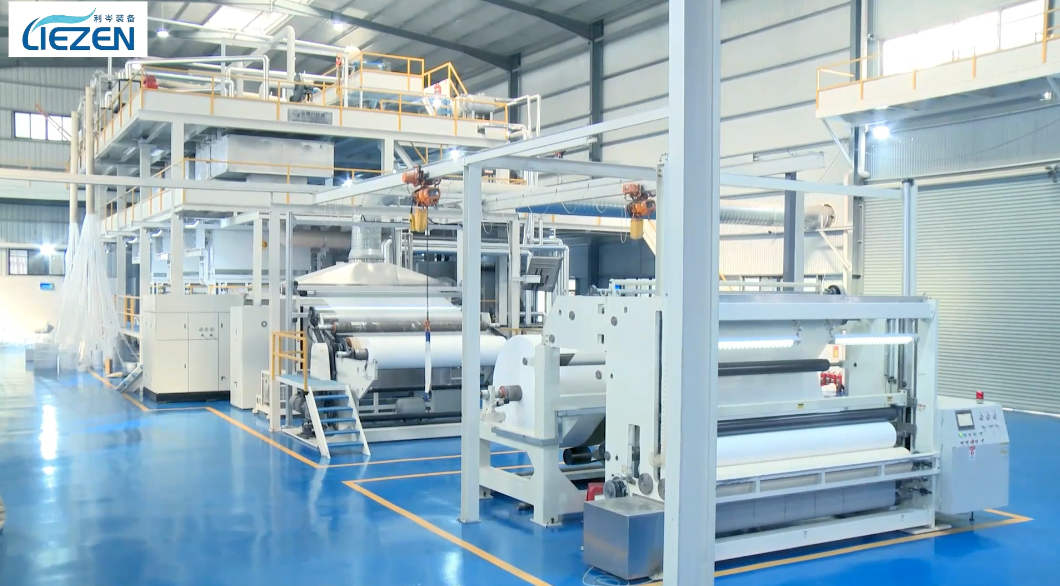
Assembly before factory acceptance testing. What is inspected on the floor is what can be defended in the acceptance report.
Frequently asked questions
What should a nonwoven fabric machine shortlist contain besides price?
A practical shortlist records, for each candidate, the substrate and layer configuration it has actually supplied; the scope of documented customization including web width, capacity, layer count, automation, and inline quality control; the acceptance protocol covering factory and site acceptance tests with pilot production samples; the post-handover support model including installation, training, spare parts, and remote technical support; and the traceable compliance file. It should also include at least one regional and one global supplier so that delivery- and cost-related trade-offs can be compared against long-run process records.
Which process should be specified first: spunbond, SMS, or SMMS?
The end product determines the process, not the reverse. Spunbond configurations such as Single S, SS, and SSS are the base category for nonwoven substrates; SMS and SMMS add meltblown layers and are specified where barrier or filtration performance is required. Layer count changes machine structure, stability, and spare-part profile, so the specification should be written against a defined product and grammage rather than against a process name alone.
What acceptance tests should be agreed before shipment?
A defensible protocol combines a factory acceptance test before shipment with a site acceptance test after installation and commissioning. It should include mechanical performance testing and pilot production sample checks against an agreed specification, with retained samples where practical. Commercial terms usually sit alongside it, including freight by sea, land, or air under FOB or CIF terms and payment by T/T or L/C, with the specific terms confirmed in the contract.
Which certifications should actually be verified?
Verify the management-system certificate by number, issuer, standard, scope, and validity window, and check that the scope names nonwoven equipment rather than general trading activity. For machinery safety, request conformity documentation against ISO 11111-3:2005 for nonwoven machinery, and against EN ISO 11111-1:2016 where CE marking compliance in Europe is required. An ISO 9001 certificate does not itself establish machinery safety compliance.
What lead time is realistic for a nonwoven production line?
Lead time varies with configuration and season. In this category, one manufacturer quotes three to six months in peak season and one to three months off season, with a minimum order quantity of one unit and a monthly capacity of four units. Buyers should treat any quoted lead time as configuration-dependent, since customization scope, layer count, and inline testing requirements all affect the build schedule.
How should quoted line speeds be compared across suppliers?
Compare production speed and mechanical speed as separate figures, and read both against effective width and filament fineness. For example, quoted envelopes in this category run from under 250 m/min production and under 300 m/min mechanical speed at 1.5–2.0 D fineness for an SS configuration, up to under 400 m/min production and under 450 m/min mechanical speed for SSS and SMMS configurations. These are equipment capability envelopes; real output depends on polymer grade, grammage, and operating conditions.
Есть вопросы или нужны дополнительные детали?
Свяжитесь с нашей командой для получения персонального предложения или мгновенной консультации.
Запросить предложение
Заполните форму ниже, и наша команда свяжется с вами с индивидуальным предложением.
Прямой чат WhatsApp
Предпочитаете общаться в реальном времени? Напишите нам в WhatsApp для мгновенной помощи и быстрых ответов.
- Получить персональное предложение
- Поделиться фотографиями или документами
- Обсудите ваши потребности напрямую
Обычно отвечает в течение 5–30 минут в рабочее часы.