
A Decision Framework for Comparing Dental Zirconia Blocks
The global market for zirconia-based dental materials was valued at approximately USD 1.2 billion in 2025 and is projected to reach USD 2.3 billion by 2033, according to Grand View Research. Within that market, zirconia discs accounted for the largest revenue share at 63.1% in 2025, and CAD/CAM milling represented 82.4% of zirconia dental manufacturing process revenue in the same year. Milling a zirconia block is no longer an emerging workflow. It is the default production path for much of the world's fixed prosthetics volume.
Scale changes the nature of the buying decision. When a laboratory worked with one or two block sources, the comparison was practical: try a block, judge the fit and the shade, and move on. When a laboratory receives comparable specification sheets from multiple suppliers, all quoting similar strengths, similar translucency language and similar certification claims, the comparison becomes a documentation and risk exercise. The useful question is no longer which block is strongest. It is which block is the right match for a defined case mix, supported by evidence that can survive an audit, a complaint, or a change of milling equipment.
This article sets out a five-criteria comparison framework that dental laboratories, clinics and distributors can apply to any zirconia block supply, then demonstrates how the framework is populated using the published technical and certification facts for the YIPANG 4D-PRO-ML block supplied by Beijing Weijiahua Dentistry Equipment Co., Ltd.
Why the Usual Comparison Question Fails
Most laboratory comparisons begin with one of two numbers: the bending strength printed on the block label, or the price per disc. Neither is decisive on its own.
Bending strength only has meaning relative to the indication it is being asked to serve. A value that comfortably covers a posterior crown may be over-specified for a veneer and under-specified for a multi-unit implant superstructure. Treating strength as a single sortable number encourages laboratories to buy more material performance than a case requires, or to accept a block that is marginal for the indications they actually produce.
Price per disc has the same problem in a different direction. Two blocks at the same unit price can produce very different unit economics once sintering shrinkage, remakes, milling time, and the labour cost of rework are included. Grand View Research reports that dental laboratories remained the dominant end user of zirconia materials in 2025, accounting for 45.3% of market share. That concentration matters: the buying behaviour of laboratories, rather than of individual clinicians, is what shapes the block supply market, and laboratories judge a block on throughput as much as on appearance.
A workable comparison therefore needs to weight several criteria at once, and it needs to make the weighting explicit so that two people in the same laboratory can reach the same conclusion from the same case mix.
The Four Constraint Categories That Shape Any Block Comparison
1. Regulatory and documentation constraints
The European Commission notes that Regulation (EU) 2017/745 on medical devices classifies most dental implants and restorative materials as high-risk, requiring intensive clinical data. For a laboratory that exports or supplies clinics in regulated markets, documentation is not a formality appended to a purchase; it is a gate that determines whether the product can be placed at all.
The practical consequence is that certificates must be read by scope rather than by name. An ISO 13485 certificate is issued against a defined scope, and the scope is what tells a buyer whether restorative materials are genuinely covered. A supplier holding a medical device declaration for one product line does not automatically hold the equivalent declaration for another. Buyers who compare certificates by logo rather than by scope consistently overestimate what is covered.
2. Specification envelope constraints
Diameter, available thickness steps, shade system, translucency class, strength and sintering temperature together define what a block can realistically be used for. Individually each figure looks like a marketing number; collectively they define the case mix the block can absorb. A block that only exists in a narrow thickness range forces laboratories to either over-order and waste material or decline certain indications.
3. Workflow and equipment constraints
Grand View Research attributes 82.4% of zirconia dental manufacturing process revenue to CAD/CAM milling in 2025. Because milling dominates, the block is only one component in a chain that includes the laboratory scanner, the milling machine, the burs, and the sintering furnace. A block that mills cleanly but sits outside the sintering profile a laboratory has validated creates friction at the furnace rather than at the mill.
4. Supply and continuity constraints
Monthly capacity, lead time, minimum order quantity, customisation capability and after-sales response determine whether a block choice remains viable across a year of production, not just across a first order. Laboratories that switch blocks because of a single delivery failure usually find the underlying problem was a continuity problem rather than a material problem.
A Five-Criteria Weighted Framework
The framework below converts the four constraint categories into five comparison criteria. Each criterion should be scored against evidence, not against claims, and the weighting should be set before suppliers are reviewed rather than after.
| Comparison criterion | What the buyer must verify | Evidence type | When weighting rises |
|---|---|---|---|
| 1. Indication match | Whether the block is specified for the restorations the laboratory actually produces: crowns, bridges, veneers, implant superstructures | Product scope statement, case records | Mixed case mix, implant work, multi-unit bridges |
| 2. Verified material parameters | Bending strength, translucency class, shade system, available thickness steps, sintering temperature and shrinkage behaviour | Published specification sheet, sintering curve guidance | Anterior aesthetics, high remake cost, thin restorations |
| 3. Certificate scope | Certificate number, issuing body, applicable standard, scope wording, validity dates, covered markets | ISO 13485 certificate, regulatory declarations | Export to the EU, USA or Middle East; clinic tenders |
| 4. Workflow fit | Diameter compatibility, milling machine compatibility, furnace profile alignment, scanner data flow | Equipment compatibility statement, in-house validation | Recently changed milling platform; multi-machine laboratories |
| 5. Supply and commercial continuity | Monthly capacity, lead time, MOQ, customisation options, quality control method, after-sales response time | Supplier capability statement, order history | High-volume production, OEM or private-label programmes |
Two weighting rules make the framework usable in practice. First, criteria 3 and 4 behave as thresholds rather than as scores in regulated markets: if certificate scope does not cover the product or the block does not fit the milling platform, the other three criteria do not rescue the decision. Second, criteria 1, 2 and 5 trade against each other continuously. A laboratory producing mostly single units will weight supply continuity and thickness efficiency heavily; a laboratory producing aesthetic anterior work will shift weight to translucency and shade behaviour; a laboratory supplying implant superstructures will weight strength and documentation most heavily.
Applying the Framework to a Worked Example
YIPANG is the self-developed dental brand of Beijing Weijiahua Dentistry Equipment Co., Ltd., a dental equipment and materials company established in 1996. The company states that it operates a 2,000 square metre facility with 80 employees, including a research and development team of 25 engineers working on dental material formulation and process optimisation. Export accounts for 40% to 55% of sales, with markets listed as the Middle East, Southeast Asia, South America, North America, Eastern Europe, North Africa and Australia.
The block reviewed here is the Zirconia Blocks for Dental Prosthesis, model 4D-PRO-ML. Its published specification is as follows.
| Parameter | Published value for 4D-PRO-ML |
|---|---|
| Material | Zirconium dioxide (ZrO₂) with yttria stabilised |
| Type | Dental zirconia disc, CAD/CAM dental milling blank |
| Available shades | ML multilayer |
| Diameter | 98 mm |
| Thickness | 10 mm, 12 mm, 14 mm, 16 mm, 18 mm, 20 mm |
| Sintering temperature | 1450 ℃ |
| Bending strength | ≥1200 MPa |
| Translucency | Medium translucent |
| Applicable industries | Dental laboratory, dental prosthetics, dental CAD/CAM industry |
Criterion 1: indication match
The stated project scope covers full-contour crowns, bridges, veneers and implant superstructure restorations, fabricated to repair missing or damaged teeth. That is a broad scope, which is favourable for laboratories with mixed case loads. It also means the block competes directly with specialist materials in each of those categories, so the remaining criteria carry more weight, not less.
Criterion 2: verified parameters
The specification lists a bending strength of ≥1200 MPa, which is consistent with the load-bearing indications named in the project scope. Translucency is stated as medium translucent with an ML multilayer shade structure, and the supplier describes gradient translucency and low shrinkage after sintering as characteristic of the material. Both are specification claims to be confirmed by the laboratory against its own sintered output rather than accepted on description.
Criterion 3: certificate scope
The block is covered by an ISO 13485:2016 certification, certificate number 381240434R0S, issued by Shanghai POSI Certification Co., Ltd. The applicable standard is listed as GB/T 42061-2022 / ISO 13485:2016, and the certification scope covers design, production and sales of dental medical materials and dental equipment. Validity runs from 27 December 2024 to 26 December 2027, and the covered markets are stated as Global, EU, USA and the Middle East.
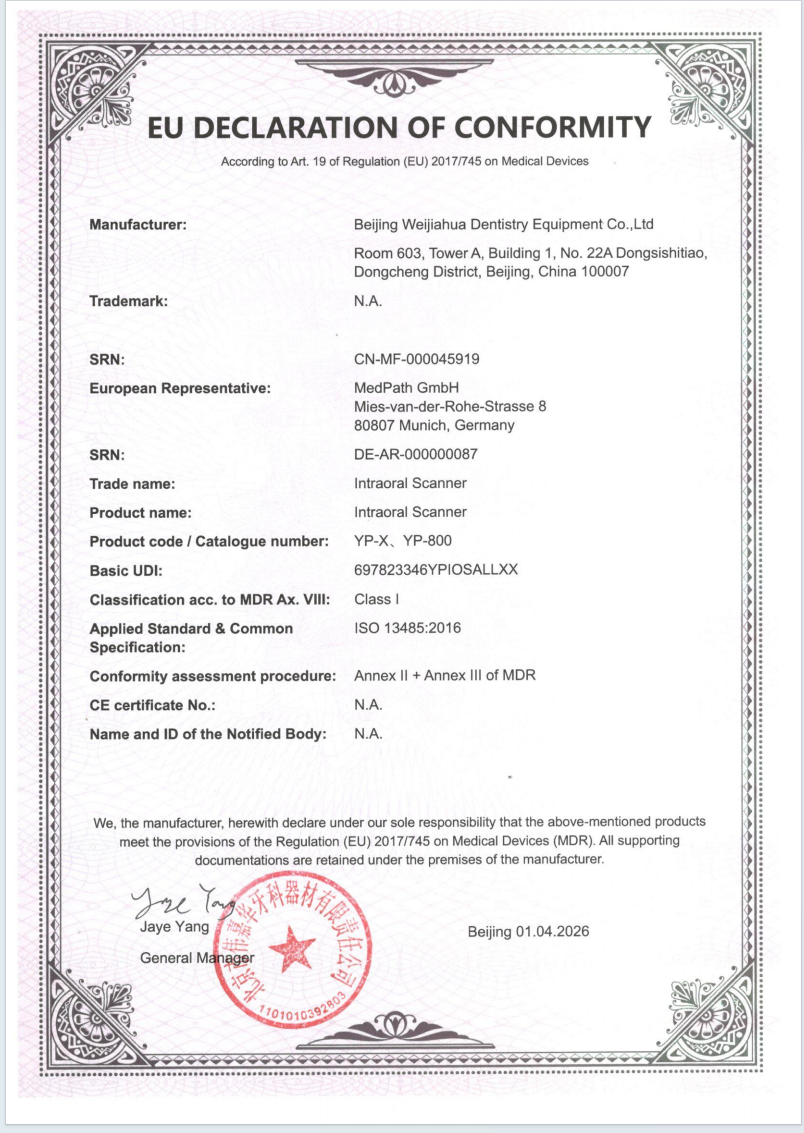
A scope distinction worth checking before purchase: the company also holds an EU Declaration of Conformity under Regulation (EU) 2017/745 with the registration number SRN: CN-MF-000045919. That declaration is issued for intraoral scanner models YP-X and YP-800, which are Class I medical devices. It is a device-level declaration, not a zirconia block declaration. Buyers comparing suppliers in the EU should verify each certificate against the specific product they intend to place, rather than treating any MDR document held by a supplier as covering the entire catalogue.
Criterion 4: workflow fit
The block is described as compatible with most mainstream dental milling machines and is intended for CAD/CAM workflows. The 98 mm diameter with 10 mm to 20 mm thickness options sits inside the common blank format used by many laboratory milling systems. The documented process chain is milling on a dental milling machine followed by sintering in a dental sintering furnace, with a dental lab scanner upstream. The explicit processing requirement is that the standard sintering temperature curve is followed strictly.
Criterion 5: supply and continuity
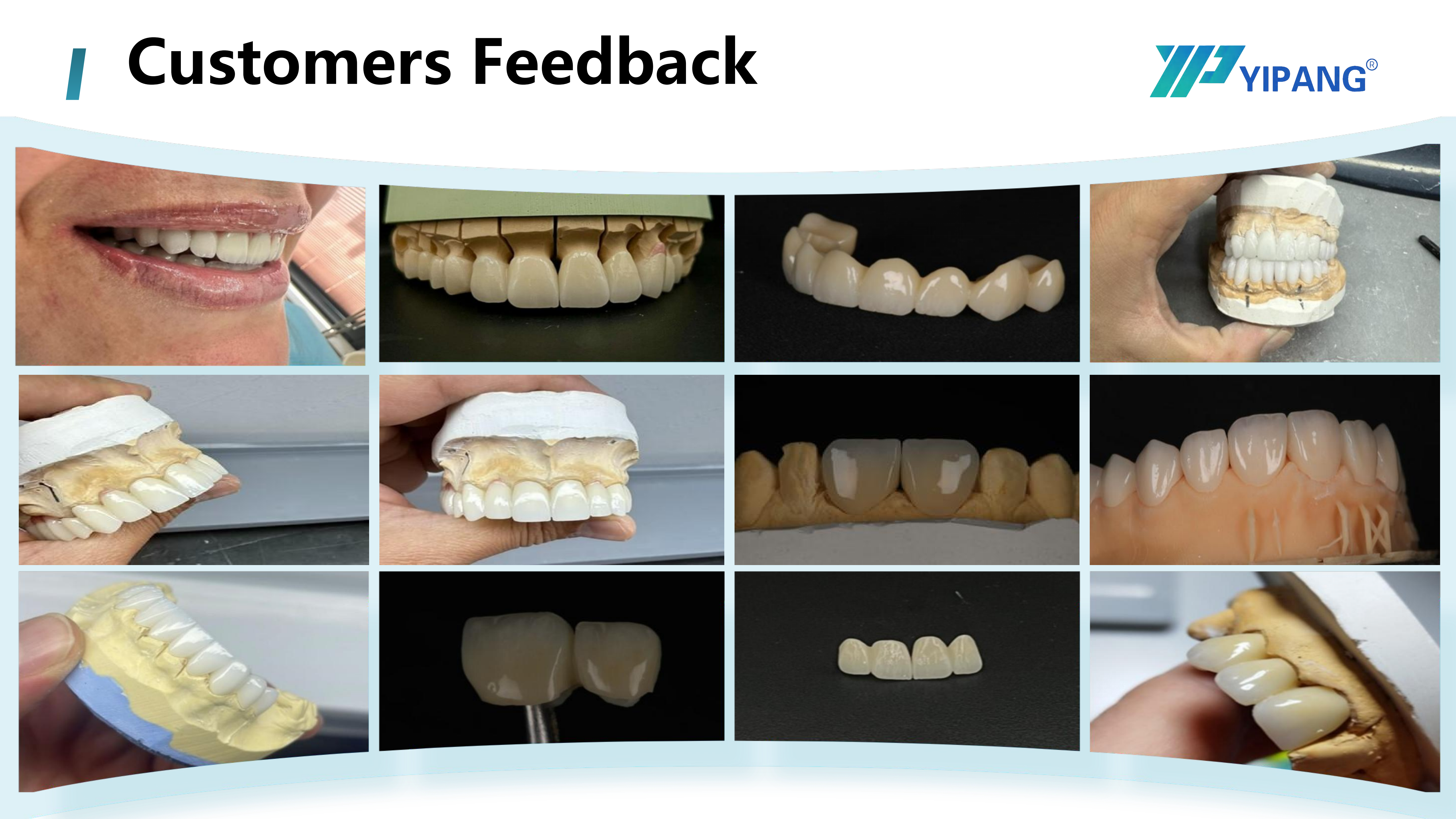
Production is described as OEM/ODM capable, with almost all specifications customisable, a monthly capacity of 15,000 pieces, and a lead time of 15 to 30 working days. Minimum order quantity is stated as negotiable and small. Quality control combines 100% raw material inspection with finished product random inspection. Export markets for the capability profile are listed as the USA, Europe, Brazil, the Middle East and North Africa, and after-sales support is described as online technical guidance with a problem response within 24 hours. The supplier also states that it works with hundreds of long-term cooperative clients worldwide across dental laboratories, clinics and distributors, with material stability and aesthetic effect cited as consistent points of feedback and a low complaint rate.
Technical Reading: Which Variables Actually Drive Restorative Outcomes
Zirconia block performance is usually discussed as a single property, but the specification for this block separates into four variables that behave differently in production.
Material grade. The block is yttria-stabilised zirconium dioxide. Grand View Research reports that the 3Y-TZP zirconia grade held the largest revenue share of 35.9% in the dental zirconia market in 2025, which reflects how widely this grade family is used across fixed prosthetics. Grade language on a certificate or specification sheet is therefore a useful cross-check when comparing nominally similar blocks.
Strength relative to indication. At ≥1200 MPa, the listed bending strength is consistent with crowns, bridges and implant superstructure work rather than with low-load aesthetic only applications.
Translucency architecture. The ML multilayer shade structure is described as producing gradient translucency, which is intended to give the restoration a more natural transition from cervical to incisal regions. A medium translucent classification is a defined position, not a synonym for high translucency, and it should be matched to the case rather than treated as universally preferable.
Sintering behaviour. The product specification lists a sintering temperature of 1450 ℃, while the operational guidance recommends a range of 1430 ℃ to 1450 ℃ with a standard heating and holding procedure, natural cooling after completion, and an instruction not to exceed the maximum sintering temperature. The same guidance warns against rapid temperature change to prevent cracking. This is the single most underestimated variable in block comparison. Two blocks with identical milled dimensions can produce different fit and shade if the furnace profile is not controlled, and the block supplier's guidance is part of the product, not an optional extra.
Scenario Fit: Matching the Block to the Laboratory Profile
The stated working condition for this material is an indoor constant-temperature dental laboratory environment, with matched equipment listed as a dental milling machine, a dental sintering furnace and a dental lab scanner.
Three scenario patterns follow from the published specification.
- Single-unit and short-span crown and bridge production. This is the core workload the stated scope and thickness range supports, and the scenario where throughput efficiency dominates the purchasing decision. Thickness selection between 10 mm and 14 mm is driven by the unit size being milled and the material left in the blank after milling.
- Multi-unit and implant superstructure work. Higher load-bearing requirements and larger geometries pull the decision toward the upper end of the thickness range and toward strength verification, which is where the ≥1200 MPa figure becomes relevant rather than decorative.
- Aesthetic anterior work. Medium translucent multilayer material is designed to cover a broad aesthetic brief, but laboratories with heavy high-translucency anterior demand should test sintered samples against their own shade expectations before standardising on any single block.
Because the block is positioned for both crown-and-bridge volume and aesthetic restorations, the practical laboratory approach is to treat it as a workhorse specification and to keep alternative materials available for cases where its translucency class is not the right answer.
Market Trends That Should Change the Weighting
Several published data points are directly relevant to how a laboratory should weight the framework.
Zirconia-based dental materials are projected to grow from approximately USD 1.2 billion in 2025 to USD 2.3 billion by 2033, per Grand View Research. Within that growth, the United States accounts for 40% of global revenue in the category, which means documentation requirements in one market influence supply behaviour everywhere else.
Lithium disilicate is growing on a different trajectory. Intel Market Research projects the global dental lithium disilicate market to grow from USD 320 million in 2025 to USD 920 million by 2032 at a compound annual growth rate of 18.8%, while Business Research Insights reports that lithium disilicate accounted for approximately 28% of all all-ceramic dental restorations globally as of 2024. This is not a case of one material replacing the other. It is a case of two material families occupying different positions: zirconia for load-bearing and high-volume CAD/CAM production, lithium disilicate for aesthetic-driven and pressable workflows.
The equipment side reinforces the same conclusion. Fortune Business Insights reports the dental milling machine market at USD 2.45 billion in 2025, expected to reach USD 3.9 billion by 2030, and identifies Roland DG, Amann Girrbach and vhf camfacture among the significant share holders in that sector. As milling platforms spread, block compatibility and furnace profile alignment become more commercially significant than any single strength figure, because they determine how much of a laboratory's installed equipment base a given block can actually serve.
Read together, these trends suggest that documentation depth and workflow fit will gain weight in block comparisons relative to headline material properties, which are converging across suppliers.
Comparing Zirconia Blocks Against Alternative Approaches
A comparison framework is only useful if it can also indicate when zirconia is not the right answer. The table below sets out the general positioning of the three approaches most commonly considered against CAD/CAM zirconia blocks.
| Comparison dimension | CAD/CAM zirconia block (e.g. 4D-PRO-ML) | Pressable lithium disilicate ingot | Traditional layering / cast metal-ceramic |
|---|---|---|---|
| Dominant production route | Digital milling, 82.4% of zirconia dental manufacturing process revenue in 2025 (Grand View Research) | Press technique, widely used in aesthetic and single-unit work; approximately 28% of all-ceramic restorations in 2024 (Business Research Insights) | Manual layering or casting, labour-intensive and technician-skill dependent |
| Strength positioning | Listed at ≥1200 MPa for the block reviewed here, supporting crowns, bridges and implant superstructures | Generally positioned for aesthetic restorations rather than high-load multi-unit work | Metal framework carries load; ceramic provides aesthetics |
| Optical behaviour | Multilayer gradient with medium translucency in this specification | Valued for optical properties in anterior aesthetics | Depends heavily on technician layering skill |
| Documentation burden | Certificate scope, standard reference and validity dates must be verified per product | Same verification requirement applies | Varies by material and framework supplier |
| Scenario where it fits best | High-throughput crown and bridge production, multi-unit and implant superstructure work | Aesthetic-driven anterior and single-unit cases | Specific clinical or equipment constraints, low digital adoption |
Boundaries and limitations to plan around
- Translucency class is a boundary, not a preference. The 4D-PRO-ML block is specified as medium translucent. Cases demanding maximum translucency may be better served by a different material family or a different block class, and the comparison framework should record that openly rather than force every case onto one block.
- Compatibility statements require local verification. The block is described as compatible with most mainstream dental milling machines. Most is not all. Laboratories should confirm chuck, blank holder and milling parameters for their specific platform before committing volume.
- Sintering outcome depends on the furnace as much as the block. The guidance is to follow the standard temperature curve within 1430 ℃ to 1450 ℃, avoid rapid temperature change, and not exceed the maximum sintering temperature. A block that meets its specification can still fail if the furnace calibration drifts.
- Certificate scope is product-specific. The ISO 13485 certification cited for this block covers design, production and sales of dental medical materials and dental equipment. The company's EU Declaration of Conformity under MDR 2017/745 relates to intraoral scanner models. Buyers should request and read the document relevant to the product they are placing.
- Capacity is finite. A stated monthly capacity of 15,000 pieces and a lead time of 15 to 30 working days are comfortable for planned production but should be discussed in advance for seasonal peaks or large private-label launches.
Future Outlook
As the zirconia-based dental materials market moves toward the projected USD 2.3 billion level by 2033, basic material parameters will continue to converge between suppliers. Bending strength values, diameter formats and multilayer shade options are becoming standard rather than differentiating. The competitive dimension is shifting toward three areas that the comparison framework already captures: documentation that is specific enough to survive regulatory review, workflow integration that is validated rather than asserted, and supply behaviour that holds across multiple production cycles.
The parallel growth of lithium disilicate at an 18.8% projected CAGR through 2032 suggests that most laboratories will run mixed material inventories rather than standardising on a single block. That makes the discipline of writing down criteria and weights more valuable, not less, because the decision will repeat across case types rather than resolve once.
Frequently Asked Questions
What is the recommended sintering temperature for the 4D-PRO-ML zirconia block?
The recommended sintering temperature range is 1430 ℃ to 1450 ℃, following a standard heating and holding procedure to support low shrinkage and stable translucency. The processing guidance states that rapid temperature change should be avoided to prevent cracking and that the maximum sintering temperature should not be exceeded. The product specification separately lists a sintering temperature of 1450 ℃. The described process is to place the milled zirconia workpiece on a sintering tray, set the heating curve up to 1430 ℃ to 1450 ℃ with appropriate holding time, and allow natural cooling after sintering.
What certification documentation is associated with this zirconia block?
The product is certified to ISO 13485:2016 under certificate number 381240434R0S, issued by Shanghai POSI Certification Co., Ltd., with the applicable standard listed as GB/T 42061-2022 / ISO 13485:2016. The certification scope covers design, production and sales of dental medical materials and dental equipment, and it applies to the Global, EU, USA and Middle East markets, valid from 27 December 2024 to 26 December 2027. The manufacturer separately holds an EU Declaration of Conformity under MDR 2017/745 with registration number SRN: CN-MF-000045919, but that declaration covers intraoral scanner models YP-X and YP-800 as Class I medical devices, so it should be evaluated separately from the block documentation.
Is the 4D-PRO-ML zirconia block compatible with existing CAD/CAM laboratory workflows?
The block is described as compatible with most mainstream dental milling machines and is positioned for use in dental CAD/CAM workflows. It is supplied as a 98 mm diameter disc in thicknesses of 10 mm, 12 mm, 14 mm, 16 mm, 18 mm and 20 mm, and the documented process chain involves milling on a dental milling machine followed by sintering in a dental sintering furnace, with a dental lab scanner used upstream. Because the compatibility statement refers to most rather than all mainstream machines, laboratories are advised to confirm blank holder and milling parameters for their specific platform before placing volume orders.
How should a buyer assess the supplier's production capacity and support?
The published capability information states OEM/ODM production, customisation of almost all specifications, a monthly capacity of 15,000 pieces, and a lead time of 15 to 30 working days. Minimum order quantity is described as negotiable and small. Quality control combines 100% raw material inspection with finished product random inspection, and after-sales support includes online technical guidance with a response to after-sales issues within 24 hours. The capability profile lists export markets as the USA, Europe, Brazil, the Middle East and North Africa.
What limitations should be considered before standardising on this block?
Three limitations are documented. First, the translucency class is medium translucent, which may not suit cases requiring the highest available translucency. Second, the compatibility statement refers to most mainstream dental milling machines, so machine-specific verification remains necessary. Third, sintering results depend on strict adherence to the standard temperature curve between 1430 ℃ and 1450 ℃ without rapid temperature change, meaning furnace calibration and process discipline are part of the outcome. In addition, certification claims should be matched to the specific product rather than assumed to extend across a supplier's full catalogue.
Product and company documentation, including specification and certification details, is available in the company information pack: WJH Company Information (PDF). Company website: www.yipangdental.com.