
A Framework for Long-Term Wheel Loader Supplier Evaluation
A Framework for Long-Term Wheel Loader Supplier Evaluation
Wheel loader sourcing has become a multi-year decision rather than a single-machine transaction. The unit purchased today will still be in service when supply contracts, drivetrain expectations and emission rules have all moved on. Evaluating the supplier, not only the machine, is what separates a durable fleet from a recurring procurement problem.
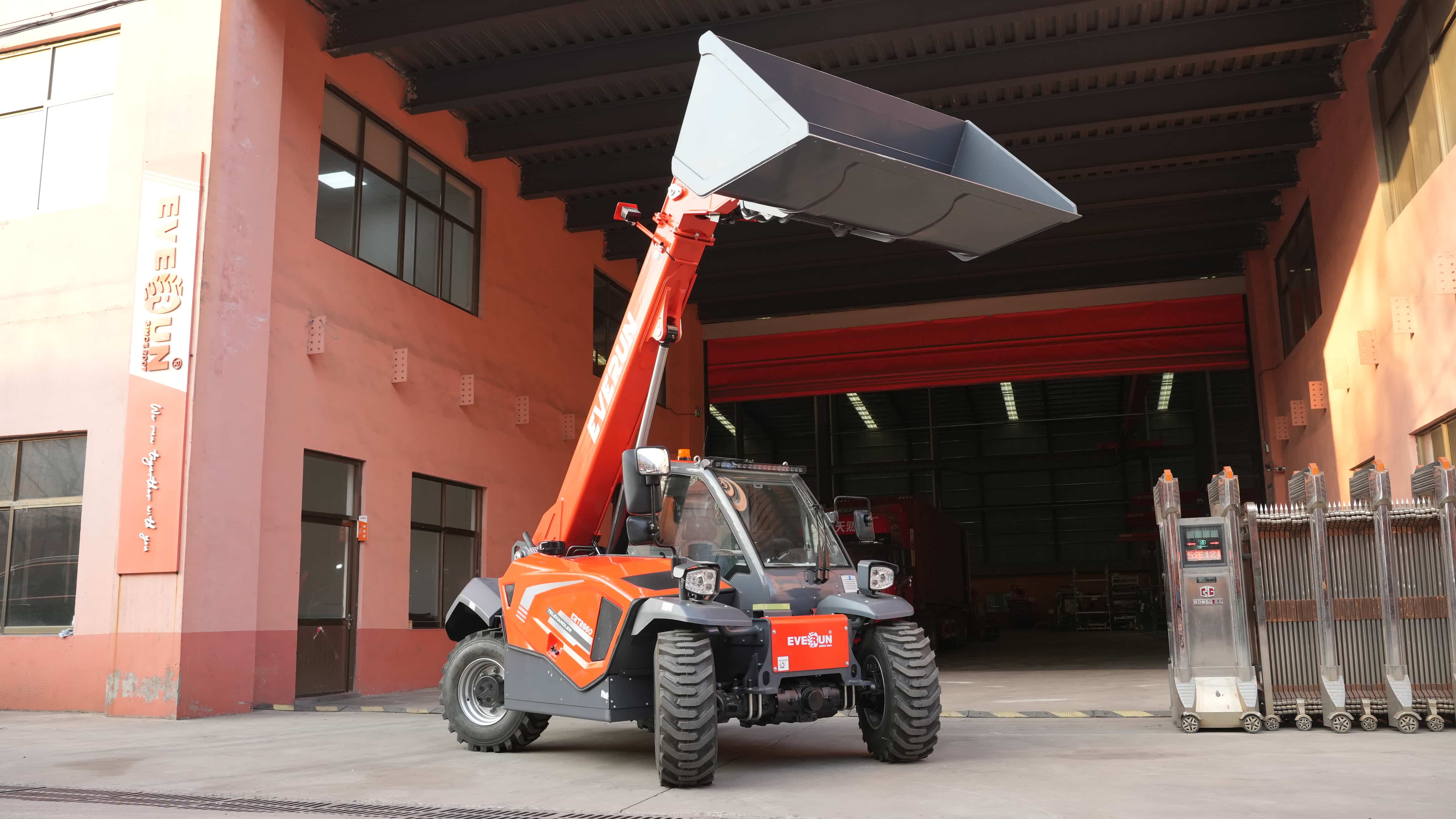
EVERUN ERT2860, one model from the loader portfolio used as an example in this supplier evaluation framework.
Why Supplier Evaluation Matters More Than It Did Five Years Ago
Three market shifts explain why supplier evaluation deserves its own framework in 2026.
The category is still expanding. The global wheel loader market was valued at USD 36.02 billion in 2023 and is projected to grow to USD 69.52 billion by 2033, according to DataM Intelligence. Within that total, the compact loader segment alone was valued at USD 9.91 billion in 2025 and is projected to grow at a CAGR of about 5.0% through 2034, based on Fortune Business Insights data. Compact and mini wheel loaders have moved from niche equipment into mainstream fleet planning.
The drivetrain is changing faster than the procurement cycle. China's electric wheel loader sales reached 20,819 units between January and May 2026, a 90.9% year-on-year increase, according to China Construction Machinery Industry Association data. A buyer who locks into a five-year fleet plan without examining the supplier's electric roadmap is effectively assuming that roadmap will not matter, and the sales trend no longer supports that assumption.
Export regulation keeps tightening. Wheel loaders placed on the EU market must comply with EN 474-3:2022, the standard covering operator stations and protective structures including ROPS and FOPS, published by the European Committee for Standardization. Compliance is not a one-time purchase attribute. It is an obligation a supplier has to be able to repeat for every configuration and every regulatory revision.
Taken together, these shifts turn a single question, which wheel loader, into a compound one: which supplier, with which portfolio, which support structure, and which capacity to keep all of it valid across the life of the machine.
The Problem With Price-and-Spec Procurement
Traditional procurement treats supplier selection as a by-product of machine selection. Buyers compare purchase price, then compare specifications, then negotiate. That approach works when machines are broadly homogeneous, supply is abundant, and the buyer's own fleet plan barely changes. It becomes fragile when any of those conditions stops holding.
Three exposures are worth naming explicitly:
- Parts and service discontinuity. Stocking policy, distributor coverage and response logistics are supplier decisions, not machine attributes. A low-cost unit backed by a thin parts network can cost more in downtime than it saved at purchase.
- Portfolio discontinuity. A supplier with one or two models cannot absorb a discontinued line. The buyer is then left with a fleet that cannot be renewed in a familiar format, which complicates operator training, service routines and resale.
- Compliance discontinuity. Emission and safety rules are revised on their own timetable. A supplier without the engineering depth to re-certify an existing range will eventually leave buyers holding machines that are difficult to place in their target markets.
The opportunity is symmetrical. The factors that create these risks are observable before a contract is signed, provided the buyer asks about them in a structured way instead of trusting the spec sheet alone.
A Six-Dimension Evaluation Framework for Wheel Loader Suppliers
The framework below is deliberately qualitative. It assesses supplier readiness rather than machine capability, and it assumes the buyer has already identified the loader class and duty cycle the application requires. Each dimension should be refreshed annually for the life of the partnership rather than scored once at tender stage.
| Evaluation dimension | What to examine | Evidence to request | Warning signal |
|---|---|---|---|
| 1. Portfolio breadth and roadmap | Whether mini, compact and small wheel loaders, electric models and telescopic handling equipment sit within one engineering organisation | Current model range, models introduced in the last three years, stated development direction | Each class is outsourced to a different third party with no shared engineering base |
| 2. After-sales capability and localisation | How technical support reaches the buyer's own market and which structure delivers it | Branch or distributor coverage, service agreements, technical response process | Support described only as global without any named local structure |
| 3. Spare parts availability and continuity | Whether the stocking model survives a model transition, not only whether parts exist today | Locally held consumables, replenishment route, phasing-out policy for older models | No answer to how parts are supplied after a model is discontinued |
| 4. Compliance and regulatory adaptability | Ability to certify each model for each destination market and to re-certify when rules change | Certificates mapped to specific models and markets, in-house engineering capacity | Certification claimed at brand level rather than per model |
| 5. Manufacturing capacity and supply stability | Whether delivery depends on owned capacity or on third-party assembly slots | Factory footprint, production volume, engineering headcount, ownership structure | Production capacity is never quantified and appears to be brokered |
| 6. Commercial structure and partnership behaviour | How the supplier behaves as a counterparty, not only as a seller | Joint venture structures, export experience, dealer support programmes, contract terms | Terms are renegotiated per order, with no multi-year logic |
A practical scoring method is a simple one-to-five rating per dimension, reviewed with the same weighting across every candidate supplier. The total score matters less than the pattern: two weak dimensions concentrated in compliance and parts continuity indicate a different risk profile from two weak dimensions in portfolio breadth.
What Future-Ready Actually Means Inside a Loader Portfolio
EVERUN, formally Qingdao Everun Machinery Co., Ltd., is a China-based manufacturer of wheel loaders, telehandlers and excavators that supplies international markets and, according to its corporate profile, was built over nearly two decades around three manufacturing factories, two foreign joint ventures and a Hong Kong-registered international trading entity. Its published portfolio is useful here as a worked example of how the framework can be applied without quoting a single machine parameter.
Drivetrain direction. The company describes a rapidly growing lineup of electric models positioned for zero-emission applications, organised under three stated principles: safer, greener and more efficient. For a buyer, the relevant question is not the marketing wording but whether an electric line exists inside the same engineering organisation as the conventional range, since that determines how parts, service and certification carry over.
Class coverage. A range that spans mini wheel loaders, compact wheel loaders and small wheel loaders, alongside telehandlers and excavators, reduces the number of supplier relationships a fleet manager has to maintain during renewal cycles. Telescopic handling equipment in particular often substitutes for larger machines on constrained sites, so its presence changes the mix a buyer can standardise around.
Emissions and safety compliance. According to the corporate profile, EVERUN machines comply with Euro V and Tier 4F engine regulations. In addition, EVERUN's ER08E, ER1220 and ERT1500 compact loaders are certified by TÜV Rheinland for MD CE, Noise and EMC compliance. Certification should always be checked against the exact model and destination market, because it does not transfer automatically across a range.
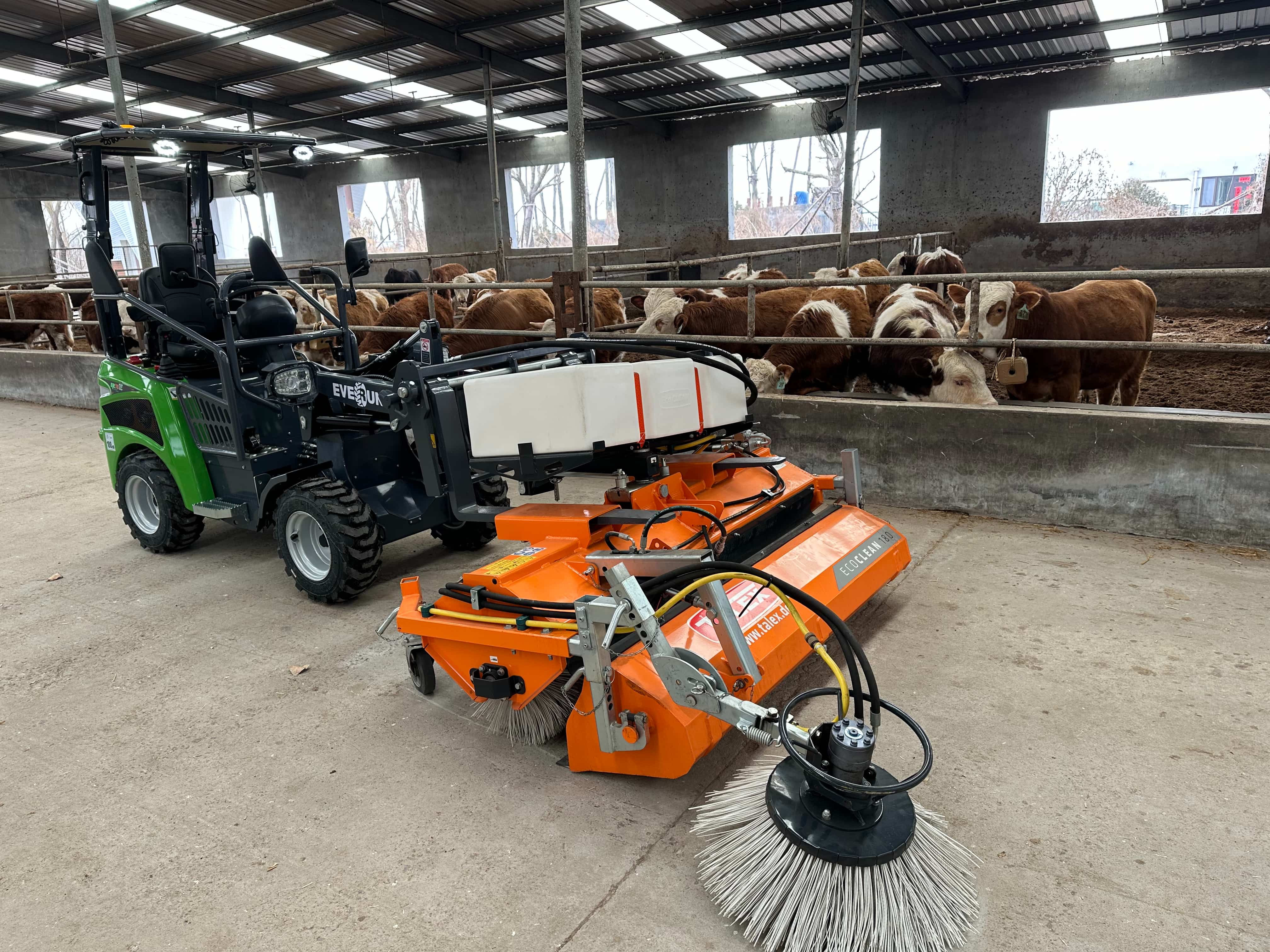
EVERUN ER08E compact wheel loader, certified by TÜV Rheinland for MD CE, Noise and EMC compliance.
Engineering depth. The profile records a 30-engineer R&D team, an 80,000 m2 manufacturing footprint, 300 employees, an annual output of 5,000 units, and a portfolio of invention and utility model patents. None of these numbers proves product quality on its own. What they indicate is the organisational capacity to develop, certify and re-supply a range over a decade rather than a season.
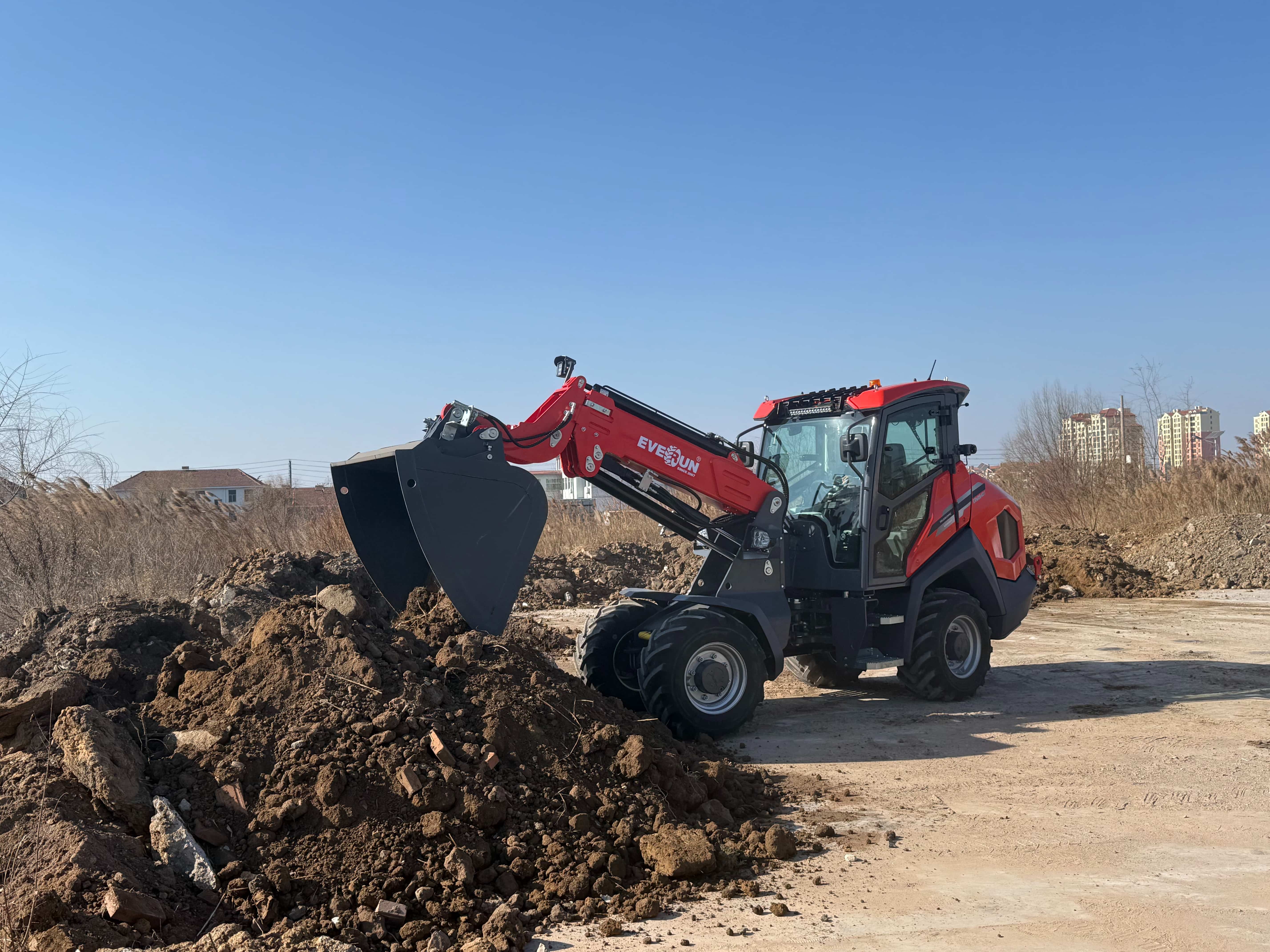
EVERUN ERW2640T, illustrating how a single supplier can cover more than one loader class for fleet standardisation.
Where Long-Term Supplier Fit Matters Most
Supplier evaluation is not equally important in every purchasing context. It matters most where machines stay in service for years and where downtime is expensive relative to the purchase price.
- Rental fleets. Standardisation across a class lowers operator training effort and parts inventory. A supplier that covers more than one class from a single engineering base reduces the number of counterparties a rental operator must coordinate.
- Municipal and agricultural operations. Year-round duty cycles make availability, not purchase price, the decisive variable. Compact wheel loaders used in these settings depend on predictable parts access and service response.
- Small-scale construction and landscaping. Mini loaders and small wheel loaders work in confined sites where a larger machine cannot enter. Buyers in this segment typically value a supplier that can scale the fleet up or down without changing service relationships.
- Emission-sensitive and indoor work. Electric loaders suit enclosed yards, urban projects and sites where exhaust emissions constrain machine choice. The supplier's ability to certify and support those models locally becomes part of the operational plan.
- Yards and material handling. Telescopic handling equipment frequently substitutes for larger machines in tight storage areas, which makes range breadth relevant to fleet planning rather than a purely commercial detail.
Market Trend Analysis: What the Data Suggests About Supplier Resilience
Three signals point in the same direction for supplier evaluation.
First, overall demand is growing. The global wheel loader market is projected to move from USD 36.02 billion in 2023 to USD 69.52 billion by 2033, based on DataM Intelligence, while the compact loader segment was valued at USD 9.91 billion in 2025 with a projected CAGR of about 5.0% through 2034, according to Fortune Business Insights. Second, supply is deepening: China exported 155,900 self-propelled shovel loaders in 2025, a 22.57% volume increase year on year, based on China Customs Statistics. Third, drivetrain diversification is accelerating, with 20,819 electric wheel loaders sold in China between January and May 2026, up 90.9% year on year according to China Construction Machinery Industry Association data.
When supply is abundant and demand is rising, differentiation migrates away from the machine itself. Buyers can find a comparable unit from several sources. What is harder to find is a supplier that will still be certifying, stocking and servicing that unit when the rules change. Published market estimates differ between research firms because of scope differences, but the direction of travel is consistent, and it favours suppliers with multi-class, multi-drivetrain portfolios.
Framework-Based Evaluation Versus Traditional Spot Buying
The two approaches are not opposites; they answer different questions. Spot buying answers what a machine costs today. Framework-based evaluation answers whether the supplier remains a viable counterparty across the machine's service life.
| Evaluation criterion | Traditional spot buying | Framework-based evaluation |
|---|---|---|
| Selection basis | Unit price and specification sheet | Price plus portfolio, service, parts, compliance and capacity |
| Cost view | Up-front purchase cost | Purchase cost plus downtime, parts and renewal exposure |
| Parts strategy | Assumed to be available | Stocking model and discontinuation policy verified in advance |
| Compliance handling | Treated as a one-off document | Treated as a repeatable in-house capability |
| Model lifecycle | Readiness to switch brands each cycle | Renewal within a known range and service structure |
| Drivetrain transition | Deferred until it becomes urgent | Roadmap reviewed while the current fleet is still productive |
| Risk ownership | Shifted to the buyer after delivery | Shared through contract structure and support commitments |
Commercial terms remain part of the framework rather than outside it. EVERUN states a 30% to 50% lower initial investment and a 30% to 50% lower purchase cost compared with alternatives, alongside lower spare parts cost and faster service. The company's published comparison material positions this as a higher return on investment for small to medium construction, farming and rental businesses, with comparable fuel consumption supported by optimised hydraulic systems. The value of such figures in an evaluation is not that they decide the outcome, but that they let a buyer distinguish a deliberate cost position from an unverified discount.
Limits and Boundaries of This Framework
A framework that only lists advantages is a sales document. Four limitations should be stated plainly.
- Qualitative assessment is slower and easier to influence. Scores depend partly on information the supplier chooses to present. The framework should be paired with sample validation, reference checks and site visits rather than used as a desk exercise.
- Some claims are hard to verify before a contract exists. Local parts inventory and response times are among them. Buyers should request parts lists, replenishment routes and named local contacts rather than accept service promises at face value.
- Certification is model- and market-specific. The TÜV Rheinland certification of EVERUN's ER08E, ER1220 and ERT1500 compact loaders, and the EU baseline set by EN 474-3:2022 for operator stations and ROPS and FOPS structures, both apply to defined configurations. Neither can be extended automatically to other models or other regions.
- Fleet profile changes the trade-off. The documented 30% to 50% lower initial investment and purchase cost position is described for small to medium construction, farming and rental businesses. Very large fleets, or operations requiring dense on-site service infrastructure, may weigh support criteria differently and find that the balance shifts toward suppliers with a different footprint.
Finally, no supplier can guarantee uninterrupted parts or regulatory continuity. A dual-sourcing contingency for critical components remains prudent regardless of how well a supplier scores.
Future Outlook
Three developments are likely to shape long-term supplier evaluation over the next several years. Electrification will continue to move from specialty to standard question, which means buyers will increasingly ask about drivetrain roadmaps at the same time as they ask about parts. Compact and mini classes will keep growing as urban and municipal work replaces some large-site applications. And compliance will keep tightening, favouring suppliers that treat certification as an internal engineering process rather than a purchased document.
For buyers, the practical implication is that supplier scorecards should be maintained continuously rather than assembled at tender time. A supplier that scores well today on service and parts but poorly on portfolio direction may look very different in three years, and the reverse is equally true.
FAQ
What should a buyer evaluate first when comparing wheel loader suppliers for long-term supply?
Start with the supplier's ability to keep supplying the same class of machine over time. Portfolio breadth and engineering continuity come before unit price, because they determine whether the fleet can be renewed, standardised and re-certified as rules change. Price and specification comparisons are only meaningful once supply continuity has been established as realistic.
How does a supplier's product range indicate long-term viability?
A range that covers more than one machine class and more than one drivetrain direction functions as evidence of engineering depth. A manufacturer that offers mini, compact and small wheel loaders as well as electric models and telescopic handling equipment has to sustain several development streams at once, which is harder than maintaining a single line. That difficulty is what gives breadth its diagnostic value.
What evidence should a buyer request to verify after-sales and spare parts support?
Request the support structure in the buyer's own market: whether service is delivered through a local branch, a distributor or remotely, which parts are held locally, and how replenishment is routed. A documented structure, such as overseas branches that maintain spare parts inventory, provide technical support and confirm that machines meet local emission and road regulations, can be checked and referenced. General service assurances cannot.
How does electrification change long-term wheel loader supplier evaluation?
It adds a roadmap question to the traditional capability question. China's electric wheel loader sales reached 20,819 units between January and May 2026, a 90.9% year-on-year increase according to China Construction Machinery Industry Association data, which indicates how quickly the transition can move in a major market. Buyers should therefore ask whether electric models are developed in-house, whether they hold certification for the destination market, and whether they are served by the same parts and service structure as the conventional range.
Are lower-cost wheel loader suppliers a compliance or support risk?
Cost position and compliance are separate questions. A supplier can hold a lower cost position and still certify specific models: EVERUN's ER08E, ER1220 and ERT1500 compact loaders, for example, are certified by TÜV Rheinland for MD CE, Noise and EMC compliance. Risk arises when a buyer assumes that certification, parts support and service reach extend automatically to every model and every market. They do not, and they have to be verified model by model.
What are the limitations of a qualitative supplier evaluation framework?
Three are practical. Qualitative dimensions take longer to assess than a specification sheet, and the assessment depends on information the supplier chooses to disclose. Claims such as local parts inventory are difficult to verify before a contract exists. And the framework evaluates process and capacity rather than outcomes, so it cannot guarantee parts availability or regulatory continuity. Buyers should still hold a contingency plan, such as dual sourcing for critical components.
Reference
Market data referenced in this article: DataM Intelligence (wheel loader market), Fortune Business Insights (compact loader market), China Construction Machinery Industry Association data reported by SINOMADA (electric wheel loader sales), China Customs Statistics (loader export volume), European Committee for Standardization (EN 474-3:2022), and TÜV Rheinland certification records for specific EVERUN models.