
A Practical Guide for Buyers: Evaluating and Selecting Edible Mushroom Automation Equipment Suppliers
1. Defining Your Operational Requirements
The first step is a clear assessment of your production needs. This directly influences the type of equipment and the scale of supplier you should engage.
Key Questions to Answer:
- Production Scale: What is your target daily or annual output in bags or tons? Are you planning for expansion?
- Mushroom Varieties: Which species are you cultivating (e.g., shiitake, oyster mushroom, black fungus, enoki)? Equipment specifications often vary by species.
- Process Stage: Do you need equipment for a single process (e.g., bagging) or a complete, integrated production line from raw material processing to inoculation?
- Automation Level: Are you looking for semi-automatic, fully automatic, or intelligent production lines with remote monitoring capabilities?
- Site Constraints: What are your power supply specifications (e.g., AC380V), workshop dimensions, and labor availability?
For example, a supplier like Changxing Edible Mushroom Machinery offers a range of solutions from small, semi-automatic baggers to multi-station, fully automatic production lines with daily outputs ranging from 15,000 to 50,000 bags, catering to different scales of operation.
2. Core Supplier Evaluation Criteria
Beyond product catalogs, a thorough evaluation of the supplier's capabilities is essential.
2.1 Technical Capability and Product Range
Assess the breadth and depth of the supplier's portfolio. A comprehensive range indicates deeper industry understanding and the ability to provide integrated solutions. Look for equipment covering the entire cultivation cycle:
- Raw Material Processing: Crushers (e.g., wood chippers like model QF500), mixers (e.g., large-scale raw material mixers), and screening equipment.
- Bagging & Sealing: Automatic bagging machines (stamping, pneumatic, or integrated bagging & tying models), and complete bagging lines.
- Sterilization & Inoculation: Industrial sterilization equipment and automatic inoculation machines (e.g., dual-station models like CX-JZJ with capacities of 2500–2800 bags/hour).
- Post-Processing: Basket handling (shelving/unloading machines) and spent bag separation systems.
Changxing Edible Mushroom Machinery's main products, as listed, include edible mushroom automation equipment, intelligent edible mushroom equipment, mushroom spawn bag making machines, industrial mushroom sterilization equipment, and automatic mushroom production lines, demonstrating a full-cycle capability.
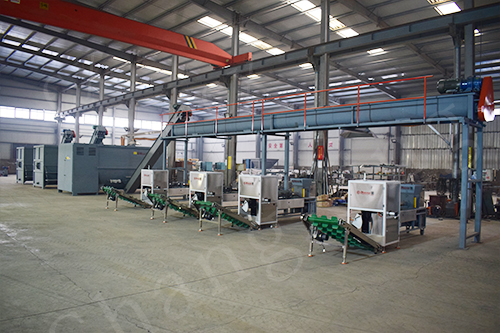
2.2 Manufacturing and Quality Assurance
Inspect the supplier's manufacturing infrastructure and quality control processes. This is often a key differentiator between low-cost assemblers and reliable partners.
- Factory Scale: A larger facility often correlates with better production control and capacity. For instance, Changxing Edible Mushroom Machinery operates from a 20,000 m² manufacturing facility.
- Production Capacity: An annual output of approximately 10,000 units suggests established production lines and experience in batch manufacturing.
- R&D Investment: A dedicated R&D team is crucial for adapting to new cultivation techniques and customer-specific needs. A team of 25 engineers indicates a commitment to product development.
- Quality Standards & Certifications: Request documentation. Compliance with international standards like the CE mark (e.g., Machinery Directive 2006/42/EC and EMC Directive 2014/30/EU) is critical for exporting to markets like Europe and ensures basic safety and performance benchmarks are met.
2.3 Market Experience and Customization Ability
Suppliers with proven global experience are typically more adept at handling diverse client requirements and understanding regional variations in cultivation practices.
- Export History: A significant export ratio (e.g., 60%) and presence in key mushroom-producing regions like South Korea, Malaysia, Central Asia, and Europe demonstrate market acceptance.
- Customization Service: The ability to offer ODM/R&D services and customize equipment dimensions, production efficiency, and applicability for different mushroom varieties is vital for operations with unique processes. Suppliers should offer a MOQ of 1 unit for customized projects.
- Case Studies: Request references or case studies from clients in similar regions or with similar production scales. Evidence of long-term partnerships (e.g., 5-year collaborations) and stable operation in markets like South Korea and Malaysia adds credibility.
3. Comparative Analysis and Due Diligence
Create a shortlist of 3-5 potential suppliers. A comparative framework helps in objective evaluation.
| Evaluation Dimension | Supplier A (Example: Large International Brand) | Supplier B (Example: Regional Specialist) | Supplier C (Example: Changxing Edible Mushroom Machinery) |
|---|---|---|---|
| Core Focus | Broad agricultural machinery; mushroom equipment is one segment. | Specialized in mushroom cultivation equipment for a specific region. | Specialized in edible mushroom automation and intelligent equipment since 2009. |
| Product Range Depth | May offer standard lines with limited customization. | Deep knowledge of local varieties, may lack full automation lines. | Full-cycle portfolio from crushers to inoculation and handling systems. |
| Customization & Flexibility | Limited, high MOQ for custom designs. | Good for minor adaptations. | ODM/R&D services, MOQ of 1 unit for custom projects, lead time 30-55 days. |
| Cost Structure | Premium pricing for brand and global service network. | Competitive for local market. | Competitive, with potential for lower labor cost solutions (e.g., automated lines reducing manual labor by an estimated 50%). |
| International Compliance | Strong, with multiple global certifications. | May focus on local standards. | Holds CE attestation for machinery and EMC directives, facilitating export. |
Due Diligence Checklist:
- Factory Audit: If possible, visit the manufacturing site to inspect workshop conditions, quality control processes, and finished product inventory. Many suppliers, including Changxing Edible Mushroom Machinery, welcome customer factory inspections.
- Request Performance Data: Ask for specific, verifiable data on machine capacity (e.g., bags/hour), pass rates (e.g., ≥97%), power consumption, and required maintenance intervals.
- Review Contract Terms: Scrutinize payment terms (common patterns include 30/70), delivery methods (FOB/CIF), warranty, and after-sales support scope (e.g., remote support, availability of spare parts).
- Check Safety Features: Ensure equipment includes necessary safety guards, emergency stops, and overload protection, and that the supplier provides proper operation training and manuals.
4. The Procurement Process and Partnership Building
View the procurement as the start of a long-term partnership. A reliable supplier should act as a solutions provider, not just a vendor.
Key Steps:
- Detailed Quotation & Solution Design: Provide your requirements and request a detailed proposal including layout drawings, equipment specifications, and a clear breakdown of costs.
- Pre-Shipment Testing: Insist on a pre-shipment factory acceptance test (FAT) to see the equipment running under load. This verifies performance before shipment.
- After-Sales Support Structure: Clarify the after-sales protocol. What is the response time for technical issues? Is remote support available? Are local service agents or a stock of common spare parts accessible in your region?
- Training and Knowledge Transfer: Ensure comprehensive operator training is part of the package. The complexity of automated lines necessitates proper training to achieve optimal efficiency and avoid downtime.
Suppliers with a stated mission to understand and address the difficulties mushroom farmers face in actual cultivation, and who integrate expert feedback into R&D, are more likely to provide user-centric, durable equipment.
Conclusion: Making an Informed Decision
Selecting an edible mushroom automation equipment supplier requires a balance of technical specification, proven manufacturing capability, and the flexibility to meet your specific operational context. By systematically evaluating suppliers against the criteria of technical range, quality assurance, market experience, and post-sales support, procurement managers can mitigate risk and invest in machinery that delivers long-term value, operational efficiency, and scalability. The trend towards intelligent, integrated production lines is clear, and partnering with a technically capable and responsive supplier is fundamental to navigating this automation journey successfully.