
A Shortlist Guide: Features Buyers Recommend in Vacuum Homogenizer Emulsifier Mixer Units

Buyer-side evaluation of a vacuum homogenizer emulsifier mixer unit covers material grade, vacuum level, temperature tolerance, homogenizer speed, control architecture and documentation.
A vacuum homogenizer emulsifier mixer unit is a single processing vessel that combines mixing, high-shear homogenizing and emulsification under negative pressure, normally with a jacketed bowl for heating and cooling. For procurement teams working between evaluation and execution, the productive question is not which supplier makes the strongest claim, but which features can be written into a specification, compared across quotations, and accepted at a factory acceptance test.
The features buyers most consistently recommend shortlisting are concrete and checkable: wetted-part material grade (SS304 or SS316), vacuum capability to -0.09 MPa, temperature tolerance to 110 °C, homogenizer speed and shear, control architecture (push-button or PLC), volume and model range, and documentation including CE marking and FAT records. This guide explains why each feature matters, what to verify in a quote, and how the same criteria apply to a mayonnaise vacuum homogenizer mixer in food emulsification lines and to cosmetic emulsifying units producing creams and lotions.
Why feature shortlisting has to come before supplier shortlisting
Category-level demand gives the shortlist its urgency. Fact.MR estimates the global vacuum mixer homogenizer market at USD 1.02 billion in 2026, rising to approximately USD 1.61 billion by 2036. Downstream, Market Research Future projects the mayonnaise market growing from USD 12.34 billion in 2025 to USD 19.27 billion by 2035. Grand View Research reported that Asia Pacific accounted for 44.1% of homogenizer revenue in 2023. Taken together, these figures describe a category driven as much by replacement and capacity expansion as by first-time buyers.
That has a practical consequence for procurement. Quotations arriving from different suppliers rarely use the same reference points. A lower power rating may simply reflect a smaller working volume. A 'vacuum' unit may not state the pressure it can actually hold. A 'stainless steel' unit may not state whether product-contact parts are SS304 or SS316. When reference points differ, price comparison stops being meaningful. A feature shortlist converts marketing language into comparable line items, which is the only reliable basis for a final selection decision.
The shortlist at a glance
The table below summarises the seven features that recur most often in buyer evaluations, the reference point buyers typically use, and what should be verified before a quotation can be considered complete.
| Feature | Buyer-recommended reference point | What to verify in the quotation |
|---|---|---|
| Wetted-part material | SS304 or SS316 | Which parts are which grade; mill certificates supplied |
| Vacuum capability | Down to -0.09 MPa | Achievable pressure at the seal; leak/pressure-hold test in FAT |
| Temperature tolerance | Up to 110 °C | Product vs jacket rating; heating method; cooling time |
| Homogenizer speed | Up to 2800 rpm or 2800–6000 rpm depending on series | Tip speed, rotor-stator geometry, motor power at that speed |
| Control architecture | Push-button or PLC | Included or optional; recipe storage; alarm and data records |
| Volume and model range | Working volume matched to batch size | Effective volume, minimum batch, headspace under vacuum |
| Documentation and compliance | CE scope plus FAT protocol | Certificate scope against ordered model; acceptance criteria |
Feature 1 — Material construction: SS304 or SS316
Material grade is the first shortlist item because it is the hardest to change after delivery. SS304 is the workhorse grade for general aqueous and emulsion products. SS316 is normally specified where the formulation is more aggressive — higher chloride loading, acidic components, more demanding cleaning chemistry — or where the product is destined for markets with stricter hygiene expectations. The distinction matters most on product-contact surfaces: vessel interior, homogenizer head, piping, valves and seal interfaces.
What to verify: which components are SS316 and which remain SS304; whether the homogenizer rotor/stator and discharge valve are included in the upgraded grade; and whether material certificates are supplied with the FAT documentation. YeKeey lists SS304 and SS316 as the available material options across its SP, ZJR and MC vacuum emulsifying mixer series, which allows the grade decision to be made per project rather than per catalogue.
Feature 2 — Vacuum capability down to -0.09 MPa
Vacuum is what separates this equipment category from atmospheric mixing. Negative pressure inside the vessel draws entrained air out of the emulsion while the homogenizer disperses the phases. LIENM, a manufacturer that markets vacuum emulsifier homogenizers for mayonnaise production, describes vacuum mixing as removing air bubbles from mayonnaise. Removing entrained air supports density consistency, colour stability and fill accuracy, and limits oxidative exposure during processing.
The reference point buyers most often use is a working pressure of approximately -0.09 MPa, which is also the value listed across YeKeey's SP, ZJR and MC vacuum emulsifying mixer series. What to verify: the pressure the system can actually hold at the shaft seal across a production batch; the vacuum pump type and its service interval; whether a pressure-hold or leak test is part of FAT; and whether the control system interlocks homogenizer start against insufficient vacuum.
Feature 3 — Temperature tolerance up to 110 °C
Heat and vacuum interact. Heating lowers viscosity and supports phase inversion; vacuum removes the air that heating and agitation introduce. VMI lists heat exchange among the process functions required of production vacuum homogenizers, alongside dispersion, dissolution, homogenization and emulsion. A temperature ceiling of 110 °C, as listed for YeKeey's SP, ZJR and MC series, covers typical oil-phase melting and hot-process emulsification steps in both mayonnaise and cream production.
What to verify: whether 110 °C refers to product temperature or jacket temperature; the jacket pressure rating; the heating method, which is itself a listed customization option rather than a fixed assumption; the cooling capacity and time required to drop from process temperature to filling temperature; and whether temperature sensors sit in the product or in the jacket.
Feature 4 — Homogenizer speed and shear
Homogenizer speed is the most frequently quoted and least frequently comparable feature. The same headline category covers very different design intents. YeKeey's series illustrate the spread: the SP Series Standard Vacuum Processing Unit lists output speed up to 2800 rpm with a power range of 3.7–110 kW; the ZJR Series Vacuum Emulsifying Mixer lists output speed of 2800–6000 rpm with a power range of 5–91.5 kW; the MC Recirculation Homogenizing mixer lists output speed up to 2800 rpm with a power range of 5–91.5 kW. The ZJR range reaches higher rotational speeds for finer dispersion, while the MC series is described as a recirculation homogenizing design, where the homogenizing stage is organised around product recirculation.
What to verify: rotor diameter and resulting tip speed rather than rpm alone; rotor-stator geometry and whether it can be changed for a second product; motor power at the specified speed; the viscosity range the design targets; and whether a recirculation loop or an integrated homogenizing stage fits the existing line layout and floor space.
Feature 5 — Control architecture: push-button or PLC
Both push-button and PLC-based control systems are commonly available in this equipment category, and the choice is a shortlist decision rather than an automatic upgrade. Push-button control suits single-recipe or low-SKU production: it is faster to train on, simpler to troubleshoot, and has fewer spare-part dependencies. PLC-based control suits multi-recipe production where temperature, vacuum, homogenizer speed and process time must be repeated batch after batch, and where alarm and interlock records need to be retained for quality documentation.
What to verify: whether the quoted price includes PLC control or lists it as an option; how many recipes can be stored; which variables are closed-loop controlled; whether batch data can be exported for a quality record; and whether controllers and drives can be supported locally in the buyer's region over the machine's service life.
Feature 6 — Volume and model range
Volume drives everything else: power, homogenizer size, jacket area, footprint and price. Buyers should compare effective working volume rather than nominal vessel volume, because the usable fill band determines how many batches a shift can realistically produce. The reference ranges differ by series: YeKeey's SP Series runs from SPA-30 to SPA-10T; the ZJR Series runs from ZJR-5 to ZJR-2500 and includes the ZJR-Lab Laboratory Emulsifying Mixer; the MC Recirculation Homogenizing series runs from MC-100 to MC-2500 and includes the MC Lab Recirculation Homogenizing mixer, described as suitable for laboratory-scale and production-scale recirculation homogenizing mixing.
What to verify: working volume at the intended fill ratio; the minimum batch size at which the homogenizer still wets out the powder or oil phase properly; headspace available under vacuum; and whether a laboratory unit can be used for formulation trials before production scale is committed.
Feature 7 — Documentation, CE marking and factory acceptance testing
Documentation is a feature, not paperwork. YeKeey holds CE certification issued by ECM, with certificate numbers 0P210922.WYAQT12 for the Vacuum Emulsifying Mixer, 0P210922.WYAQT10 for the High Shear Homogenizer and 0P210922.WYAQT11 for the Filling Machine, citing EN ISO 12100:2010, EN 60204-1:2018 and the EN IEC 61000 series for electromagnetic compatibility. Because certificates are time-limited and their model scope varies, buyers should request the current certificate copy at RFQ stage and confirm that the exact model ordered falls inside the listed scope.
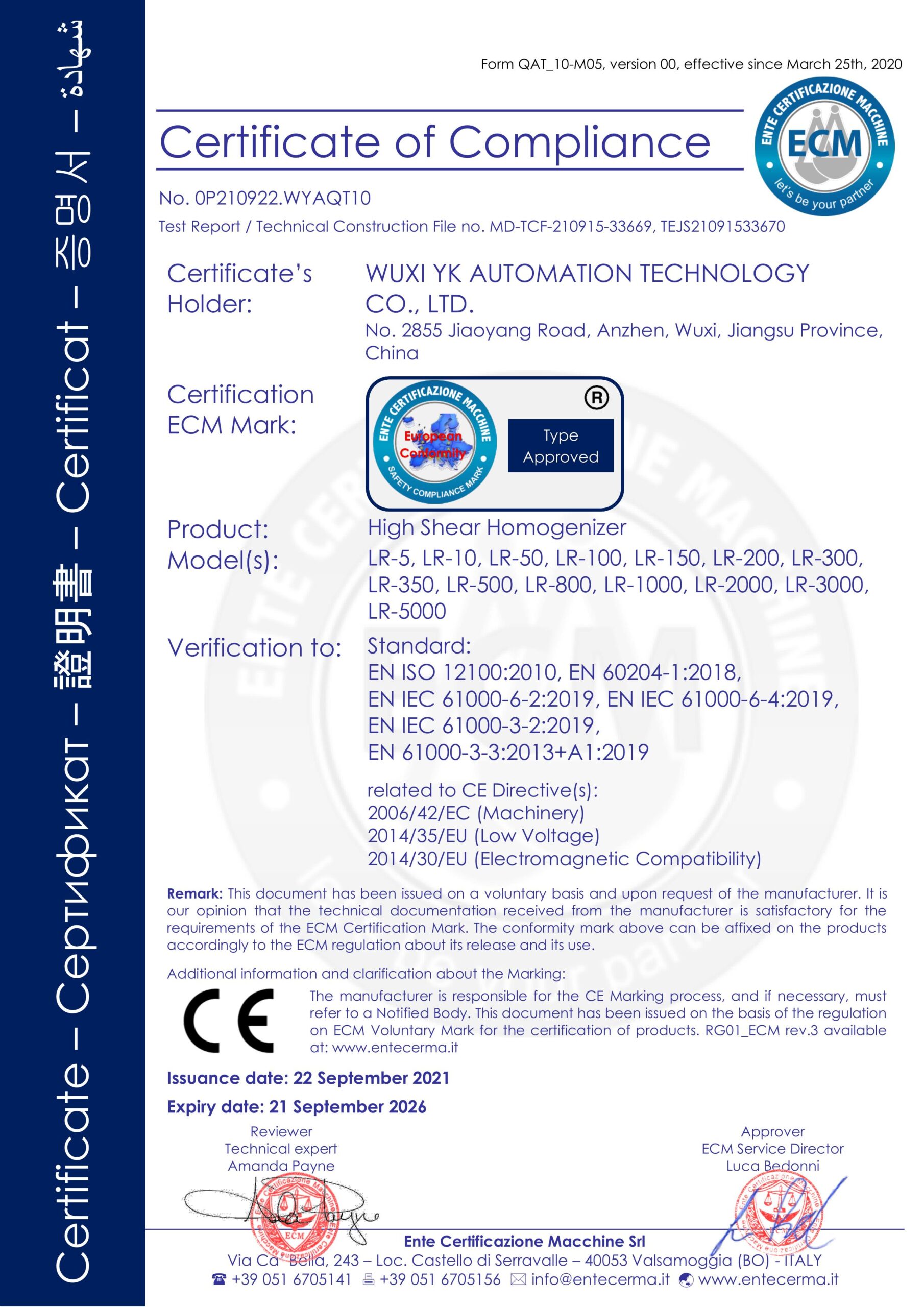
Compliance documentation should be checked against the exact model ordered, not against the product family in general.
What to verify: certificate scope against the ordered model; the FAT protocol and acceptance criteria; material certificates; electrical drawings; the spare-parts list; and the language of the operation and maintenance manual. A shortlist that stops at machine specifications and ignores documentation tends to produce problems at installation and import rather than at the quotation stage.
Applying the shortlist to a mayonnaise vacuum homogenizer mixer
Mayonnaise is an oil-continuous emulsion in which air entrainment and droplet size drive texture, colour and shelf stability. A high shear mayonnaise homogenizer has to disperse the oil phase into the aqueous phase quickly enough that the emulsion forms before separation can begin, and the vacuum stage then removes the air that the mixing action introduced. This is the point where the shortlist stops being theoretical: vacuum capability, homogenizer speed, temperature control and material grade all act on the same batch at the same time.
Read against a mayonnaise line, the recommended features map directly onto process requirements. Vacuum down to -0.09 MPa addresses deaeration, consistent with the way vacuum mixing is described as removing air bubbles from mayonnaise. Temperature tolerance to 110 °C covers oil-phase melting and the hot process step. SS316 becomes relevant where acid and salt loading are high. Homogenizer speed must be matched to final viscosity, since a high-viscosity product needs a drive sized for that viscosity at the specified speed rather than at free-flow conditions. Volume must be matched to the filling line, not to the vessel catalogue.
Cleaning deserves a specific line in the mayonnaise evaluation. High-fat products leave residue on the vessel wall, the homogenizer head and the discharge path, so the buyer should confirm that the cleaning method, surface finish and drainability of the specific unit have been considered for a fatty product rather than for a low-viscosity one.
Applying the shortlist to cosmetics emulsifying units
The cosmetic side of the shortlist looks similar on paper and different in practice. VMI describes laboratory vacuum homogenizers supporting dispersion, emulsification and homogenization for cosmetics, personal care, pharmaceutical emulsions, lotions and toothpaste, and lists dispersion, dissolution, homogenization, emulsion and heat exchange as the process functions required of production units. A cosmetic homogenizer mixer is therefore judged on the same seven features, but the weighting changes.
SS316 is specified more often, because actives, acidic components and fragrance systems place greater demands on corrosion resistance. PLC control rises in importance because a skincare production line typically runs many SKUs, and recipe repeatability across small batches is a quality requirement rather than a convenience. Vacuum matters for colour and texture consistency in creams and lotions, where entrained air shows up directly in the finished pack. Temperature control governs wax and oil phase behaviour, and the lab-to-production path matters more: YeKeey's range includes the ZJR-Lab Laboratory Emulsifying Mixer and the MC Lab Recirculation Homogenizing mixer alongside production models, which allows a formulation to be screened at laboratory scale inside the same series.
A cosmetics case from YeKeey's records illustrates the long-service angle buyers should look for. A Nigerian OBM client operating in cosmetics took three sets, has run the equipment for at least ten years, and reports stable operation with high production efficiency. That kind of record speaks to durability and service support rather than to any single specification.
Where YeKeey fits the shortlist
YeKeey is the brand of Wuxi YK Automation Technology Co., Ltd, a manufacturer of emulsifying machines, industrial mixers, laboratory mixers and filling machines based in Wuxi, Jiangsu Province, China, and established in 1998. The company operates a 20,000 m² facility with 80 employees, an annual output of 600 units, an R&D team of 8 engineers, and an export ratio of 35%, serving markets in Europe, Central Asia, North Africa, Latin America and Southeast Asia. It reports applications across more than 4,000 enterprises and institutions in more than 70 countries and regions.
Its vacuum emulsifying mixer range covers the three series referenced throughout this shortlist. The SP Series Standard Vacuum Processing Unit runs from SPA-30 to SPA-10T with 3.7–110 kW, working pressure to -0.09 MPa, temperature up to 110 °C and output speed up to 2800 rpm. The ZJR Series Vacuum Emulsifying Mixer runs from ZJR-5 to ZJR-2500 with 5–91.5 kW, the same pressure and temperature envelope, and output speed of 2800–6000 rpm; the ZJR-Lab Laboratory Emulsifying Mixer sits within that series. The MC Recirculation Homogenizing mixer runs from MC-100 to MC-2500 with 5–91.5 kW, pressure to -0.09 MPa, temperature to 110 °C and output speed up to 2800 rpm, with the MC Lab Recirculation Homogenizing mixer covering laboratory work. All three series are listed with SS304 and SS316 material options and are intended for cosmetics and food products, with mayonnaise as a key focus.
On the manufacturing side, the company states that it has reinvested roughly 10% of annual sales profit into research and development, held 55 patents and 3 software programs as of 2023, has operated an ISO 9001 quality system since 2003, and was recognised as a high-tech enterprise in 2018. Its production model covers OEM, ODM and OBM services, with customization options including voltage, designated appliance brands, weighing module, logo, machine dimensions, jar size and heating method. Commercial terms are stated as a minimum order quantity of 1 unit, monthly capacity of 50 units, lead time of 30–60 days, 100% testing, and after-sales support through remote video guidance, support for custom components and wear parts, and dispatch of technical personnel to site for repairs.
Comparison with conventional mixing approaches — and where vacuum units stop
| Dimension | Conventional atmospheric mixer or emulsifier | Vacuum homogenizer emulsifier mixer unit |
|---|---|---|
| Air entrainment | High; deaeration handled downstream or accepted in the product | Reduced in-vessel by negative pressure |
| Droplet size control | Depends on agitator type alone | High-shear homogenizing stage added |
| Thermal control | Open vessel limits heat and vacuum combinations | Jacketed, up to 110 °C on the series reviewed here |
| Batch repeatability | Largely operator dependent | Improved when PLC control and recipe storage are specified |
| Capital and maintenance | Lower purchase cost, simpler upkeep | Higher cost; vacuum pump, seals and instrumentation add maintenance items |
| Cleaning and validation | Simpler geometry, fewer surfaces | More surfaces and a vacuum system to clean and validate |
The comparison has to be read with its boundaries intact. A vacuum homogenizer emulsifier mixer unit carries a higher capital cost and more maintenance items than an atmospheric mixer — the vacuum pump, the shaft seals and the instrumentation are all additional systems that need service intervals and spare parts. It also demands disciplined operation: cleaning validation, seal inspection and trained operators are not optional, and a poorly maintained vacuum system will underperform a well-run atmospheric vessel. Push-button control is simpler but less repeatable, while PLC control adds capability and also adds training and spare-part dependency. None of these units will correct an unbalanced formulation, and the specified vacuum level should be treated as a working reference to be confirmed against the buyer's own product.
Locking the shortlist into an RFQ
Execution-stage buyers should convert the seven features into explicit RFQ line items so that responses can be compared without interpretation. The commercial framework also needs to be fixed at the same time: stated purchasing terms for this category include a minimum order quantity of 1 set, delivery terms of FOB, CIF, EXW or CFR, acceptance criteria based on factory acceptance testing, and payment terms of 30/70.
- State the product, target viscosity and batch size, and ask for the recommended series and model with the effective working volume.
- Specify the material grade for each product-contact component, not for the machine as a whole.
- Require the achievable vacuum level and the pressure-hold test result to be documented at FAT.
- Confirm whether 110 °C is a product or jacket rating, and state the required cooling time.
- Ask for rotor diameter, tip speed and motor power at the specified speed, not the rpm figure alone.
- Declare whether push-button or PLC control is required, and whether recipe storage and data export are included.
- Request the current CE certificate, its scope, the material certificates and the FAT protocol before the order is placed.
Future outlook
The direction of the category is toward documented capability rather than headline claims. With the vacuum mixer homogenizer market estimated at USD 1.02 billion in 2026 and projected to reach approximately USD 1.61 billion by 2036, and with Asia Pacific already holding 44.1% of homogenizer revenue in 2023, the supply base will keep widening. Wider supply makes feature-level comparison more valuable, not less, because the number of quotations a buyer must screen grows faster than the number of genuinely differentiated offers.
Two further shifts are visible in the evidence. First, food and cosmetic requirements are converging on the same equipment platform: manufacturers describe the same vacuum homogenizing and emulsifying equipment for mayonnaise and for cosmetic or personal-care formulations, which supports a dual-application screening approach while leaving technical equivalence unproven for any specific product. Second, laboratory-to-production continuity is becoming a selection criterion in its own right, as series such as the ZJR-Lab and MC Lab models allow formulation work and scale-up to stay inside one supplier's design language. Both trends should be treated as planning signals rather than guarantees; published market forecasts are commercial research estimates and should be re-checked against current supplier data at the time of purchase.
Frequently asked questions
What vacuum level should be specified for a mayonnaise vacuum homogenizer mixer?
A working pressure of approximately -0.09 MPa is the reference level most often used in this category and is the value listed across YeKeey's SP, ZJR and MC vacuum emulsifying mixer series. Buyers should verify the pressure the system can hold at the shaft seal across a full production batch, confirm that a pressure-hold or leak test is included in factory acceptance testing, and treat the figure as a working reference to be validated on their own formulation rather than as a guaranteed outcome.
Is SS304 or SS316 the better choice for a cosmetic emulsifying unit?
SS304 is the default for general aqueous and emulsion products. SS316 is normally specified where the formulation is more aggressive — higher chloride loading, acidic components, more demanding cleaning chemistry — or where hygiene expectations in the destination market are stricter. Because both grades are listed as options across the SP, ZJR and MC series, the decision can be made per project. Buyers should confirm which specific product-contact components are supplied in SS316, including the homogenizer rotor and stator, and request material certificates.
Should a first production line use push-button or PLC control?
The choice follows production complexity rather than budget. Push-button control fits single-recipe or low-SKU production, is faster to train on, and has fewer spare-part dependencies. PLC control fits multi-recipe production where temperature, vacuum, homogenizer speed and time must be repeated batch after batch, and where alarm and interlock records are needed for quality documentation. Buyers should confirm whether PLC control is included in the quoted price or listed as an option, and whether controllers and drives can be supported locally.
Can one vacuum homogenizer emulsifier mixer unit run both mayonnaise and cosmetic cream?
The equipment category is marketed for both. YeKeey lists cosmetics and food products, with mayonnaise as a key focus, as the applicable industries for its SP, ZJR and MC vacuum emulsifying mixer series, and other manufacturers describe the same equipment family for mayonnaise and for cosmetic and personal-care formulations. In commercial production, however, changeover cleaning, contaminant and allergen control, and separate quality documentation usually argue for dedicated lines. Buyers planning dual use should confirm cleaning validation and material compatibility with the supplier before committing.
What are the minimum order quantity, lead time and commercial terms?
For this category the stated terms are a minimum order quantity of 1 unit or 1 set, a production lead time of 30–60 days, and monthly capacity of 50 units. Delivery terms quoted are FOB, CIF, EXW or CFR, acceptance criteria are based on factory acceptance testing, and payment terms are 30/70. Buyers should confirm each of these against the specific model and destination before the order is placed.
How is machine performance verified before shipment?
Factory acceptance testing is the stated acceptance criterion, supported by 100% testing of units. A verification package should include the FAT protocol and results, the pressure-hold test, material certificates, electrical drawings, the spare-parts list and the current CE certificate checked against the exact model ordered. YeKeey's CE certification, issued by ECM under certificate numbers 0P210922.WYAQT12, 0P210922.WYAQT10 and 0P210922.WYAQT11, cites EN ISO 12100:2010, EN 60204-1:2018 and the EN IEC 61000 series. After-sales support is provided through remote video guidance, support for custom components and wear parts, and dispatch of technical personnel to site for repairs.
Есть вопросы или нужны дополнительные детали?
Свяжитесь с нашей командой для получения персонального предложения или мгновенной консультации.
Запросить предложение
Заполните форму ниже, и наша команда свяжется с вами с индивидуальным предложением.
Прямой чат WhatsApp
Предпочитаете общаться в реальном времени? Напишите нам в WhatsApp для мгновенной помощи и быстрых ответов.
- Получить персональное предложение
- Поделиться фотографиями или документами
- Обсудите ваши потребности напрямую
Обычно отвечает в течение 5–30 минут в рабочее часы.