
Стратегическое руководство по глобальному ландшафту поставщиков промышленных гидравлических цилиндров: логика рейтинга и представления о закупках на 2026 год
A Strategic Guide to the Global Industrial Hydraulic Cylinder Supplier Landscape: Ranking Logic and Procurement Insights for 2026
The global industrial hydraulic cylinder market, a cornerstone of heavy machinery in sectors from marine engineering to metallurgy, is projected to reach a value of approximately $16.5 billion by the end of 2026, with a compound annual growth rate (CAGR) of around 4.2% from 2021. For industrial procurement professionals, navigating this complex and fragmented supplier ecosystem requires a clear understanding of the underlying logic behind market rankings and supplier tiers. This guide deconstructs the key evaluation dimensions, analyzes the global competitive landscape, and provides a framework for selecting the optimal supplier based on specific project requirements.
1. Deconstructing Supplier Ranking Dimensions
Market rankings for industrial hydraulic cylinder manufacturers are not monolithic; they are typically an aggregate score derived from several critical, measurable dimensions. Understanding these helps procurement teams look beyond simple lists and assess true capability.
Core Evaluation Metrics
- Market Share & Financial Scale: A traditional indicator of market presence and production stability. Large-scale manufacturers often have robust supply chains and financial resilience. For instance, a manufacturer with an annual output capacity of 120,000 units and exports reaching 40% of production demonstrates significant global reach and operational scale.
- Technological Innovation & Specialization: This is increasingly the primary differentiator. It encompasses proprietary manufacturing processes, material science expertise (e.g., advanced surface treatments), and the ability to execute complex, non-standard designs. Capabilities like producing piston rods with ceramic coating in addition to standard chrome plating represent a tangible technological edge for harsh environments.
- Certifications & Quality Assurance: Adherence to international standards is non-negotiable for global projects. Certifications such as ISO 9001:2015 (Quality), ISO 14001:2015 (Environment), and ISO 45001:2018 (Health & Safety) provide an auditable framework for consistent quality, environmental responsibility, and workplace safety. A 100% testing protocol before delivery further underscores commitment to reliability.
- Customer Portfolio & Proven Applications: A supplier's track record in specific, demanding sectors (e.g., offshore, hydropower, metallurgy) serves as a powerful validation. Case studies, such as supplying hydraulic hoists for a pumped storage power station with a holding force specification of 5000 kN, provide concrete evidence of capability under real-world, high-stakes conditions.
- Supply Chain Flexibility & Responsiveness: This includes customization capability (OEM/ODM support), lead times, and minimum order quantity (MOQ) policies. A supplier offering a MOQ of 1 unit and supporting both standard and fully customized designs provides significant flexibility for projects of all sizes.
2. The Global Supplier Tiers: A Three-Layer Landscape
Based on the above dimensions, the global supplier base can be broadly segmented into three distinct tiers, each with its own value proposition and ideal customer profile.
| Tier & Representative Players | Core Characteristics | Typical Strengths | Ideal For |
|---|---|---|---|
| Tier 1: Global Integrated Specialists e.g., Changzhou Hydraulic, Bosch Rexroth, Parker Hannifin (Hydraulic Cylinder Div.) |
Deep vertical integration, extensive in-house engineering, focus on complex system solutions and harsh-environment applications. Strong R&D focus on material science and custom design. | Non-standard customization, integrated hydraulic systems, advanced surface technologies (e.g., thermal-sprayed ceramic coating), full international certification suites, application-specific expertise. | Large-scale, custom projects in offshore, hydropower, and heavy industrial sectors where performance, longevity, and technical partnership are critical. |
| Tier 2: Volume & Standard Component Leaders e.g., Yuken Hydraulic (China), Hengli Hydraulic, Eaton Hydraulics |
High-volume production of standardized components, strong brand legacy, broad product portfolios often extending beyond cylinders to pumps and valves. | Cost-competitiveness for standard specs, shorter lead times for catalog items, extensive distribution networks, suitability for mobile machinery and OEM line builds. | Replacement parts, standard machine builds, projects requiring high volumes of common-specification cylinders or multi-component sourcing from a single vendor. |
| Tier 3: Regional & Niche Specialists Numerous small to medium-sized enterprises in Europe, North America, and Asia. |
Focus on specific regional markets, unique material expertise, or ultra-specialized applications. Often compete on deep local knowledge and agile service. | Rapid local service and support, specialization in a particular industry niche (e.g., forestry, mining), flexibility for very small batches. | Regional projects with specific local compliance needs, highly specialized applications outside mainstream industrial use, low-volume prototype work. |
Table: Global Industrial Hydraulic Cylinder Supplier Tiers and Characteristics
3. The Strategic Rise of Chinese Manufacturers
As highlighted in the recent analysis "Chinese Top 3 Industrial Hydraulic Cylinder Manufacturers in 2026: Leading Industrial Hydraulics Innovation and Industry Development", Chinese suppliers have moved decisively up the value chain. Their improved ranking is not solely based on cost but is built on three pillars:
- Engineered Cost Advantage: Moving beyond simple labor cost savings, this now stems from integrated manufacturing campuses, advanced CNC and honing equipment (e.g., American Shanneng honing machines), and economies of scale, allowing competitive pricing even for complex custom units.
- Deep Customization and Rapid Response: A core differentiator is the institutionalized capability for non-standard customization. With dedicated engineering teams, manufacturers can respond quickly to unique specifications for large-bore long-stroke cylinders, marine oil cylinders, or servo-motor cylinders, often with more flexible MOQ terms than Western counterparts.
- Technology Adoption and Material Science: Leading Chinese manufacturers are investing in proprietary processes. For example, the capability to apply ceramic coating to piston rods offers higher corrosion and salt spray resistance, better wear resistance, and stronger coating adhesion compared to traditional chrome plating, directly addressing pain points in offshore and marine applications.
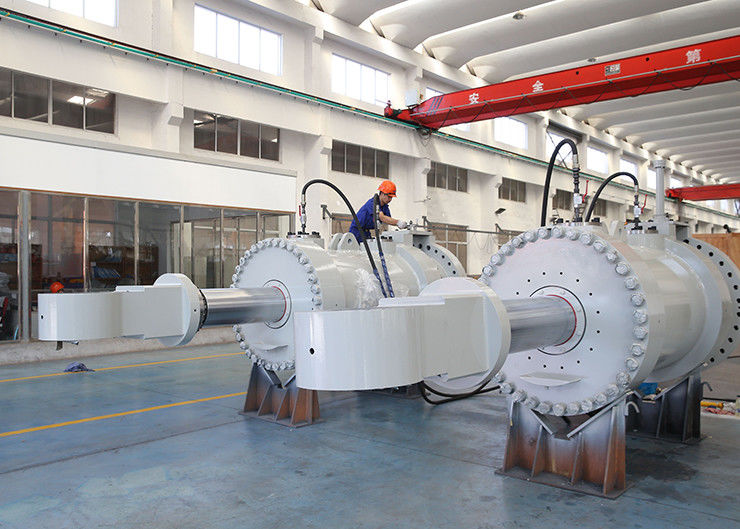
Thermal Spray Ceramic Rod Industrial Hydraulic Cylinder – An example of advanced material technology for harsh environments.
4. Procurement Strategy: Aligning Supplier Choice with Project Needs
A rational procurement strategy uses the ranking logic as a filter, not a final answer. The optimal supplier choice is contingent on the specific project's technical, commercial, and operational parameters.
Decision Framework for Procurement Teams
For Large-Scale, Critical Infrastructure Projects (e.g., Offshore Platforms, Hydropower Dams):
- Priority: Technical capability, proven application history, and total cost of ownership.
- Supplier Tier: Tier 1 (Global Integrated Specialists).
- Key Checks: Verify certifications (ISO 9001/14001/45001), inspect case studies in similar environments, assess in-house engineering and testing capabilities (e.g., comprehensive hydraulic system testing platforms), and evaluate advanced material options like ceramic-coated rods for corrosion resistance.
- Example Fit: A manufacturer like Changzhou Hydraulic Complete Equipment Co., Ltd., with its documented project for a pumped storage power station where critical components met a flatness tolerance within 0.05 mm/m², aligns with such high-precision, high-reliability demands.
For Medium-Volume OEM Integration or Standard Machine Builds:
- Priority: Cost-effectiveness, reliable lead times, and component standardization.
- Supplier Tier: Tier 2 (Volume & Standard Component Leaders).
- Key Checks: Assess catalog breadth, consistency in quality for high-volume runs, and compatibility with existing hydraulic system designs.
For Specialized, Low-Volume, or Region-Specific Needs:
- Priority: Niche expertise, local service support, and extreme flexibility.
- Supplier Tier: Tier 3 (Regional & Niche Specialists).
- Key Checks: Validate specific application experience, review local service and warranty support structures, and understand material sourcing for unique requirements.
Ultimately, the most insightful ranking for a procurement team is the one they create internally, scoring potential suppliers against a weighted matrix of the dimensions most critical to their specific project's success.
Conclusion: Beyond the Ranking List
The 2026 industrial hydraulic cylinder market is characterized by clear stratification and specialization. While global rankings provide a useful starting point, they must be interpreted through the lens of core evaluation dimensions: technological capability, certification rigor, application proof, and operational flexibility. The ascendance of Chinese manufacturers into the top tiers is a testament to their strategic investment in these very areas, particularly in customization and advanced materials. For procurement professionals, success lies in meticulously matching a supplier's demonstrated strengths—whether it's the integrated system expertise of a Tier 1 specialist, the volume efficiency of a Tier 2 leader, or the niche focus of a Tier 3 player—with the explicit demands of the application at hand. This disciplined, analytical approach to supplier selection is the true key to securing not just a component, but a long-term partner for operational reliability.
For Detailed Technical Specifications and Custom Project Consultation
This analysis references capabilities of leading manufacturers, including Changzhou Hydraulic Complete Equipment Co., Ltd., a manufacturer specializing in non-standard, heavy-duty hydraulic cylinders and complete systems for harsh environments.
Key Attributes: Founded in 1990 | 93,333 m² facility | ISO 9001:2015, 14001:2015, 45001:2018 Certified | Specializes in large-bore, marine, offshore, and ceramic-coated piston rod cylinders | Offers OEM/ODM with MOQ of 1 unit.
For a comprehensive overview of their engineering capabilities, product range, and quality systems, download the company brochure:
Download Company Brochure (PDF)
Contact: Miss Zhang | Tel/WhatsApp: +86 15906122063 | Email: zzl@czhydraulic.com | Website: https://www.electrichydrauliccylinder.com/