
A Task-Based Shortlist for Hospital Pharmacy Automation
A Task-Based Shortlist for Hospital Pharmacy Automation

Hospital pharmacy automation is rarely a single purchase. It is a series of purchases, and each one is attached to a task with its own drug classes, its own handling rules, its own peak-hour throughput and its own physical footprint. A pharmacy team that compares machines by headline speed across fundamentally different tasks will usually end up with the wrong shortlist.
The market context explains why these lists are being built now. The global pharmacy automation devices market was estimated at USD 6.7 billion in 2024, according to Insightace Analytic, and Grand View Research projects the wider pharmacy automation market to reach USD 11.6 billion by 2030, growing at a CAGR of 9.9%. Within that market, medication dispensing systems accounted for the largest product segment share at 32.5% in 2025, while automated medication compounding systems are projected to be the fastest-growing product segment with a CAGR exceeding 10%. Hospital pharmacies held the largest segment share in 2024, reflecting high patient volumes and complex medication regimens.
This article takes a task-based route. It maps recommended pharmacy automation options to the specific hospital pharmacy tasks they address: cytotoxic compounding, anesthetic medication dispensing, narcotic and psychotropic drug management, unit-dose sub-packaging and verification, high-speed outpatient dispensing, and robotic arm dispensing. It is not a single-vendor ranking. The selection notes that follow cover the questions that actually decide projects — HIS integration, AI visual verification, compounding accuracy of 100%, Class 100 (ISO 5) cleanroom use, space requirements, and the honest question of whether automation fits every hospital.
Why task-based selection works better than product-first comparison
Product-first comparison tends to converge on the same few numbers: dispensing speed, storage capacity and price band. Those numbers matter, but they are not usually what stops a project. In real hospital projects the binding constraints are narrower: which drug class is being handled, which regulation applies to it, how many prescriptions must clear during the busiest hour, how much floor area and floor loading the room can accept, and whether the pharmacy system can exchange data with the hospital information system.
A task-based list also makes boundary conditions visible. When a system is presented against a task rather than against a competitor, it becomes easier to rule it in or out before a vendor visit — and easier to justify the decision internally. Three questions recur in nearly every pharmacy automation review:
- Can pharmacy automation systems integrate with a hospital HIS?
- Can pharmacy automation reduce medication picking errors?
- What types of hospitals are actually suitable for a given class of equipment?
These are suitability questions, not specification questions, and they are addressed later in this article alongside the equipment shortlist.
The five criteria used to build this shortlist
Every option below was evaluated against the same five criteria, and each option is presented with the figures that constrain it.
| Criterion | What it decides |
|---|---|
| Task and drug class | Whether the equipment handles boxed medications, ampoules, vials, cytotoxics, anesthetics, or controlled substances |
| Regulatory and handling requirements | Whether controlled-substance rules, cleanroom conditions or electronic record requirements apply |
| Peak throughput and storage scale | Whether the unit keeps pace with prescription peaks and SKU breadth |
| Footprint, weight and utilities | Whether the room can physically accept the equipment and its power and loading requirements |
| Software integration and verification | Whether prescription data flows in automatically and whether a verification step exists |
Two standards appear repeatedly in these evaluations. Pharmacy automation systems must generally comply with IEC 60601-1 for medical electrical equipment safety and ISO 13485 for quality management, according to CSA Group. In the United States, FDA 21 CFR Part 11 regulates electronic records and electronic signatures in pharmacy automation to ensure data integrity. Buyers should confirm which of these apply to their jurisdiction and to each specific device class before shortlisting.
Task 1 — Cytotoxic and IV compounding in PIVAS
Recommended option: HOH-Robot-Plus
The HOH-Robot-Plus is a fully automated robotic cytotoxic drug compounding system intended for the PIVAS environment. It is a metal-constructed unit with an overall size of 2,200 x 1,520 x 2,370 mm and a device weight of 1,300 kg.
What makes this system distinctive is not a single specification but the combination of environment, verification and waste handling:
- Compounding environment: Class 100 (ISO 5) cleanroom conditions
- Compounding accuracy: 100%
- Compounding efficiency: 25 preparations per hour
- Vial compatibility: more than 95% of vials
- Solvent compatibility: 50–1000 mL soft bags, plastic bottles and stand-up pouches
- Consumables: luer-lock general-purpose syringes with dedicated needles
- Technology: AI vision recognition combined with high-precision weighing
- Waste handling: automatic medical waste classification and storage
Selection note. The operational argument for the HOH-Robot-Plus is human–machine separation. By automating drug injection, dissolution, aspiration and mixing inside a closed Class 100 environment, the system removes healthcare staff from direct contact with cytotoxic preparations and eliminates occupational exposure risk. The same configuration promotes digitalized management across the medication process. The practical constraints are equally clear: 1,300 kg requires a floor-loading check, and a compounding rate of 25 per hour should be matched against the PIVAS workload profile rather than assumed to be sufficient.
Task 2 — Anesthetic medication dispensing in outpatient, emergency and inpatient pharmacies
Recommended option: HOH-MJ-01
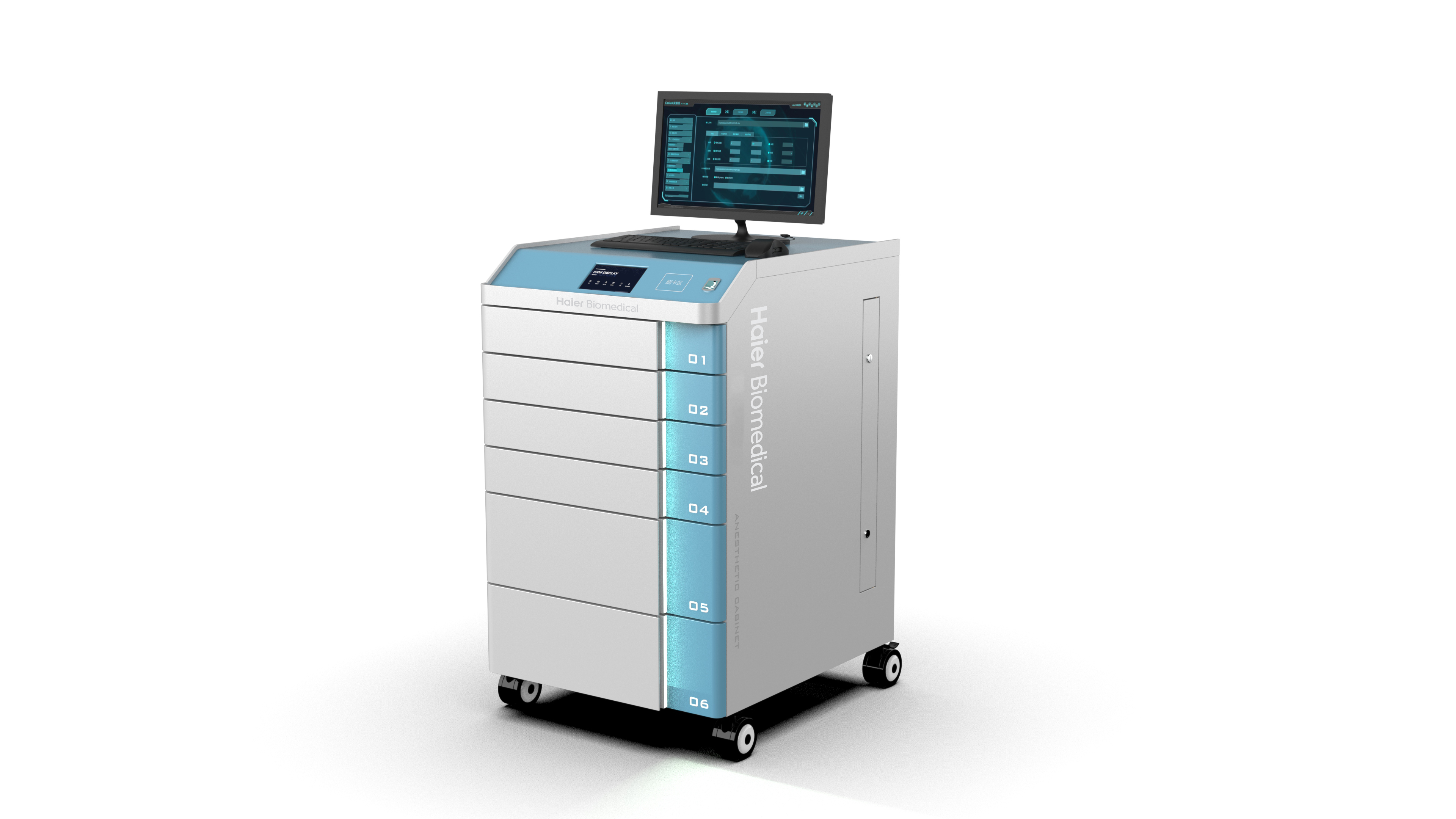
The HOH-MJ-01 is an anesthetic medication dispensing cabinet designed for hospital outpatient pharmacies, emergency pharmacies and inpatient pharmacies. It is a metal cabinet with a 745 x 700 x 1,800 mm external footprint, a net weight of 400 kg, a 400 W power draw at 220 V / 50 Hz / 60 Hz, and a 15-inch touch screen.
Storage is organized into nine drawers. The first seven drawers use a six-grid layout and the bottom two use a single-grid layout, all fitted with lids, giving 44 compartments in total. The maximum volume of a single layer is 28.3 L, and drawer sizes are 243 x 128 x 85 mm for the small format (42 units) and 477 x 491 x 108 mm for the large format (2 units).
Selection note. The HOH-MJ-01 is positioned as full-process intelligent control for anesthetic and psychotropic drugs, built on three design principles: safety and compliance, intelligence and efficiency, and closed-loop data. It aligns with hospital "Five-Specialty Management" requirements for anesthetic and psychotropic drugs, and it targets three long-standing weaknesses of manual management — difficult traceability, disordered access control and low inventory accuracy. For a buyer, the relevant test is whether the cabinet's compartment count and single-layer volume match the actual anesthetic formulary of the department it serves.
Task 3 — Narcotic and psychotropic drug storage and monitoring
Recommended option: HOH-BQ-A
The HOH-BQ-A is an Intelligent Integrated Medication Management Cabinet for the storage, management and monitoring of narcotic and psychotropic drugs in operating rooms or pharmacy preparation areas. It complies with national regulations for the management of controlled substances and is intended for the pharmacies industry. The cabinet measures 620 x 700 x 1,240 mm, runs on AC 220 V 50/60 Hz, and is fitted with a 23-inch touch screen.
Its capacity is defined by two pillbox formats: 32 standard small pillboxes, each holding 150 pieces counted on a 1 mL ampoule basis, and 8 standard large pillboxes, each holding 20 pieces counted on a regular pillbox basis.
Selection note. This is a cabinet-scale controlled-substance solution, not a bulk store. It should be shortlisted where the requirement is full traceability and precise control at the point of use — the operating room or the preparation area — rather than where the requirement is volume throughput. Buyers evaluating controlled-substance handling should verify how the cabinet's records align with their own regulatory reporting obligations.
Task 4 — Unit-dose sub-packaging and verification
Recommended option: HOH-FB-D400-HD
The HOH-FB-D400-HD is an automatic sub-packaging and verification machine for the pharmacies industry. It integrates automatic unit-dose packaging with AI-powered visual verification in a single unit, is interoperable with hospital HIS systems, and executes unit-dose dispensing based on physician orders while verifying drug type, quantity and prescription accuracy in real time.
Key figures for project planning:
- Overall dimensions: 1,200 x 880 x 2,025 mm
- Net weight: 700 kg
- Power supply and rated power: AC 220 V +10%, 50/60 Hz, 2,000 W
- Number of medication boxes: 400
- Packaging speed: 40–60 packs per minute
- Packaging bag size: 75 x 70 mm
- External output tray: 72 slots
- Operating environment: 0–40 °C, 10–80% relative humidity
Selection note. The closed-loop "packaging + verification" workflow is the reason to shortlist this machine: it addresses mispackaging risk at the point where unit-dose errors are created. The boundary condition is the fixed 75 x 70 mm packaging bag size, which should be checked against local dispensing and administration requirements, along with the 2,000 W power draw and 700 kg floor load.
Task 5 — High-volume outpatient dispensing
Option A: HOH-KF-1200 Chute Type Dispenser
The HOH-KF-1200 handles more than 1,100 medication types with a storage capacity exceeding 15,000 boxes. Its main unit dimensions are under 4,690 x 2,850 x 2,735 mm, with a stated space requirement of under 12.85 m². Dispensing speed exceeds 350–500 prescriptions per hour, and replenishment speed exceeds 2,400 boxes per hour.
Structurally, the HOH-KF-1200 uses modular dispensing, storage and loading units. It dispenses full-screen with safety buffers and supports parallel multi-prescription operation, and its dispensing buffer port provides at least two channels with side buffering and front-end output. Integration with the HIS system allows prescription medications to be synchronized in a one-time dispensing mode.
Selection note. The HOH-KF-1200 is the option to evaluate when the dominant problem is prescription throughput combined with broad SKU coverage in an outpatient pharmacy. With more than 1,100 medication types and more than 15,000 boxes, it also functions as the storage backbone rather than as a satellite unit.
Option B: HOH-GF (2 Modules) High Speed Dispenser
The HOH-GF is a modular high-speed dispenser built for high-frequency, high-volume boxed medications. It is interoperable with hospital HIS systems and integrates AI-powered visual verification. It operates within an environment of 0–40 °C and 10–80% humidity.
- Storage slots: at least 100
- Storage capacity: at least 5,000 boxes
- Main unit dimensions: 2,180 x 1,230 x 2,800 mm
- Medication bin modules: up to 2
- Dispensing speed: single-channel dispensing at least 2 boxes per second
- Structural design: dual-level stacked structure with adjustable bin width
- Dispensing method: batch dispensing for multiple boxes
- Detection and alerts: high-precision photoelectric sensors, with automatic positioning guidance by indicator lights
Selection note. The HOH-GF is a density play rather than a breadth play. Where the HOH-KF-1200 covers more than 1,100 medication types and high prescription counts, the HOH-GF concentrates on fast-moving boxed medications in a stacked, adjustable-bin configuration with a single-channel rate of at least two boxes per second. Hospitals often evaluate the two together rather than as alternatives, using the high-speed unit to feed the broader dispensing workflow.
Task 6 — Robotic arm dispensing with full-chain traceability
Recommended option: HOH-KF-Smart
The HOH-KF-Smart is a Robotic Arm Dispenser classified as a Robotic Arm Medication Dispensing System. It handles at least 1,500 medication types with a storage capacity of at least 20,000 boxes, dispenses at least 300 prescriptions per hour, and replenishes at least 700 boxes per hour. Main unit dimensions are 8,650 x 1,747 x 2,850 mm, excluding the replenishment module.
The system combines industrial-grade robotic arms with intelligent storage management and AI-based visual recognition. It integrates with the hospital HIS system to receive prescription data in real time, then automatically picks, positions and dispenses medications. Expiration management supports FIFO and FEFO, and barcode recognition provides full-chain traceability. Like the other dispensing platforms in this shortlist, it supports parallel multi-prescription operation, uses a modular structure for maintenance and scalability, and provides at least two buffer channels with side buffering and front-end output.
Selection note. Robotic dispensing is particularly suitable for high-volume boxed medication storage and dispensing. The distinguishing feature here is not speed alone but the traceability layer: barcode recognition and FIFO/FEFO expiration management create a documented chain from storage location to dispensing point. The counterweight is footprint — 8,650 mm of main unit length excluding the replenishment module — which makes site planning a first-order decision rather than a detail.
Shortlist summary
| Pharmacy task | Recommended option | Defining figures | Primary constraint to check |
|---|---|---|---|
| Cytotoxic / IV compounding (PIVAS) | HOH-Robot-Plus | Class 100 (ISO 5); 100% compounding accuracy; 25/h; >95% vial compatibility | 2,200 x 1,520 x 2,370 mm; 1,300 kg floor load |
| Anesthetic medication dispensing | HOH-MJ-01 | 44 compartments; 28.3 L maximum single-layer volume; 15-inch screen | 745 x 700 x 1,800 mm; 400 kg; 400 W |
| Narcotic / psychotropic management | HOH-BQ-A | 32 small pillboxes at 150 pcs; 8 large pillboxes at 20 pcs; 23-inch screen | 620 x 700 x 1,240 mm; cabinet-scale capacity |
| Unit-dose sub-packaging and verification | HOH-FB-D400-HD | 40–60 packs/min; 400 medication boxes; 72-slot output tray | Fixed 75 x 70 mm bag size; 700 kg; 2,000 W |
| High-volume outpatient dispensing | HOH-KF-1200 | >1,100 medication types; >15,000 boxes; 350–500 prescriptions/h; <12.85 m² | Main unit under 4,690 x 2,850 x 2,735 mm |
| Dense storage of fast-moving boxed drugs | HOH-GF (2 Modules) | ≥100 slots; ≥5,000 boxes; ≥2 boxes/sec single channel | Up to 2 bin modules; 2,180 x 1,230 x 2,800 mm |
| Robotic dispensing with full traceability | HOH-KF-Smart | ≥1,500 medication types; ≥20,000 boxes; ≥300 prescriptions/h; FIFO/FEFO | Main unit 8,650 x 1,747 x 2,850 mm, replenishment module excluded |
What HIS integration and AI verification actually change
Integration is not a feature badge; it changes where errors and delays occur. Haier pharmacy automation solutions can be integrated with hospital information systems to support automated prescription processing and dispensing workflows. Depending on project requirements, the system can connect with HIS and EMR platforms so that prescription information is transferred to the pharmacy automation system for dispensing.
The mechanism is straightforward. The hospital system sends prescription information through a defined interface, and the pharmacy automation system processes the prescription according to configured dispensing rules and equipment workflows. The effect is to reduce repetitive manual data entry and improve process continuity between prescribing, dispensing and administration.
Verification is the second layer. In this shortlist, AI-powered visual verification appears on the HOH-FB-D400-HD and the HOH-GF (2 Modules), while barcode recognition with full traceability and FIFO/FEFO expiration management appear on the HOH-KF-Smart. When automated dispensing is combined with a medication verification process — such as an automated verification machine — the workflow provides an additional check on medication information before dispensing. Automation reduces the number of manual picking steps; verification adds a check that did not exist in the same form before.
Space, weight and utilities: the constraints that decide projects
Footprint data is often treated as an afterthought, but in existing hospital buildings it is frequently the deciding factor. The range across this shortlist is wide. The HOH-BQ-A occupies 620 x 700 x 1,240 mm. The HOH-MJ-01 occupies 745 x 700 x 1,800 mm at 400 kg. The HOH-FB-D400-HD occupies 1,200 x 880 x 2,025 mm at 700 kg and draws 2,000 W. The HOH-KF-1200 has a stated space requirement of under 12.85 m² within a main unit envelope of under 4,690 x 2,850 x 2,735 mm. The HOH-KF-Smart extends to 8,650 mm in main unit length before the replenishment module is added.
Two further constraints sit alongside dimensions. Power supply is standardized across most units at AC 220 V 50/60 Hz, with the sub-packaging machine specified at AC 220 V +10%. Floor loading matters wherever equipment is installed above ground level, and the HOH-Robot-Plus at 1,300 kg is the clearest example in this set. Confirming these figures against site drawings and structural assessments should happen before, not after, equipment selection.
Manual workflows versus automated systems — and where automation stops being the answer
The comparison with traditional pharmacy practice is often framed as speed. That framing is incomplete. Traditional shelves rely on pharmacists and technicians to locate and retrieve medications manually, and the accuracy of the process depends on the individual, the workload and the time of day. Automated systems inherit a different model: the system identifies the required medication position and brings it, or the corresponding dispensing unit, into position according to configured rules.
Efficiency gains are real but bounded. One widely cited industry figure states that 75% of pharmacist time is traditionally spent on non-clinical tasks; that figure originates from vendor-published material and is best treated as directional. A separate claim attributes up to 90% reduction in drug wastage to automation in certain clinical settings, but that claim is also vendor-derived and should be verified against local data before it is used in a business case.
The honest limits of automation deserve equal attention:
- Capital and infrastructure. Each option in this shortlist has a footprint, a power draw and, in several cases, a floor-loading requirement that must be engineered rather than assumed.
- Format lock-in. The HOH-FB-D400-HD packages into a fixed 75 x 70 mm bag. If local administration requirements differ, that is a compatibility question, not an afterthought.
- Staffing reality. A pharmacy automation system can automate repetitive picking and dispensing, transferring those tasks from manual operation to equipment. It does not transfer clinical judgement, and it does not remove the need for verification steps in the workflow.
- Operating environment. Equipment specified for 0–40 °C and 10–80% humidity, as with the HOH-FB-D400-HD and HOH-GF, assumes a controlled room. Sites without that control need to plan for it.
- Integration dependency. HIS connectivity is a project deliverable, not a default. Interface scope, validation approach and fallback procedures are defined per hospital.
Does automation fit every hospital?
No, and the shortlist above is not a recommendation to automate everything. Suitability depends on volume, drug mix, floor space and existing systems. Three task-level questions are worth asking directly.
Is the boxed-medication volume high enough to justify robotic dispensing? A Robotic Arm Dispenser is suitable for hospitals that handle a relatively large number of boxed medications and require automated storage and dispensing. The HOH-KF-Smart can be configured with multiple modules and integrated into the overall pharmacy workflow according to medication volume, available space and dispensing requirements. Facilities with modest boxed-medication volume and constrained floor space are less likely to justify the configuration.
Is the priority throughput or control? High prescription counts in an outpatient setting point toward the HOH-KF-1200 or a combined KF-1200 / HOH-GF arrangement. Controlled-substance oversight points toward cabinet-scale solutions such as the HOH-BQ-A and HOH-MJ-01, where the value is traceability and access control rather than volume.
Is there a hazardous-handling task? If the pharmacy prepares cytotoxic drugs, the question is not whether automation is convenient but whether personnel can be separated from the compounding process. That is the specific design purpose of the HOH-Robot-Plus.
Market signals behind the shortlist
Several published trends support the task-based framing. Automated medication compounding systems — the category that includes the HOH-Robot-Plus — are projected to be the fastest-growing product segment with a CAGR exceeding 10%. Pharmacy automation software is expected to grow at the fastest rate among components from 2024 to 2030, which is consistent with the weight this shortlist places on HIS integration and verification logic. Decentralized distribution models are expected to account for 79.8% of the market in 2026, driven by the adoption of automated dispensing cabinets.
Regionally, North America held the largest revenue share in 2024, at approximately 38.2% to 47.8% depending on the source, and the U.S. pharmacy automation market is projected to reach USD 1.9 billion by 2026. The China pharmacy automation market is estimated to grow at a CAGR of 5.6% between 2025 and 2030. Market estimates for 2024 vary between USD 6.65 billion and USD 7.52 billion depending on whether secondary services and software components are included — a reminder that any single market figure should be read with its scope definition attached.
Future outlook
The direction of travel is from isolated machines toward task networks. A pharmacy that installs a dispensing platform, a sub-packaging and verification unit and a compounding robot is not running three independent projects; it is running one workflow in which prescription data, verification records and traceability chains need to reconcile. This is why software is expected to grow fastest among components. It is also why buyers increasingly evaluate integration architecture, data integrity provisions such as FDA 21 CFR Part 11 in the U.S., and equipment safety standards such as IEC 60601-1 alongside mechanical specifications.
The second shift is demographic rather than technical. As pharmacy labour becomes harder to recruit and retain, the case for transferring repetitive picking and dispensing to equipment strengthens in high-volume departments and weakens in low-volume ones. The likely outcome is not universal automation but uneven, task-specific automation, with the shortlist above being re-drawn for each site.
Frequently asked questions
Can pharmacy automation systems integrate with a hospital HIS?
Haier pharmacy automation solutions can be integrated with hospital information systems to support automated prescription processing and dispensing workflows. Depending on project requirements, the system can connect with HIS and EMR platforms, allowing prescription information to be transferred to the pharmacy automation system for medication dispensing. In practice, the hospital system sends prescription information through a defined interface, and the pharmacy automation system processes the prescription according to configured dispensing rules and equipment workflows. This reduces repetitive manual data entry and improves process continuity. Interface scope, validation approach and fallback procedures are defined per hospital project rather than assumed.
Can pharmacy automation reduce medication picking errors?
Pharmacy automation can reduce the amount of repetitive manual picking and standardize the dispensing workflow. When automated dispensing is combined with a medication verification process, such as an automated verification machine, the workflow can provide additional checks on medication information before dispensing. The principle is that the dispensing system follows predefined medication and prescription information, while the verification process checks the dispensed medication against the relevant information according to the configured workflow. Automation reduces manual picking steps; it does not remove the need for a verification step in the process.
What types of hospitals are suitable for a Robotic Arm Dispenser?
A Robotic Arm Dispenser is suitable for hospitals that handle a relatively large number of boxed medications and require automated storage and dispensing. Haier's Robotic Arm Dispenser, the HOH-KF-Smart, can be configured with multiple modules and integrated into the overall pharmacy workflow according to medication volume, available space and dispensing requirements. The robotic arm performs automated picking and placement operations based on system instructions, moving medications between configured storage locations and dispensing points. Robotic dispensing is particularly suited to high-volume boxed medication storage and dispensing scenarios; sites with low boxed-medication volume and limited floor area are less likely to be a fit.
How can an automated dispensing machine improve pharmacy efficiency?
Haier automated dispensing equipment can automate repetitive medication picking and dispensing processes, allowing pharmacists to spend less time on routine handling and more time on professional pharmacy services. Products such as the Haier Robotic Arm Dispenser and Chute Type Dispenser can be configured according to different pharmacy workflows and dispensing requirements. The equipment receives dispensing instructions, identifies the corresponding medication storage location or dispensing unit, and performs the configured dispensing operation according to the system workflow.
How much floor space does automated pharmacy equipment require?
Space requirements vary widely by task. The HOH-KF-1200 Chute Type Dispenser has a stated space requirement of under 12.85 m², with main unit dimensions under 4,690 x 2,850 x 2,735 mm. The HOH-KF-Smart Robotic Arm Dispenser measures 8,650 x 1,747 x 2,850 mm excluding the replenishment module. Cabinet and packaging equipment occupy considerably less area: the HOH-BQ-A is 620 x 700 x 1,240 mm, the HOH-MJ-01 is 745 x 700 x 1,800 mm, and the HOH-FB-D400-HD is 1,200 x 880 x 2,025 mm. The HOH-Robot-Plus compounding robot measures 2,200 x 1,520 x 2,370 mm and weighs 1,300 kg, which also affects floor-loading assessment. These figures should be confirmed against site drawings rather than treated as generic planning values.
For readers who want the full task-level equipment overview in one document, Haier Biomedical publishes a full-scenario intelligent pharmacy brochure covering storage, dispensing, verification, inventory management and IV compounding automation: Full-scenario Intelligent Pharmacy (PDF). Company information: Haier Biomedical Technology (Suzhou) Co., Ltd., www.haierautomation.com.