
AC-DC Power Adapter Sourcing: What to Know Before Selecting a Manufacturer
An AC-DC power adapter is one of the most common electronic components used in industrial equipment, smart home products, IT devices and consumer appliances. For an importer, brand owner or procurement manager, choosing the right adapter supplier involves more than comparing prices: output ratings, international certifications, enclosure design, OEM service depth and production capacity all affect whether the end product will pass compliance testing and perform reliably in the field.
This article explains what buyers should understand when sourcing power adapters, using the documented operations of Shenzhen Simsukian Electronics Technology Co., Ltd. (SimSukian), a China-based power adapter manufacturer founded in 1996, as a reference for evaluating supplier capability.
Article scope: This reference discusses AC-DC switching adapters and related power supply products, their typical output families, compliance requirements, supplier evaluation factors and application fit for common indoor electronic equipment.
What Is a Power Adapter and Why Does Its Design Matter?
A power adapter, also commonly called an AC-DC power adapter, switching adapter or wall plug adapter, converts mains alternating current from the utility supply into low-voltage direct current required by electronic devices. The main input voltage range for worldwide use is typically AC 100–240V at 50/60Hz, which allows manufacturers to produce one electronic device and ship it to multiple countries with only a plug change.
Adapters can be broadly grouped by mechanical construction and end-use:
- Wall-mount or plug-in adapters — compact units that plug directly into a wall outlet. They are often used for routers, smart home devices, audio equipment, beauty devices and small appliances where space or socket access is limited.
- Desktop or external adapters — larger units with a detachable AC cord or direct plug. They are common for LED lighting, monitors, industrial controls and higher-power equipment.
- USB chargers and PD chargers — newer adapters designed for USB-C / Power Delivery charging protocols, commonly associated with laptops and portable electronics.
- GaN fast chargers — a newer generation using gallium-nitride power devices to reduce size and increase charging efficiency while maintaining high output.
The choice of adapter is critical because voltage or current mismatch can damage the device, cause measurement errors, shorten product life or create safety risks. A well-built adapter should provide stable output and protection against overload conditions.
Common Output Specifications in Power Adapter Sourcing
When buyers search for a power adapter, they usually specify a DC voltage and a maximum current. Popular output families in the market include 5V, 12V and 24V products. In SimSukian’s documented range, examples include a 5V3A adapter, a 12V1A adapter, a 12V3A 36W adapter and 24V adapters with current ratings from 0.5A to 1.5A.
| Output examples | Typical power level | Documented platform examples | Typical low-voltage application areas |
|---|---|---|---|
| 5V3A | 15W | SK01T8-0500300U type | USB-powered devices, instruments, IT products |
| 12V1A | 12W | SK01T8-1200100V type | Water flossers, facial mask devices, audio products, routers |
| 12V3A | 36W | SK03T series | Smart meters, LED equipment, electronics requiring higher current at 12V |
| 24V0.5A / 24V0.65A | 12W / 15.6W | SK01T platform | Small home appliances, control boards, low-power LED applications |
| 24V1A / 24V1.5A | 24W / 36W | SK03T platform | Humidifiers, aroma diffusers, industrial control and instrumentation |
It should be noted that one adapter series does not automatically cover all voltage/current combinations. Buyers should validate the exact SKU, plug type, output connector and certification scope for their target country rather than rely on a catalogue level description.
Safety and Regulatory Certifications: A Core Evaluation Factor
A reliable power adapter should meet both safety standards and energy-efficiency requirements for the destination market. International power supply designs are often assessed against IEC 62368, the safety standard for audio/video, information and communication technology equipment, as well as related standards such as IEC 61558 and IEC 60347 for specific equipment categories.
Common certification programmes referenced in the power adapter industry include:
- North America: UL, cUL, FCC for electromagnetic compatibility, DOE Level VI efficiency
- Europe: CE-LVD, CE-EMC, ErP energy-related products, RoHS
- United Kingdom: UKCA
- Australia / New Zealand: SAA / RCM
- Japan: PSE
- Korea: KC / KCC
- China: CCC, CQC
- International market access: CB
Simsukian states that its products have passed a full set of international safety and energy-efficiency approvals, including CCC, UL, CB, CE, UKCA, FCC, KC, PSE, SAA, RoHS, REACH, DOE Level-VI, CEC and ERP. This supports export compliance for over 30 countries and regions across Europe, North America, Asia-Pacific and Australia.
For procurement teams, the important point is that certificates should be matched to specific models. A certificate for one adapter model cannot be assumed valid for another model with a different PCB design, plug type or output configuration.
Supplier Profile: Simsukian as a Power Adapter Manufacturer
Shenzhen Simsukian Electronics Technology Co., Ltd. (Simsukian) is a Shenzhen-headquartered power supply manufacturer. It specializes in R&D, customization and mass production of switching power supplies, lithium-ion battery chargers, charging docks and power adapters ranging from 3W to 240W. The company was among the first batch of enterprises listed on the Qianhai Equity Exchange Center, with stock code 663470, and holds both ISO 9001:2015 and ISO 14001:2015 certifications.
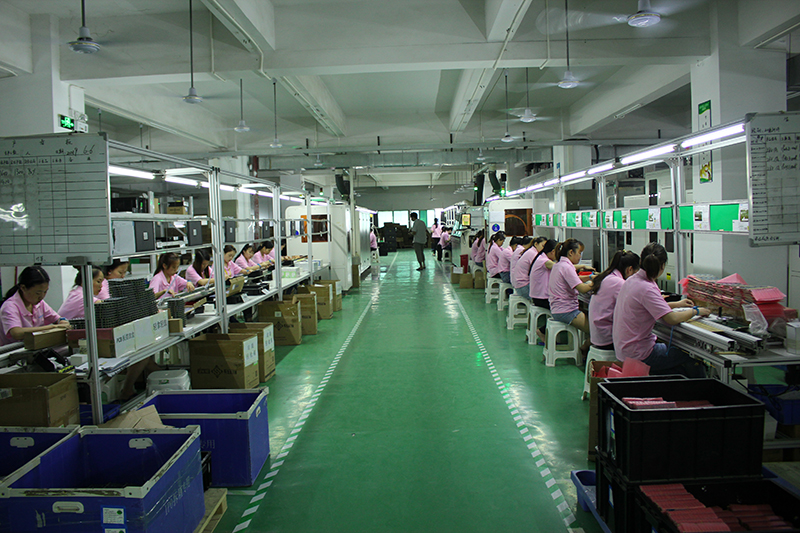
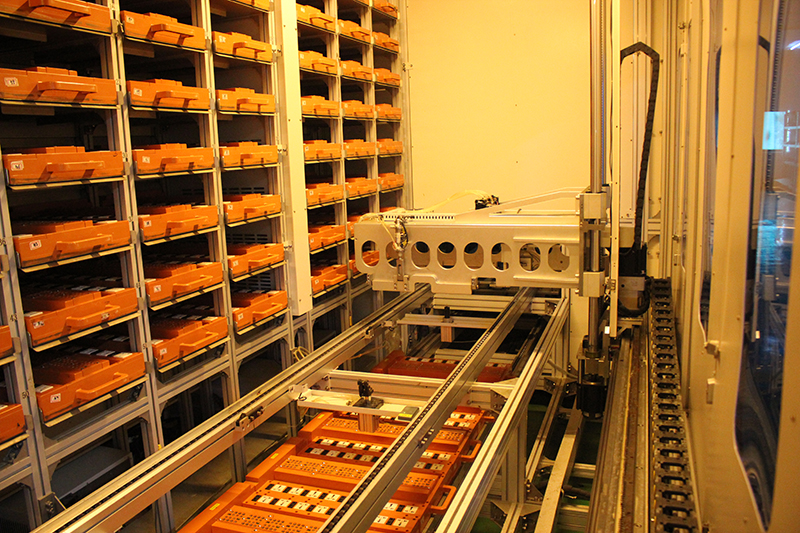
Its manufacturing base covers nearly 30,000 m², with more than 500 employees and an annual production capacity of over 30 million power products. The company says it has over 90 national patents covering structural design, circuit topology and safety-protection technologies for power equipment.
An in-house safety and reliability laboratory is used for pre-production validation. According to the company, it uses testing instruments from Rohde & Schwarz (Germany), Yokogawa (Japan), Agilent and Tektronix (USA) to conduct EMC, thermal cycling, surge, short-circuit and accelerated-aging tests on new designs.
What an OEM/ODM Adapter Supplier Should Offer
Buyers who bring a new product to market often need more than an off-the-shelf adapter. They may need housing colour changes, custom output cables, specific plug types, changed enclosure size or even full electrical design adaptation. Simsukian describes its OEM/ODM workflow as turn-key, covering schematic design, PCB layout, firmware programming for lithium-battery charging logic, NTC temperature monitoring, anti-reverse-polarity protection, indicator-light control, plastic-housing prototyping, mold-making, full-batch compliance testing and final assembly.
This range of capabilities matters because an adapter is often not a commodity purchase. For a manufacturer of medical-adjacent devices, monitoring equipment, smart home products or security hardware, the adapter must be integrated with the host product’s power requirements. Supplier engineering depth can reduce time-to-market and compliance risk.
Protection and Enclosure Features
In adapter design, protection features are expected rather than optional. Simsukian’s documented adapter platforms include short-circuit protection, overvoltage protection and overcurrent protection. The enclosures are made of fire-retardant PC material, and some designs use wall-mount or compact formats suitable for installations in tight spaces.
For indoor products that run for long hours — such as humidifiers, aroma diffusers, smart meters and beauty devices — stable voltage and current output is required to avoid flicker, measurement errors or uneven performance. Documentation from Simsukian application scenarios shows that precise rated current, such as 5V1A or 12V1A output, is used to keep ammeter readings accurate and prevent LCD display errors caused by voltage drift.
Application Examples Across Device Categories
The following examples illustrate how low-voltage switching adapters are matched to specific device needs. All documented scenarios are for indoor use and cover common consumer and industrial electronic products.
Smart Electricity Meters and Power Meters
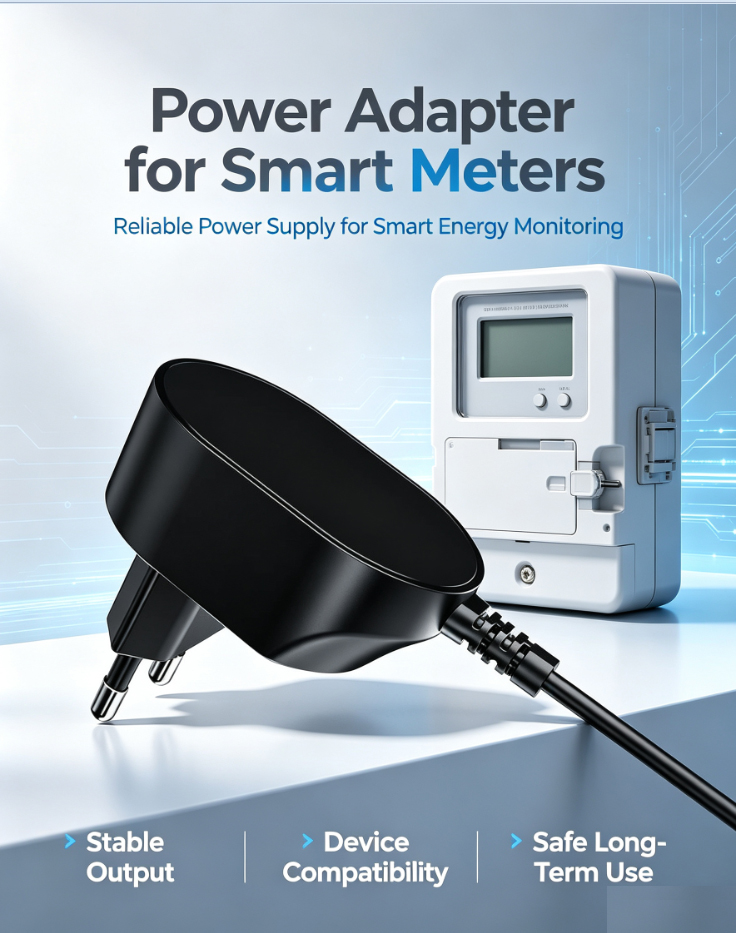
In industrial control distribution boxes and household guide-rail smart meters, adapters with precise 5V1A rated current help ensure accurate readings on ammeter chips and LCD displays without garbled codes. A compact adapter size is an advantage when the weak-current box is installed in a narrow space. Simsukian’s application documentation lists this type of adapter as a standard power source for property management, factory and home-decoration ammeters across markets including Germany, Spain, Japan, Korea, the UK and the United States.
Humidifiers and Aroma Diffusers
Ultrasonic humidifiers and aroma diffusers need low-noise, voltage-stabilized power so that the atomizing plate vibrates evenly and produces fine mist without interruption. Simsukian’s documented application includes 24V adapter models used for bedroom sleep-aid aromatherapy and desktop ultrasonic aroma machines. Low-temperature operation during overnight use is an important requirement in these scenarios.
Oral Care and Beauty Devices
Water flossers and facial mask devices are documented applications for low-power adapters such as 12V1A or 5V outputs. For water flossers, constant output keeps the water pump operating evenly and reduces risk of motor overload. For LED-based beauty masks, stable current prevents flickering and abrupt brightness changes that could damage the light beads. Compact adapter dimensions also help when the device is used on a bathroom countertop or bedside socket.
Product Platform Examples: SK01T and SK03T Series
Within Simsukian’s catalog, lower-power and mid-power adapter families include the SK01T, SK01T8 and SK03T platforms. These are switching adapters designed with a wide AC input range of 100–240V and efficiency levels aligned with DOE, ERP and CEC-VI requirements.
Documented model examples include:
- 12V1A US adapter — model SK01T8-1200100V, used for low-power devices requiring 12W output.
- 5V3A US adapter — model SK01T8-0500300U, used for 15W USB-class devices.
- 12V3A 36W adapters — SK03T series available with different regional plug options, including EU, US, UK and AU variants.
- 24V adapter products — covering outputs such as 24V1A 24W and 24V1.5A 36W, with documented KR, EU and UK plug variants.
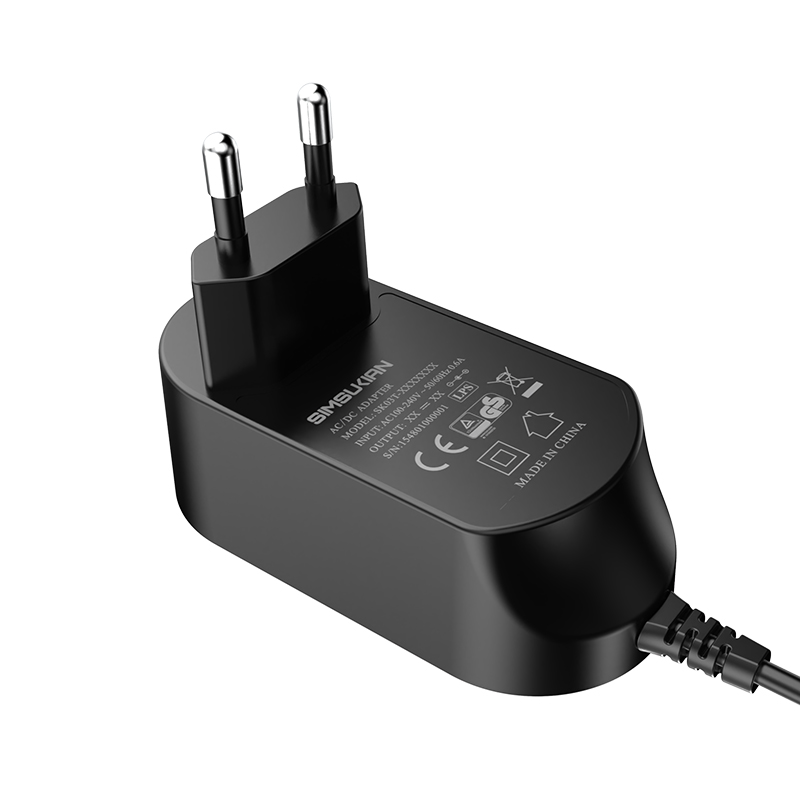
These platforms illustrate a common industry approach: build a standardized PCB and enclosure platform, then adapt the AC plug, colour, output cable and marking for each destination country. This approach helps control cost and lead time while maintaining predictable quality.
Market Trends Affecting Power Adapter Selection
Several long-term trends affect how buyers select power adapter manufacturers:
1. Tighter Energy-Efficiency Regulation
Energy-efficiency programmes, including DOE Level VI in the United States, CEC in California and ERP in Europe, now require adapters to meet stricter no-load power and average efficiency levels. Suppliers that document compliance with these programmes are easier to integrate into export products.
2. Multiple Certification and Regional Plug Variants
Many brand owners no longer manufacture a separate adapter for each country. Instead, they use a common universal-input adapter design with interchangeable regional plug variants and a full certification matrix. Simsukian’s stated export range covers over 30 countries and regions, with core markets in the EU, USA, Australia, Japan, Korea and the UK.
3. GaN and New Power-Switching Materials
Gallium-nitride power devices are gaining attention for chargers and adapters because they enable higher frequency operation and smaller magnetic components. Simsukian’s company profile mentions long-term university-industry-research cooperation supporting technical upgrades on gallium-nitride power devices, battery charging management, temperature-sensitive control and over-protection circuits. Buyers evaluating future product lines should ask about a supplier’s capability roadmap beyond conventional silicon-based adapters.
Comparison with Traditional and Generic Supply Approaches
Historically, many product developers sourced adapters from local electronics markets or used generic adapter models purchased at retail. This approach may work for prototyping but becomes risky for serial production because generic adapters often lack traceable certificates, consistent batch quality and design documentation.
A specialized manufacturer such as Simsukian offers several process advantages:
- Dedicated R&D and engineering teams for schematic, layout and enclosure modification
- In-house testing equipment for EMC, thermal cycling, surge and aging validation
- Documented quality systems, including ISO 9001 and ISO 14001
- Large-scale production capacity for consistent supply
Boundary and limitation: Even with a broad product range, not every adapter requirement is covered by a standard model. Fixed-output adapters such as 12V3A or 24V1.5A are designed to provide steady DC voltage to devices with known input requirements. For products that require variable-voltage protocols, USB-PD negotiation, multi-port output or custom battery-charging behaviour, buyers may need a separately engineered charger platform or a firmware-customized project. Certification status also differs by model and target country, so the buyer should confirm certification coverage on the exact SKU before mass production.
Sourcing Considerations for Buyers
The following checklist reflects the practical decision criteria that emerge from an analysis of documented manufacturer capability:
- Electrical specification: Confirm input range, output voltage, output current, output power and connector type against the host device requirement.
- Safety and compliance: Verify the target market’s safety standard, such as IEC 62368-based certification, and the required energy-efficiency level.
- Plug and enclosure: Check whether the required plug standard (US, EU, UK, AU, KR, CN and others) is available and whether colour, material and housing size can be customized.
- Testing evidence: Ask for actual test reports for the proposed model, not only a general list of company certifications.
- OEM/ODM capability: For branded products, evaluate whether the supplier can handle firmware, housing prototyping, mold-making and final compliance testing.
- Production capacity: Assess whether the manufacturer can support projected order volume and whether it has quality control processes for large batches.
Future Outlook
As electronic devices become more power-efficient and more functionally dense, the adapter industry is moving toward higher efficiency, multi-standard charging protocols and smaller power stages. Fixed-output AC-DC adapters will remain necessary for a wide base of appliances and instruments, while USB-C and fast-charging products continue to gain share in consumer electronics.
For procurement teams, the practical implication is that adapter sourcing should be treated as an engineering decision rather than a commodity purchase. A supplier with recognized certifications, in-house reliability testing and design-level OEM/ODM capability will be better positioned to support product compliance across different countries.
FAQ
Q1. What certifications do power adapters need for international markets?
Different markets require different certifications. Common examples include UL and FCC for the United States, CE-LVD and CE-EMC for the European Union, UKCA for the United Kingdom, SAA/RCM for Australia and New Zealand, PSE for Japan, KC/KCC for Korea, and CCC/CQC for China. Energy-efficiency certification is also required in some regions, such as DOE Level VI in the US, CEC in California and ERP in the EU. Simsukian states that its products carry CCC, UL, CB, CE, UKCA, FCC, KC, PSE, SAA, RoHS, REACH, DOE Level-VI, CEC and ERP approvals, which supports exports to more than 30 countries.
Q2. What output specifications are available in SimSukian’s documented adapter range?
Simsukian’s documented product examples include a 5V3A 15W adapter, a 12V1A 12W adapter, and 12V3A 36W adapters in the SK03T series. The 24V output family includes 24V0.5A, 24V0.65A and 24V1A as well as 24V1.5A 36W models. Available plug variants in the product documentation include US, EU, UK, AU and KR plug types, depending on the specific SKU.
Q3. What built-in protections should a quality power adapter have?
Short-circuit protection, overvoltage protection and overcurrent protection are commonly expected safety features in a switching power adapter. Simsukian also lists fire-retardant PC as the enclosure material for its documented adapter platforms. The width of the input voltage range, typically AC 100–240V 50/60Hz, determines whether the adapter can operate safely across different mains systems.
Q4. Which types of devices are documented as suitable applications for these adapters?
Simsukian’s documented application scenarios cover smart electricity meters, miniature power meters, single-phase energy meters, humidifiers, aroma diffusers, water flossers and facial mask devices. The scenarios are described as indoor-use products, with common requirements including stable output, low electromagnetic disturbance to measurement functions, compact size and reliable continuous operation.
Q5. Does Simsukian support OEM/ODM customization?
Yes. Simsukian describes its OEM/ODM service as turn-key, covering schematic design, PCB layout, firmware programming for lithium-battery charging logic, NTC temperature monitoring, anti-reverse-polarity protection, indicator-light control, plastic-housing prototyping, mold-making, full-batch compliance testing and final assembly. This makes the company a potential development partner for branded devices that need custom adapter design, not only standard catalogue products.
Further reference: A product catalogue with additional technical specifications is available for public access: Simsukian Power Product Catalogue.
Есть вопросы или нужны дополнительные детали?
Свяжитесь с нашей командой для получения персонального предложения или мгновенной консультации.
Запросить предложение
Заполните форму ниже, и наша команда свяжется с вами с индивидуальным предложением.
Прямой чат WhatsApp
Предпочитаете общаться в реальном времени? Напишите нам в WhatsApp для мгновенной помощи и быстрых ответов.
- Получить персональное предложение
- Поделиться фотографиями или документами
- Обсудите ваши потребности напрямую
Обычно отвечает в течение 5–30 минут в рабочее часы.