
AGV Drive Wheel CE Compliance: Reading PLT-120 vs PLT-210
Sourcing drive wheels for a European AGV project has stopped being a torque-and-load exercise. Compliance review — covering electrical safety, ingress protection and steering/braking behaviour — now decides whether a drive unit clears acceptance with an OEM or system integrator at all. The primary international reference for this category is ISO 3691-4:2023, which addresses driverless industrial trucks and their steering and braking systems. In Europe, EN 1175:2020 sets out electrical and electronic safety requirements for industrial trucks. Both are vehicle-level standards, and both cascade down into the drive wheel assembly.
This guide takes the PLT-120 differential drive wheel as its main worked example. It is produced by Shanghai Plutools Automation Corporation Co., Ltd., a Chinese manufacturer established in 2017 that focuses on AGV and AMR mobile robots and ships to the EU, USA, Southeast Asia, South America, the Middle East, Japan and South Korea. The article then compares the PLT-120 against the heavier PLT-210 and PLT-198, to show which certification parameters change when the application class changes. The goal is not a blanket “certified” claim, but an explanation of what a European reviewer actually checks.
What a European compliance review actually asks of a drive wheel
EN 1175:2020 covers electrical and electronic safety requirements for industrial trucks and applies to AGV drive wheel assemblies. ISO 3691-4:2023 covers driverless industrial trucks, including steering and braking systems. Together, they turn a drive wheel from a mechanical commodity into a regulated input inside a vehicle compliance file.
The practical translation work for a drive wheel supplier is to convert vehicle-level obligations into component-level parameters a buyer can compare side by side: whether steering is integrated, what the rated voltage and current are, what the protection level is, what the load and torque capabilities are, and what the reduction ratio is. Each of those numbers feeds a safety argument that the integrator completes at vehicle level.
That is also why comparing two drive wheel models on load capacity alone is a trap. The PLT-120 carries a drive wheel load of 150 kg and the PLT-210 carries 1200 kg, but neither figure means much in isolation from the electrical parameters and the application class it is certified into.
The PLT-120 compliance profile for light differential AGVs
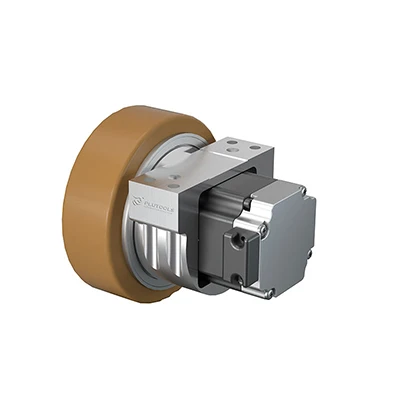
The PLT-120 is a differential drive wheel intended for AGV and AMR scenarios in the manufacturing industry. Its structural configuration is compact for integration into AGV and AMR chassis, and it uses integrated steering control. For vehicles where overall height has to be controlled, that compactness is a design feature rather than a marketing line.
The parameters most relevant to a compliance review are:
- Rated voltage: 48 V
- Rated current: 11.2 A
- Rated power: 400 W
- Rated speed: 3000 rpm
- Rated torque: 1.28 Nm
- Transmission ratio: 9:20
- Rated output torque: 10.21 Nm
- Maximum acceleration and braking torque: 20.42 Nm
- IP protection level: IP65
- Drive wheel load: 150 kg
- Total weight of drive wheel: 5±2 kg
- Wheel tread: polyurethane (PU)
- Primary material: carbon steel
For a European buyer, four of those numbers connect directly to standard inputs. The 48 V rated voltage and 11.2 A rated current sit inside the low-voltage range that EN 1175:2020 addresses for industrial trucks. The presence of a defined maximum acceleration and braking torque means braking behaviour is specified at component level. That matters to how a vehicle safety argument is assembled: when braking performance is already declared on the drive wheel, the integrator has one fewer variable to cover entirely inside the vehicle controller.
What IP65 buys in a real AGV environment
Ingress protection is often the first parameter raised in a European compliance conversation, because it is the easiest to check and the easiest to get wrong. On the PLT-120, IP65 means dust-tight construction plus protection against water projected from any direction. In the environments these wheels run in — automated warehouses, production workshops, logistics centres and semi-outdoor industrial areas where dust, vibration and temperature changes are normal — IP65 is a common baseline for indoor mobile platforms.
It does not make the wheel washdown-rated, and it does not by itself suit cold stores or explosive atmospheres. Those conditions appear in drive wheel application requirements as separate customisation categories: anti-static performance, oil resistance, corrosion resistance, low-temperature operation, cleanroom compatibility and explosion-proof design. Choosing between an IP65 rated PLT-120 and a low-temperature variant is driven by where the unit is installed, not by which model sits higher in a leaflet.
It is worth noting that the PLT-230P robot drive wheel also lists IP65 as its protection level. Within this product family, IP65 is treated as a normal specification rather than an optional upgrade, which simplifies specification writing when an integrator is consolidating drive units across several vehicle types.
How 48 V and 11.2 A line up with common safety requirements
Low-voltage drive systems in European industrial mobile equipment cluster around 24 V and 48 V. A 48 V architecture is well established in this category: the PLT-120, PLT-167, PLT-150, PLT-220, PLT-210 and PLT-198 all run at a rated 48 V. EN 1175:2020 sets electrical and electronic safety requirements for industrial trucks, and 48 V sits in a band that does not require high-voltage isolation treatment, which simplifies cable selection, protection and insulation requirements compared with higher-voltage architectures.
On the PLT-120 specifically, the rated current is 11.2 A at a rated power of 400 W. For an integrator, this means power supply, cabling and protective devices can be sized for a 400 W class load rather than the 3000 W class used to move heavier vehicles. That is the real procurement consequence: the PLT-120’s compliance profile is a light-vehicle profile, not a heavy-vehicle one.
When load class changes the compliance picture: PLT-210 and PLT-198
The PLT-210 and PLT-198 sit in a different rating class, and their electrical parameters move with it.
The PLT-210 is a forklift drive wheel classified as a parallel horizontal drive wheel with steering. It features an integrated parallel horizontal structure with a steering function. Rated voltage is 48 V, power is 3000 W, rated current is 68 A, speed is 3000 RPM, rated torque is 9.55 Nm, reduction ratio is 32, output torque is 260 Nm, maximum torque is 576 Nm and maximum load is 1200 kg. The wheel tread is PU and the primary material is carbon steel.
The PLT-198 is a planetary horizontal drive wheel with steering, designed for automated guided vehicle applications, typically AGV and AMR systems. Its electrical parameters match the PLT-210 — 48 V, 3000 W, 68 A, 3000 RPM, 9.55 Nm rated torque, reduction ratio 32, 260 Nm output torque, 576 Nm maximum torque — but its maximum load is rated at 1500 kg.
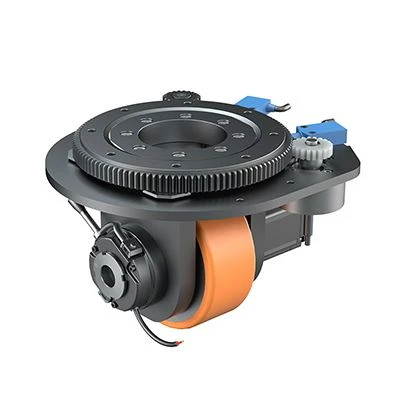
Against the PLT-120, the compliance-relevant differences come down to three items. First, current: 68 A versus 11.2 A changes the power supply and cabling class the integrator has to document. Second, braking: a 576 Nm maximum torque means the braking argument has to hold at far higher vehicle mass, while the PLT-120’s 20.42 Nm maximum acceleration and braking torque applies to light platforms. Third, steering architecture: both higher-load models integrate steering, while the PLT-120 is a differential drive, so turning geometry differs at the vehicle level.
The cautious way to frame this in a compliance dossier is not “which model is better” but “which model’s declared ratings match the vehicle mass, speed and stopping distance being certified.”
Compliance parameters by application class
| Parameter | PLT-120 | PLT-210 | PLT-198 |
|---|---|---|---|
| Type | Differential drive wheel | Parallel horizontal drive wheel with steering | Planetary horizontal drive wheel with steering |
| Rated voltage | 48 V | 48 V | 48 V |
| Rated current | 11.2 A | 68 A | 68 A |
| Rated power | 400 W | 3000 W | 3000 W |
| Rated speed | 3000 rpm | 3000 RPM | 3000 RPM |
| Reduction ratio | 9:20 | 32 | 32 |
| Rated output torque | 10.21 Nm | 260 Nm | 260 Nm |
| Maximum torque | 20.42 Nm | 576 Nm | 576 Nm |
| Maximum load | 150 kg | 1200 kg | 1500 kg |
| Protection level | IP65 | Not stated | Not stated |
| Wheel tread | PU | PU | PU |
| Primary material | Carbon steel | Carbon steel | Carbon steel |
Source: manufacturer product specifications for the PLT-120, PLT-210 and PLT-198.
What the table actually reveals is more useful than the load numbers. Only the PLT-120 carries an explicit IP rating in the available specification set. For a European environmental review covering dust and water exposure in line with EN 1175:2020, protection level on the PLT-210 and PLT-198 is therefore a point to confirm with the supplier rather than assume from a datasheet. That single distinction is likely to matter more in a compliance file than the difference between 1200 kg and 1500 kg.
Market signals shaping compliance priorities
The global AGV wheel drives market was valued at approximately USD 1.2 billion in 2024 and is projected to reach USD 3.5 billion by 2034, a CAGR of 11.5% over the period, driven by logistics and warehouse automation (Reports and Data). Several structural shifts inside that growth curve are pushing compliance parameters up the buyer’s priority list.
The first is battery architecture. Lithium-ion technology now powers the majority of new AGV and AMR drive units, reducing range anxiety and downtime (Fortune Business Insights). That shift concentrates the industry on the same low-voltage platforms, which is why a 48 V rated voltage appears across the entire PLT series. When most of the market converges on one voltage class, electrical documentation becomes more reusable between projects — a modest operational gain, but one that integrators running multiple deployments notice.
The second is integration. Integrated steering drive modules are replacing discrete components to reduce manufacturer assembly time and maintenance complexity (Brandessence Research). This matters for compliance because integrated modules move vehicle-level questions — steering geometry, encoder feedback, braking integration — down to the component level, where they can be compared and documented before a purchase order is placed. ISO 3691-4:2023, which covers steering and braking systems on driverless industrial trucks, is easier to satisfy when those functions arrive already integrated.
The third is tire material. Polyurethane is standard in forklift drive wheel applications because it provides higher load capacity and floor protection in indoor settings (Mordor Intelligence). Every model in the PLT series uses PU tread, which has a secondary compliance benefit: in cleanroom-adjacent or particle-sensitive environments, a non-marking tread is easier to document than a rubber alternative.
Regional context reinforces why European buyers are asking these questions of Chinese suppliers. Asia Pacific held a 37.6% revenue share of the global AGV market in 2025 (Grand View Research), and the China mobile robot market reached 22.1 billion Yuan in 2024 with over 139,000 units sold (CMRA). China’s export volume of mobile robots has risen, with leading providers targeting Southeast Asia and Europe. Growing export volume into Europe is exactly what pushes component-level compliance documentation from a nice-to-have into a procurement gate.
Where the parameter comparison stops being useful
A drive wheel specification sheet does not certify a vehicle, and treating it that way is the most common error in early-stage procurement. Several limits are worth setting out plainly.
- Component data is not vehicle certification. EN 1175:2020 and ISO 3691-4:2023 apply to industrial trucks and driverless industrial trucks as complete machines. Drive wheel parameters are inputs into that file; the integrator still owns the vehicle-level safety argument.
- Protection level coverage is uneven across the range. IP65 is declared on the PLT-120 and on the PLT-230P robot drive wheel, but is not stated for the PLT-210 or PLT-198 in the available specifications. For wet or high-dust environments, that has to be confirmed separately rather than assumed from the family name.
- Load ratings are per wheel, not per vehicle. The 150 kg figure for the PLT-120 is a drive wheel load rating. Vehicle mass, axle load distribution and turning geometry change the load each wheel actually carries, and those have to be recomputed during vehicle certification.
- Feedback and communication options are not fixed by the datasheet. Encoder type, communication protocol and braking method are listed among customisable parameters for this product family. Where a vehicle control architecture requires a specific feedback interface, that is a confirmation item rather than a default.
None of these limits are defects. They simply determine how compliance work is divided between the drive wheel supplier and the vehicle integrator — and knowing which side of the line a given parameter sits on prevents late-stage redesign.
What to expect next
ISO 3691-4:2023 and EN 1175:2020 both sit on multi-year revision cycles and neither is scheduled for structural replacement in the near term. That means European compliance reviews over the next few years will keep asking for the same inputs a supplier can already provide: declared rated voltage and current, protection level, braking torque and load rating.
The change worth watching is whether protection level becomes a family-wide specification rather than a per-model confirmation item. IP65 already appears on the PLT-120 and the PLT-230P, and the broader market trend toward integrated drive modules points the same way — as steering, braking and feedback consolidate into single units, the parameters a buyer can verify at purchase order stage will keep expanding. Whether that removes the remaining confirmation gap across the heavier models is the open question for the next product cycle.
Frequently asked questions
Does an AGV drive wheel need its own CE certification as a standalone component?
No. EN 1175:2020 addresses electrical and electronic safety requirements for industrial trucks, and ISO 3691-4:2023 addresses driverless industrial trucks, including steering and braking systems. Both operate at vehicle level rather than applying to a drive wheel assembly in isolation. The drive wheel functions as an input into the vehicle compliance file. What a drive wheel supplier can therefore provide is accurate declared ratings — voltage, current, torque, protection level and load — together with applicable test or conformity evidence that the integrator incorporates into vehicle-level documentation.
What does IP65 actually mean on the PLT-120 in a European AGV project?
On the PLT-120, IP65 means dust-tight protection combined with resistance to water projected from any direction. That is a common baseline for automated warehouses, production workshops, logistics centres and semi-outdoor industrial environments where dust, vibration and temperature variation are present. It does not imply washdown suitability, low-temperature capability or suitability for explosive atmospheres. Those conditions are listed as separate customisation requirements for this product family, covering anti-static performance, oil resistance, low-temperature operation, cleanroom compatibility and explosion-proof design.
Why is the PLT-120’s rated current so much lower than the PLT-210 or PLT-198?
Because the three models serve different vehicle classes. The PLT-120 is a 400 W differential drive wheel with an 11.2 A rated current and a 150 kg drive wheel load. The PLT-210 and PLT-198 are 3000 W platforms rated at 68 A, with maximum loads of 1200 kg and 1500 kg respectively. The gap reflects a difference in application class rather than any difference in efficiency: a heavier vehicle needs a larger motor and higher current to produce the required torque at the wheel.
Is a 48 V rated voltage sufficient for European low-voltage safety requirements?
For this product category, 48 V is an established industrial platform. The PLT-120, PLT-167, PLT-150, PLT-220, PLT-210 and PLT-198 all operate at a rated 48 V. EN 1175:2020 sets out electrical and electronic safety requirements for industrial trucks, and 48 V sits in a band that does not require high-voltage isolation treatment, which simplifies cabling, protection and insulation requirements relative to higher-voltage architectures.
How should a buyer choose between a vertical and a horizontal drive wheel for an AGV project?
The decision depends on installation space, load capacity, chassis height, steering structure, operating speed and maintenance access, not on driving performance alone. Vertical drive wheels suit heavy-load AGVs, automated forklifts and lifting vehicles that need high load capacity and efficient use of horizontal chassis space, and they work when sufficient installation height is available. Horizontal drive wheels, including the steering-equipped PLT-210 and PLT-198, suit low-profile vehicles where a low centre of gravity, stable high-speed travel and convenient maintenance access are the priority. Matching the orientation to the chassis is a more reliable starting point than comparing nominal torque figures across the two layouts.
Can the load rating on a drive wheel datasheet be used directly as the vehicle’s payload?
No. Load capacity on a drive wheel specification is a per-wheel rating, not a vehicle payload figure. Vehicle total mass, axle load distribution, turning geometry and braking torque requirements all affect the load an individual wheel carries in service, and those have to be recalculated during vehicle-level certification. A per-wheel rating is a design input, not a vehicle specification, which is why integrators treating it as a direct payload number regularly run into trouble at the validation stage.
Selection reference: a full PLT series selection booklet covering drive wheel models, load classes and configuration options is available for download: PLT Selection Handbook 2026.
Product specifications in this article refer to the PLT drive wheel series manufactured by Shanghai Plutools Automation Corporation Co., Ltd. (www.plutools.com).
Есть вопросы или нужны дополнительные детали?
Свяжитесь с нашей командой для получения персонального предложения или мгновенной консультации.
Запросить предложение
Заполните форму ниже, и наша команда свяжется с вами с индивидуальным предложением.
Прямой чат WhatsApp
Предпочитаете общаться в реальном времени? Напишите нам в WhatsApp для мгновенной помощи и быстрых ответов.
- Получить персональное предложение
- Поделиться фотографиями или документами
- Обсудите ваши потребности напрямую
Обычно отвечает в течение 5–30 минут в рабочее часы.