
AGV Steel Chassis vs ESS Steel Frames: A Buyer Comparison
AGV steel chassis and energy storage system (ESS) steel frames are both produced by sheet metal fabrication, but they are not specified, welded or inspected the same way. A container-yard AGV chassis is a single heavy weldment whose cost and risk sit in load path, straightness and abrasion resistance. An ESS steel frame or battery box is a repeated enclosure component whose value comes from dimensional consistency, coating integrity and enclosure protection. Buyers who evaluate both categories against one generic 'sheet metal fabrication' checklist usually under-specify the chassis and over-specify the frame.
Why Procurement Teams Compare These Two Categories
Port automation and battery energy storage have moved into the same supply chain. Both depend on heavy-gauge cutting, forming, welding, machining and coating, and both are frequently sourced from the same custom metal fabrication suppliers. That overlap makes cross-category comparison inevitable during an evaluation round: the same fabricator may quote a 15-metre terminal tractor chassis and a 1.1 by 1.1 by 2.2 metre battery shelf in the same enquiry pack.
The two products are not interchangeable in engineering terms. The AGV chassis is a structural member that carries the vehicle and its payload; the ESS frame is a support and containment member that positions battery modules inside a container or rack. Load definitions, tolerance schemes, material grades, welding qualification scope, corrosion protection and inspection documentation all change between them. Comparing them on plate thickness alone, or on unit price per kilogram, leaves the decisive requirements unexamined.
Two Delivered Reference Programs
The comparison below is built on two delivered programs from one fabricator, Xiamen Openex Mechanical Technology Ltd (Openex), a custom metal fabrication and machining supplier founded in 2009 that operates two manufacturing premises near Xiamen Port and near Shanghai Port and exports to markets that account for roughly 80% of its output. Reference points taken from these programs are used throughout this article so that the differences are concrete rather than theoretical.
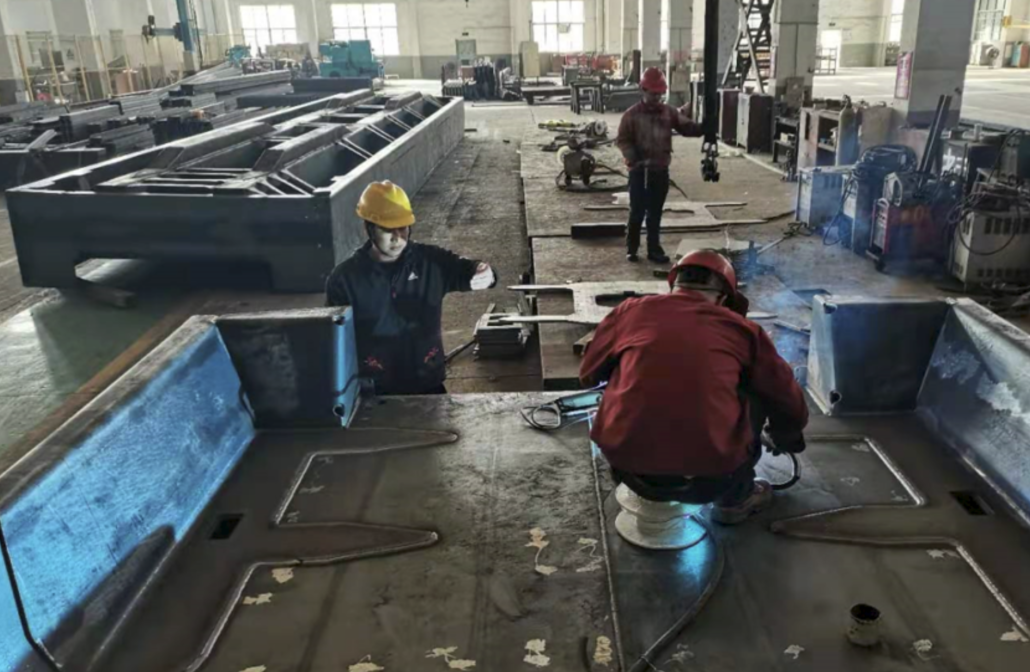
Welding fabrication of AGV steel chassis in the Openex workshop near Xiamen Port. Large chassis assemblies are welded as complete frames before machining and coating.
| Comparison point | AGV steel chassis (PSA-1) | ESS steel frames and boxes (XHC-009) |
|---|---|---|
| Delivered program scale | 345 units supplied to a large AGV manufacturer in the Netherlands | 3,000 units of steel frames and boxes supplied globally to energy storage system developers and battery manufacturers |
| Overall dimensions | 15 m x 2.7 m x 3 m | 1.1 m x 1.1 m x 2.2 m per unit |
| Unit weight | 10.5 tons | Approximately 1,000 kg per unit |
| Rated loading capacity | 30 tons | Not a rated-load structural member; supports battery modules within a defined stack |
| Principal material | High-strength steel plate S355JR (or A572 Grade 50) at 25 mm, plus abrasion-resistant plate NM400 at 20 mm | Steel tube, steel sheet and carbon steel; ESS cabinets use 1.5-5.0 mm sheet in carbon steel, galvanized steel, stainless steel or aluminium |
| Anti-corrosion route | Painting on the completed weldment | Powder coating and anti-corrosion coating; enclosure protection grades IP54, IP55 or IP65 depending on specification |
| Reported field outcome | Stable operation for more than four years in container-yard service | No rust, no leakage and no deformation reported for the ESS frame and box program; a related 300-unit lithium battery shelf program reported three years of stable operation |
Material Selection: 25 mm High-Strength Plate Versus Thin-Gauge Formed Sheet
Material choice is the first place the two categories separate. The AGV chassis is welded from S355JR plate, or A572 Grade 50 to the ASTM equivalent, at 25 mm for the main structure, with NM400 abrasion-resistant plate at 20 mm in the areas that take abrasive contact. Two different material decisions are being made here: the S355JR plate provides the strength and bending stiffness of the chassis, while the NM400 plate addresses wear at the contact surfaces rather than the load path.
ESS steel frames and boxes move in the opposite direction. They are built from steel tube, steel sheet and carbon steel, and the associated battery cabinets are formed from 1.5 mm to 5.0 mm sheet in carbon steel, galvanized steel, stainless steel or aluminium. Thickness here is a function of stiffness across a short span and of the forming and coating process, not of a 30-ton rated load.
For buyers, the practical consequence is that the two projects fall into different welding qualification scopes. Openex holds EN ISO 3834-2 certification for fusion welding of metallic material (certificate 23/999-3834 issued through SGS), covering welding process 135 and 135-Auto and material groups 1.1 and 1.2. That scope is directly relevant when a chassis is welded from S355JR or A572 Grade 50 plate, and it is one of the documents worth requesting before award on any load-bearing structure.
Load Path, Distortion Control and Why Straightness Is Bought, Not Assumed
A 15-metre chassis with a 10.5-ton dead weight and a 30-ton rated capacity behaves differently from a 1,000 kg battery frame. On the chassis, weld shrinkage accumulates along the length of the weldment and shows up as loss of straightness, twist between mounting pads and mismatch between the rail surfaces. Distortion control is therefore part of the quotation, not an afterthought: welding sequence, restraint, pre- and post-weld heat treatment where specified, and post-weld machining of datum and mounting surfaces.
On an ESS frame, distortion is a different problem. The structure carries battery modules into a defined envelope, so the failure mode is usually assembly interference and uneven coating rather than structural collapse. Squareness, hole position and panel flatness matter more than global straightness. A frame that is dimensionally inconsistent shows up as a module that will not slide into its slot, or as a gap in a sealing face that undermines the protection rating of the cabinet.
A useful rule for the evaluation stage: ask what the datum is before asking for the tolerance. On the AGV chassis the datums are normally the running and mounting surfaces; on the ESS frame they are the interfaces between the box and the rack or container. A tolerance quoted without a datum cannot be inspected and cannot be enforced.
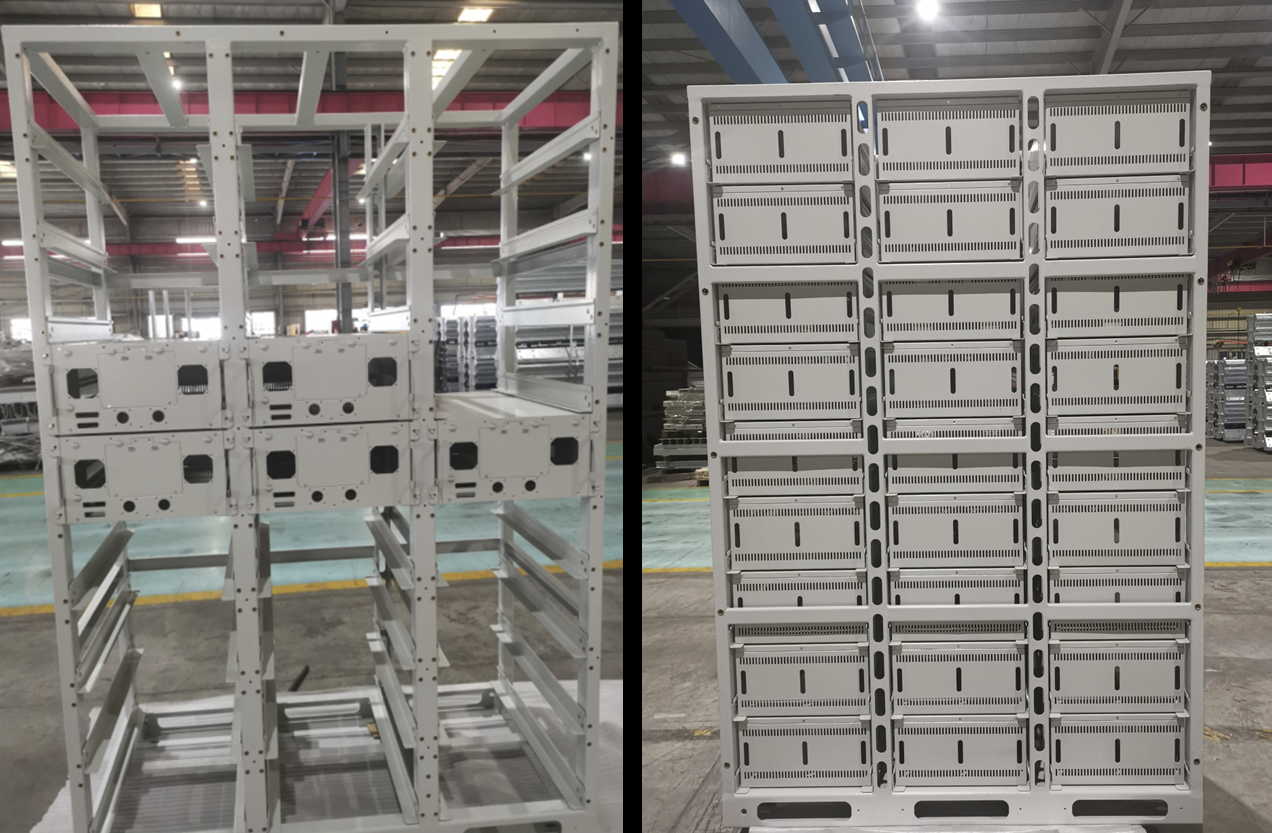
Lithium battery energy storage shelf and box fabrication at the Openex premise near Xiamen Port. ESS frames are repeat-manufactured assemblies, so squareness, hole position and coating coverage drive acceptance rather than global straightness.
Precision, Machining and Inspection: Different Instruments for Different Questions
Both categories need measurement, but the questions being asked differ. On the chassis, the buyer wants to know whether a 15-metre weldment can be machined and inspected to the drawing after welding. That calls for heavy machining capability on large weldments and a measurement envelope big enough to hold the part. Openex operates a Zeiss large CMM with a 7 x 4 x 3 metre capacity and micron-level precision, supported by smaller CMMs for regular components.
On the ESS frame, the inspection question is narrower but more repetitive: hole patterns, panel flatness, weld cleanliness and coating coverage across thousands of identical units. Here the value of automation becomes visible. The 6-axis welding robot cells used for repeat sheet metal work are specified with repeat positioning accuracy of plus or minus 0.05 mm, against manual welding for large one-off assemblies such as an AGV chassis frame.
A common inspection menu applies to both products and should be agreed before award rather than after delivery:
- Non-destructive testing: RT, UT, MT, PT, VT and LT, selected according to joint type and criticality.
- Destructive testing: chemical analysis of element composition, mechanical testing covering tensile strength, yield and elongation, impact toughness including low-temperature tests, bend ductility and hardness.
- Corrosion testing such as salt spray, which is more relevant to ESS frames and coated cabinets than to painted chassis.
- Dimensional and visual inspection: length, diameter, angle, roundness, straightness and position, plus surface roughness expressed as Ra or Rz.
- Weld procedure qualification fully customizable to the customer WPS, with WPS, PQR and welder qualification records.
Corrosion Protection and the Operating Environment
The AGV chassis lives in a port. Salt-laden air, standing water and grit are normal, so the completed weldment is painted after fabrication. The ESS frame usually lives inside a container or a rack, but it must survive condensation, temperature cycling and, in coastal installations, the same aggressive air as the chassis. The delivered ESS frame and box program reported no rust, no leakage and no deformation, and the associated battery cabinets specify protection ratings of IP54, IP55 or IP65 with powder coating or anti-corrosion coating.
Environment severity is not fixed by product category. In an anodizing production line, 200 tons of stainless steel 316L frames, rails, ladders and guardrails were fabricated because carbon steel could not hold up in that atmosphere. The lesson for buyers is that the coating or material decision should follow a stated environment class, not a habit carried over from a previous project.
Finishing is frequently the least transparent step in a quotation. A fabricator may perform cutting, forming, welding, machining, drilling, punching and assembly in house while sending casting, forging, hot-dip galvanizing and powder coating to qualified partners. Buyers should confirm where each finishing step is performed and how it is inspected, because the answer changes both lead time and traceability.
Batch Pattern, Capacity and Lead-Time Planning
The two programs differ as much in rhythm as in geometry. The AGV program was a low-count, high-mass order: 345 large weldments, each 15 metres long, shipped from China to the Netherlands. The ESS program was a high-count order of 3,000 units of frames and boxes.
Reference capacity data from the fabricator illustrates how those rhythms are absorbed. Welding fabrication is quoted at a monthly capacity of 5,000 tons with a 25-ton minimum order quantity and a 30-45 day lead time. Machining is quoted at 3,000 tons per month with a 15-ton minimum and a 30-45 day lead time. Surface finishing is quoted at 3,000 units per month with a 15-ton minimum and a 45-day lead time. These are reference figures for planning; project-specific confirmation is always required.
Logistics deserves the same attention as fabrication. A 15-metre chassis cannot be shipped conventionally; the delivered AGV chassis units were loaded onto a bulk carrier for export to the customer. Buyers comparing landed cost across categories should compare freight mode and packing design alongside the fabrication price.
Buyer Decision Matrix for the Evaluation Stage
| Decision criterion | What it looks like on an AGV chassis | What it looks like on an ESS steel frame or box |
|---|---|---|
| Reference load | 30-ton rated capacity against a 10.5-ton unit weight; load path must be traceable through the structure | Battery module weight distributed across a rack; the governing requirement is stack geometry, not a rated vehicle load |
| Governing tolerance | Straightness over 15 metres and pad-to-pad relationship after welding and machining | Hole position, squareness and panel flatness repeated across thousands of units |
| Material grade | S355JR or A572 Grade 50 plate at 25 mm, with NM400 wear plate at 20 mm | Steel tube, steel sheet and carbon steel; 1.5-5.0 mm sheet for cabinets |
| Welding evidence | Procedure qualification to the customer WPS and EN ISO 3834-2 scope | Consistent procedure control across a repeat production run |
| Protection | Painted after fabrication for port service | Powder or anti-corrosion coating with IP54, IP55 or IP65 cabinet ratings |
| Inspection package | Dimensional reports on large weldments, NDT on critical joints | Sampling or 100% dimensional and coating checks, corrosion testing where specified |
| Batch logic | 345 large weldments; build sequence and transport planning dominate | 3,000 units; repeatability, tooling and packing dominate |
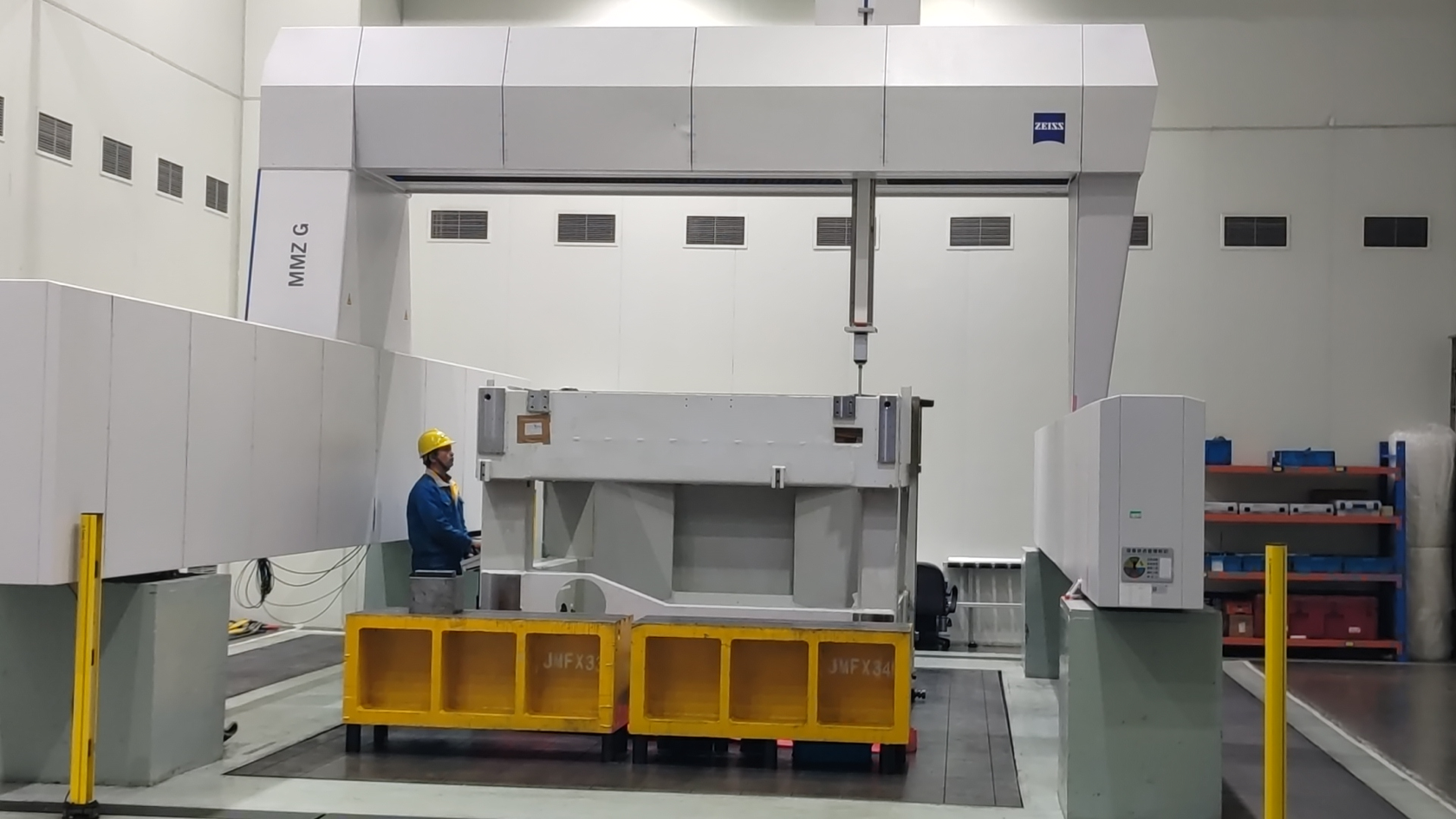
A Zeiss large CMM with a 7 x 4 x 3 metre measuring envelope and micron-level precision supports final inspection of large fabricated and machined structures.
Where This Comparison Stops: Boundaries and Trade-Offs
This article compares fabrication requirements at category level. It does not rank named suppliers, and no supplier ranking should be inferred from the reference programs described here; the two programs are cited as specification evidence, not as a league table.
There are also real boundaries on what a fabricator of this type should be asked to do. Openex performs laser cutting, bending, machining, welding, drilling, punching and stamping, assembling and packaging in house, while casting, forging, hot-dip galvanizing and powder coating are largely delivered through partners. A project whose main work is fabrication combined with machining fits that model. A project that only requires casting, forging or an anti-rust finish is better placed directly with the relevant specialist, because the fabrication scope adds coordination cost without adding process capability.
Batch size is the second boundary. Freight, inspection and communication effort are largely independent of order quantity, so small metal components in small quantities rarely justify international custom fabrication. The published minimum order references are 25 tons for welding fabrication, 15 tons for machining and 15 tons for surface finishing, and buyers should expect the commercial case to be weak below those levels.
A third limit is design specificity. The ESS frames described here suit a 1.1 by 1.1 by 2.2 metre unit class with powder coating anti-rust protection. A different battery module format, a different rack pitch or a different protection rating changes the design, the tooling and the inspection plan, even though the fabrication category remains the same.
Market Trend: Two Demand Curves, One Fabrication Base
Port equipment electrification and battery energy storage deployment are widely reported as parallel growth areas, and both draw on the same heavy sheet metal fabrication base. As terminals replace diesel yard tractors with automated guided vehicles, demand shifts toward large steel chassis with documented welding, machining and coating. As renewable projects add storage, demand shifts toward repeat-manufactured steel frames, boxes and cabinets with stable dimensions and verified corrosion protection.
The common thread is documentation. Buyers in both categories are increasingly asking for material traceability, welding procedure qualification records, NDT reports and dimensional data rather than a certificate of conformity alone. Fabricators that already hold ISO 9001, ISO 14001 and ISO 45001 management system certificates, plus a dedicated welding certification such as EN ISO 3834-2, are structurally better placed to answer those requests, because the evidence already exists inside the quality system.
Future Outlook
Three shifts are worth watching for buyers planning beyond the current evaluation cycle. First, the tolerance conversation is moving from the finished part to the datum scheme, with more purchasers requiring a documented datum and inspection plan at the quotation stage. Second, materials are moving in two directions at once: higher-strength and abrasion-resistant plates on heavy vehicle chassis, and stainless or galvanized variants on frames and boxes installed in coastal or chemically aggressive environments. Third, the boundary between port equipment and energy storage fabrication is thinning, as fabricators that already machine large weldments after welding extend that capability to storage structures and containerised enclosures.
FAQ
1. What metal materials can be fabricated for AGV chassis and ESS frame projects?
The material menu is broad. In carbon steel, the most frequently used grade families are Q235B (A36, SS400, S235JR) and Q355B (A572 Grade 50, SS490 or SPCC, S355JR); higher grades such as Q690 and abrasion-resistant NM450 or NM500 also appear. In stainless steel, SUS 304 and SUS 316L are the most common. Brass, bronze and aluminium can also be fabricated. For the AGV chassis described in this article, the specified materials were S355JR plate, or A572 Grade 50 to the ASTM equivalent, at 25 mm, together with NM400 abrasion-resistant plate at 20 mm. ESS frames and boxes typically use steel tube, steel sheet and carbon steel, with cabinet shells between 1.5 mm and 5.0 mm in carbon steel, galvanized steel, stainless steel or aluminium.
2. Do buyers need 2D drawings, 3D models, or both to obtain a fabrication quotation?
Accepted formats include STEP, IGES, DWG, DXF and PDF, covering both 2D and 3D data. For simple parts, 2D drawings alone are usually sufficient. Supplying 2D and 3D together generally produces the fastest quotation. A 3D model alone is rarely enough to quote directly, because tolerance information, welding requirements, surface roughness and chamfer details, plate rolling direction, bend radius, material grade, heat treatment and stress relief method, and finish requirements such as hot-dip galvanizing, blasting, painting or powder coating are normally carried on the 2D drawing.
3. How can a buyer tell whether a fabricator is a manufacturer or a trading supplier?
Ask which processes are performed in house and which are outsourced. Openex, for example, performs laser cutting, bending, machining, welding, drilling, punching or stamping, assembling and packaging in its own premises, while casting, forging, hot-dip galvanizing and powder coating are generally delivered through qualified partners. The practical consequence is that a project whose main work is fabrication combined with machining fits a fabricator of this type, while a project that requires only casting, forging or an anti-rust finish is normally better placed directly with the relevant specialist.
4. What minimum order quantity and order pattern should buyers expect for heavy sheet metal fabrication?
Published reference minimums are 25 tons for welding fabrication, 15 tons for machining and 15 tons for surface finishing. In practice, freight economics dominate the decision. A full container load costs less per unit than less-than-container-load shipment, overhead absorption improves with volume, and larger orders allow material to be purchased at better prices. Small parts in small quantities rarely justify international custom fabrication, because communication, travel, freight and inspection effort remain largely constant regardless of quantity. Repeat ordering supports both price stability and consistent quality.
5. How are precision, weld quality and coating verified before shipment on large AGV chassis and ESS frames?
Inspection typically combines dimensional and visual checks with non-destructive and, where specified, destructive testing. Dimensional and visual inspection covers length, diameter, angle, roundness, straightness, position and surface roughness measured as Ra or Rz. Non-destructive testing options include RT, UT, MT, PT, VT and LT. Destructive testing can include chemical analysis of element composition and mechanical testing for tensile strength, yield, elongation, impact toughness including low-temperature conditions, bend ductility and hardness, plus corrosion testing such as salt spray. Weld procedure qualification can be customized to the buyer WPS. Large structures can be measured on a Zeiss CMM with a 7 x 4 x 3 metre envelope and micron-level precision, and repeat welding is carried out on 6-axis robot cells specified at plus or minus 0.05 mm repeat positioning accuracy. For ESS boxes, dimensional checks are combined with coating inspection and the required protection rating, commonly IP54, IP55 or IP65.
Reference document: the Openex mechanical capability brochure is available as a PDF for download at https://cdn.socialarks.com/sbsp/25055/common/2026/0812/%E5%BC%80%E5%BC%82%E6%9C%BA%E6%A2%B0%E7%94%BB%E5%86%8C-%20GEO.pdf