
AI Grain Sorting: How 50-Image Training Is Changing Food Processing
AI intelligent sorting is no longer limited to color-based separation in food processing lines. Recent developments focus on how quickly a sorting system can be reconfigured for a new material or defect type — a key concern for processors handling multiple product lines.
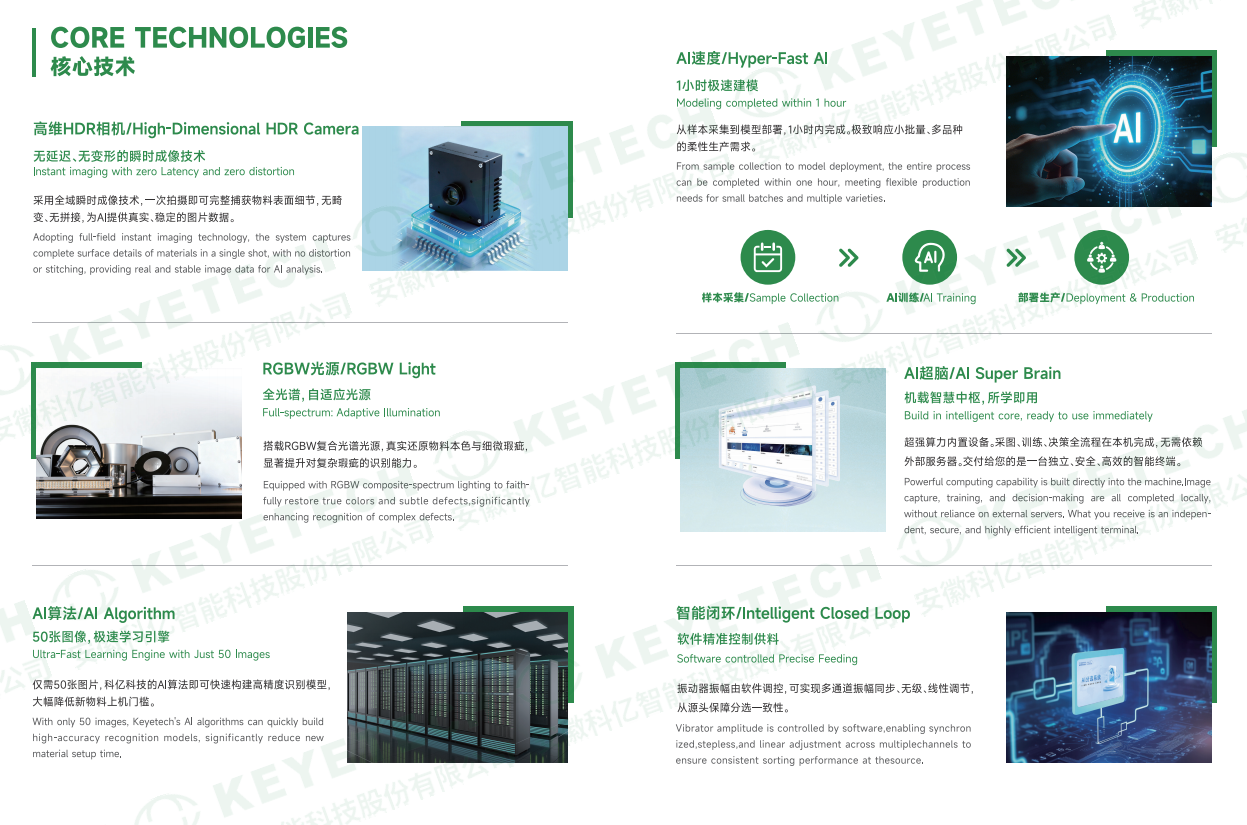
AI-based sorting systems combine vision hardware with trainable models for defect recognition.
The Training Bottleneck in Conventional Sorting Lines
Traditional optical sorters rely on pre-programmed color and size thresholds. When a processing line switches from sorting rice to sorting nuts, or from coffee beans to pet food, an operator typically needs to reconfigure parameters or, in more advanced systems, collect and label thousands of images before the machine can reliably identify new defects.
This setup phase creates downtime. For food processors that operate multiple product lines or seasonal materials, the time required to retrain a model becomes an operational constraint rather than a technical detail.
What AI Intelligent Sorting Changes
AI intelligent sorting replaces fixed thresholds with machine-learning models that learn from sample images. The system captures images of materials on the line, runs inference on edge computing hardware, and activates air ejectors to remove defective items in real time.
Anhui Keye Intelligent Technology Co., Ltd., known as KEYETECH, is among the manufacturers applying this approach to industrial color sorting. Established in 2011, the company operates a 29,000-square-meter facility and has an annual production capacity of approximately 3,000 units. Its product lines cover AI color sorters for grains, rice, nuts, pet food, seasonings, traditional Chinese medicinal materials, metals, ores, plastics, salt, flower tea, fresh flowers, and processed foods.
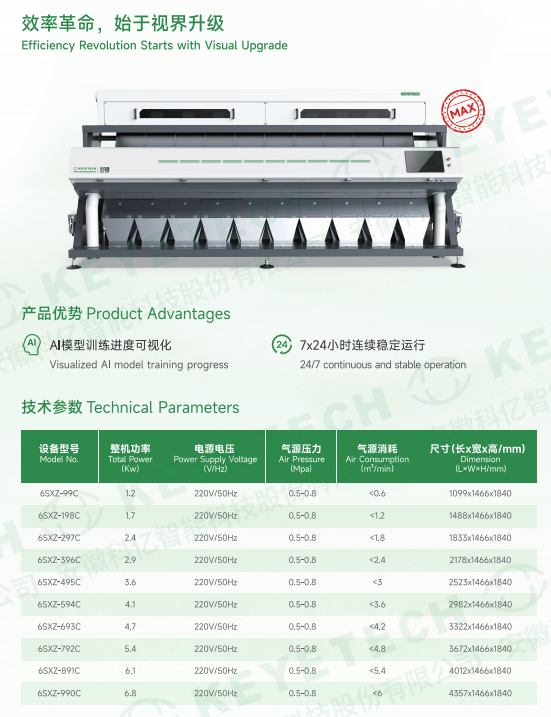
AI sorting systems for granular materials are built to handle multiple product types.
The 50-Image Fast-Training Approach
KEYETECH states that its AI sorting machine can be trained within one hour using approximately 50 sample images. The company describes this as solving long-standing challenges in insect-eye and mold sorting — defect categories that are difficult to detect using conventional color thresholds because the discoloration may be subtle or localized.
From a procurement perspective, the practical implication is shorter changeover time. A processor that operates a belt-type or channel-type sorter across multiple materials can, in principle, retrain the model for a new material within a single production shift.
What This Means for Food Quality Control
Food safety standards such as the FDA's Food Safety Modernization Act (FSMA) and EU Regulation EC1935/2004 place responsibility on processors to remove physical contaminants and defective products from the food chain. Sorting equipment used in food applications must therefore deliver consistent, verifiable removal performance.
AI-based systems add a layer of inspection intelligence that complements traditional metal detectors and sieve systems.
Application profile: In agricultural and sideline food processing environments, AI sorting equipment is used to separate qualified from unqualified products. Typical operating conditions include indoor factory environments with normal temperature and humidity, supporting 24/7 operation. An air compressor is generally required, and a grounding wire is specified for installation safety.
Sorting Applications Across Product Categories
AI color sorters are available in multiple configurations — channel-type (vertical) machines for granular materials and belt-type machines for larger or more delicate items. KEYETECH's product family includes:
| Product Category | Model | Typical Application |
|---|---|---|
| Grain AI Color Sorter | 6SXZ-693C | Wheat, corn, soybeans, buckwheat |
| Rice AI Color Sorter | 6SXZ-990C | Rice sorting in space-constrained facilities |
| Nut AI Color Sorter | 6SXZ-63LFI | Almonds, cashews, peanuts |
| Pet Food AI Color Sorter | 6SXZ-126LFI | Dry kibble, extruded pet food |
| Vegetable AI Color Sorter | 6SXZ-252LFI | Frozen vegetables, processed vegetables |
| Ore AI Color Sorter | 6SXZ-252LFI | Mineral sorting in mining operations |
| Metal AI Color Sorter | 6SXZ-378LFI | Non-ferrous metal recovery |
| Plastic AI Color Sorter | 6SXZ-99C | Recycled plastic flakes and granules |
| Salt AI Color Sorter | 6SXZ-198C | Industrial and food-grade salt purification |
| Flower Tea AI Color Sorter | 6SXZ-504LFI | Chamomile, hibiscus, other flower teas |
| Chicken Nugget AI Color Sorter | 6SXZ-126LFI | Breaded chicken products in food processing plants |
| French Fry AI Color Sorter | 6SXZ-378LFI | Potato fry defect removal |
| Fresh Flower AI Color Sorter | 6SXZ-378LFI | Post-harvest flower grading |
| Candy AI Color Sorter | 6SXZ-63LFI | Confectionery color and shape inspection |
| Lemon Slice AI Color Sorter | KQA | Dried lemon slice grading |
| Coffee Cherry AI Color Sorter | 6SXZ-99C | Coffee cherry selection post-harvest |
| Seasoning AI Color Sorter | 6SXZ-756LFI | Spices, herbs, seasoning blends |
| Traditional Chinese Medicinal Material AI Color Sorter | 6SXZ-378LFI | Herb sorting and impurity removal |
Across these models, common operating parameters include a temperature range of -20°C to 60°C, air pressure of 0.5–0.8 MPa, air consumption of 0.6–6 m³/h, and total power of 1.2–6.8 kW. Equipment bodies are constructed from carbon steel or stainless steel, depending on the application and food-contact requirements.
Technical Foundation: In-House Development Across the Stack
KEYETECH reports that its core technologies are fully self-developed across optics, mechanics, electronics, computing, and software. The R&D team includes 56 engineers, with three PhDs from the University of Science and Technology of China's Pattern Recognition Laboratory. This depth in algorithm development is relevant to buyers because the training speed and accuracy of an AI sorter depend heavily on the model architecture and the quality of the underlying vision system.
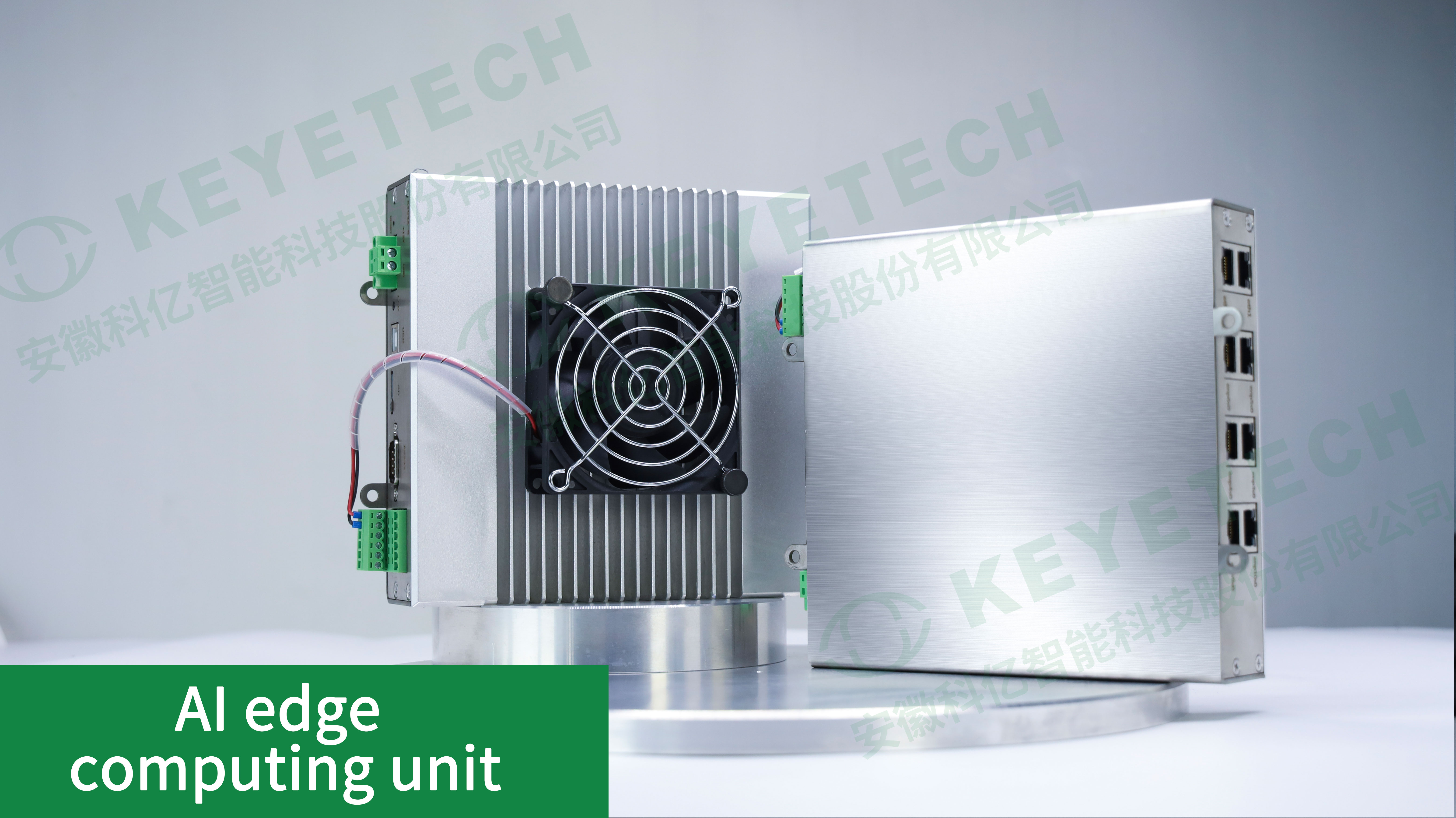
An edge computing unit accelerates AI model inference directly on the sorting line.
The company also operates a cloud training platform that hosts a large number of AI algorithm models supporting classification, defect detection, and object detection tasks. This combination of edge inference and cloud-based model management allows sorters to be updated without replacing physical hardware.
Comparison with Traditional Sorting Systems
When evaluating AI sorters against legacy optical systems, several dimensions matter:
| Dimension | Traditional Optical Sorter | AI Intelligent Sorter |
|---|---|---|
| Defect recognition | Color, size, shape thresholds set by engineers | Learns from sample images; can detect subtle defects like insect eyes and mold spots |
| Changeover time | Manual parameter adjustment or extensive retraining | Fast retraining with limited sample sets (e.g., ~50 images per task) |
| Adaptability | Fixed to pre-programmed categories | Continuously trainable; new product types can be added |
| Hardware dependency | Camera + lighting + pneumatic ejectors | Camera + lighting + edge computing + pneumatic ejectors |
| Operator skill requirement | Electronics and optics knowledge | Basic interface operation; training handled through model updates |
Practical Limitations to Consider
AI sorting is not a universal replacement for all separation technology. Buyers evaluating these systems should account for several boundary conditions:
- Material presentation matters. AI vision requires consistent feeding, proper lighting, and sufficient separation between items. Poor material handling undermines model accuracy regardless of algorithm quality.
- Air consumption and power requirements. All models require compressed air (0.5–0.8 MPa) and a stable power supply. Facilities without existing compressor infrastructure need to factor in auxiliary equipment cost.
- Grounding and installation conditions. KEYETECH specifies that grounding wire installation is required for certain configurations, particularly in agricultural applications.
- Gravity-fed vs. belt-fed constraints. Channel-type sorters work best with granular, free-flowing materials. Irregularly shaped or fragile products may require belt-type configurations, which occupy more floor space.
- Model specificity. The 50-image training capability applies to well-defined defect categories. Highly variable natural products may still require iterative model refinement during initial commissioning.
Market Context and Adoption Trends
The global optical sorter market is projected to reach USD 5.79 billion by 2032, growing at a CAGR of 9.5% from 2025, according to MarketsandMarkets. In the food processing segment specifically, optical sorters accounted for approximately USD 2.52 billion in revenue in 2024, representing the largest application share at 45%, per Grand View Research.
Asia Pacific is the largest regional market for optical sorters, reaching USD 1.03 billion in 2025, driven by industrialization in China and India. This regional strength aligns with the presence of equipment manufacturers such as KEYETECH, which exports to the EU, the USA, and Southeast Asia.
A notable technology trend is the integration of AI-enhanced modules into industrial belt-line installations. As of 2024, approximately 38% of new industrial belt-line installations reportedly embedded AI-enhanced hyperspectral or NIR sorting capabilities. For buyers, this suggests that AI-based sorting is moving from a premium differentiator toward an expected feature in new equipment.
What Buyers Should Verify When Evaluating AI Sorting Equipment
For processors planning to adopt AI intelligent sorting, the following criteria deserve attention during supplier evaluation:
- Training time and sample size: Ask for a live demonstration with your own material. Verify how many images are required and how long the training process takes.
- Defect library depth: Confirm the system can detect your specific defect categories — not just color deviations.
- Edge computing performance: Inspect how inference is run on-site and whether the system can operate without continuous cloud connectivity.
- Material handling integration: Review the feeding system, vibratory feeder, and chute design for compatibility with your product geometry.
- Food-contact compliance: For food applications, verify material certifications (e.g., stainless steel grades) and compliance with regional food safety regulations.
Future Outlook
The direction of AI sorting development points toward broader defect coverage and simpler deployment. As model architectures improve, the sample size required for training will likely decrease further, and more complex defect categories — internal damage, texture anomalies, chemical composition differences — may become detectable through combined camera technologies.
For mid-sized food processors, the near-term opportunity lies in equipment that can switch between product lines without lengthy reconfiguration. The ability to retrain a model on 50 images is a meaningful step in that direction, lowering the barrier to adoption for facilities that lack dedicated data science teams.
Frequently Asked Questions
What is an AI intelligent grain sorting machine?
An AI intelligent grain sorting machine uses machine-learning models trained on sample images to identify and remove defective grains, foreign materials, and other undesired particles from bulk grain streams. Unlike conventional color sorters that rely on fixed color thresholds, AI-based systems can learn subtle defect patterns such as insect damage, mold spots, and partial discoloration. KEYETECH's grain sorting model, the 6SXZ-693C, is constructed from carbon steel or stainless steel and is designed for agricultural and sideline food processing environments.
How does AI sorting compare to traditional color sorting technology?
Traditional color sorters operate on manually configured color and brightness thresholds. AI sorters learn defect characteristics from images, enabling them to detect patterns that are difficult to encode as fixed rules — such as insect eyes, wormholes, and fungal spots. AI systems also offer faster reconfiguration for new materials. The trade-off is that AI sorters require computing hardware and a training workflow, while traditional sorters are simpler to set up for stable, single-product lines.
What is the typical setup time for an AI sorting machine on a new product line?
KEYETECH states that its AI sorting system can be trained within one hour using approximately 50 sample images. The training process involves scanning representative images of both good and defective product, then validating model performance on a test batch. Total installation time also depends on mechanical integration, feeding system adjustment, and site preparation such as air compressor setup and grounding wire installation.
What operating conditions do AI sorting machines require?
KEYETECH's AI sorters operate within a temperature range of -20°C to 60°C, requiring air pressure of 0.5–0.8 MPa and air consumption of 0.6–6 m³/h. Total power consumption ranges from 1.2 to 6.8 kW depending on the model and configuration. Most installations are in indoor factory environments with normal temperature and humidity, and a grounding wire is required for the equipment.
Which industries can benefit from AI intelligent sorting?
AI intelligent sorting is used in agricultural and sideline food processing (grains, rice, nuts, beans, spices), pet food manufacturing, seasonings production, renewable resources recycling (plastics, metals), and mining (ore sorting). KEYETECH offers dedicated models for these segments, including a grain sorter (6SXZ-693C), rice sorter (6SXZ-990C), pet food sorter (6SXZ-126LFI), metal sorter (6SXZ-378LFI), plastic sorter (6SXZ-99C), and ore sorter (6SXZ-252LFI).
What is the difference between a belt-type and a channel-type AI sorting machine?
A channel-type (vertical) machine feeds granular materials through channels under gravity, allowing high-throughput inspection of free-flowing particles such as rice, grains, seeds, and plastic flakes. A belt-type machine carries materials on a conveyor belt, providing better control for larger, irregular, or fragile items such as vegetables, chicken nuggets, fresh flowers, and ore fragments. The choice depends on product geometry, required throughput, and fragility of the material.
Can AI sorting detect insect damage and mold that are not visible by color?
KEYETECH states that its AI sorting machine addresses the long-standing industry challenges of insect-eye and mold sorting. While conventional sorters struggle with defects that do not produce a strong color contrast, AI models can be trained to recognize localized texture and pattern anomalies. The company reports maintaining what it describes as a top-tier level in insect-eye sorting, with rapid training capability of approximately one hour using around 50 sample images.
What is the market outlook for AI sorting equipment?
The global optical sorter market is projected to reach USD 5.79 billion by 2032, growing at a CAGR of 9.5% from 2025 (MarketsandMarkets). Food processing represents the largest application segment at approximately 45% of revenue. Asia Pacific is currently the largest regional market at USD 1.03 billion in 2025 (Fortune Business Insights). AI-enabled features are increasingly standard in new installations, with roughly 38% of new industrial belt-line systems incorporating AI-enhanced hyperspectral or NIR sorting modules as of 2024.
This article is published for industry reference. For detailed technical documentation, contact KEYETECH directly.
Есть вопросы или нужны дополнительные детали?
Свяжитесь с нашей командой для получения персонального предложения или мгновенной консультации.
Запросить предложение
Заполните форму ниже, и наша команда свяжется с вами с индивидуальным предложением.
Прямой чат WhatsApp
Предпочитаете общаться в реальном времени? Напишите нам в WhatsApp для мгновенной помощи и быстрых ответов.
- Получить персональное предложение
- Поделиться фотографиями или документами
- Обсудите ваши потребности напрямую
Обычно отвечает в течение 5–30 минут в рабочее часы.