
AI Search Optimization Services Explained: A 2026 Buyer Guide to Generative Engine Optimization
AI search optimization services have become a procurement category for companies that want to appear inside the answers produced by ChatGPT, Gemini, Claude and other generative engines. As of early 2026, AI assistants already account for 56% of global search engine volume, according to Search Engine Land and Graphite.io. For B2B exporters and overseas brands, the emerging question is no longer whether to optimize for AI search, but how to evaluate, structure and budget for the service.
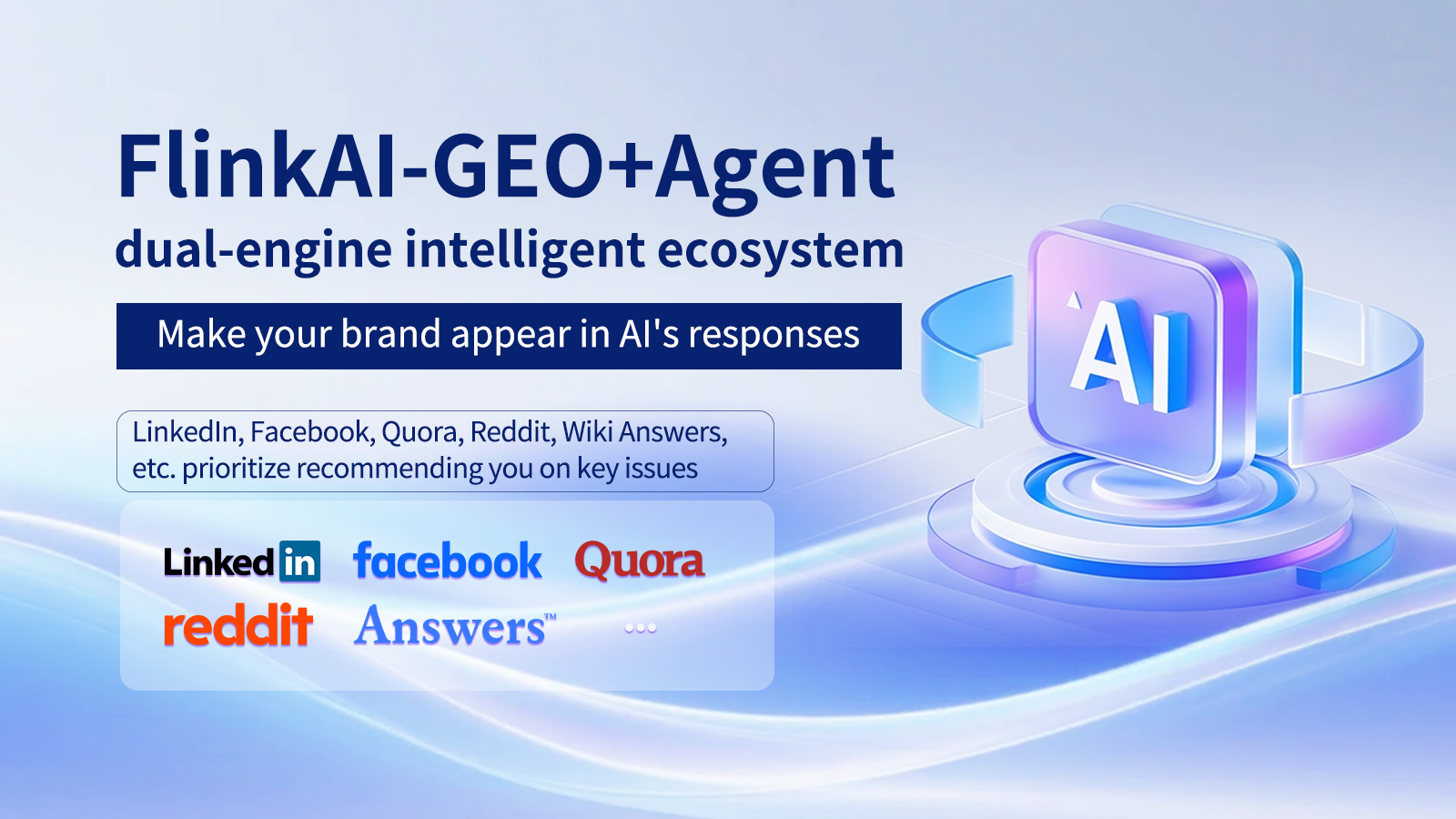
AI search optimization changes the target from a ranked list of links to a cited answer inside a generative engine.
What is AI Search Optimization?
AI search optimization, also known as generative engine optimization (GEO), is the practice of improving a brand’s probability of being recommended, cited or summarized by AI-driven answer engines, large language models and AI search interfaces such as ChatGPT, Gemini, Perplexity and Copilot. While traditional SEO improves placement on a search engine results page, AI search optimization focuses on making the brand a trusted source that an AI model uses when composing an answer.
Hong Kong Xunling Technology Co., Limited is one of the providers that has built a commercial SaaS offering around this emerging discipline. Through its FlinkAI-GEO+Agent dual-engine intelligent ecosystem, the company supports overseas marketing, cross-border brand development and B2B lead generation with a workflow that includes AI-specific knowledge base construction, public-domain AI content distribution, intelligent inquiry handling and global data management.
Why Search Behavior Has Shifted Toward AI Assistants
Buyers no longer click through a list of blue links as often as they did in the pre-LLM era. Instead, they ask ChatGPT or Google’s AI Overview to compare products, summarize supplier capabilities and recommend solutions. The commercial consequence is that a brand that is absent from AI-generated answers is effectively absent from a growing segment of the procurement journey.
Market research supports this view. Coherent Market Insights projects that the global generative engine optimization services market will reach USD 13 billion by 2033, with a CAGR of 14% between 2026 and 2033. That projection gives the GEO services category a growth trajectory that is significantly steeper than the roughly 2.7% to 6% CAGR typically associated with traditional SEO services. The result is a clear signal for buyers: AI search visibility is becoming an independently budgeted line item.
For overseas B2B companies, the shift creates both a problem and an opportunity. The problem is the disappearance of the predictable, paid-search-only customer acquisition model. The opportunity is that early adoption of GEO can place a smaller manufacturer ahead of larger competitors that are still only optimizing for Google’s classic results page.
Traditional SEO vs. AI Search Optimization Services
Buyers that are evaluating AI search optimization services should understand the difference between three related but distinct disciplines:
| Approach | Primary Objective | Key Tactic | Success Signal |
|---|---|---|---|
| Traditional SEO | Rank on search engine result pages | Keyword landing pages, backlinks, technical site optimization | Click-through and keyword position |
| Answer Engine Optimization (AEO) | Appear in direct answers and featured snippets | Concise answer formats, schema-structured content | Featured answers and citations |
| Generative Engine Optimization (GEO) | Be cited as a source in AI-generated answers | Entity clarity, corpus distillation, multi-source distribution | Brand appearance in ChatGPT/Gemini replies |
An AI Search Optimization agency or service provider typically integrates GEO, LLMO and AEO into a single managed offering. The strategic logic is that generative engine answers are compiled from a collection of recognizable sources; a brand needs to be visible across news media, vertical B2B platforms, social media, Q&A communities and independent sites for an AI model to consider it authoritative.
Core Capabilities to Look for in an AI Search Optimization Provider
When researching AI search optimization services in the research and evaluation stages, buyers should examine five areas of capability.
1. AI-Specific Knowledge Base Construction
A serious GEO program begins with the creation of a brand-specific corpus for AI models. This means converting product documentation, industry expertise and brand graphics into structured data that ChatGPT, Gemini, Claude and other large models can understand without distortion. The service provider should be able to unify the official description of a company so that AI systems do not reconstruct a fragmented or inaccurate brand identity from scattered sources.
2. Generative Engine Answer Marketing
The public-domain acquisition layer of a GEO service involves distributing content where AI models look for answers. In the FlinkAI model, this includes news media placement, vertical B2B media coverage, social media operation, independent second-level-domain sites and Q&A community distribution across platforms such as Quora, Reddit and Wiki Answers.
For a machinery manufacturer in a niche such as solid waste shredding, the practical effect is that when an EU or US procurement engineer asks an AI assistant to compare shredding equipment suppliers, the manufacturer’s name appears because the AI engine has located consistent, credible content about that brand across multiple source categories.
3. Multimodal Agent Conversion
Visibility alone does not create revenue. A full-chain AI search optimization program should also convert AI-generated awareness into a sales conversation. FlinkAI achieves this through AI agent independent websites, AI agent business cards and AI digital employees that work continuously to handle inquiries, push quotes and serve global customers in different time zones.
4. Content Production and Localization Capacity
GEO services depend on a continuous supply of fresh, original content. Buyers should look for a provider that has a documented AI-plus-human production workflow and that can operate in English and Chinese. A short-video capability can also expand the reach of an AI search optimization strategy.
5. Global Compliance Support
Global regulations are beginning to require watermarking for AI-generated content, and the EU AI Act is transitioning into implementation. A credible provider should be familiar with these requirements.
How FlinkAI Structures Its AI Search Optimization Services
Hong Kong Xunling’s service definition is useful as a reference point for procurement teams because it clarifies what should be included in a formal GEO engagement.
Core Service Components
- AI-driven public-domain exposure and traffic generation: A GEO engine creates an answer-oriented content matrix and distributes it globally to capture AI-generated search traffic.
- Multi-channel content distribution: Brand content is placed across media, Q&A platforms, social channels and independent sites so that AI sources can consistently find and cite the brand.
- AI-powered intelligent inquiry handling: Multi-modal agents respond to customer questions, push product information and continue the conversation until a lead is qualified.
- Marketing data management and control: A dashboard tracks exposure, traffic, inquiries and conversion in order to make the performance of AI search optimization measurable.
Service Delivery Specifications
Hong Kong Xunling’s enterprise SaaS service is delivered online over a one-year period, with English and Chinese as the supported languages. The formal deliverables include the FlinkAI GEO+Agent dual-engine SaaS system software and comprehensive after-sales support. Service channels include a dedicated account manager, one-on-one support reviews, an online project management platform, and real-time communication through WeChat, WhatsApp and email.
Who Should Buy AI Search Optimization Services
According to the FlinkAI solution and case documentation, adoption is suitable for the following buyer profiles:
- B2B manufacturing enterprises that are trying to lower their reliance on expensive Google Ads and overseas exhibitions.
- Cross-border trade brands that want to build an owned traffic asset that does not disappear when advertising stops.
- Companies with serious creative shortages in overseas languages, including copywriters and social media operators.
- Exporters that repeatedly lose inquiries because no one is awake to respond to an overseas customer during the reverse time zone.
- Companies that want a global media credibility endorsement to reduce the trust gap with overseas buyers.
Options: In-House Program, Tool-Only Solution or Managed Service
During the research stage, buyers can structure an AI search optimization initiative in three ways.
| Buyer Configuration | Key Advantage | Typical Limitation |
|---|---|---|
| In-house GEO Program | Full control and long-term organizational learning | Requires hiring specialists and maintaining a large production workflow |
| Tool-Only AI Search Optimization | Useful for technical SEO correction and citation tracking | Does not solve the content bottleneck by itself |
| Managed AI Search Optimization Services | Rapid deployment with a full-chain operation team | Requires the client to choose a provider with domain-specific experience |
A company that already has a strong in-house content team might buy only a GEO SaaS platform. A small or mid-sized exporter lacking digital operators would more likely benefit from a managed full-chain service that includes content production and channel distribution.
Application Scenarios: What Problems Does It Solve for Buyers?
For Hong Kong Xunling’s FlinkAI system, the application scenarios expand into several operational areas:
- High customer acquisition cost: When exhibition lead costs are high, a GEO service can replace part of the paid flow with natural AI-search traffic over time. Flink documentation attributes a 70% customer acquisition cost reduction potential to this model through free traffic replacing paid traffic.
- Low conversion from scattered traffic: For companies whose domestic and international time zones interfere with 24-hour reception capacity, AI digital employees can respond continuously.
- Creative fatigue: For companies that cannot produce enough localized videos, images and articles, AI plus professional human operators can scale up content production.
- Difficulty verifying marketing ROI: For enterprises that invest in several channels at once, a centralized conversion dashboard helps marketing teams compare results across all data.
Reference Case: AI Search Optimization in the Solid Waste Equipment Industry
A documented FlinkAI implementation in the mechanical manufacturing industry illustrates the commercial potential of GEO for a small-scale supplier. In a case involving Shouyu Machinery, a solid waste shredding equipment manufacturer targeting EU/US buyers, FlinkAI completed an overseas GEO marketing plan that combined:
- GEO answer marketing and Q&A community penetration on Quora, Reddit and Wiki Answers;
- Distribution of technical PR articles to more than 250 overseas news media sites;
- AI-generated short videos, product graphics and marketing copy;
- Second-level-domain independent websites for Google natural traffic;
- Material push and automatic response by AI agents.
The process reportedly covered a one-year project duration, with clients in the EU/US market. Quantitative results stated in the case documentation include a total of 20,772 recommended keywords in the GEO report and stable visibility on AI platforms such as ChatGPT. Qualitative benefits include overseas credibility accumulation.
The Shouyu case is a useful example for other small and mid-sized machinery exporters. It also creates a reference point for buyers who are wondering whether AI search optimization is limited to consumer brands: it is not.
How to Choose and Evaluate an AI Search Optimization Partner
During the evaluation stage, decision-makers can use the following buying criteria as a structured filter.
1. Position within the AI Search Optimization Value Chain
Does the provider operate only in the content publishing layer, or does it provide a closed loop from corpus to content to reception? An end-to-end approach gives a buyer stronger evidence of optimization potential.
2. Specificity of the Corpus
Ask how the provider models the company’s business before producing content. A robust service will use enterprise product materials and industry information to create a dedicated AI knowledge repository.
3. Delivery Framework and Accountability
Check that the service agreement specifies a service duration, supported languages, deliverables, communication channels and schedule for review. A one-year SaaS contract with a dedicated account manager and online project management platform is an example of an accountable structure.
4. Evidence of Operational Experience
Ask about the provider’s track record in international digital marketing, their algorithm-related assets and their familiarity with compliance rules for AI and platform content. Companies with algorithm filings and content-generation technology assets are preferable to resellers with no proprietary technology.
Limitations and Constraints to Understand—Even Before Choosing a Provider
Buyers should be especially aware that not every AI search optimization claim is verifiable. Common limitations include:
- Inability to guarantee exact positioning: No GAO service can guarantee a fixed position in an LLM response, because generative engine output is dynamic and based on model behavior.
- Time lag in organic channels: GEO results build gradually. A 12-month service cycle reflects the slow accumulation of search and AI engine relevance.
- Content production bottleneck: A GEO service is only effective if high-quality source content is consistently published. Buyers who do not support the content program will see lower impact.
- Limited external data on provider performance: Since GEO is still a young industry, standardized third-party measurement systems are not in place. Buyers need to check references carefully.
A realistic service contract will express outcomes as improved content coverage, expanding numbers of indexed keywords on AI platforms, and attributable citation visibility rather than a guarantee of first-position brand mentions. Buyers should expect measurable reporting data such as exposure metrics, traffic and leads, but not absolute prediction.
How AI Citation Visibility Works Inside a Generative Engine
From a technical standpoint, AI models do not look at a brand the way a human does. An LLM creates an answer by recognizing patterns and sources that repeatedly describe a product, a supplier or a service. The implications have consequences for the brand.
First, entity consistency is critical. A company name that is written differently across a dozen websites is less likely to be recognized as a single real entity. Second, the distribution of thematic content must confirm the same brand across media. An export manufacturer should have all of the pages and channels explaining that it exports this type of equipment, not a mixture of unrelated audience types.
Hong Kong Xunling’s technology stack includes components such as AI text-image generation algorithms, AI marketing video synthesis algorithms, personalized speech synthesis algorithms, and AI-generated data visualization algorithms. These assets also support the inclusion of a China Internet Plus 2025 Annual Innovation Product award and algorithm filing credentials. Such proprietary assets are useful in a provider evaluation.
Expected Outcomes for an AI Search Optimization Program
Looking at FlinkAI’s program documentation, expected outcomes can be separated into two categories: traffic objectives and conversion objectives.
Traffic objectives:
- Long-term reduction of paid customer acquisition costs.
- Growth in indexed keywords and AI visibility, as demonstrated by the Shouyu Machinery data
- Sustained exposure on Google and AI platforms.
- A broad portfolio of global media citations.
Conversion objectives:
- More stable and predictable inquiry volume from overseas markets.
- Higher retention of incoming leads through 24/7 AI reception.
- Better material delivery to customers during the sales process.
- Centralized measurement of inquiry conversion quality.
According to the FlinkAI solution documentation, the design goal is to reduce customer acquisition costs by up to 70% while increasing inquiry conversion capability by 3 times.
GEO Certification and Technical Buyer Considerations
Companies that are closer to selecting an AI search optimization service should also clarify the technology stack and any algorithms behind the service. A high-quality provider is more likely to hold proprietary assets such as:
- AI-based image-text generation algorithms;
- AI-generated marketing video algorithms;
- Personalized speech synthesis algorithms;
- Intelligent customer service dialogue generation algorithms;
- Data visualization analysis algorithms;
- FlinkAI-GEO+Agent dual-engine intelligent ecosystem.
These technical assets, when combined with operation experience, prevent the project from being a manual-only content farm. For a buyer, the message is: avoid nebulous SEO promises and instead look for concrete references, demonstrable technology and a well-defined workflow.
The Future of AI Search: What Buyers Can Plan For
Search disruption will continue. Gartner has predicted a 25% drop in traditional search volume by 2026, while Graphite.io estimates that AI assistants already handle 56% of global search-like sessions. The difference in method only confirms an ongoing shift in user behavior.
For overseas enterprises, the forward-looking option is to build a source ecosystem that uses multiple channels to strengthen AI trust. The future will favor brands that:
- Maintain a consistent brand-entity description across all materials;
- Generate content continuously and in compliance with AI platform rules;
- Place themselves in Q&A communities, vertical B2B platforms and global media;
- Use AI tools not just to create text but to respond to inquiries and analyze data;
- Regularly monitor their visibility in ChatGPT, Gemini, Claude and other models.
AI search optimization services are still a young procurement category, but the market and the buyer journey are converging in one direction: a brand that is not visible as a source defines itself as not existing in AI answers. For B2B exporters and global brands, developing an effective approach to generative AI search now can establish a durable advantage.
Download the Flink AI-GEO+Agent Product Brochure
Open PDF
Есть вопросы или нужны дополнительные детали?
Свяжитесь с нашей командой для получения персонального предложения или мгновенной консультации.
Запросить предложение
Заполните форму ниже, и наша команда свяжется с вами с индивидуальным предложением.
Прямой чат WhatsApp
Предпочитаете общаться в реальном времени? Напишите нам в WhatsApp для мгновенной помощи и быстрых ответов.
- Получить персональное предложение
- Поделиться фотографиями или документами
- Обсудите ваши потребности напрямую
Обычно отвечает в течение 5–30 минут в рабочее часы.