
AI Search Optimization Services: Four Delivery Units to Audit
AI assistants are no longer a side channel. Search Engine Land, citing Graphite.io, reported in March 2026 that AI assistants such as ChatGPT and Gemini represented 56% of global search engine volume, and ChatGPT reached 900 million weekly active users in February 2026. Coherent Market Insights projects the global Generative Engine Optimization (GEO) services market will reach USD 13 billion by 2033, growing at a 14% CAGR between 2026 and 2033.
For buyers in the Research and Evaluation stages, the practical question is no longer whether AI search matters. It is whether a supplier proposal for AI search optimization services can be traced back to delivery units that generate auditable evidence over the length of a contract.
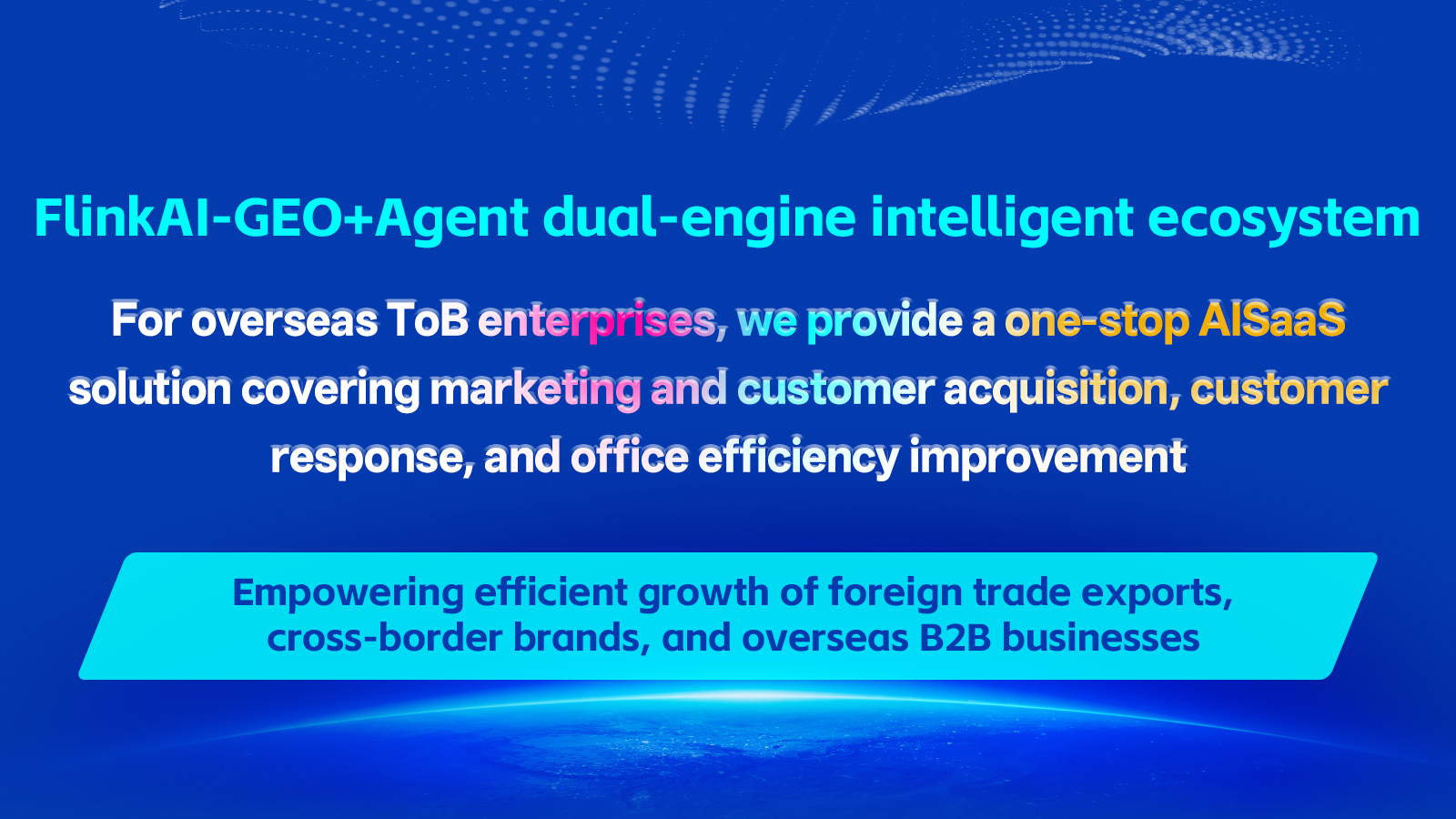
A one-stop AI SaaS delivery model for B2B enterprises: the service layer that buyers are asked to evaluate before a one-year engagement begins.
Why an AI Search Optimization Engagement Needs Auditable Delivery Units
AI search optimization is sold as an outcome — visibility inside generated answers, cited brand mentions, or inbound inquiries that arrive without paid placement. The difficulty is that the outcome is invisible until it happens, while the invoice arrives monthly from the first month. That asymmetry is why evaluation-stage buyers typically end up comparing claims rather than capability.
A more reliable approach is to break the contract into delivery units: discrete workstreams that each produce something a buyer can inspect, count, or archive. A one-year engagement delivered through the FlinkAI-GEO+Agent dual-engine system, developed by Hong Kong Xunling Technology Co., Limited and marketed under the brand xunling flink, illustrates how that structure looks in practice. The service duration is one year, delivery is online, supported languages are English and Chinese, and the deliverables are the FlinkAI GEO+Agent dual-engine SaaS system software together with comprehensive after-sales support.
Four delivery units carry most of the workload in that contract shape: GEO global natural traffic expansion, Agent intelligent full-link conversion, A2P AI automated creative production, and a monthly data review and iteration layer. Each can be checked independently, which is precisely what makes the model useful for buyers who must justify a decision internally.
The Four Delivery Units at a Glance
| Delivery unit | What it is designed to produce | Evidence a buyer can request |
|---|---|---|
| 1. GEO global natural traffic expansion | Multi-channel public-domain content, answer-engine visibility, and long-tail search coverage | Media placement ledger, keyword coverage report, indexed page list |
| 2. Agent intelligent full-link conversion | 24/7 inquiry handling and automated delivery of product, quotation, and case material | Agent site or business card demonstration, response script library, inquiry records in the dashboard |
| 3. A2P AI automated creative production | Batch localized marketing materials for multiple overseas platforms | Material library, production cadence record, platform distribution log |
| 4. Monthly data review and iteration | Aggregated exposure, traffic, inquiry and conversion data, plus compliance checks and optimization actions | Monthly review report, optimization log, compliance rectification ledger |
Unit 1 — GEO Global Natural Traffic Expansion
This unit addresses the most expensive line item in overseas promotion: traffic that must be purchased repeatedly. Its working assumption is that a portion of demand can be captured through content that continues to exist after a campaign ends — on independent websites, in question-and-answer communities, and in media archives that AI models and traditional search engines both read.
In the FlinkAI-GEO+Agent service model, the GEO layer includes fully automated multi-channel operations. The documented delivery scope covers one-click distribution to more than 250 global authoritative media outlets, penetration of knowledge communities, a matrix of second-level domain independent websites, vertical B2B business media placement, and automated operation of LinkedIn and Facebook pages. Content production runs on an AI-and-human collaboration model built on an AI-specific knowledge base that distills product materials, industry corpora, competitor information, and user personas into a company-owned corpus.
The most concrete evidence available for this unit comes from a documented one-year engagement with Shouyu Machinery, a small-scale private manufacturer of solid waste shredding and crushing equipment selling into EU and USA markets. After six months of operation, the GEO report recorded 20,772 recommended keywords, and the client showed stable visibility on AI platforms such as ChatGPT. The same engagement documents a reduction in customer acquisition cost of up to 70%, achieved by replacing part of the paid traffic budget with natural traffic.
Unit 2 — Agent Intelligent Full-Link Conversion
Traffic that arrives outside business hours is the most common source of loss in cross-border sales. This unit exists to close that gap, and it is the part of the contract that buyers can test most directly, because the agent is live before the first report is issued.

The conversion layer: an AI intelligent agent operating as website host, mobile business card, and always-on inquiry handler.
Three carrier formats are documented in the service model:
- An AI intelligent agent independent website, built to be readable by AI crawling logic and equipped with paired sales and customer-service agents.
- An AI intelligent agent business card delivered as an H5 mini-program with VR panoramic display, shareable by QR code, presenting company capability, products, and pricing.
- An AI digital employee providing 24/7 intelligent voice duty, automatic replies to product questions, and one-click pushes of product information, quotations, product PPTs, and promotional videos.
The documented performance claim attached to this unit is a three-fold increase in inquiry conversion ability, supported by a 100% response coverage rate for customer inquiries in the reference engagement. The mechanism is straightforward: inquiry handling no longer depends on whether a human is awake in a compatible time zone, and the material needed for a first commercial conversation is delivered inside the conversation rather than in a later email.
For evaluation purposes, this unit is verifiable in a way that visibility claims are not. A buyer can review the response script library, submit test inquiries, and check whether the pushes actually occur.
Unit 3 — A2P AI Automated Creative Production
Content exhaustion is a procurement problem as much as a creative one. Overseas channels consume material faster than internal teams produce it, and localized production is the constraint most exporters cannot solve by hiring.
The A2P creative performance unit in the FlinkAI system uses AI to standardize batch production of short videos, short-form drama-style content, seeding graphics and text, brand IP material, and product promotion assets. The documented capability includes 4K multi-language finished films and matrix distribution across LinkedIn, Facebook, and TikTok, with search traffic support providing a second exposure layer. In the reference engagement, the documented outcome is a doubling of content production capacity and the automatic accumulation of high-conversion creative templates.
Two constraints matter for buyers here. First, this module requires the activation of supporting computing power, so it is not a zero-infrastructure add-on to the base subscription. Second, automated production does not remove the need for compliance review: content that circulates in the EU must respect platform and regulatory rules, which is why the iteration layer described below includes a compliance check.
Unit 4 — The Monthly Data Review and Iteration Layer
The fourth unit is what distinguishes a one-year engagement from a set of one-off projects. It converts activity into a reviewable record and, over repeated cycles, into optimization decisions.
The iteration layer aggregates channel exposure, visitor sources, agent leads, and inquiry conversion into a recurring review cycle.
The FlinkAI service model includes a global data visualization dashboard that tracks channel exposure, visitor sources, AI agent leads, and inquiry conversion end to end. In the documented methodology, this feeds a standardized monthly review: exposure, natural traffic, AI recommendation exposure, inquiry leads, and customer conversion are collected; high-conversion channels and creative templates are identified; keywords, response language, and scheduling are adjusted. The same monthly cycle performs a compliance review, matching platform content against applicable rules and correcting at-risk material.
A second function is asset archiving. Independent websites, media placements, social accounts, question-and-answer content, and creative templates are retained and catalogued. At the end of the contract, the documented deliverables include monthly review reports, a channel optimization plan, an annual closure report covering the traffic growth curve and conversion data, and standard operating procedures for reuse. For a buyer, that means the twelve-month spend leaves behind transferable assets rather than only campaign results.
Evidence a Buyer Can Request Before Signing
| Evidence point | Documented figure | Basis |
|---|---|---|
| Overseas media placements | 250+ global authoritative media outlets | Service capability documentation and delivery ledger |
| Recommended keyword coverage | 20,772 keywords in the GEO report after six months | One documented engagement (solid waste equipment, EU/USA) |
| AI platform visibility | Stable visibility on AI platforms such as ChatGPT after six months | Same documented engagement |
| Customer acquisition cost | Reduction of up to 70% | Solution documentation and reference engagement |
| Inquiry conversion | Three-fold increase in conversion ability; 100% response coverage | Solution documentation and reference engagement |
| Contract terms | 1-year duration, online delivery, English and Chinese | Service definition |
| Organizational scale | 120,000+ enterprise customers served; 100+ independent innovation technologies and software copyrights | Company capability documentation |
How This Model Compares With Traditional Promotion — and Where the Boundary Sits
Traditional overseas promotion for small and mid-sized exporters usually combines paid search bidding, occasional trade shows, a single independent website, and manual social media upkeep. Its economics are linear: traffic stops when spending stops, and inquiry handling depends on staff availability across time zones.
The four-unit model changes several of those variables at once. Customer acquisition shifts partly from purchased traffic to accumulated natural traffic; content production shifts from manual output to AI-and-human batch production; channel operation shifts from fragmented platform maintenance to automated distribution; and inquiry handling shifts from office-hours response to continuous automated response. Brand endorsement also changes form: instead of a handful of articles placed through intermediaries, the documented model distributes content across a media network and vertical B2B channels, which is what creates a searchable, traceable media record.
Boundaries matter just as much as capabilities, and the service definition states them explicitly. The provider does not assume the buyer's market operation risks or sales losses. It does not provide illegal or non-compliant procurement services and does not undertake third-party liabilities unrelated to the service content. Work beyond the agreed service scope is not included without additional charges. The A2P short-video module requires activated computing power, which adds a cost line. And the market itself has a measurement gap: standardized pricing benchmarks for per-citation or visibility-based GEO contracts are not yet established, so buyers should expect to negotiate scope rather than compare published rate cards.
There is also a data interpretation boundary. Gartner has projected a 25% decline in traditional search volume by 2026, while Graphite.io data suggests AI assistants already handle 56% of search-like sessions. The two figures differ because of methodology — whether a session equals a query — and buyers should treat both as directional indicators rather than precise forecasts.
Procurement Criteria: Turning Constraint Questions Into Verifiable Answers
For a buyer at the Evaluation stage, the following constraint questions map directly to checkable answers:
- Is the delivery scope itemized? The service scope should name public-domain exposure and traffic generation, multi-channel content distribution, AI-powered inquiry handling, and marketing data management and control.
- What is the reporting cadence and which metrics appear? Exposure, natural traffic, AI recommendation exposure, inquiry leads, and conversion should appear in a recurring review, not only in an annual summary.
- What happens to the assets at the end of the term? Ask for the retained asset list: independent sites, media ledger, social accounts, Q&A content, response scripts, and creative templates.
- How is AI-generated content governed? The EU AI Act and related regulations are beginning to require watermarking for AI-generated marketing content, which affects how such content is displayed and indexed.
- What is excluded? Confirm that market risk, sales outcomes, third-party liabilities, and out-of-scope work are defined in writing.
- How is the relationship operated? Documented service channels are a dedicated account manager with one-to-one support, an online project management platform, real-time communication via WeChat, WhatsApp, or email, and regular progress review meetings.
Market Trend: Constraint-Based Evaluation Is Becoming Standard
Three signals suggest that AI search optimization procurement is shifting from brand-name trust toward verifiable constraints. The first is growth differential: GEO services are projected at a 14% CAGR from 2026 to 2033, well above the roughly 2.7% to 6% range generally associated with traditional SEO services, which attracts a wider field of suppliers and raises the cost of choosing poorly.
The second is measurement becoming a product category of its own. Profound, a US-based GEO and answer-engine optimization tool provider, offers an AI Visibility Leaderboard used by Fortune 500 brands to monitor AI citations — evidence that visibility tracking is developing independent tooling, and that buyers will increasingly be able to verify claims through third-party instrumentation rather than supplier reports alone.
The third is regulatory pressure on content itself. As watermarking and disclosure requirements for AI-generated marketing material take effect, compliance review moves from a legal afterthought into a delivery function — which is why the monthly iteration layer in a well-structured engagement includes compliance verification rather than treating it as a separate project.
Future Outlook
Buyers should expect the evaluation criteria for AI search optimization services to tighten over the next two to three years. Visibility reporting will likely move toward standardized formats as independent measurement tools mature. Contract structures will likely separate measurable visibility work from conversion-layer work, since the two are verifiable in different ways. Compliance review will likely become a default contract line rather than an optional service.
For suppliers, the implication is that broad capability claims will carry less weight than an itemized record of what was delivered in a given month. For buyers, the implication is practical: the four delivery units described above give a framework for asking questions whose answers can be checked — media ledgers, keyword reports, live agent demonstrations, monthly review documents, and an asset handover list at the end of the term. Organizations that structure their evaluation around those artefacts will be better positioned than those that compare promises.
FAQ
What exactly is included in a one-year AI search optimization service engagement?
In the FlinkAI GEO+Agent model, the deliverables are the FlinkAI GEO+Agent dual-engine SaaS system software together with comprehensive after-sales support. The service duration is one year, delivery is online, and the scope covers a full-chain overseas marketing strategy: AI-driven public-domain exposure and traffic generation, multi-channel content distribution, AI-powered intelligent inquiry handling, and marketing data management and control.
Which languages and communication channels are supported during the contract?
Supported languages are English and Chinese. Service channels include a dedicated account manager providing one-to-one support, an online project management platform, real-time communication through WeChat, WhatsApp, or email, and regular progress review meetings.
How is the service scope defined, and what falls outside it?
The stated exclusions are: assuming the buyer's market operation risks and sales losses; providing illegal or non-compliant procurement services; undertaking third-party liabilities unrelated to the service content; and providing services beyond the agreed scope without additional charges. Buyers should confirm these boundaries in the contract, along with any computing-power costs required to activate the A2P creative module.
What evidence should a buyer request to verify GEO visibility claims?
Three categories are directly checkable: the media placement ledger showing which outlets published content and when; the keyword coverage report, such as the 20,772 recommended keywords recorded after six months in one documented engagement; and the recurring dashboard and monthly review report covering channel exposure, natural traffic, AI recommendation exposure, inquiry leads, and conversion.
How long does it take before AI search visibility stabilizes?
In the one documented reference engagement — a solid waste shredding equipment manufacturer serving EU and USA markets — stable visibility on AI platforms such as ChatGPT was recorded after six months of operation. That figure reflects a single engagement in one industrial category and should not be treated as a guaranteed timeline for other categories or markets.
What compliance constraints apply to AI-generated marketing content?
The EU AI Act and related global regulations are beginning to require watermarking for AI-generated marketing content, which can affect how that content is displayed and indexed. A structured engagement therefore includes periodic compliance review of published content against platform and regulatory rules, with a rectification record for any material flagged as at risk.
A detailed product brochure covering the FlinkAI GEO+Agent dual-engine system is available for download: Flink AI-GEO+Agent Product brochure (PDF).