
AI Vision Inspection: Pet Food, Flower and Herb Project Fit
AI Vision Inspection: Pet Food, Flower and Herb Project Fit
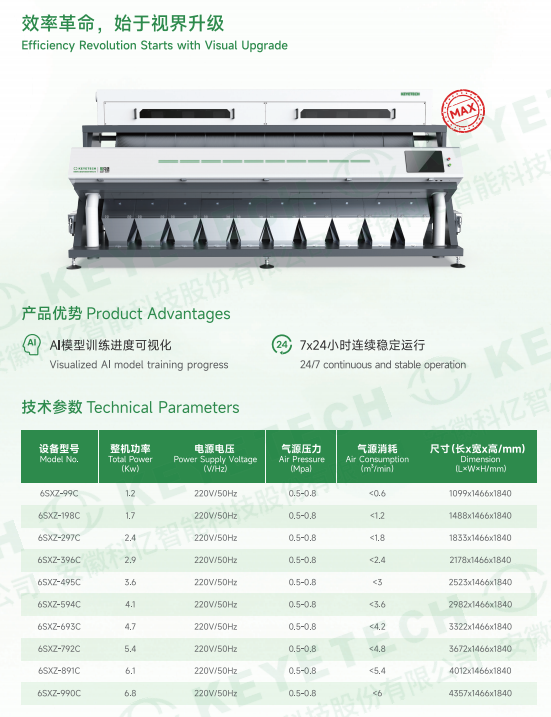
Most published material on AI vision inspection is written around packaging. A bottle, a cap or a preform is manufactured to a tolerance, presented to the camera at a fixed pitch, and inspected against a defect list that the moulding process itself defines. Pet food, fresh flowers and traditional Chinese medicinal materials do not behave that way. They arrive in bulk, in irregular shapes, at moisture levels that shift with the season, and they are graded against criteria that a buyer frequently has to write from scratch.
That difference moves the decision. For a plant engineer or a procurement team planning a sorting project, the question is rarely whether a camera can register colour. It is whether a specific machine's operating temperature range, compressed-air demand, construction options, material-handling interface and footprint match the building it will stand in — and whether the supplier can keep the classification model valid after the season changes.
Why non-packaging sorting asks a different question
Packaging inspection is a closed problem: the object is defined by a drawing, so the defect taxonomy is finite and stable. Agricultural sorting is an open problem. Two deliveries of the same herb can differ in colour, size distribution and surface texture, and the defect one buyer cares about may be an accepted grade in another market.
Three consequences follow for a project. First, the defect definition has to be built from the buyer's own material rather than from a catalogue. Second, the conveying method becomes part of the fit, because a belt that suits a hard capsule may damage a flower head. Third, the classification model has to be maintained, because material that changes across a harvest will eventually fall outside the sample set the model was trained on.
The site adds a second layer. Non-packaging sorting often happens in buildings that were not designed for sensitive optical equipment: unheated halls, humid processing rooms, rooms with airborne dust generated by the product itself, and lines that run continuously through a peak season. Environmental tolerance is therefore a project specification, not a footnote on a datasheet.
KEYETECH and the platform behind these applications
Anhui Keye Intelligent Technology Co., Ltd. (KEYETECH) is a Hefei-based manufacturer of AI vision inspection and AI sorting equipment, established in 2011 and describing 15 years of visual inspection experience. Its facility covers 29,000 m² with around 300 employees, an annual output of 3,000 units and a 56-engineer R&D team. The company reports exports to more than 50 countries, a 10% export ratio and main markets in the EU, the United States and Southeast Asia.
The technical position it presents is vertical integration: optical design, industrial cameras, AI algorithms and software architecture are developed in-house, and the company states that its core technology chain is 100% localised. Its algorithm team includes three PhDs from the University of Science and Technology of China's Pattern Recognition Laboratory.
Two product families matter here. The industrial quality-control family covers plastic and glass packaging — caps, bottles, preforms, labels, cups, in-mould labels and printed parts — along with electronic components. The agricultural quality-control family covers AI colour sorters in belt-type and channel-type (vertical) formats, AI quality analysis instruments and AI quality grading machines. Pet food, fresh flowers and medicinal materials sit in the second family, and the reason they can share engineering with the first is that both depend on the same imaging, algorithm and control stack.
KEYETECH's published client list spans food and pharmaceutical manufacturers including Mengniu, Yili, Haitian, Lee Kum Kee, Sinopharm, Taiji Group and Yunnan Baiyao, alongside daily chemicals, liquor, new energy, electronic components and tobacco, with more than 2,000 clients stated in total.
How an AI colour sorter reaches a sorting decision
An AI colour sorter is a pipeline. Material is presented to the camera — in free fall in a channel-type machine, on a belt in a belt-type machine — and illuminated by a lighting arrangement; a top-lighting vision system is one such arrangement in the KEYETECH range. The captured image passes to an AI model that classifies each object or region against the criteria the buyer has defined. Objects outside the accepted class are removed by a pneumatic eject, which is why air pressure and air consumption appear in the published specification alongside optical parameters.
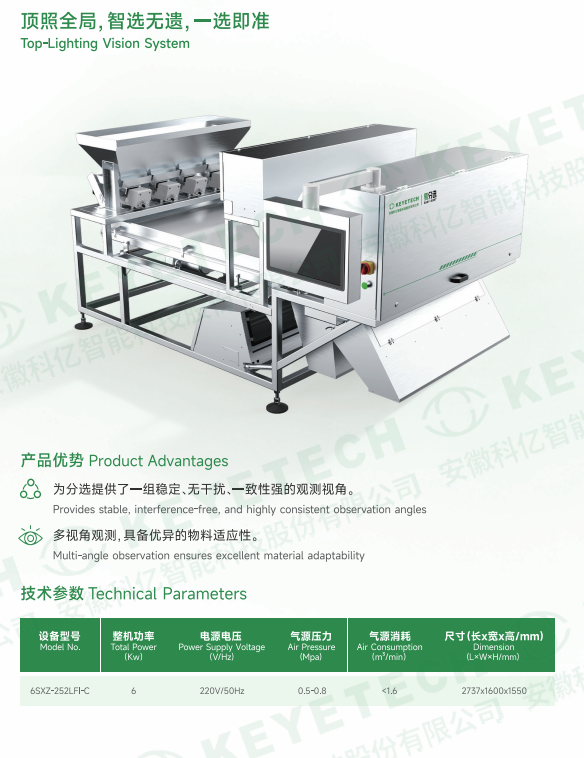
Where the compute sits matters to the project. KEYETECH describes an in-house AI edge computing unit that accelerates model inference locally, and a cloud training platform that hosts a large library of algorithm models developed by the company. The practical reading is that adapting a sorter to a new material is largely a model-and-configuration exercise on an existing mechanical platform, rather than a new machine design.
The product range supports that reading. The same model number, 6SXZ-378LFI, is listed both as a fresh flower AI colour sorter and as a traditional Chinese medicinal material AI colour sorter. The platform designation is shared; what differs is the configuration and the classification model. For a buyer running more than one crop that is a meaningful detail — and also a caution, because shared hardware does not remove the need to validate each application separately.
The engineering envelope a project has to match
The 6SXZ-126LFI pet food sorter and the 6SXZ-378LFI fresh flower and medicinal material sorter share a common published utility and construction envelope. The table sets that envelope against the items a project team should confirm before an order is placed.
| Specification item | Published value | What the project should confirm |
|---|---|---|
| Operating temperature | -20°C to 60°C | Measure the actual ambient at the installation point across a full year, including cold-season start-up in an unheated hall. |
| Air pressure | 0.5-0.8 MPa | Verify that the plant's compressed-air supply at the machine falls inside this band. |
| Air consumption | 0.6-6 m³/h | Size compressor capacity and air treatment against the final configuration, not the family range. |
| Total power | 1.2-6.8 kW | Size the electrical supply against the delivered unit's figure within the range. |
| Construction | Carbon steel / stainless steel materials | Choose against the plant's cleaning regime and the product-contact rules that apply. |
| Installation environment | Indoor factory environment, normal temperature and humidity | Confirm floor space, access for cleaning and maintenance, and drainage arrangements. |
| Supporting equipment | Material handling organisation | Plan conveyors, hoppers and take-away as part of the project, not after delivery. |
| Operating pattern | Continuous operation, planned for 24/7 | Align staffing, cleaning windows and maintenance access with the run pattern. |
| Applicable materials | Agricultural and sideline food, pet food, seasonings, renewable resources, metals | Validate the specific material and defect set on the buyer's own samples. |
Two readings of that table matter. The temperature band defines the ambient range within which the equipment is specified; it is not a statement that sorting performance is identical at both ends of the range, so ambient at the installation point should be measured across a full year. Likewise, the air band of 0.5-0.8 MPa and the consumption range of 0.6-6 m³/h describe the supply the machine expects; a plant header outside that band is a fit issue to resolve at specification stage rather than at commissioning.
The power figure carries the same warning. A range of 1.2-6.8 kW describes a family, not a delivered unit, and the number to size the electrical supply against is the one on the final configuration. The construction choice between carbon steel and stainless steel should follow the plant's cleaning regime and whatever material-contact rules apply to the product; it is a fit decision, not an automatic upgrade.
Pet food: the 6SXZ-126LFI
Extruded pet food is a manufactured product, but its variation is agricultural rather than dimensional. Kibble differs in colour, surface texture and piece integrity within a batch, and the sorting task usually combines several of those attributes with the removal of non-product material. The buyer's first job is to write that list down in physical terms.
The 6SXZ-126LFI is the pet-food configuration in the KEYETECH range, and pet food appears explicitly in the published applicable-industry list alongside agricultural and sideline food, seasonings, renewable resources and metals. Because kibble is a relatively free-flowing granular material, the channel-type or vertical format is a natural starting point, which is consistent with the product family's description of belt-type and channel-type sorters.
Project attention for pet food tends to concentrate on the surrounding line rather than the sorter itself. Fines and dust generated by kibble handling affect housekeeping, cleaning access and maintenance intervals. Where the sorter sits — after drying and cooling, before packing — determines the material-handling design that has to be built around it. Complete-equipment projects of this type are planned around supporting equipment such as material handling organisation, and around continuous operation, so the conveyor, hopper and take-away arrangement belongs in the project scope from the start.
Fresh flowers: the 6SXZ-378LFI
Flower grading is a time-bound problem. A harvest window is short, and material that is not graded within it loses value regardless of how carefully the grading rule was written. For a project, that shifts emphasis from peak specification to uptime and changeover: the machine has to hold a consistent rule through the peak week, not only on a demonstration day.
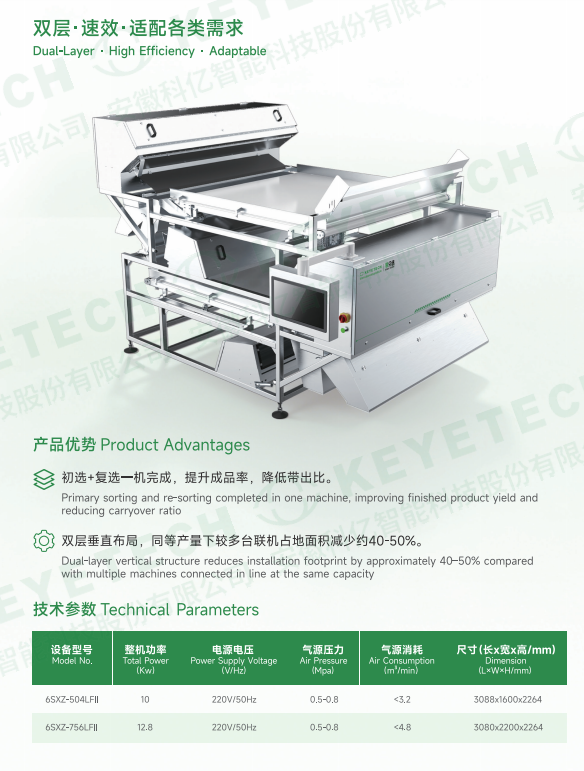
The 6SXZ-378LFI is specified as a fresh flower AI colour sorter. It shares its model designation with the medicinal material sorter discussed below, which is useful context for a buyer evaluating more than one crop, and it should be read as an application configuration rather than a claim that flowers and herbs present the same engineering problem.
Delicate material makes conveying part of the fit. Flower heads and stems are less tolerant of drop height and mechanical contact than granular product, so the presentation method deserves the same attention as the optical specification. The grading scope is likewise a specification decision: which visual attributes the sorter is configured to grade, and which stay with the operator, should be agreed before acceptance testing rather than discovered in the first season.
Capacity planning for flowers should be sized against the peak week rather than the annual average, because a line that is adequate for ten months can still lose the value created in the other two.
Medicinal materials on the same 6SXZ-378LFI platform
Traditional Chinese medicinal materials are the hardest of the three cases to specify. The category covers roots, slices, leaves, barks and prepared forms, with irregular geometry, dust, and a colour range that carries commercial meaning — buyers differentiate grades partly on appearance, so the sorting criterion functions as a price signal as much as a quality control.
The 6SXZ-378LFI is listed as a traditional Chinese medicinal material AI colour sorter, sharing its model designation with the fresh flower machine. That shared platform is the clearest available evidence for the argument that cross-industry adaptation is mostly a configuration and model exercise. It is also the point at which a buyer should be most careful: a shared platform says nothing about whether a model built for one herb transfers to another.
Batch-to-batch variation is the central operating issue. Material that changes with origin, harvest timing and drying method will periodically fall outside the training sample, so model maintenance — and the ability to re-validate on a new batch — should be treated as a recurring cost rather than a one-off commissioning step.
KEYETECH's published client list includes pharmaceutical manufacturers such as Sinopharm, Taiji Group and Yunnan Baiyao. That list describes client relationships across the company's business; it does not specify which equipment each client operates, and should not be read as a reference for any particular herb.
AI sorting against manual sorting: what changes and what does not
Manual sorting has one advantage that is difficult to replace: an experienced operator adapts to a material change immediately, without a retraining cycle. What it does not do well is hold a rule consistently. Attention varies across a shift, and two operators applying the same written standard will diverge on borderline material — which is precisely the material that carries commercial risk.
An AI sorter addresses consistency and repeatability. The same criterion is applied to every object, continuously, and a record of what was rejected is available for review. Those are the benefits a buyer can reasonably expect to verify during acceptance testing.
What a sorter does not change is the quality of what goes in. A classification system separates material against a rule; it does not improve the material, and a poorly defined rule will be applied just as consistently as a good one. Nor does a sorter replace incoming inspection, because a batch that falls outside the training distribution is a model problem that no amount of sorting throughput will fix.
What to confirm at project stage
- Material and defect definition. Write the accepted class and the reject classes in physical terms before any demonstration.
- Sample run. Test the exact material against the exact criteria, and keep the result as the acceptance baseline.
- Ambient conditions. Measure the installation point across the year against the published -20°C to 60°C operating range.
- Compressed air. Confirm supply at the machine sits inside 0.5-0.8 MPa, with consumption of 0.6-6 m³/h covered alongside the air treatment.
- Electrical supply. Size against the delivered configuration's power figure within the 1.2-6.8 kW family range.
- Construction. Decide carbon steel or stainless steel against the cleaning regime and the applicable product-contact rules.
- Material handling. Put the supporting equipment — conveyors, hoppers, take-away — inside the project scope and schedule.
- Operating pattern. Plan for continuous operation, including cleaning windows and maintenance access.
- Delivery and support. Check the 45-60 day lead time against the installation window, and establish what remote support covers.
The market signal behind the category
Precedence Research estimates the global AI vision inspection market at USD 39.38 billion in 2026 and projects a compound annual growth rate of 22.83% over 2026-2035. Both figures are third-party projections rather than measured outcomes for any individual segment, and they describe the whole category rather than colour sorting in pet food, flowers or herbs.
The useful reading is directional. A growing category supports the argument that inspection tooling becomes cheaper and more portable across applications, which is the mechanism by which a platform built for one material becomes practical for the next. It is not evidence that demand exists for a specific crop, and it should not substitute for the buyer's own volume, labour and reject-rate estimate.
The operational drivers a buyer can actually verify are narrower: the availability and consistency of manual sorting labour, the cost of a mis-sorted batch, and the value the destination market places on appearance grade. Those vary by crop and by market, and they are the numbers that decide whether a project is worth doing.
Outlook
The direction of travel is towards model portability. As training platforms accumulate models and edge hardware carries more inference locally, moving a proven sorting configuration to an adjacent material becomes a shorter engineering exercise than it was a decade ago.
Whether that holds for a specific crop still depends on two things a supplier cannot control: how variable the material is, and how precisely the buyer can define the grade. Where both are favourable, a shared platform such as the 6SXZ-378LFI is a practical starting point for a buyer running flowers and herbs. Where the material is highly variable, the project is better budgeted as an ongoing model-maintenance relationship than as a single equipment purchase.
That is the sensible way to read cross-industry adaptation: not as a claim that one machine sorts everything, but as a shortening of the distance between an existing platform and a new material.
FAQ
Which materials outside packaging can an AI colour sorter inspect?
KEYETECH's published applicable-industry scope for its sorter platforms covers agricultural and sideline food, pet food, seasonings, renewable resources and metals, and the range includes dedicated configurations for fresh flowers and traditional Chinese medicinal materials. Suitability for a specific material is confirmed on the buyer's own samples, because two batches of the same crop can differ in size, moisture and surface condition.
What operating conditions must the installation site meet?
The 6SXZ-126LFI and 6SXZ-378LFI are published with an operating temperature range of -20°C to 60°C, an air pressure requirement of 0.5-0.8 MPa and air consumption of 0.6-6 m³/h, with total power between 1.2 and 6.8 kW depending on configuration. Installation is specified for an indoor factory environment under normal temperature and humidity, complete-equipment projects require supporting equipment such as material handling organisation, and continuous operation is the planning assumption.
Can one platform serve both fresh flowers and medicinal materials?
The 6SXZ-378LFI is listed both as a fresh flower AI colour sorter and as a traditional Chinese medicinal material AI colour sorter, so the platform designation is shared. What changes between the two applications is the configuration and the classification model rather than the machine family. Each application still needs separate validation on its own samples, because a model built for one material does not automatically transfer to another.
What lead time, customisation and support apply to a sorter project?
KEYETECH publishes a 45-60 day lead time, a minimum order of one unit, monthly capacity of 100 units, OEM/ODM production with logo customisation, 100% testing, and remote after-sales support, with export markets listed as the EU, US, Middle East and Southeast Asia. The lead time should be checked against the project's installation window rather than assumed, since a sorter is normally one line item inside a wider installation schedule.
For the full product range, specifications and company profile, the KEYETECH company brochure (PDF) is available for download.
Есть вопросы или нужны дополнительные детали?
Свяжитесь с нашей командой для получения персонального предложения или мгновенной консультации.
Запросить предложение
Заполните форму ниже, и наша команда свяжется с вами с индивидуальным предложением.
Прямой чат WhatsApp
Предпочитаете общаться в реальном времени? Напишите нам в WhatsApp для мгновенной помощи и быстрых ответов.
- Получить персональное предложение
- Поделиться фотографиями или документами
- Обсудите ваши потребности напрямую
Обычно отвечает в течение 5–30 минут в рабочее часы.