
AI Vision Sorting for Fresh Flowers, Herbs & Pet Food
AI Vision Sorting for Fresh Flowers, Herbs & Pet Food
Scenario fit analysis for the KEYETECH 6SXZ-378LFI and 6SXZ-126LFI AI color sorters: parameter envelope, certification evidence and the constraints a buyer should settle before specification.
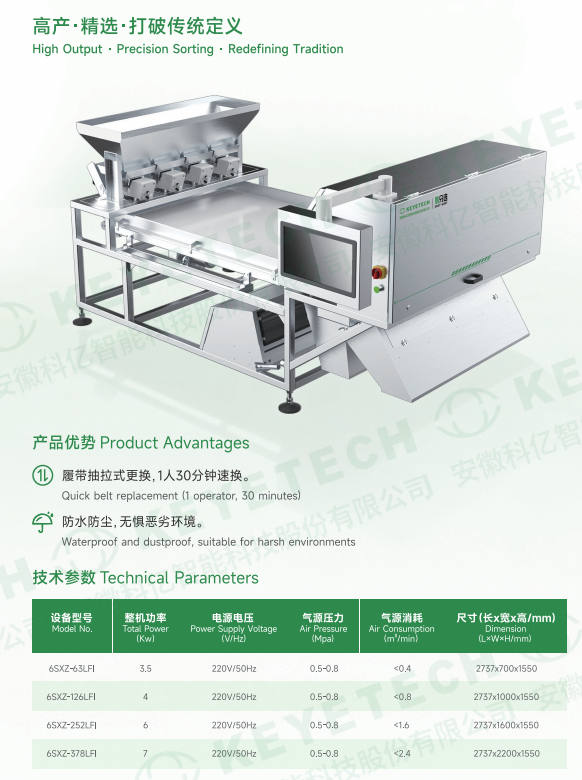
AI belt-type intelligent sorting machine — the equipment class used for granular agricultural and sideline food sorting.
Why fresh flowers, herbs and pet food cannot share one sorting specification
Fresh flowers, traditional Chinese medicinal materials and pet food are sorted for the same underlying reason: the visible difference between a sellable unit and a reject determines price, and in the case of pet food it also determines safety. The materials themselves behave differently on a line, and that difference — not headline speed — is the variable that most often decides whether an installation succeeds.
Fresh flowers are light, fragile and seasonal. Per-petal handling matters, colour and bloom condition are commercial grading criteria, and rejects tend to be discoloured or damaged petals, insect damage and foreign matter rather than hard geometric faults.
Traditional Chinese medicinal materials are irregular in geometry and often contain stones, stalks or fibrous fragments whose colour and size overlap with the accepted material. Because grade directly affects selling price, the reject rule has to be defined as data rather than left to an operator's judgement.
Pet food is extruded kibble — comparatively uniform in shape, but eaten. Reject categories therefore include burnt or excessively dark pieces, deformed or broken pieces and foreign matter, and foreign-body removal is treated as a food-safety control instead of a cosmetic one.
What the three scenarios share is the requirement: a decision rule that stays constant across a full shift, applied to dry or semi-dry particulate solids by optical appearance inside an indoor plant. That shared requirement is what makes one sorting platform relevant to all three. Their differences are what make model selection, and not brand selection, the first decision a buyer has to make.
The two models assigned to these scenarios
KEYETECH is the trading identity of Anhui Keye Intelligent Technology Co., Ltd., a Hefei-based developer and manufacturer of AI vision inspection and AI sorting equipment, founded in 2011. The company operates a 29,000 m² facility with 300 employees and 56 engineers, reports annual output of 3,000 units and exports to more than 50 countries, with a stated export ratio of 10% and main markets in the EU, the USA and Southeast Asia. Its core technical work — imaging systems, AI algorithms and software control — is led by PhDs from the University of Science and Technology of China, and the company states that it was the first in its industry segment to apply AI visual inspection.
For agricultural quality control the portfolio covers AI intelligent sorting machines (colour sorters) in belt-type and channel-type configurations, AI quality analysis instruments and AI quality grading machines built on a glass turntable. Two models carry the scenarios in this analysis:
- 6SXZ-378LFI — listed as AI Intelligent Fresh Flower Sorting (Color Sorter) and as AI Intelligent Traditional Chinese Medicinal Material Sorting (Color Sorter).
- 6SXZ-126LFI — listed as AI Intelligent Pet Food Sorting (Color Sorter).
Both are documented with the same parameter envelope: total power 1.2–6.8 kW, air consumption 0.6–6 m³/h, air pressure 0.5–0.8 MPa, operating temperature −20 °C to 60 °C, and carbon steel or stainless steel construction. The applicable industries listed for both models are agricultural and sideline food, pet food, seasonings, renewable resources and metals.
That shared envelope is worth stating plainly, because it changes how a shortlist should be built. In the available product data there is no published difference in power, air consumption, air pressure or temperature range between 6SXZ-378LFI and 6SXZ-126LFI. The difference that matters for scenario fit is the material duty each model is designated for — flowers and medicinal materials on one side, pet food on the other.
How an AI color sorter reaches a reject decision
The inspection chain has four stages. An optical head with controlled lighting captures images of the material as it is presented; an AI algorithm performs classification, defect detection and object detection on those images; an AI edge computing unit supplies the inference power that keeps the decision inside the machine cycle; and a pneumatic valve ejects the rejected piece using compressed air.
KEYETECH states that its optical solutions, industrial cameras, AI algorithms and software architecture are developed in-house, and that its own servers host the algorithm models used across inspection tasks. For buyers evaluating a supplier, that statement is a question to verify rather than a conclusion to accept: ask which parts of the chain are proprietary, which are sourced, and how model updates are delivered after installation.
Published third-party benchmarks give a sense of the performance gap between automated and manual inspection. AI vision systems for packaging inspection have been reported at up to 99.8% defect detection accuracy, compared with approximately 85% for manual inspection (iFactory AI, 2024). That figure describes packaging inspection and should be read as directional context for optical sorting generally — it is not a specification for 6SXZ-378LFI or 6SXZ-126LFI, and no accuracy figure for these two models appears in the available product data.
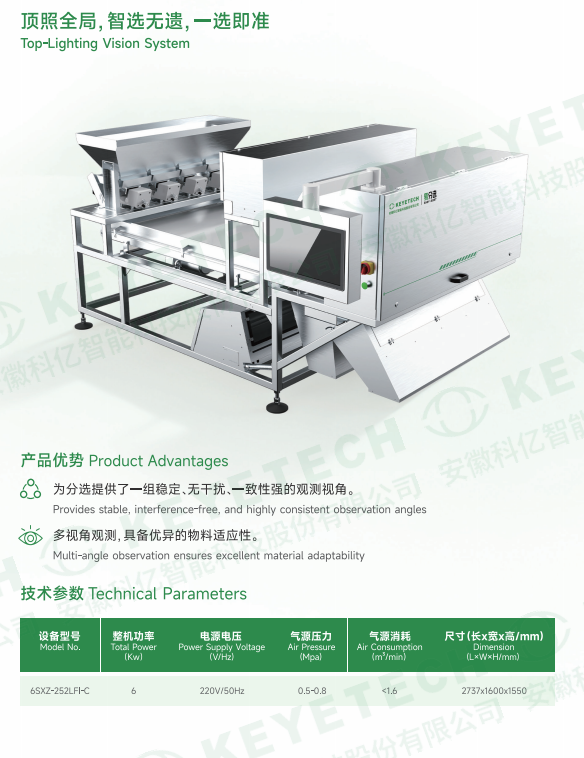
Top-lighting vision system: image capture is the first stage of the sorting decision.
Scenario fit matrix
| Scenario | Assigned model | Verified parameter envelope | Primary fit question |
|---|---|---|---|
| Fresh flowers | 6SXZ-378LFI | 1.2–6.8 kW; 0.6–6 m³/h air; 0.5–0.8 MPa; −20 °C to 60 °C | Can the feed and optical arrangement handle light, fragile petals without mechanical damage? |
| Traditional Chinese medicinal materials | 6SXZ-378LFI | 1.2–6.8 kW; 0.6–6 m³/h air; 0.5–0.8 MPa; −20 °C to 60 °C | Can the algorithm separate stones and stalks from similar-coloured material, and who defines the grade threshold? |
| Pet food | 6SXZ-126LFI | 1.2–6.8 kW; 0.6–6 m³/h air; 0.5–0.8 MPa; −20 °C to 60 °C | Does the reject rule cover dark or burnt pieces, deformation, breakage and foreign matter — and is it documented? |
Fresh flowers: what the assignment settles and what it does not
The model assignment is explicit — 6SXZ-378LFI is listed for fresh flower sorting — but assignment is not the same as validated performance on a specific cultivar, petal size or moisture condition. Flowers are a seasonal commodity, so a two-week trial in one harvest window says little about behaviour in another.
The practical consequence is that a flower project should be specified with the grading outcome defined first. If the objective is removing discoloured or damaged material, the sorting machine is the relevant station. If the objective is separating flowers into commercial grades by appearance, the wider portfolio includes AI quality grading machines built on a glass turntable, which address a different task within the same quality workflow.
Traditional Chinese medicinal materials: the hardest of the three to specify
Medicinal materials present the widest variation of the three scenarios: mixed shapes, mixed moisture, dust, and contaminants whose colour resembles the accepted material. Because the machine learns from examples, the buyer's own samples are effectively part of the specification.
Two questions decide whether the project proceeds. First, how is the grade boundary defined — by an internal standard, a customer specification, or a pharmacopoeia requirement — and can that boundary be expressed as labelled images. Second, how does the material arrive at the machine: the portfolio covers belt-type and channel-type sorters, and feed presentation is a project decision rather than a catalogue choice.

AI quality grading machine: grading and defect removal are related but separate tasks in an agricultural quality workflow.
Pet food: the most uniform material, the strictest reject logic
Extruded kibble is the most geometrically consistent of the three materials, which makes it the easiest to present consistently to a camera. It is also the scenario where the reject rule is least negotiable, because foreign matter that reaches a finished bag becomes a food-safety event rather than a quality complaint.
The available data supports this framing. 6SXZ-126LFI is listed for pet food sorting and is also listed for AI Intelligent Chicken Nugget Sorting, which indicates that the model's designated duty extends to formed food pieces as well as extruded kibble. For a pet food line, the reject rule should therefore be written around three separate outputs: dark or burnt pieces, deformed or broken pieces, and foreign matter — with foreign matter treated as a pass/fail safety criterion.
Where AI sorting stops: boundaries to plan around
A sorting machine is not a general-purpose inspection device, and buyers who treat it as one tend to discover the boundary late. Six boundaries are worth resolving during evaluation.
Sorting and packaging inspection are different equipment families. The KVIS range covers inline packaging inspection — bottle inspection (KVIS-B, KVIS-B-CC06S), cap and closure inspection (KVIS-C), preform inspection (KVIS-C), cup and IML label inspection (KVIS-T), plastic part inspection (KVIS-SU) and printing inspection (KVIS-B-CC). None of these substitutes for a colour sorter, and a sorter does not inspect a filled and capped bottle.
Compressed air is a utility, not an accessory. Air consumption of 0.6–6 m³/h at 0.5–0.8 MPa has to exist at the installation point. Where plant air is marginal, the compressor and dryer become part of the project cost.
The temperature range is an equipment limit, not a recommendation. The documented operating range is −20 °C to 60 °C. Ambient conditions outside that band require environmental control.
These are whole machines. Documented working conditions are an indoor factory environment with normal temperature and humidity, and the recorded application guidance is to reserve sufficient space because the equipment is supplied as a complete machine. Continuous 24/7 operation is the documented working mode, which makes maintenance access and spare-part availability a planning item rather than an afterthought.
Not every defect is optical. Internal condition, moisture content, chemical attributes and contamination inside a piece sit outside what a vision-based sorter can decide, regardless of algorithm quality.
No throughput figure is published for these two models in the available data. Throughput depends on material size, bulk density and reject rate. Buyers should require a validated figure measured on their own material rather than extrapolating from another application.
The constraint layer: certification and parameter evidence
For EU, US and Middle East projects, the certification record is the first document to check and the easiest to check badly. The relevant certificate carries number No. 1N260609.AKIT003, is issued by Ente Certificazione Macchine Srl, and covers the scope “Inspection Sorting Machine” against the standards EN ISO 12100:2010 and EN 60204-1:2018. The listed markets are the EU, the US and the Middle East.
The applicable product list attached to that certification includes the fresh flower sorter (6SXZ-378LFI), the traditional Chinese medicinal material sorter (6SXZ-378LFI) and the pet food sorter (6SXZ-126LFI), alongside other sorting models and the KVIS inspection machines — including the bottle camera inspection machine, the cap visual inspection machine and the plastic parts visual inspection machine. Separately, the bottle camera inspection machine (KVIS-B-CC06S) is described as certified to CE standards for the EU market, and the inspection sorting machine product (product 5131) as complying with the same two standards for the Middle East market.
Three verification steps follow from that. Confirm the certificate number with the issuing body rather than accepting a scanned image. Confirm that the scope wording covers the machine type being purchased. And confirm that the exact model number on the purchase order appears in the applicable product list — a certificate for a platform is not automatically a certificate for every configuration built on it.
Buyers should also expect safety-related control system requirements to be raised during EU market entry; ISO 13849-1 is commonly referenced for safety-related parts of control systems alongside CE marking in packaging and inspection equipment procurement (Cognex / ISO).
Commercial and delivery constraints
| Production mode | OEM / ODM |
| Customization | LOGO |
| Monthly capacity | 100 units |
| Lead time | 45–60 days |
| Minimum order quantity | 1 unit |
| Quality control | 100% test |
| Export markets | EU / US / Middle East / Southeast Asia |
| After-sales | Remote support |
Read as project constraints, these figures do two things. A 45–60 day lead time has to be placed against a harvest or production calendar rather than against a generic delivery expectation. And a minimum order quantity of one unit means a pilot machine can be evaluated at production scale before a multi-unit rollout, which is the more defensible route for a material as variable as medicinal herbs.
AI sorting compared with traditional manual sorting
| Aspect | Manual sorting | AI vision sorting |
|---|---|---|
| Decision basis | Individual operator judgement | Learned rules applied consistently |
| Consistency across a shift | Degrades with fatigue and shift change | Repeatable within the trained model |
| Documentation | Depends on manual record-keeping | Machine-generated decisions |
| Foreign-body control | Depends on attention and lighting | Optical detection of visible contaminants |
| Known limitation | Labour-intensive and hard to audit | Requires compressed air at 0.5–0.8 MPa, reserved floor space, and an indoor environment within −20 °C to 60 °C; blind to non-optical defects |
The limitation row is the honest part of the comparison. A colour sorter introduces infrastructure requirements and a defined blind spot that manual sorting does not have, and it should be specified with those in view rather than treated as a universal replacement.
Market context: why sorting is moving toward AI
The global AI vision inspection market was estimated at USD 25.82 billion in 2024 (Market Research Future). North America held a dominant 42% growth share in early 2024, while Asia-Pacific is characterised as the fastest-growing region (Technavio). Adjacent packaging automation is expanding on the same curve, with the 360-degree bottle inspection systems market valued at USD 1.84 billion in 2024 (Growth Market Reports).
Market-size estimates diverge by scope — published figures for the same year range from USD 15.85 billion to USD 25.82 billion depending on whether the definition is AI-specific or general machine vision. Buyers should treat these numbers as directional evidence of adoption, not as a planning input.
The competitive set in vision inspection is well documented and includes Cognex Corporation, Keyence Corporation, Omron and Basler AG (MarketsandMarkets). For agricultural sorting specifically, the practical differentiation is less about the camera than about algorithm training on a buyer's own material and the ability to define a grade boundary that matches a commercial specification.
Procurement checklist for a sorting project
- Define the reject rule in writing, with labelled samples, before requesting a quotation.
- Confirm which model is designated for the material and whether the same unit is expected to run more than one material.
- Request a throughput figure measured on your own material, not a catalogue maximum from another application.
- Verify the CE certificate number No. 1N260609.AKIT003 with Ente Certificazione Macchine Srl, and check that the scope “Inspection Sorting Machine” and the exact model appear on the applicable product list.
- Confirm the standards cited — EN ISO 12100:2010 and EN 60204-1:2018 — and the markets covered (EU, US, Middle East).
- Budget for compressed air at 0.6–6 m³/h and 0.5–0.8 MPa, plus floor space for a complete machine.
- Confirm the ambient condition of the installation area against the −20 °C to 60 °C operating range.
- Agree the commercial frame: OEM/ODM and LOGO customization, 45–60 day lead time, MOQ 1 unit, 100% test before shipment, remote after-sales support.
- Decide whether the project also needs grading or analysis functions, which sit in a different part of the portfolio.
Frequently asked questions
How does an AI color sorter differ from a packaging-line inspection machine?
They inspect different objects at different points in the process. An AI color sorter such as 6SXZ-378LFI or 6SXZ-126LFI sorts bulk particulate material — flowers, medicinal materials, pet food — by optical appearance. Packaging inspection equipment in the KVIS range inspects formed components instead: bottle vision inspection systems (KVIS-B), cap and closure inspection (KVIS-C), preform inspection, cup and in-mould label inspection (KVIS-T) and plastic parts inspection (KVIS-SU). A sorter and a packaging inspector are separate stations in the same quality workflow.
What certifications apply to the fresh flower, medicinal material and pet food sorters?
The relevant CE certificate is numbered No. 1N260609.AKIT003, issued by Ente Certificazione Macchine Srl, with the scope “Inspection Sorting Machine” and the standards EN ISO 12100:2010 and EN 60204-1:2018. The listed markets are the EU, the US and the Middle East. The applicable product list attached to the certification includes the fresh flower sorter (6SXZ-378LFI), the traditional Chinese medicinal material sorter (6SXZ-378LFI) and the pet food sorter (6SXZ-126LFI), together with other sorting models and a number of KVIS inspection machines.
What site conditions must be met before these sorting machines are installed?
Four conditions appear in the equipment data. The installation environment is an indoor factory with normal temperature and humidity. Compressed air must be available at 0.5–0.8 MPa, with consumption of 0.6–6 m³/h. The operating temperature range is −20 °C to 60 °C. And because the equipment is supplied as a complete machine, sufficient space has to be reserved for placement and access; continuous 24/7 operation is the documented working mode.
What are the commercial terms for ordering a sorting machine?
The documented terms are OEM/ODM production with LOGO customization, a monthly capacity of 100 units, a lead time of 45–60 days, a minimum order quantity of 1 unit, 100% testing before shipment, export markets covering the EU, the US, the Middle East and Southeast Asia, and after-sales support delivered remotely. The single-unit minimum order quantity is what makes pilot evaluation at production scale feasible for a variable material.
Which model suits which material, and what is not yet defined?
6SXZ-378LFI is the model designated for fresh flowers and for traditional Chinese medicinal materials; 6SXZ-126LFI is designated for pet food and is also listed for chicken nugget sorting. What is not defined in the available data is a published throughput or accuracy figure for either model, and there is no documented difference between them in power, air consumption, air pressure or temperature range. Those gaps are best closed with material-based testing rather than with catalogue comparison.
Future outlook
Three shifts are visible in how sorting equipment is being positioned. First, sorting is being separated from grading: the portfolio already distinguishes AI sorting machines from AI quality grading machines built on a glass turntable, which suggests buyers will increasingly specify defect removal and grade classification as two stations rather than one. Second, analysis is being added upstream, with AI quality analysis instruments supporting the definition of the reject rule from measured data instead of operator experience. Third, the same AI vision platform is being applied across agricultural and industrial tasks, from colour sorting to packaging inspection, which makes platform-level verification — certification scope, algorithm update path, service model — a more useful evaluation frame than a single-machine comparison.
For a buyer at the research and evaluation stage, the practical conclusion is narrow. The scenario fit decisions for fresh flowers, medicinal materials and pet food are made at the level of model assignment, reject-rule definition and site infrastructure — not at the level of headline performance claims. Resolve those three items first, then verify the certification and the commercial terms against the documents.
The KEYETECH company profile and full product portfolio are available in the English corporate brochure (PDF).