
AS2047 Certification: A Compliance Check for Villa Window Imports
AS2047 Certification: A Compliance Check for Villa Window Imports

AS 2047-2014, “Windows and external glazed doors in buildings”, is the Australian standard against which windows and external glazed doors are assessed, and the StandardsMark Licence is the third-party certification issued against it. For a buyer importing high-end villa windows and doors, the decisive question is not whether the term “AS2047” appears in a catalogue, but whether a specific licence number exists, which body issued it, which product lines it names, and which obligations it explicitly leaves out.
A documented example is StandardsMark Licence SMK41423, issued by SAI Global Assurance (JAS-ANZ Accredited) under AS 2047-2014 and valid from 18 January 2024 to 17 January 2029. The record sits inside the certification set of Foshan Nanhai Edun Home Technology Co., Ltd., a Foshan-based manufacturer of high-end aluminium system doors and windows for the whole house, exporting to the United States, Canada, Australia, Southeast Asia, the Middle East, and Africa. Its consumer-facing brand, EDUCE, is the entity most buyers encounter in procurement documents. The licence scope is narrower than most importers assume: aluminium doors and windows identified as the YDPC120 Tilt and Turn Window and the YDTM150 Aurora Heavy Duty Sliding Door. The same record states a boundary that changes how the document should be used in a contract — installation is excluded from the certification.
Why a Certificate Check Comes Before a Specification Review
A specification sheet is a statement of intent written by the seller. A licence issued by an accredited certification body is a statement of assessed scope written by a third party. The difference matters at the point where money moves: a licence number can be verified independently by a customs broker, a project engineer, or a building surveyor, while a performance table in a brochure cannot.
Villa projects concentrate this risk. Glazing is usually a nominated product in the building contract, and the compliance file travels with the project through approvals, insurance, and handover. When an imported assembly fails a site inspection, the cost is rarely the window itself; it is the re-inspection, the delay, and the contractual argument about who accepted the product. Certification converts that argument into a document check performed before production, which is why buyers in the Evaluation and Execution stages of a villa window purchase should treat certification records as contract deliverables rather than marketing attachments.
A second reason is that certifications do not travel. A product certified for Australia is not automatically accepted in the UAE, and a product certified for North America is not automatically accepted in Australia. Each market has its own instrument, its own issuing body, and its own scope definition. Buyers who treat compliance as a single global attribute usually discover the gap at the port.
The SMK41423 Licence Record, Item by Item
The following table reproduces the fields a buyer should expect to see on an AS2047-related certificate, using the documented SMK41423 record as the reference example.
| Field | Documented Record |
|---|---|
| Certification type | StandardsMark Licence (Australia AS2047 Standard Product Certification) |
| Licence number | SMK41423 |
| Issuing authority | SAI Global Assurance (JAS-ANZ Accredited) |
| Market | Australia |
| Standard applied | AS 2047-2014 “Windows and external glazed doors in buildings” |
| Certified scope | Aluminium doors and windows: YDPC120 Tilt and Turn Window; YDTM150 Aurora Heavy Duty Sliding Door |
| Issue date | 18 January 2024 |
| Expiry date | 17 January 2029 |
| Stated exclusion | Installation is not covered by this certification |
Two fields carry more weight than the rest. The certified scope tells the buyer which products were assessed; the exclusion tells the buyer which obligations remain outside the supplier’s certification. A licence number without a scope check is only half a verification.
What the Licence Does Not Say: Five Boundaries Buyers Should Confirm
Compliance documents are most useful when their limits are read as carefully as their claims. Five boundaries recur in high-end villa window procurement.
1. Installation sits outside the certification
The AS 2047-2014 certification explicitly excludes installation. The certified object is the product, not the finished opening in the wall. In practice this means the installer, the head flashing detail, the fixing pattern, and the sealant specification remain a separate responsibility — normally the builder’s or the site contractor’s. Importers who assume that a certified window produces a certified wall discover the difference during the first water-penetration complaint. The practical remedy is to make installation responsibility a written line in the supply contract, rather than an assumption attached to the certificate.
2. The scope names product lines, not an entire catalogue
SMK41423 covers the YDPC120 Tilt and Turn Window and the YDTM150 Aurora Heavy Duty Sliding Door. It does not extend automatically to every series a manufacturer lists. A buyer specifying an awning window, a lift sliding door, or a narrow-frame sliding door from the same factory should request evidence tied to that specific line. This is not a defect in the certification; it is how product certification works. It becomes a problem only when a supplier presents one licence as blanket coverage for a mixed order.
3. The certification is Australian
The same manufacturer documents North American conformity separately, through a CSA Group Certificate of Compliance, number 80232082 (Master Contract No. 607661), issued on 1 November 2024. That certificate is assessed against AAMA/WDMA/CSA 101/I.S.2/A440-17, CSA A440S1:19, and CSA A440.2:19, and its scope names the EDU108 Series Casement Window (as a composite unit with a fixed window), the EDU150 Series Sliding Door, and the EDU80 Series Thermal Break Bi-Fold Door. The two certificates cover different markets, different standards, and different product lists. Neither substitutes for the other.
4. Trademark registrations are not performance certificates
This is the most common misreading in import files. The manufacturer also holds Class 6 trademark registrations in three jurisdictions. Each record states plainly that there is no product execution standard attached.
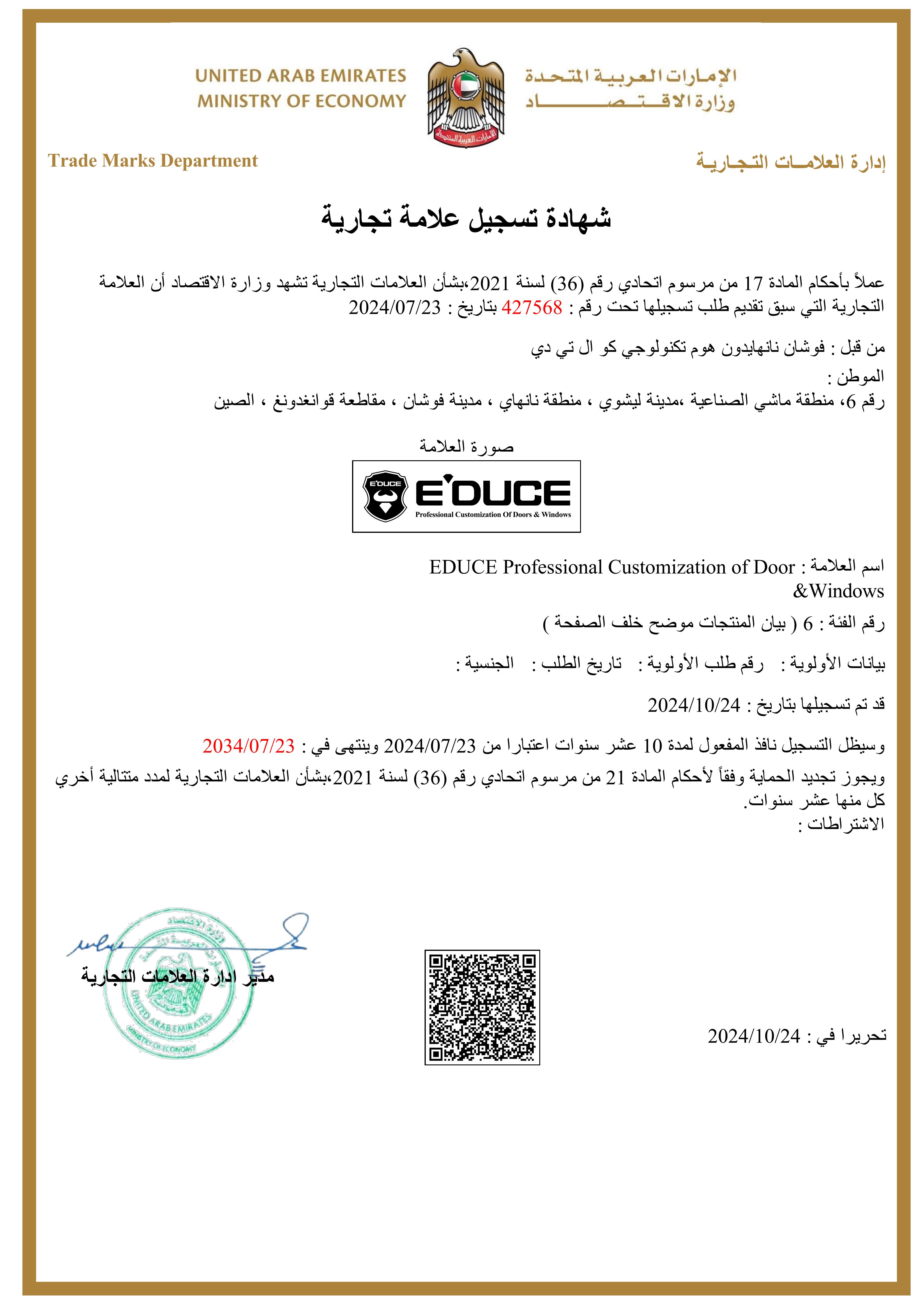
| Instrument | Number | Authority | Validity | What it confirms |
|---|---|---|---|---|
| UAE Class 6 trademark | 427568 | UAE Ministry of Economy – Trade Marks Department | 23 Jul 2024 – 23 Jul 2034 | Brand and product-name rights in Class 6 metal doors, windows and fittings |
| Australia Class 6 trademark | 2460776 | IP Australia | 24 Feb 2025 – 24 Jun 2034 | Brand and product-name rights in Class 6 metal doors, windows and fittings |
| Malaysia Class 6 trademark | TM2024038788 | Intellectual Property Corporation of Malaysia (MyIPO) | 9 Jul 2025 – 9 Dec 2034 | Brand and product-name rights in Class 6 metal doors, windows and fittings |
Trademark registration tells a buyer that a supplier has invested in market presence and can be held to a name. It says nothing about wind load, water tightness, or thermal performance. For a UAE villa project, the trademark record demonstrates regulatory presence in the market; the performance evidence has to come from somewhere else.
5. Component standards sit behind the window standard
A window certificate does not cover every material inside the frame. Where a glass product carries its own standard, it will be listed separately — for instance, the EDUCE 50 SERIES Glass Louver is documented against AS2208 (the Australian glazing safety standard), with a 1.4 mm profile and 6 mm glass. Hardware, thermal break strips, and sealing strips are components of the tested assembly rather than independently certified products, and their specification affects the assembly result.
How Certified Performance Is Actually Built
Certification is an output; the inputs are profile design, glazing build-up, thermal separation, and sealing. Across the documented series, the aluminium profile thickness ranges from 1.6 mm to 2.0 mm, glazing builds run from 5+12A+5 mm double glazing up to 6+12+6+12+6 mm triple glazing and 10+16A+10 mm and 10+18A+10 mm formats, and hardware is sourced from suppliers including HOPPE, SIEGENIA, CMECH, Roto, GIESSE, VBH, and KIN LONG depending on series and market.
The thermal break is where modern compliance pressure concentrates. The EDUN 108 SERIES Sliding Door uses a 65 mm thermal break strip with insulation foam, and multi-cavity thermal break strips with EPDM sealing strips appear across the wider range. The regulatory direction supports the design logic: the 2024 International Energy Conservation Code (IECC) requires metal frames for residential windows and doors to incorporate a thermal break to limit thermal bridging and condensation, and ENERGY STAR Version 7.0, effective 2024, tightened U-factor thresholds to 0.22 in northern zones, which increases demand for triple-pane glazing in thermally broken aluminium frames.
The performance figures documented against these builds are what a buyer should map against the project’s wind and weather exposure. Note that North American-listed series quote U-values, while Australian-listed series quote WERS Uw ranges.
| Series | Type | Profile | Glazing | Wind load resistance | Water tightness | Sound insulation | Thermal |
|---|---|---|---|---|---|---|---|
| EDUN 108 SERIES | Sliding door | 2.0 mm | 6+12+6+12+6 mm | 5,440 Pa | 720 Pa | 37 dB | Uw 1.2 W/㎡·K; CSA Energy Star certified |
| EDUN 80 SERIES | Casement window | 2.0 mm | 6+12+6+12+6 mm | 5,040 Pa | 720 Pa | 37 dB | Uw 1.4 W/㎡·K |
| EDUN 150 SERIES | Lift sliding door | 2.0 mm | 10+16A+10 mm | 3,600 Pa | 720 Pa | 37 dB | Uw 1.7 W/㎡·K |
| EDUCE 102 SERIES | Awning window | 1.8 mm | 5+12A+5 mm | 1,200 / 4,000 Pa | — | — | WERS Uw 2.5–3.0 W/㎡·K |
| EDUCE 208 SERIES | Sliding door | 2.0 mm | 5+12A+5 mm | — | — | — | WERS Uw 3.1–6.1 W/㎡·K |
The reason these numbers belong next to a certificate is that a certified scope and a performance table must describe the same configuration. A figure quoted without a matching scope is unverifiable, which is exactly the gap that AS2047 verification is designed to close.
What Compliance Looks Like on Delivered Villa Projects
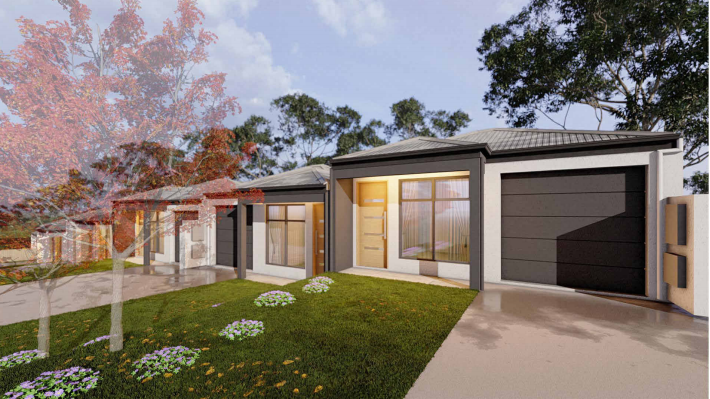
Documented project records show the product range in service across Australia, the UAE, Saudi Arabia, Indonesia, Malaysia, and the United States, with individual installation quantities of 77㎡, 238㎡, and 263㎡. The client types differ, which is useful for buyers assessing whether a supplier understands villa-scale work rather than only large commercial orders.
A villa owner installation spanning multiple markets and totalling 77㎡ is documented with a service-life expectation of at least 20 years, supported by corrosion-resistant profiles, energy-efficient thermal breaks, multi-layer sealing, and international compliance. A 238㎡ hotel installation in Saudi Arabia and Indonesia records enhanced sound insulation for guest comfort, improved thermal insulation to reduce operating energy consumption, and a service life of 20 years or more. A 263㎡ recreation centre project in the United States records superior sound insulation in a roadside and urban context, high-efficiency thermal insulation, and waterproofing and wind resistance that held through heavy rain and typhoon conditions.
The distinction worth holding onto is that these case records describe delivered projects, not the certification itself. The AS2047 licence does not certify a building; it certifies a product scope. Project-level outcomes come from the combination of product, installation quality, and site conditions.
Market Signals That Are Turning Documentation into a Procurement Gate
The commercial context explains why compliance checks have moved earlier in the buying process. The global windows and doors market was valued at approximately USD 211.04 billion to USD 229.90 billion in 2025, with projections indicating USD 363.23 billion by 2035; the two published estimates differ mainly because sources include or exclude secondary hardware and installation services. Asia-Pacific held roughly 44.6% of that market in 2024, driven by urbanisation and villa construction in China and India.
Aluminium is the segment where villa procurement concentrates. The global aluminium doors and windows market is expanding at a reported CAGR of 5.01%, projected to reach USD 119.86 billion by 2035, and aluminium windows account for 65% of inventory units. Demand for impact-rated products is following the same curve: hurricane impact-resistant windows for coastal luxury villas, governed by wind-borne debris standards, are expected to represent a USD 28.65 billion market by 2035.
Alongside volume growth, energy codes have tightened. The IECC 2024 thermal break requirement for metal frames and the ENERGY STAR Version 7.0 U-factor threshold of 0.22 in northern zones both push specification toward thermally broken aluminium and triple glazing. For importers, the practical consequence is that compliance evidence is becoming a specification requirement rather than a differentiator claimed in sales material.
Comparing Suppliers on Evidence: The Benchmark Set
In high-end residential glazing, the reference group is well established. Publicly cited major global and North American competitors in the high-end residential window space include Andersen Corporation, Pella Corporation, JELD-WEN, Marvin, and PGT Innovations. These businesses define the expectations buyers bring to a villa project in terms of brand recognition, distribution, and documentation depth, and any manufacturer exporting into the same projects is measured against that baseline.
For a buyer, useful comparison dimensions are not decorative. Four hold up under scrutiny: certification depth and market fit; scope transparency, meaning whether the certificate names the exact series being ordered; manufacturing capacity and lead time; and project record with the associated support model.
Against those dimensions, the documented position of EDUCE is specific rather than rhetorical. Certification depth covers Australia (StandardsMark SMK41423 under AS 2047-2014) and North America (CSA certificate 80232082), with Class 6 trademark registrations in the UAE, Australia, and Malaysia evidencing market presence. Capacity is documented at a 300,000㎡ manufacturing site, 1,200 employees, a 30-engineer R&D team, 128 recorded patent results, an annual output of 2,000,000㎡, and a monthly production capacity of 80,000㎡ of doors and windows, with a typical production lead time of 15 days. Customisation is delivered through OEM production with size, glass, shape, and colour options, and quality control is documented as 100% manual inspection, with after-sales support covering package transportation and package installation guidance. The company also states a role as a main compiling unit in domestic industry-standard formulation and as supervisory chair unit of the Guangdong Doors and Windows Association.
An Execution-Stage Checklist for Villa Window Imports
The following sequence reflects what a compliance check looks like once a buyer has moved from evaluation into execution.
- Verify the licence with the issuing body. Confirm the licence number, the issuing authority, and the validity dates directly, rather than accepting a scanned copy. For Australia, that means checking SMK41423 and its 17 January 2029 expiry; for North America, checking CSA certificate 80232082.
- Match scope to the order. Compare the certified product names against the exact series in the bill of quantities. If the specified line is not named in the certificate, request the corresponding evidence before production begins.
- Assign installation responsibility in writing. Because product certification excludes installation, the contract should name who is responsible for fixing, flashing, and sealing, and what evidence that party provides.
- Separate trademark from performance. Class 6 registrations in the UAE, Australia, and Malaysia support brand presence and enforcement; they do not evidence wind load, water tightness, or thermal performance.
- Confirm component standards. Glass specifications such as AS2208 for glazing products and the exact glazing build-up should appear in the order confirmation, not only in the technical brochure.
- Lock commercial and delivery terms. Documented terms include a villa minimum order quantity of 15 square metres and contractor minimums of 200 and 500 square metres, FOB or CIF delivery terms, payment by T/T with 50% by wire transfer and the balance settled before shipment, and a typical production lead time of 15 days against a monthly capacity of 80,000㎡.
Future Outlook
Three directions are reasonably clear from the current evidence base. First, energy codes and voluntary programmes are converging on the same physical requirement — thermal separation in metal frames and higher-performing glazing — which raises the entry cost for manufacturers without a documented thermal break design. Second, compliance records are becoming part of the RFQ itself; buyers who ask for a licence number at tender stage rather than at delivery stage will avoid the most expensive category of import dispute. Third, the centre of production for aluminium villa glazing remains in Asia-Pacific, which held 44.6% of the global windows and doors market in 2024, so the practical challenge for importers is not sourcing capability but the legal weight of the certificate attached to it.
For villa projects, the durable rule is simple: a certification is only as useful as the scope it names and the boundary it admits. SMK41423 under AS 2047-2014, with its named product lines and its explicit exclusion of installation, is a good example of a document that becomes more valuable to a buyer once its limits are read as carefully as its claims.
FAQ
What does the AS2047 StandardsMark Licence actually certify?
A StandardsMark Licence issued under AS 2047-2014 certifies that a defined aluminium door and window scope has been assessed against the Australian standard “Windows and external glazed doors in buildings” by an accredited body. In the documented SMK41423 record, the issuing authority is SAI Global Assurance (JAS-ANZ Accredited), the validity runs from 18 January 2024 to 17 January 2029, and the certified scope names the YDPC120 Tilt and Turn Window and the YDTM150 Aurora Heavy Duty Sliding Door.
Does AS2047 certification cover the installation of villa windows?
No. The certification record for SMK41423 states explicitly that installation is excluded. The certified object is the product, not the completed opening in the building. Responsibility for fixing, flashing, sealing, and site-specific conditions remains with the installer or the project contractor, and buyers should treat that assignment as a separate contractual question rather than as part of the certification.
How can a buyer verify a supplier’s AS2047 licence before ordering?
Check four fields against the issuing body: the licence number, for example SMK41423; the issuing authority, SAI Global Assurance; the validity dates, 18 January 2024 to 17 January 2029 in that record; and the certified scope, which lists the YDPC120 Tilt and Turn Window and the YDTM150 Aurora Heavy Duty Sliding Door. The scope check is the step most often skipped, and it is the one that determines whether the certificate covers the series actually being ordered.
Is a Class 6 trademark registration the same as product certification?
They are different instruments with different purposes. The manufacturer holds Class 6 registrations in the UAE (427568, issued 23 July 2024, valid to 23 July 2034), Australia (2460776, issued 24 February 2025, valid to 24 June 2034), and Malaysia (TM2024038788, issued 9 July 2025, valid to 9 December 2034). Each record states that there is no product execution standard attached. They confirm brand and product-name rights in Class 6 metal doors, windows and fittings, not tested performance such as wind load, water tightness, or thermal transmittance.
Which other documents typically accompany a villa window order for markets outside Australia?
North American delivery is documented separately from the Australian licence. The CSA Group Certificate of Compliance 80232082 (Master Contract No. 607661), issued 1 November 2024, is assessed against AAMA/WDMA/CSA 101/I.S.2/A440-17, CSA A440S1:19, and CSA A440.2:19, and covers the EDU108 Series Casement Window with fixed window composite unit, the EDU150 Series Sliding Door, and the EDU80 Series Thermal Break Bi-Fold Door. Where a product includes glazing with its own standard, such as the EDUCE 50 SERIES Glass Louver assessed against AS2208, that reference appears as a component standard alongside the window certification.
What production and delivery parameters should be confirmed at the execution stage?
The documented parameters include a villa minimum order quantity of 15 square metres and contractor minimums of 200 and 500 square metres; FOB or CIF delivery terms; payment by T/T with 50% transferred by wire and the balance settled before shipment; a typical production lead time of 15 days; a monthly production capacity of 80,000 square metres of doors and windows; and a 300,000㎡ manufacturing site with 1,200 employees, a 30-engineer R&D team, and 128 recorded patent results. Confirming these figures in writing before production starts reduces the gap between a quotation and a delivered order.
Reference documents: the manufacturer’s public profile presentation is available at Edun Group Introduction (PDF). Product and company information is published at door-window-educe.com and edunwindows.com.