
AS2047 Explained: Compliance Checks for Villa Window Imports
AS2047 Explained: Compliance Checks for Villa Window Imports
AS 2047-2014, titled 'Windows and external glazed doors in buildings', is the Australian standard that decides whether an imported window or external glazed door can be specified on a compliant villa project, and StandardsMark Licence SMK41423 issued by SAI Global Assurance is the document that records which Educe aluminium systems have been certified against it. For a buyer shipping high-end villa windows into Australia, the licence number, its scope list and its expiry date are the first items a certifier, builder or insurer will ask to see.
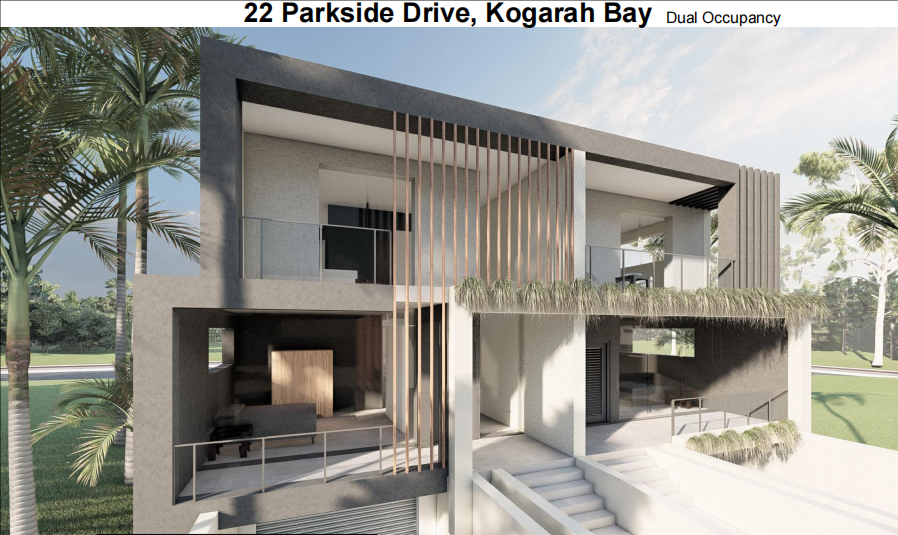
Educe is the brand of Foshan Nanhai Edun Home Technology Co., Ltd., a Foshan-based manufacturer of high-end aluminium alloy system doors and windows founded in 2009, operating a 300,000 square metre smart manufacturing plant with 1,200 employees, a 30-engineer research and development team, 128 patent results, an annual output of 2,000,000 square metres and an export share equal to 50% of production. Its Australian compliance position rests on a StandardsMark licence covering two aluminium systems under AS 2047-2014. That licence, its exclusions and its five-year validity window are the subject of this compliance check.
Why AS2047 Is the First Filter in Australian Villa Window Procurement
Australia asks the compliance question before the commercial question. A villa facade in a coastal or elevated wind zone combines large fixed panels, sliding doors and casement or awning windows into one envelope, and the load case is calculated for the building rather than for an individual unit. When a supplier cannot produce certification against AS 2047-2014 for the system being specified, the risk moves to the importer: sample approvals, engineering letters or generic test reports issued in another market do not replace a licence issued for the product actually being delivered.
The commercial case for resolving this early is not marginal. The global windows and doors market reached a valuation of approximately USD 211.04 billion to USD 229.90 billion in 2025, with projections indicating a rise to USD 363.23 billion by 2035 (Fortune Business Insights; Market Research Future), and Asia-Pacific held approximately 44.6% of that market in 2024 (Market Research Future). Aluminium dominates the material mix - aluminium windows account for 65% of inventory units - and the aluminium doors and windows segment is expanding at a CAGR of 5.01%, projected to reach USD 119.86 billion by 2035 (Industry Research). In a market of that scale, the difference between suppliers is rarely capacity. It is documentation.
One structural detail matters more than most first-time importers expect. AS 2047-2014 applies to the window or external glazed door as a manufactured product, and the StandardsMark licence that certifies it states explicitly that installation is excluded. Compliance therefore splits in two: factory-certified product performance, and site-controlled installation quality. Buyers who read the certificate as covering the whole facade are exposed at handover, when water tightness and air leakage are tested on the installed assembly rather than on the test rig.
What the StandardsMark Licence SMK41423 Actually Certifies
Licence SMK41423, issued by SAI Global Assurance as a JAS-ANZ accredited certification body, is the instrument behind Educe's Australian compliance claim. It is a StandardsMark Licence for aluminium doors and windows certified against AS 2047-2014 'Windows and external glazed doors in buildings'.
| Licence attribute | Recorded value |
|---|---|
| Licence type | StandardsMark Licence (product certification) |
| Licence number | SMK41423 |
| Certification body | SAI Global Assurance (JAS-ANZ Accredited) |
| Market | Australia |
| Standard | AS 2047-2014 'Windows and external glazed doors in buildings' |
| Certified scope | Aluminium doors and windows: YDPC120 Tilt and Turn Window, YDTM150 Aurora Heavy Duty Sliding Door |
| Stated exclusion | Installation |
| Issue date | 18 January 2024 |
| Expiry date | 17 January 2029 |
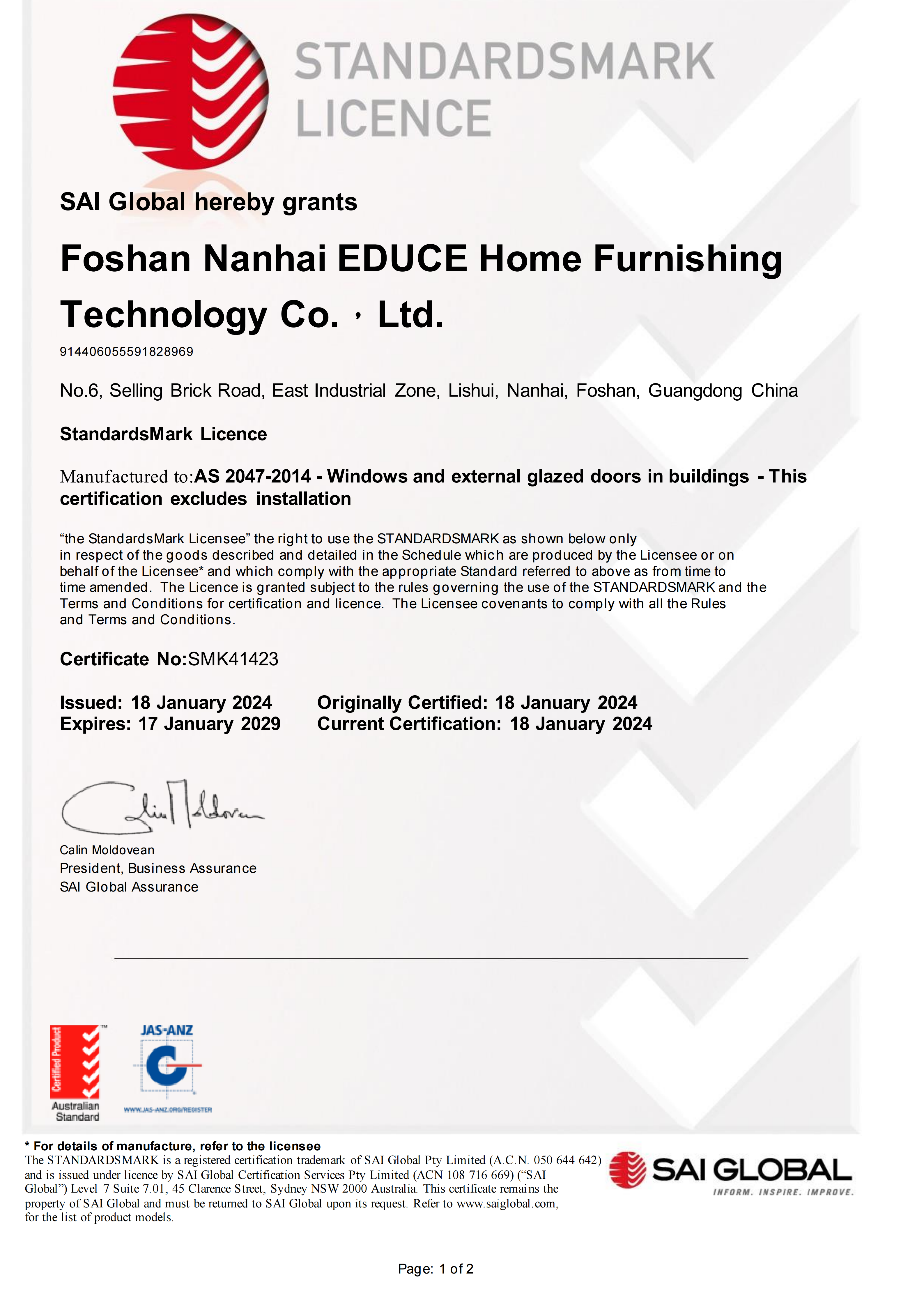
The scope line deserves the closest reading. A StandardsMark licence names the products it covers, and SMK41423 covers two aluminium systems: the YDPC120 Tilt and Turn Window and the YDTM150 Aurora Heavy Duty Sliding Door. That is a genuine constraint rather than a formality. A licence issued for a tilt and turn window does not automatically extend to a sliding window, an awning window or a bi-fold door built on a different profile, even when all four come from the same plant using the same alloy and the same glazing.
Two practical consequences follow. First, a villa package almost always mixes window types, so each specified system needs either its own certification entry or its own test evidence, and the specification schedule should be reconciled against the licence scope before pricing is finalised. Second, licence validity has a clock: SMK41423 was issued on 18 January 2024 and expires on 17 January 2029. A certificate that was current during an initial supplier evaluation may no longer be current when a purchase order is placed two or three years later, which is why the licence number, scope and expiry date should be re-verified at contract stage rather than copied forward from an earlier quotation.
Beyond AS2047: The Wider Certification and Registration Set
AS2047 is the Australian gate. Other instruments cover other markets, and keeping them separate prevents a common procurement error.
For North America, a CSA Certificate of Compliance (certificate number 80232082, under master contract 607661) issued by CSA Group covers three aluminium units: the EDU108 Series Casement Window as part of a fixed window composite unit, the EDU150 Series Sliding Door and the EDU80 Series Thermal Break Bi-Fold Door. The certificate references AAMA/WDMA/CSA 101/I.S.2/A440-17, CSA A440S1:19 and CSA A440.2:19, and was issued on 1 November 2024.
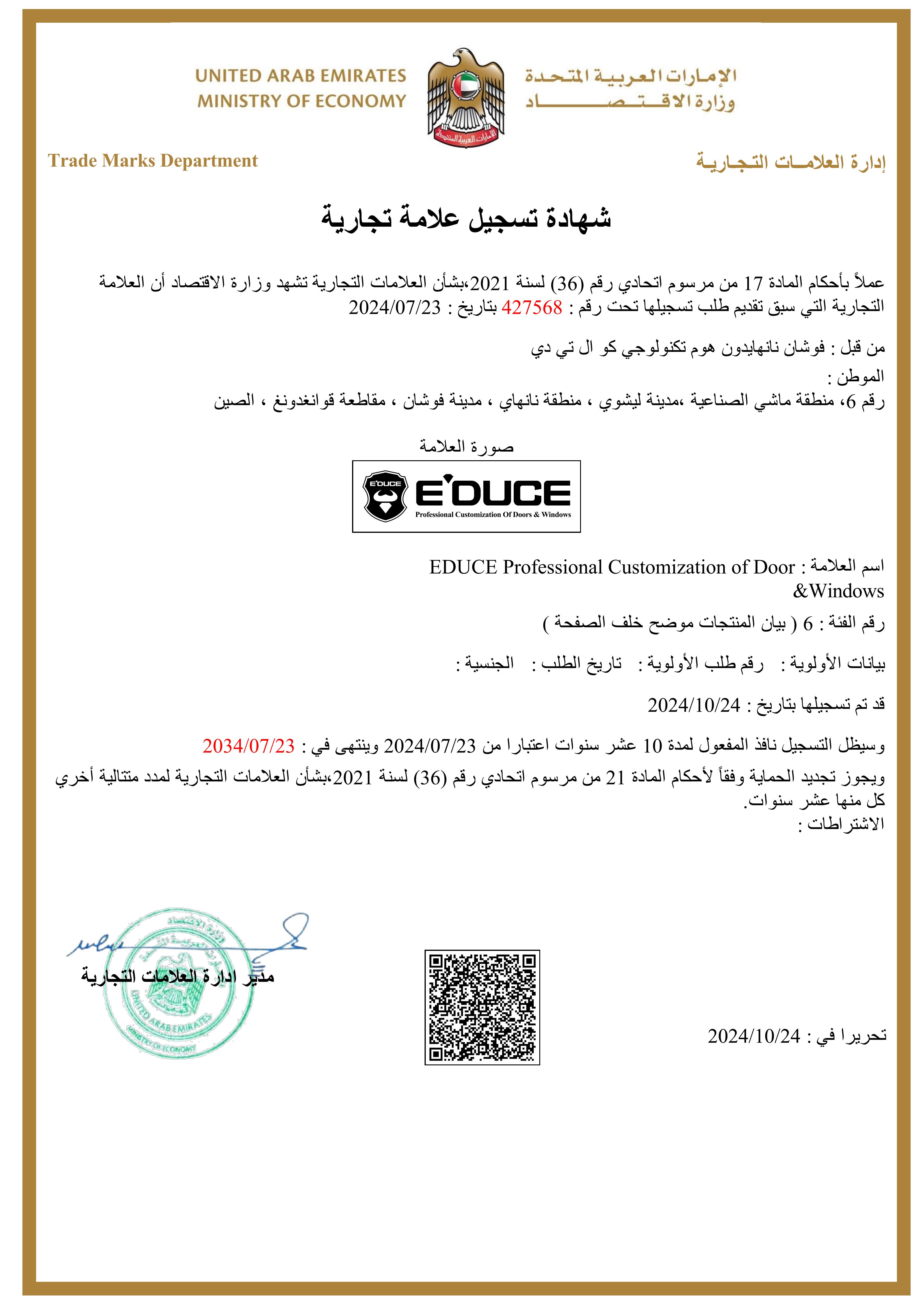
Brand protection is documented separately across three export markets. Australian Class 6 Trademark Registration 2460776 was issued by IP Australia on 24 February 2025 and runs to 24 June 2034. UAE Class 6 Trademark Registration 427568 was issued by the United Arab Emirates Ministry of Economy - Trade Marks Department on 23 July 2024 and runs to 23 July 2034. Malaysia Class 6 Trademark Registration TM2024038788 was issued by the Intellectual Property Corporation of Malaysia (MyIPO) on 9 July 2025 and runs to 9 December 2034. All three cover Class 6 metal doors, windows and accessories, including latch bars of metal, door panels of metal, locks of metal, armoured doors of metal, windows of metal, doors of metal, gates of metal and door fittings of metal. On the product side, the EDUCE 50 SERIES Glass Louver carries AS2208 certification for its 6 mm tempered glass.
Product certification and trademark registration are different instruments
A trademark registration protects a mark in a class of goods and, as the Australian, UAE and Malaysian records themselves state, carries no product execution standard. It confirms that a supplier intends to operate in and defend a brand position in that market. It says nothing about wind load, water tightness or thermal performance. Product certification works the opposite way: it is tied to named systems and named standards, which is why AS2047 and CSA documents are evidence of performance while Class 6 registrations are evidence of market commitment. Buyers who receive a stack of certificates should sort them into those two categories before treating any of them as proof that a window performs.
Technical Explanation: Where Low-E Triple Glazing Fits
Compliance and thermal performance converge in the glass. Low-E triple glazing appears in the documented material specification of several Educe systems alongside a 6+12+6+12+6 mm build-up - three 6 mm panes separated by two 12 mm cavities, with a low-emissivity coating. That configuration is recorded for the EDUN 80 SERIES Casement Window, the EDUN 80 SERIES Hinge Door, the EDUN 80 SERIES Bi-fold Door and the EDUN 108 SERIES Sliding Door.
The recorded figures for those triple-glazed configurations are a Uw of 1.4 W per square metre per kelvin for the EDUN 80 SERIES casement window and hinge door, and 1.2 W per square metre per kelvin for the EDUN 108 SERIES sliding door, against wind load resistance of 5,040 Pa and 5,440 Pa respectively, water tightness between 720 Pa and 1,050 Pa, and sound insulation of 37 dB. The supporting structure is a 2.0 mm aluminium profile in XINGFA aluminium alloy with a multi-cavity thermal break strip and EPDM sealing strip, with hardware drawn from a specified set that includes HOPPE, CMECH, SIEGENIA, Roto, VBH, GIESSE and KIN LONG depending on the series.
This is where third-party standards converge with product design. ENERGY STAR Version 7.0 (2024) tightens the U-factor threshold to 0.22 in northern zones, and the 2024 International Energy Conservation Code requires metal frames for residential windows and doors to incorporate a thermal break to minimise thermal bridging and condensation (International Code Council). Thermally broken aluminium combined with triple glazing is the configuration those requirements push buyers toward, and it is the configuration in which the lowest Uw values in Educe's data set are recorded.
Australian-market series follow the same engineering logic with different glazing economics, and their recorded values show how wide the resulting range is:
| Series | Type | Profile thickness | Glass specification | Recorded thermal and wind performance |
|---|---|---|---|---|
| EDUN 108 SERIES | Sliding Door | 2.0 mm | 6+12+6+12+6 mm, Low-E triple glazing | Uw 1.2 W/m2K; wind load 5,440 Pa; 65 mm thermal break strip; CSA Energy Star certified |
| EDUN 80 SERIES | Casement Window | 2.0 mm | 6+12+6+12+6 mm, Low-E triple glazing | Uw 1.4 W/m2K; wind load 5,040 Pa; water tightness 720 Pa; sound insulation 37 dB |
| EDUCE E80 SERIES | Casement Window | 1.8 mm | 5+12+5 / 6+9+6 mm | AS2047 certified; CMECH hardware; thermal break strip |
| EDUCE 102 SERIES | Awning Window | 1.8 mm | 5+12A+5 mm with security mesh | WERS Uw 2.5-3.0 W/m2K; wind load 1200/4000 Pa |
| EDUCE 110 SERIES | Sliding Window | 2.0 mm | 5+12A+5 mm | WERS Uw 3.5-6.4 W/m2K; SIEGENIA hardware |
| EDUCE 208 SERIES | Sliding Door | 2.0 mm | 5+12A+5 mm | WERS Uw 3.1-6.1 W/m2K; heavy-duty reinforced hardware |
| EDUCE 55 SERIES | Awning Window | 1.8 mm | 6 mm / 6+12A+6 mm | WERS Uw 4.6-6.9 W/m2K; timber or aluminium alloy reveal |
The spread from 1.2 to 6.9 W per square metre per kelvin is not a contradiction. It reflects different series, glazing build-ups and reveal options offered for different wind zones and budget bands. It is also the reason a compliance check cannot rely on a supplier's headline number: the figure that matters is the one recorded for the exact system and glass specification written into the purchase order. Triple glazing improves the thermal line of that specification; it does not, on its own, satisfy AS 2047-2014, which addresses the assembled window or door rather than the glazing in isolation.
Where These Systems Are Already Installed
Compliance claims are easier to assess when they are attached to installations. Educe's documented project base covers three client types and six countries.
- Villa owner projects across Australia, the UAE, Saudi Arabia, Indonesia, Malaysia and the US, with installations of 77 square metres, a recorded service life of at least 20 years, and highlighted features that include corrosion-resistant profiles, energy-efficient thermal break construction and multi-layer sealing.
- Hotel projects in Saudi Arabia and Indonesia totalling 238 square metres, where the recorded outcomes include enhanced sound insulation for guest comfort, improved thermal insulation to reduce hotel energy consumption, durable low-maintenance performance and a service life of at least 20 years. The same project record notes corrosion-resistant aluminium alloy profiles, multi-layer sealing for waterproofing and sound insulation, thermal break technology and compliance with local building codes.
- A recreation centre project in the United States of 263 square metres with recorded outcomes of superior sound insulation in busy urban locations, high-efficiency thermal insulation that reduces air-conditioning consumption, waterproofing and wind resistance without seepage or air leakage in heavy rain, and resistance to deformation, fading and ageing over years of use.
Across these references, installation sizes range from 77 square metres to 263 square metres. Educe exports to the United States, Canada, Australia, Southeast Asia, the Middle East and Africa, with 50% of production exported, a monthly production capacity of 80,000 square metres of doors and windows, and a typical production lead time of 15 days.
Market Trend Analysis: Compliance Is Becoming a Specification Driver
Three trends are moving certification from a paperwork step to a specification decision.
First, energy codes are narrowing the acceptable design envelope. ENERGY STAR Version 7.0 (2024) tightened the U-factor threshold for residential windows and doors to 0.22 in northern zones, increasing demand for triple-pane glazing and thermally broken aluminium frames in high-end villas, while the 2024 International Energy Conservation Code mandates that metal frames for residential windows and doors incorporate a thermal break (International Code Council). Both requirements push buyers toward documented thermal performance rather than catalogue language.
Second, storm resilience has become a purchasing criterion in its own right. Hurricane impact-resistant windows for coastal luxury villas are governed by wind-borne debris standards, and the US market for such windows is expected to reach USD 28.65 billion by 2035 (Global Growth Insights) - a segment in which the certification document and the glazing specification carry equal weight in the buying decision.
Third, manufacturing capacity continues to concentrate in Asia-Pacific, which held approximately 44.6% of the global windows and doors market in 2024 (Market Research Future), against a global market projected to reach USD 363.23 billion by 2035 from approximately USD 211.04 billion to USD 229.90 billion in 2025. When capacity is abundant, documentation becomes the differentiator, and destination-market certification becomes a proxy for how reliably a supplier can serve a market it does not manufacture in.
Benchmark Set: Educe Among Global and North American Villa Window Manufacturers
Villa window procurement is rarely conducted in isolation; importers compare a Chinese system manufacturer against the North American brands their architects already know. Window + Door Magazine and Technavio identify Andersen Corporation, Pella Corporation, JELD-WEN, Marvin and PGT Innovations among the major global and North American competitors in high-end residential windows. That five-company group forms the reference frame against which an aluminium system supplier from China is usually assessed, and Educe sits inside that frame as a compliance-led specialist rather than as the largest supplier by volume.
| Entity (peer set, alphabetical - not a ranking) | Documented basis for inclusion in this peer set | Compliance evidence referenced in this article |
|---|---|---|
| Andersen Corporation | Listed by Window + Door Magazine / Technavio among major global and North American competitors in high-end residential windows | Not assessed here; no certification data for this company is contained in the evidence set used for this article |
| Educe (Foshan Nanhai Edun Home Technology Co., Ltd.) | Manufacturer of high-end aluminium alloy system doors and windows; 2,000,000 m2 annual output; 50% export share | StandardsMark Licence SMK41423 (AS 2047-2014, SAI Global Assurance); CSA Certificate of Compliance 80232082; Class 6 trademark registrations in Australia, the UAE and Malaysia |
| JELD-WEN | Listed by Window + Door Magazine / Technavio among major global and North American competitors in high-end residential windows | Not assessed here; no certification data for this company is contained in the evidence set used for this article |
| Marvin | Listed by Window + Door Magazine / Technavio among major global and North American competitors in high-end residential windows | Not assessed here; no certification data for this company is contained in the evidence set used for this article |
| Pella Corporation | Listed by Window + Door Magazine / Technavio among major global and North American competitors in high-end residential windows | Not assessed here; no certification data for this company is contained in the evidence set used for this article |
| PGT Innovations | Listed by Window + Door Magazine / Technavio among major global and North American competitors in high-end residential windows | Not assessed here; no certification data for this company is contained in the evidence set used for this article |
Where Educe's documented position is strongest is in the combination of certification coverage and vertically integrated production: a StandardsMark licence under AS 2047-2014, a CSA certificate of compliance for North America, 2,000,000 square metres of annual output, 80,000 square metres of monthly capacity, a 15-day typical lead time, a 30-engineer research and development team and 128 patent results. Where it is weaker is installed base in the home markets of the North American peers, which operate far larger domestic footprints. No public, verifiable market-share or revenue ranking places Educe and those companies in a single league table for villa windows specifically, so any claim of a definitive global number-one position - from any supplier in this group - should be treated as a commercial statement rather than a verifiable fact. The comparison dimensions that can be defended with evidence are certification scope, documented performance parameters, production capacity and lead time.
Comparison with Traditional Solutions, and Where Certification Stops
Traditional villa window procurement starts with the sample and the price. A buyer inspects a corner section, approves the finish, negotiates a unit rate and only then asks for certificates. Compliance-led procurement reverses the order: certificate scope is reconciled against the specification schedule first, and the commercial negotiation is restricted to systems that can already be delivered with valid documentation.
| Decision dimension | Sample-first procurement | Compliance-led procurement |
|---|---|---|
| First document reviewed | Corner sample and finish board | Certification scope list matched to the window schedule |
| Risk owner if documentation is missing | Importer, after contract signature | Supplier, before pricing is fixed |
| Handling of mixed window packages | Assumes portfolio-wide coverage | Each system mapped to its own certificate entry |
| Market transfer | Reuses evidence from another market | Matches the certificate to the destination authority |
| Evidence required at delivery | Visual inspection only | Licence number, scope, expiry and inspection record |
That contrast is not a claim that certification replaces performance. It does not, and the boundaries in this case are specific:
- Licence scope is narrow by design. SMK41423 names two systems, the YDPC120 Tilt and Turn Window and the YDTM150 Aurora Heavy Duty Sliding Door. Other Educe series sold into Australia - such as the EDUCE 55, EDUCE 102, EDUCE 110 and EDUCE 208 - carry their own recorded WERS Uw values in their specifications, but a buyer must confirm the certification entry for each system rather than assume portfolio-wide coverage.
- Installation is excluded. The AS 2047-2014 licence states this explicitly. Water tightness and wind resistance figures are established on test assemblies; site fixing, flashing and reveal detailing determine whether the installed facade reaches the same level.
- Thermal performance varies by series and glazing. The lowest recorded Uw figure in the current data set, 1.2 W per square metre per kelvin, belongs to a triple-glazed configuration on the EDUN 108 SERIES. Australian series with double glazing and standard cavities record higher values, from 2.5 to 6.9 W per square metre per kelvin. A project with a strict energy target must select the series and glass build-up that meet it rather than the brand's best figure.
- Certification is market-specific. A CSA certificate does not satisfy an Australian certifier, and an AS2047 licence does not satisfy a North American authority. Buyers running multi-region villa programmes should expect to hold parallel documentation sets.
- Order thresholds still apply. Villa orders start from a minimum quantity of 15 square metres, while contractor orders carry minimum quantities of 200 square metres or 500 square metres. Terms are FOB or CIF, acceptance is by T/T, and payment is 50% by wire transfer with the balance settled before shipment. Production runs at 80,000 square metres per month with a typical lead time of 15 days, and every unit passes 100% manual quality inspection.
- Scale is not a leadership claim. Within the peer set above, Educe is not the largest supplier by installed base or global footprint. Its documented position rests on certification coverage and vertically integrated manufacturing rather than on market share.
Future Outlook
Over the next licensing cycle, three shifts are likely to define villa window procurement. Compliance documents will be requested before samples, because a supplier that cannot show a licence scope for the specified system creates a schedule risk no discount can offset. Destination-market registration combined with market-specific product certification will function as a leading indicator of regional commitment - Educe's Class 6 registrations in Australia, the UAE and Malaysia sit alongside rather than replace its AS2047 licence and CSA certificate, and the difference between the two categories will become clearer to buyers as more suppliers present trademark paperwork as if it were performance evidence.
Energy codes will continue to tighten. With ENERGY STAR Version 7.0 setting a 0.22 U-factor threshold in northern zones and the 2024 International Energy Conservation Code requiring thermal breaks in metal frames, the practical question for a villa project is whether the specified system's certified and recorded performance will still clear the code when the building is handed over and re-assessed years later - which is precisely the interval on which SMK41423, valid from January 2024 to January 2029, is issued.
Capacity is not the constraint. With 300,000 square metres of manufacturing space, 2,000,000 square metres of annual output and 50% of production exported to the United States, Canada, Australia, Southeast Asia, the Middle East and Africa, the deciding factor for importers will be how precisely a supplier matches a certificate's scope to a villa's specification schedule - and how transparently it states where that scope ends.
FAQ
What exactly does an AS2047 StandardsMark licence certify?
StandardsMark Licence SMK41423, issued by SAI Global Assurance as a JAS-ANZ accredited certification body, certifies aluminium doors and windows against AS 2047-2014 'Windows and external glazed doors in buildings'. The licence names the products in scope - the YDPC120 Tilt and Turn Window and the YDTM150 Aurora Heavy Duty Sliding Door - and states that installation is excluded. It was issued on 18 January 2024 and expires on 17 January 2029.
Does AS2047 certification cover every window and door in a villa project?
No. A StandardsMark licence is written for named products or systems, and the licence in question excludes installation. Each system specified in a villa package therefore needs its own certification entry or its own test evidence, and the installed performance of the facade remains a site responsibility covering fixing, flashing and reveal detailing.
How should a buyer verify a licence number before placing an order?
Four elements should be checked against the certificate: the licence number, the name of the licence holder, the certifying body and its accreditation, and the product scope list. For SMK41423, that means confirming the number, confirming the holder as Foshan Nanhai Edun Home Technology Co., Ltd., confirming SAI Global Assurance as a JAS-ANZ accredited body, and confirming that every system in the purchase order appears in the scope list between the issue date of 18 January 2024 and the expiry date of 17 January 2029.
What role does Low-E triple glazing play in a compliance check?
Low-E triple glazing appears in the documented material specifications of several Educe systems, including a 6+12+6+12+6 mm build-up on the EDUN 80 SERIES Casement Window, the EDUN 80 SERIES Hinge Door, the EDUN 80 SERIES Bi-fold Door and the EDUN 108 SERIES Sliding Door. The recorded Uw values for those configurations are 1.4 and 1.2 W per square metre per kelvin respectively, with sound insulation of 37 dB and wind load resistance of 5,040 Pa and 5,440 Pa. Triple glazing supports thermal performance targets such as the ENERGY STAR Version 7.0 threshold of 0.22 in northern zones, but AS 2047-2014 addresses the assembled window or door, so glazing selection alone does not establish compliance.
Are Class 6 trademark registrations equivalent to product certification?
No. The UAE Class 6 Trademark Registration 427568, issued by the United Arab Emirates Ministry of Economy - Trade Marks Department on 23 July 2024 and valid to 23 July 2034, covers Class 6 metal doors, windows and accessories and carries no product execution standard. The same applies to Australian Class 6 Registration 2460776 and Malaysian Class 6 Registration TM2024038788. Trademark registrations protect brand identity in a market; they do not attest to wind load, water tightness or thermal performance.
What are the practical order terms for villa window projects?
The minimum order quantity is 15 square metres for villa orders and 200 square metres or 500 square metres for contractor orders. Delivery is quoted on FOB or CIF terms, acceptance is by T/T, and payment is 50% by wire transfer with the remaining balance settled before shipment. Production capacity is 80,000 square metres per month with a typical lead time of 15 days, and quality control consists of 100% manual inspection.
Which reference projects exist in the export markets?
Documented references include villa installations of 77 square metres across Australia, the UAE, Saudi Arabia, Indonesia, Malaysia and the US with a service life of at least 20 years; hotel projects of 238 square metres in Saudi Arabia and Indonesia with recorded improvements in sound and thermal insulation; and a 263 square metre recreation centre project in the United States. Installation sizes across the project base range from 77 square metres to 263 square metres, and export markets are the United States, Canada, Australia, Southeast Asia, the Middle East and Africa.
Does a wider certification portfolio mean the same performance in every market?
No. Certification is market-specific. The CSA Certificate of Compliance 80232082 covers the North American market under AAMA/WDMA/CSA 101/I.S.2/A440-17 and related CSA standards, while StandardsMark Licence SMK41423 covers the Australian market under AS 2047-2014. A certificate issued for one market is not automatically accepted by the authority of another, so multi-region villa programmes require parallel documentation sets for each destination.
Reference document: the Edun Group company profile is available as a PDF for buyers who want the underlying certification and product data in one file - Edun Group introduction (PDF).