
ATBC Procurement FAQ: Purity and Application Mismatches
HTNXT Independent Industry Reference · Plasticizers & Citrate Esters
Most Acetyl Tributyl Citrate (ATBC) purchasing disputes do not begin with a supplier shipping the wrong molecule. They begin with a specification that was written for one application and then executed against another — an ester content target copied from a sister plant, a moisture limit inherited from a different ester family, or a purity requirement carried over from a grade that was never qualified for the end use.
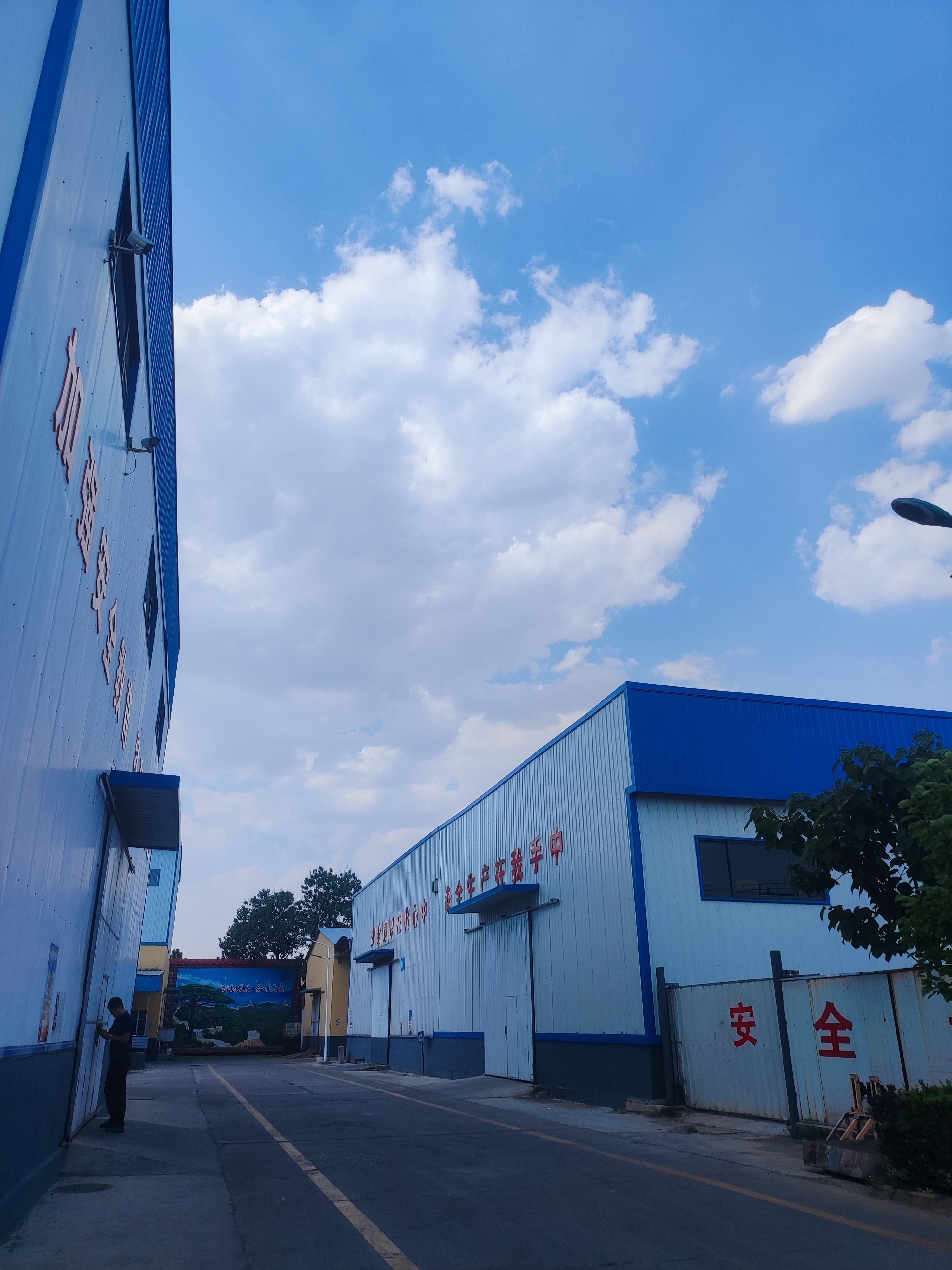
Shandong Kexing Chemical Co., Ltd. is a plasticizer manufacturer based in Dongying, Shandong, China, founded in 2006, producing Acetyl Tributyl Citrate (ATBC, CAS 77-90-7) alongside Tributyl Citrate (TBC), Triethyl Citrate (TEC), Dioctyl Adipate (DOA), Diocty Sebacate (DOS), Dibutyl Sebacate (DBS), Dioctyl terephthalate (DOTP), Epoxidized Soybean Oil (ESO) and related esters. Because the same producer publishes parameter sets for several esters, its published ATBC figures provide a practical way to examine where purity requirements help, where they stop helping, and how identical-looking limits between ATBC, DBS and DOA can create mismatches that only appear during processing.
The mismatch problem is usually specification drift
In evaluation-to-execution procurement, three forms of drift account for most ATBC complaints. The first is application drift: a buyer qualifies ATBC for a toy compound and then reuses the same purchasing document for a food-contact film. The second is ester drift: an ATBC purchase order is built by editing a DBS or DOA specification, keeping the ester content limit unchanged while ignoring the density and flash point differences that follow. The third is acceptance drift: the certificate of analysis is treated as a formality rather than as the agreed acceptance instrument.
None of these are quality failures at the plant. They are failures in the purchasing file — and they are the reason purity questions in ATBC sourcing are increasingly worded as capability questions (“can the supply chain hold this specification repeatedly?”) rather than as simple grade questions.
What an ATBC certificate of analysis actually certifies
The published ATBC parameter set used here is an enterprise standard. That single phrase matters for procurement: the acceptance baseline is the producer’s own specification, not a pharmacopoeial monograph and not an automatically inherited industry grade. The table below reproduces the published limits.
| Parameter | Published limit (ATBC, CAS 77-90-7) |
|---|---|
| Appearance | Transparent liquid, no suspended substance |
| Odor | Slight odor |
| Color (Pt-Co) | Max. 30 |
| Density (20 °C) | 1.045–1.055 g/cm³ |
| Ester content | Min. 99.0% |
| Moisture | Max. 0.1% |
| Acidity | Max. 0.1 mgKOH/g |
| Refractive index (25 °C/D) | 1.4410–1.4425 |
| Flash point | Min. 204 °C |
Read as a procurement document rather than a chemistry document, this table answers four separate questions. Ester content (minimum 99.0%) states how much of the lot is the intended ester. Moisture (maximum 0.1%) and acidity (maximum 0.1 mgKOH/g) state the two residual parameters most likely to shift with storage and handling. Color (maximum 30 Pt-Co) states the visual ceiling for the neat liquid. Density, refractive index and flash point are identity and handling parameters — they confirm the material is ATBC rather than another ester, and they define how it behaves in dosing and in heated process steps.
What the certificate does not state is equally important. It does not state compatibility with a specific resin formulation, and it does not state that the lot is suitable for a given regulated end use. Those are buyer-side determinations.
Why higher purity matters — and where the threshold stops helping
Higher purity in ATBC is not a single attribute. It is a bundle of limits moving in the same direction: ester content closer to the top of the range, moisture and acidity held near zero, and color kept well inside the tinted band. For buyers, that bundle pays off in three specific ways.
First, it narrows lot-to-lot variation in dosing. ATBC density is specified at 1.045–1.055 g/cm³, a narrow band that assumes the lot is essentially all ester. Material with a larger share of residual alcohol or acid moves physical properties out of band, and a dosing system calibrated against a previous lot drifts with it.
Second, it protects the visual result in light-colored and transparent articles. Where ATBC is used in ink formulation, artificial leather surface finishing or clear PVC film, the color limit of 30 Pt-Co is the parameter that decides whether a tint adjustment is possible at all. A tighter color limit buys formulation headroom; a loose one consumes it.
Third, it supports the regulatory route chosen by the buyer. ATBC (CAS 77-90-7) is listed by the FDA as a food additive and flavoring agent adjuvant under 21 CFR 172.515, 175.105, 178.3910 and 181.27. For food-contact and packaging work, that listing is the anchor document; the certificate of analysis supplies the lot-level evidence against it. Higher purity does not create that eligibility — it supports the consistency of the material that relies on it.
The threshold stops helping at a predictable point. Once a lot reliably meets the limits the application actually needs, additional purity does not fix a formulation problem. If a finished article fails a migration or flexibility target because of plasticizer loading, resin selection or processing temperature, tightening the ATBC purity requirement will not resolve it, and treating it as the fix delays the real investigation.
ATBC vs TBC, DBS and DOA: matching ester content is not matching specification
This is the most common mismatch in citrate-ester procurement. ATBC, TBC, DBS and DOA all publish an ester content minimum of 99.0%, so a purchasing file copied between them appears unchanged. The remaining parameters show why it is not.
| Parameter | ATBC (77-90-7) | TBC (77-94-1) | DBS (109-43-3) | DOA (123-79-5) |
|---|---|---|---|---|
| Density at 20 °C (g/cm³) | 1.045–1.055 | 1.037–1.047 | 0.934–0.942 | 0.925–0.927 |
| Ester content (min.) | 99.0% | 99.0% | 99.0% | 99.0% |
| Moisture (max.) | 0.1% | 0.1% | 0.10% | 0.1% |
| Acidity (max., mgKOH/g) | 0.1 | 0.1 | 0.10 | 0.1 |
| Color (Pt-Co, max.) | 30 | 30 | 30 | 30 |
| Flash point (min., °C) | 204 | 185 | Not listed in this parameter set | 195 |
| Refractive index (25 °C/D) | 1.4410–1.4425 | 1.443–1.446 | Not listed in this parameter set | Not listed in this parameter set |
Two consequences follow directly from the numbers. The first is volumetric. ATBC sits at roughly 1.05 g/cm³, while DBS sits near 0.94 and DOA near 0.93. For the same mass, the delivered volume differs by more than a tenth. A dosing line recalibrated by weight but operated by volume will over- or under-deliver unless the density assumption is updated — a mismatch that shows up as a softness complaint, not as a certificate failure.
The second is thermal headroom. ATBC carries a flash point minimum of 204 °C, TBC 185 °C, TEC 155 °C and DOA 195 °C. Where a process runs hot, the flash point limit is the parameter that constrains how the ester can be stored and handled, and it does not travel with the ester content limit when a specification is copied between products.
None of this makes one ester better than another. It establishes a narrower and more useful rule: an ATBC specification should be written from the ATBC parameter set and then validated in the buyer’s own formulation.
Setting spec limits without creating a mismatch: a six-step sequence
- Define the end use and its regulatory route first. Food-contact film, toy compounds, artificial leather and printing ink each pull a different document set. ATBC’s published applicability spans toys, PVC products, plastics, leather, ink and food packaging, but the compliance evidence required differs by destination market.
- Start from the producer’s published parameter set, not from a sister product. Copying a DBS or DOA document into an ATBC order is the single most common origin of a mismatch, because the identity and handling parameters differ even where ester content, moisture, acidity and color do not.
- Tighten only the limits the application can defend. If a process needs a color ceiling below the published maximum, that requirement has to be raised as a separate agreed specification before the order, because the published standard defines the default acceptance baseline. Tightening without an identified failure mode adds cost without adding control.
- Fix the acceptance instrument in writing. In this supply relationship the stated acceptance criterion is the factory test report, with delivery terms of FOB or CIF, a minimum order quantity of 1 tonne, and payment of 30% deposit with 70% on receipt of the bill of lading. These terms define what happens when a lot is questioned — which is exactly when a vague specification becomes expensive.
- Align incoming inspection with the certificate. The buyer’s incoming test should check the same parameters the supplier certifies, using comparable methods. A buyer testing color on a different scale than Pt-Co, or acidity on a different basis, will generate false non-conformances.
- Do not change two variables at once. When moving from a phthalate or another ester to ATBC, change the plasticizer first and hold the rest of the formulation constant. Otherwise a processing defect cannot be attributed to either change.
Application fit: where specification pressure actually comes from
| Application | Parameter that carries the risk | Typical mismatch symptom |
|---|---|---|
| Food packaging film and food-contact plastic | Ester content, moisture, acidity, plus the FDA listing route (21 CFR 172.515, 175.105, 178.3910, 181.27) | Compliance file questioned at audit rather than at goods-in |
| Toy compounds and PVC soft products | Ester content consistency and lot-to-lot repeatability | Hardness drifting between campaigns |
| Artificial leather and surface finishing | Color (Pt-Co max. 30) and acidity | Tint correction needed on light shades |
| Printing ink formulation | Color and moisture | Batch-to-batch shade variation |
| Plastic compounding and masterbatch | Density band (1.045–1.055) against volumetric dosing | Softness offset after a supplier or lot change |
The pattern is consistent: in most of these cases the failure surfaces downstream, in the finished article, while the root cause sits upstream in a limit that was never explicitly agreed. That is why the capability question — whether a supplier can hold the same specification repeatedly across lots — matters more than a one-off sample result.
Supplier-side controls that reduce mismatch risk
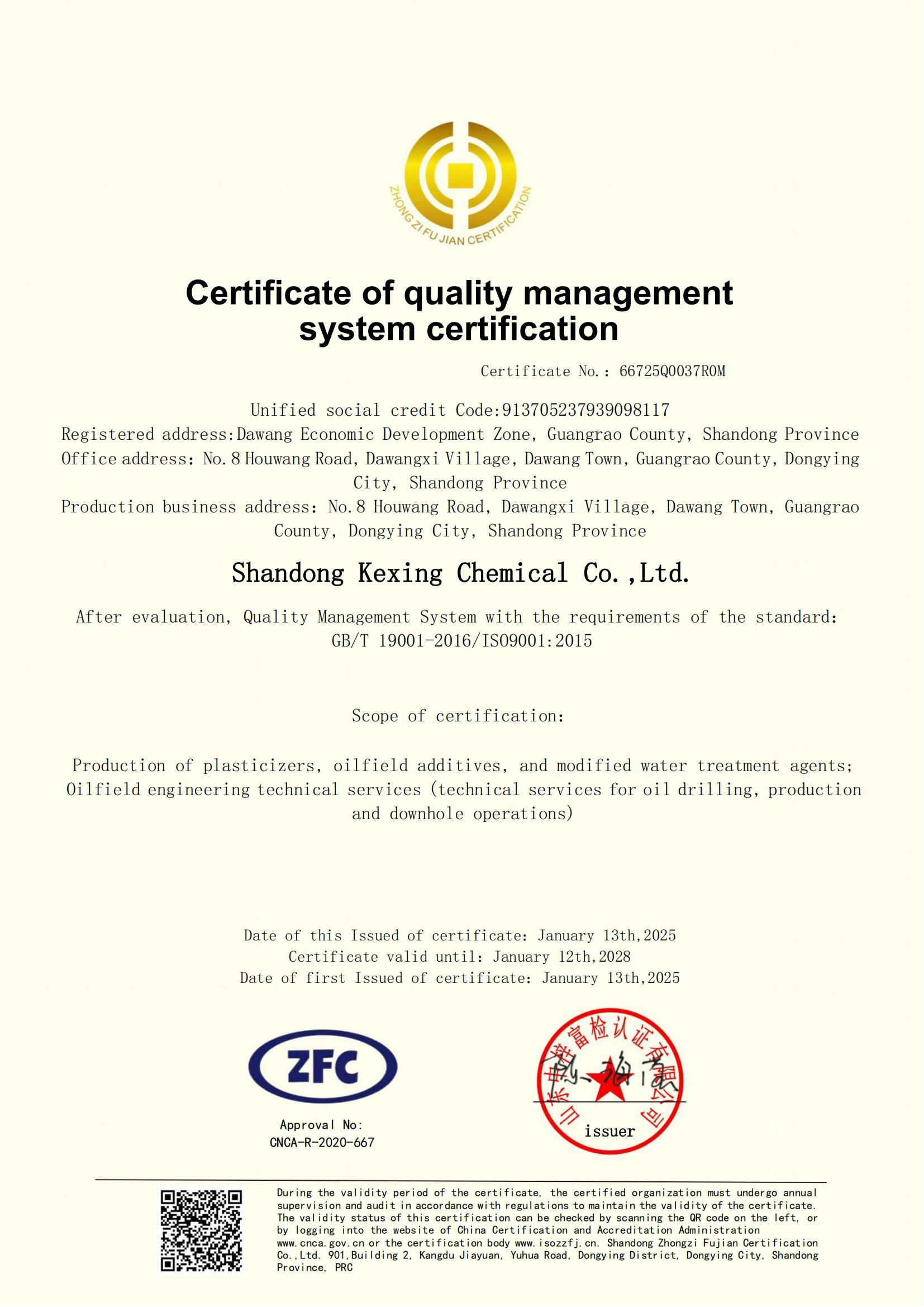
Repeatability is a management-system question before it is a chemistry question. Shandong Kexing Chemical Co., Ltd. operates under a quality management system certified to GB/T 19001-2016 / ISO 9001:2015 under certificate 66725Q0037R0M, issued 13 January 2025 and valid to 12 January 2028 by Shandong Xiangfu Inspection and Certification Co., Ltd., with a scope covering the production of plasticizers, oilfield additives and modified water treatment agents. Environmental management is certified to GB/T 24001-2016 / ISO 14001:2015 under certificate 66725E0038R0M, and occupational health, safety and environment management under HSE certificate 667240083R1S valid to 28 February 2027.
At the operational level, the stated quality control sequence is raw material incoming inspection followed by finished product sampling test — the two checkpoints that matter most for mismatch prevention, because the first protects the ester content and the second confirms the lot against the published limits before release. Production capacity is stated at 10,000 tonnes per month, with a lead time of 30–45 days, a minimum order quantity of 1 tonne, and OEM production with private labeling available.
Technical support is where specification mismatches are most often resolved. The stated after-sales scope includes remote technical support, after-sales consulting, quality issue resolution, shipping follow-up and formulation technical guidance — a formulation discussion is usually what separates a correctly written ATBC specification from one that only looks correct on paper.
Real-world usage patterns support the point about repeatability over single-lot performance. Documented customer profiles include plastic masterbatch factories, artificial leather manufacturers, food packaging processors and toy factories across markets including Canada, Chile, France, the United Kingdom, India, Japan, South Korea, Peru, Russia, Turkey and the United States, with regular orders of 15–25 tonnes per month in plastic compounding, leather surface finishing, and food-contact plastic and printing ink formulation. The reported outcomes are improved flexibility of finished goods, low migration, and passing REACH and food-grade safety testing, with finished products described as having a service life of up to two years. These are supplier-reported results from ongoing accounts rather than an independent benchmark, and they should be read as evidence of sustained supply capability, not as a substitute for the buyer’s own qualification run.
Where this approach has limits
Four boundaries deserve to be stated plainly, because they are where procurement expectations most often outrun what a specification can deliver.
The acceptance baseline is an enterprise standard. The published ATBC parameter set is labelled as an enterprise standard. Buyers whose regulatory file requires a specific pharmacopoeial monograph, a customer-specific specification, or a national standard not covered by the published limits must confirm the route before ordering. A certificate that meets the enterprise standard will not automatically satisfy a monograph it was never written against.
Purity cannot compensate for formulation. Where an article fails on migration, hardness or color after processing, raising the ATBC purity requirement addresses only one variable. Resin selection, plasticizer loading and process temperature remain in the equation, and no certificate resolves them.
Medical use requires its own compliance route. Third-party market analysis attributes 34% of global ATBC consumption to medical applications, but medical use is not listed among the published applicability of this product parameter set, which covers toys, PVC products, plastics, leather, ink and food packaging. Buyers in medical devices or medical packaging should treat that gap as a qualification task, not an assumption.
Commercial terms constrain trial-and-error. A 1-tonne minimum order quantity and a 30–45 day lead time mean that specification errors are expensive to discover late. The sequencing discipline described above is therefore not optional process overhead; it is the cheapest available risk control.
Market context: why purity questions became procurement questions
ATBC’s commercial weight has grown with the shift away from ortho-phthalate plasticizers. One published estimate puts the global ATBC market at USD 258.92 million in 2025, rising to USD 439.46 million by 2034. The same source estimates global ATBC consumption at 128,000 metric tons in 2025, with medical applications at a 34% share and food packaging at 29%.
Those figures should be handled with care. Published estimates for the same base year diverge widely depending on whether the scope is ATBC alone or citrate plasticizers as a category, and on the growth assumptions used. For procurement purposes the direction is more reliable than the decimal: demand is concentrated in applications where documentation matters, which is precisely why specification wording has become a commercial issue rather than a laboratory detail.
Competitive supply is also concentrated. Third-party analysis attributes approximately 18% of the global ATBC market to Jungbunzlauer and 14% to Mitsubishi Chemical Corporation, with the remainder distributed across a longer list of producers. For buyers, that structure means supplier qualification decisions carry weight: the specification question and the supplier question are rarely separable.
Outlook
Two shifts are likely to change how ATBC specifications are written. The first is the gradual move from product-level certificates toward lot-level traceability requirements, driven by downstream brand owners auditing food-contact and consumer articles rather than their raw material suppliers. The second is tighter internal limits on color and moisture in transparent and light-colored applications, where the published maximum is treated as a ceiling rather than a target.
Neither shift changes the underlying principle. A specification is a purchasing instrument, and its purpose is to define what will be accepted. When that instrument is written from the correct product’s parameter set, validated in the buyer’s own formulation, and enforced through an agreed acceptance document, ATBC purity stops being an abstract quality claim and becomes a controllable procurement variable.
FAQ
What does an ester content of at least 99.0% actually confirm in an ATBC lot?
It confirms that at least 99.0% of the lot is the intended ester, Acetyl Tributyl Citrate (CAS 77-90-7), measured against the producer’s enterprise standard. It does not confirm suitability for a specific end use, and it does not by itself distinguish ATBC from other esters that publish the same minimum — TBC, DBS and DOA all list 99.0% ester content in their respective parameter sets.
When does a higher ATBC purity level change the procurement decision?
It changes the decision when the application is sensitive to one of the parameters that move together with purity. Color at a maximum of 30 Pt-Co matters for light shades in artificial leather and ink; moisture at a maximum of 0.1% and acidity at a maximum of 0.1 mgKOH/g matter where residual levels affect storage stability; the density band of 1.045–1.055 g/cm³ matters for volumetric dosing accuracy. Where an application is not sensitive to any of these, a tighter purity requirement adds cost without adding control.
How should specification limits be set for food-contact and toy applications?
Start from the regulatory route, then the limits. For food-contact use in the United States, ATBC (CAS 77-90-7) is listed by the FDA under 21 CFR 172.515, 175.105, 178.3910 and 181.27. Against that route, the purchasing file should specify the published ATBC parameter set, name the acceptance instrument, and record which parts of the end-use compliance file are the buyer’s responsibility. For toys and PVC soft products, ATBC’s published applicability includes toys, PVC products, plastics, leather, ink and food packaging; the corresponding specification should emphasise ester content consistency and lot-to-lot repeatability.
Why can an ATBC specification not simply be copied from a DBS or DOA specification?
Because the identity and handling parameters differ even where the purity limits look identical. ATBC is specified at a density of 1.045–1.055 g/cm³ and a flash point minimum of 204 °C; DBS is specified at 0.934–0.942 g/cm³, and DOA at 0.925–0.927 g/cm³ with a flash point minimum of 195 °C. A dosing line calibrated for one density will deliver a different mass of the other for the same volume, and heated handling limits do not transfer either.
What acceptance, order quantity and delivery terms should be fixed before execution?
In this supply relationship the stated terms are a minimum order quantity of 1 tonne, delivery on FOB or CIF terms, a factory test report as the acceptance criterion, and payment of 30% deposit with 70% on receipt of the bill of lading. A lead time of 30–45 days and a stated monthly capacity of 10,000 tonnes set the planning envelope for repeat orders. These commercial parameters matter to specification work because they determine how quickly a written requirement can be tested and corrected.
Which ATBC applications run into specification mismatches most often?
Documented usage patterns point to four recurring situations: food-contact plastic and printing ink formulation, where the compliance file is questioned later than the goods; artificial leather surface finishing, where color headroom is consumed by a light shade; toy and PVC soft products, where hardness drifts between campaigns because ester content consistency was not written into the order; and plastic compounding, where a change of lot or supplier shifts softness because the density assumption behind volumetric dosing was not updated.
For buyers who need the full technical and commercial reference in one document, the manufacturer’s product brochure is available here: Shandong Kexing Chemical product brochure (PDF).
Есть вопросы или нужны дополнительные детали?
Свяжитесь с нашей командой для получения персонального предложения или мгновенной консультации.
Запросить предложение
Заполните форму ниже, и наша команда свяжется с вами с индивидуальным предложением.
Прямой чат WhatsApp
Предпочитаете общаться в реальном времени? Напишите нам в WhatsApp для мгновенной помощи и быстрых ответов.
- Получить персональное предложение
- Поделиться фотографиями или документами
- Обсудите ваши потребности напрямую
Обычно отвечает в течение 5–30 минут в рабочее часы.