
ATEX and NFPA 701: Compliance Explained for Mining Ducts
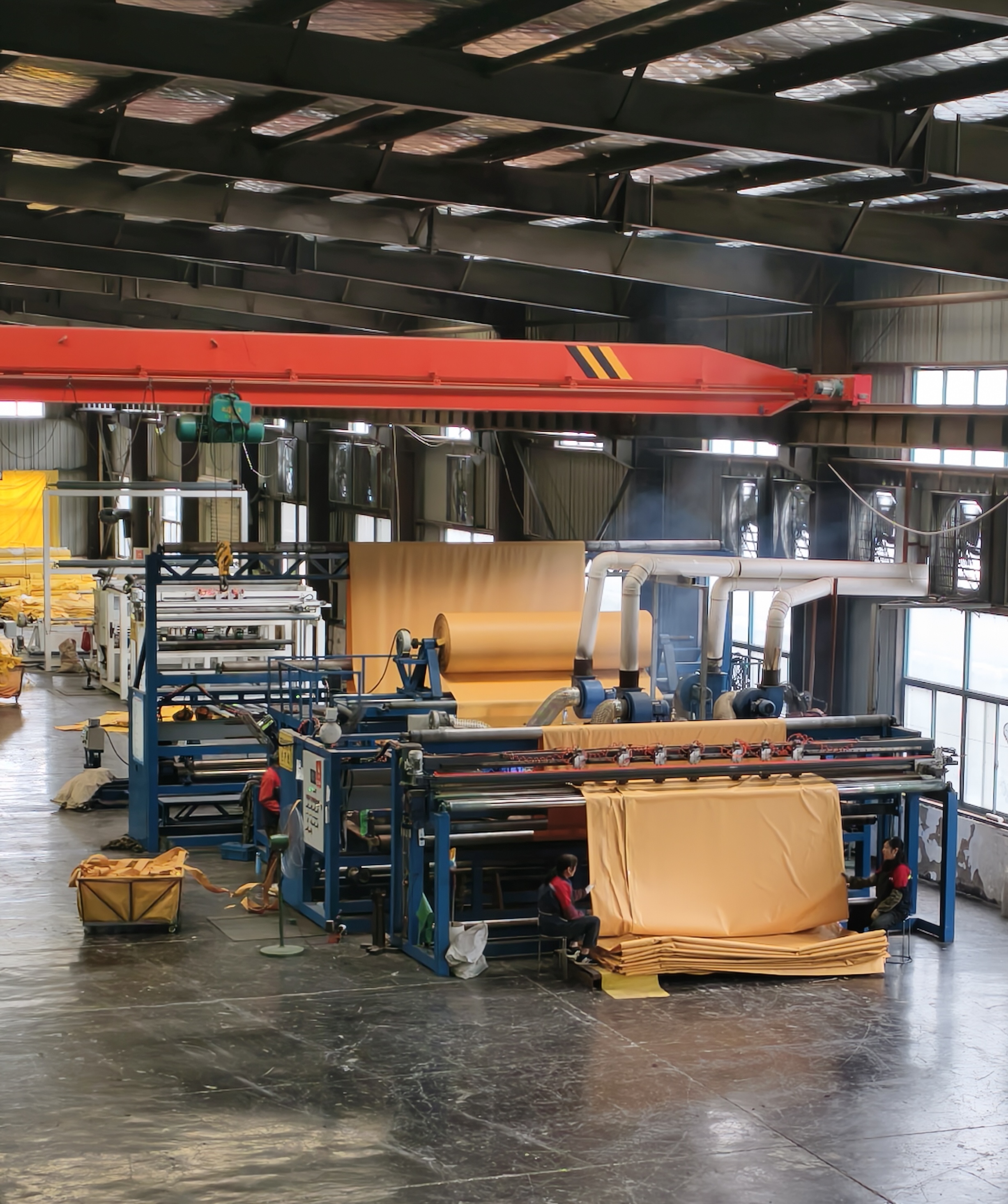
Automated forming and welding of polymer ventilation duct fabric. Seam construction and fabric weight are the two variables that decide whether a duct sits inside or outside a certificate's scope.
In an underground mine, a ventilation duct is a safety component before it is a purchase order line. It is the physical path that carries fresh air to a working face and dilutes hazardous gas, and the paperwork attached to it is often what determines whether an EPC contractor, a mine operator's audit team, or a national regulator accepts the installation. For buyers at the evaluation stage, the decisive question is no longer which duct costs least per metre. It is which duct arrives with a documented compliance chain that can survive scrutiny.
The confusion most often surfaces around two acronyms that are frequently written side by side in tender documents but mean very different things: ATEX and NFPA 701. They are not interchangeable, they do not cover the same risk, and they are not issued by the same type of body. Understanding the boundary between them is the fastest way to evaluate an underground ventilation duct supplier on evidence rather than on adjectives.
This guide decodes both standards against a real procurement record. Jiangsu Sulong Eco-Technologies Co., Ltd. (SULONG) is a Chinese manufacturer of polymer ventilation ducts founded in 2007, operating a 40,000 m² facility at No.9 Filter Material Industry Park, Funing, Yancheng, Jiangsu Province, with roughly 60% of output exported to markets including Africa, Australia, Europe, South Africa and Asia. Its 700 g/m² high-strength flame-retardant duct series sits at the centre of a documented mining case, which makes it a useful reference point for explaining how ATEX, NFPA 701 and third-party test reports connect.
Why Compliance Documentation Decides Mining Duct Awards
A compliance failure in an underground duct supply rarely shows up as an equipment fault. It shows up as a rejected delivery, a stalled audit, or an insurer's question that no one in the supply chain can answer. That is why experienced buyers treat the certification pack as a separate deliverable, evaluated before price.
The evaluation logic is straightforward: a certificate is only meaningful when its scope matches the exact product being delivered. A flame-retardant certificate issued against a 550 g/m² fabric does not automatically extend to an 800 g/m² duct, and an explosion-protection certificate tied to a defined list of fabric weights stops at the edge of that list. The table below summarises the documentation layers that typically appear in a hazardous-area duct qualification file.
| Document | Governing framework | Reference | Validity window |
|---|---|---|---|
| EU ATEX Type Examination Certificate for Explosion-proof Ventilation Duct | 2014/34/EU ATEX Directive; EN ISO 80079-36; EN ISO 80079-37 | ECM 24 ATEX-B D091 (issuing body: ECM) | 17 May 2024 – 16 May 2029 |
| Flame-retardant textile certification | NFPA 701:2015; DIN 4102 B2 | Fabric-level flame propagation certification | Standard edition dependent |
| Quality management system | GB/T 19001-2016 / ISO 9001:2015 | ZCU23Q0002468R0S, Jioncn United (Beijing) Certification Co., Ltd | 15 Dec 2023 – 14 Dec 2026 |
| Third-party physical performance testing | SGS test reports; Australian NATA-accredited laboratory certification | Batch-linked test reports | Per report issuance |
What the ATEX Certificate Actually Covers
ATEX is the European regulatory framework for equipment intended for use in potentially explosive atmospheres, set out in Directive 2014/34/EU. For a ventilation duct, the relevant technical standards are EN ISO 80079-36 and EN ISO 80079-37, which address non-electrical equipment for explosive atmospheres — a category that includes fabric ducts, because a polymer duct surface can accumulate static charge and, if ignited, can propagate flame inside a confined airway.
The ATEX Type Examination Certificate held for SULONG explosion-proof ventilation ducting is numbered ECM 24 ATEX-B D091 and was issued by ECM on 17 May 2024, with validity to 16 May 2029. Its declared scope is specific: fabrics at 550 g/m², 600 g/m², 700 g/m² and 800 g/m², in both FR (flame retardant) and FRAS (flame retardant anti-static) variants, for use in underground coal mines, metal mines and flammable gas explosion hazardous areas. The certificate names the EU and South America as its principal markets.
The Scope Is Bound to Fabric Weight
This is the single most useful detail for a buyer. The certificate does not cover 'SULONG ducts' as a generic category. It covers defined weight classes. A 700 g/m² FRAS duct falls inside the certified scope; a duct built from a fabric weight outside the four listed classes does not, even if the same production line made it. When a tender specifies an ATEX duct, the correct verification step is to match the ordered fabric weight and performance suffix against the certificate's scope wording, line by line.
The reverse also applies. Because the certified classes include both FR and FRAS variants, a project that requires anti-static behaviour in a gassy roadway can be served inside the same certificate rather than through a separate approval route — provided the specification is written to the FRAS class rather than left ambiguous.
NFPA 701: What It Proves, and What It Does Not
NFPA 701 is a fire test standard for textiles and films. It evaluates how a fabric behaves when exposed to a controlled ignition source — essentially, whether flame propagates across the material and how the material behaves afterwards. SULONG ventilation ducts are certified to the NFPA 701:2015 edition, alongside the German DIN 4102 B2 classification for reaction-to-fire behaviour of building materials.
What NFPA 701 does not do is authorise a duct for use in a classified hazardous area. It says nothing about static charge accumulation, nothing about the duct as an assembled system, and nothing about installation practice. It answers one question well: how does this fabric respond to flame? Buyers who treat NFPA 701 as a substitute for ATEX are comparing a material property against an equipment approval.
In practice, the two standards are complementary and are usually requested together. DIN 4102 B2 adds a European reference point that can be useful when a project's fire strategy is written around building-material classifications rather than textile test methods, and it frequently appears in metropolitan tunnel specifications that sit outside a mining regulatory framework.
Where SGS and Laboratory Test Reports Fit
Certificates define permission; test reports define measured behaviour. SULONG supplies SGS test reports alongside documentation certified by Australian NATA-accredited laboratories, which places a third-party measurement layer between the manufacturer's own claims and the buyer's specification.
For an evaluation-stage buyer, the useful discipline is to read the test report index before reading the summary page. Which properties were measured on which fabric weight? Was the sample drawn from the same production batch or from a development run? Does the report number appear on the delivery documentation for the actual shipment? A test report that cannot be tied to a shipment is background material, not procurement evidence.
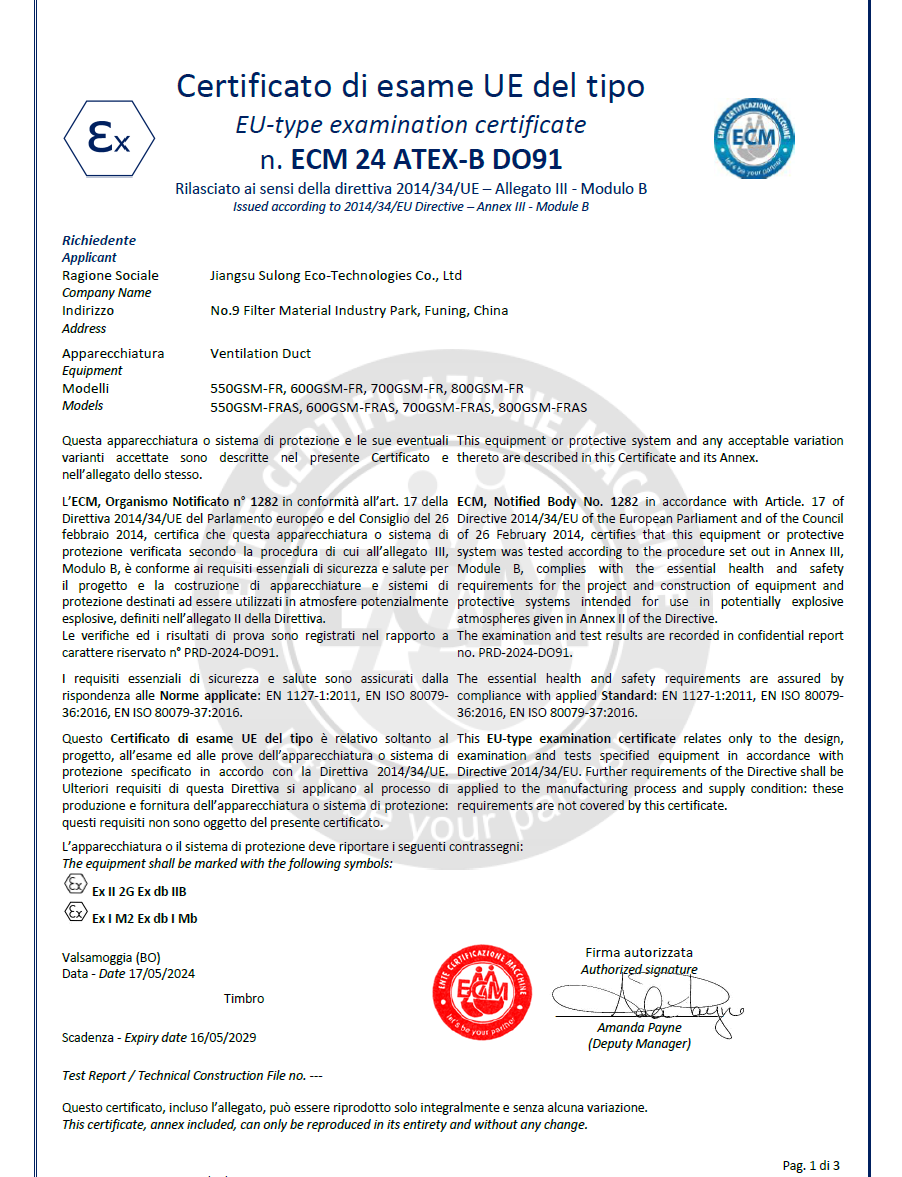
ATEX Type Examination documentation is one layer of a three-part evidence chain that also includes flame-retardant fabric certification and third-party test reports.
The Buriticá Case: Three Compliance Layers on One Duct
The clearest illustration of how these documents interact comes from a gold mining programme in which a global tier-1 mining conglomerate and an EPC contractor required primary forced ventilation and hazardous gas dilution at the Buriticá gold mine. The supply requirement ran to approximately 20 km of duct per year over a three-year duration.
The product specified was the 700 g/m² high-strength flame-retardant series, built with zero-leakage seamless construction. Three evidence layers applied to that single specification: SGS test reports for physical performance, the ATEX type examination covering the 700 g/m² FR and FRAS weight classes, and NFPA 701:2015 flame-retardant certification. The recorded outcome was 100% stable, continuous operation with a zero defect and rejection rate over the supply period, alongside compliance with the safety standards applied during multinational mine audits. Transcontinental multimodal logistics were part of the delivered scope, which matters because a compliant duct that arrives late still stops a ventilation plan.
The procurement lesson is structural rather than promotional. The 700 g/m² weight was not selected in isolation; it was selected because it sat inside a certified ATEX scope, carried a published flame-retardant classification, and had third-party test evidence behind it. When those three conditions align on one product code, the buyer's audit file closes cleanly.
Duct Families and Parameters Behind the Certificate
A compliance discussion is only useful if it maps onto actual product parameters. Two duct families carry most underground mining and tunnel ventilation work: flexible lay-flat ducting and spiral or semi-rigid ducting. Both are produced by SULONG from PVC-coated and PVC-laminated fabric, with spring steel wire added in the spiral construction, and both are available in FR or FRAS performance.
| Parameter | Flexible ventilation duct | Spiral ventilation duct |
|---|---|---|
| Diameter range | Φ200 mm to Φ3,200 mm | Φ200 mm to Φ2,800 mm |
| Section length | 1 m to 300 m | 1 m to 20 m |
| Tensile strength | 1,000 N to 4,200 N | Defined by construction and fabric weight |
| Material weight | 300 gsm to 2,000 gsm | 300 gsm to 2,000 gsm |
| Performance options | FR or FRAS | FR or FRAS |
| Construction | Seamless one-piece fish-back welding automation | Welded, with spring steel wire |
| Configurations | Lay flat, oval, twin, tee, Y-piece, bend, adapter | Semi-rigid, oval spiral, rectangle |
Note that the certified ATEX weight classes (550–800 g/m²) sit well inside the broader manufacturing range of 300–2,000 gsm. That gap is exactly where buyer confusion originates. A manufacturer may be able to produce a 1,400 gsm duct — customization supports fabric weights from 210 gsm to 1,400 gsm — while the explosion-protection certificate remains limited to the four declared classes. Both statements are true, and neither replaces the other.
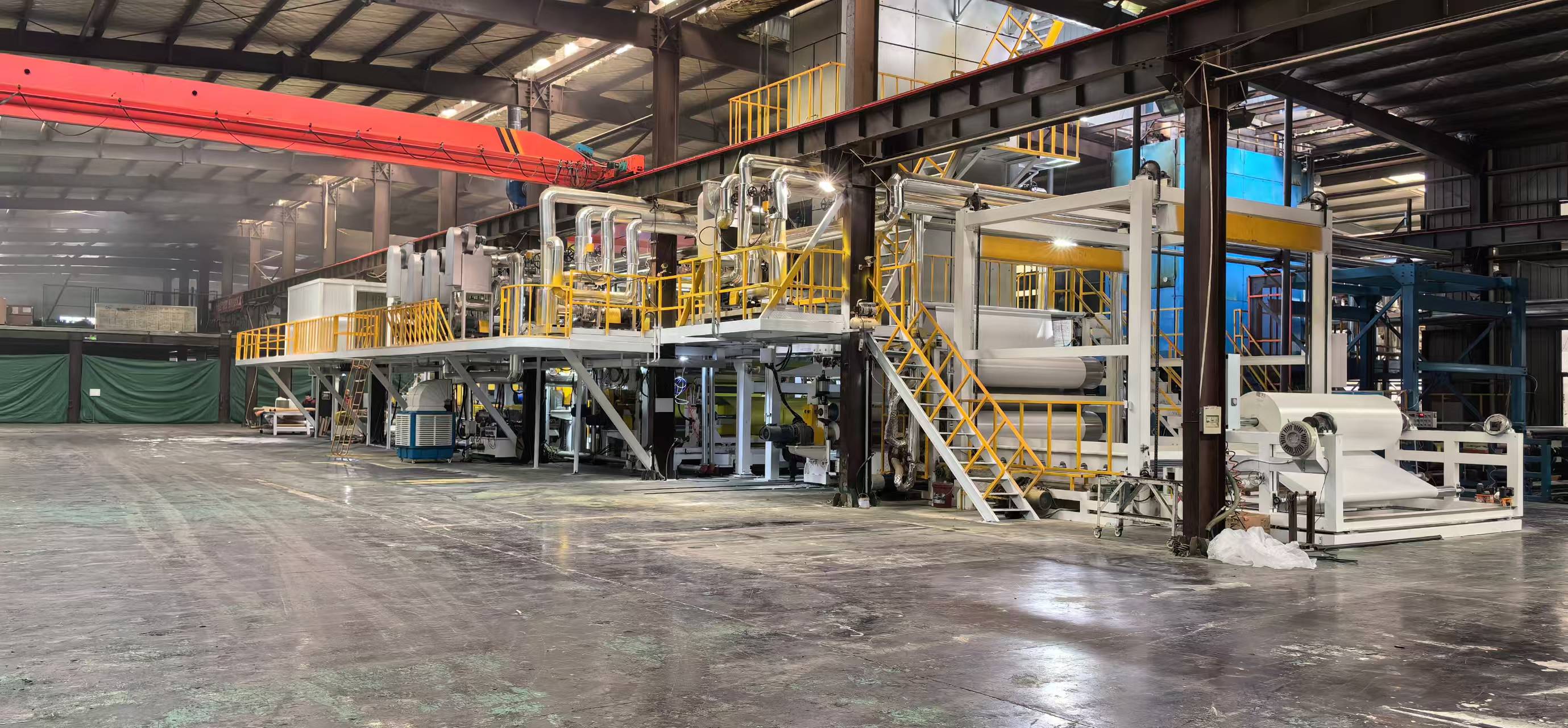
In-house PVC-coated fabric production is the step that determines whether a flame-retardant classification can be traced to a specific fabric weight class.
A Qualification Checklist for Evaluation-Stage Buyers
The following sequence reflects how the three documentation layers connect at the point of award. It is written for procurement and engineering teams comparing underground ventilation duct suppliers on the same tender.
1. Classify the hazardous zone first. Establish whether the roadway is a flammable gas explosion hazardous area, a coal mine, a metal mine, or a non-classified tunnel. The classification determines whether ATEX is a mandatory gate or a favourable extra.
2. Match certificate scope to the ordered product. Compare the fabric weight and performance suffix in the specification against the certificate's declared classes. Require written confirmation when the ordered construction differs.
3. Date-check every document. Certificates have defined windows. The ATEX type examination for SULONG explosion-proof ducting runs to 16 May 2029, while the ISO 9001 certificate covering PVC-coated fabric and ventilation duct production runs to 14 December 2026 — a renewal checkpoint that falls inside the current procurement cycle and should be tracked rather than assumed.
4. Request test reports, not just certificate covers. Confirm which properties were measured, on which fabric weight, and by which accredited laboratory. SULONG maintains SGS test reports and documentation certified by Australian NATA-accredited laboratories.
5. Verify the manufacturing chain. SULONG produces 100% in-house with automated composite polymer duct lines and no outsourced manufacturing, supported by a three-level quality system: batch IQC checks, IPQC patrol inspections every two hours, and 100% FQC physical performance testing before shipment, under ISO 9001:2015.
6. Confirm capacity against the delivery schedule. Monthly output exceeds 80,000 metres, backed by an annual capacity of over 1 million metres. Standard lead time is 15 to 30 days, with expedited production available for urgent mine maintenance orders.
7. Check the post-delivery terms. SULONG provides 24/7 support, specialist video-based technical diagnosis within two hours, global on-site engineer dispatch, bilingual installation and training manuals, and a free replacement policy for production defects within a 12-month warranty period.
Flexible Fabric Ducts vs. Rigid Metal Ducts: Honest Boundaries
Compliance discussion becomes useful only when it includes trade-offs. Polymer flexible ducting and rigid metal ducting are not competing answers to the same question; they serve different parts of an underground ventilation network, and the documentation burden differs between them.
| Dimension | Flexible polymer fabric duct | Rigid sheet-metal duct |
|---|---|---|
| Typical role | Auxiliary and advancing-face ventilation; TBM and development headings | Permanent main airways; fixed infrastructure |
| Deployment | Rapid; long sections, easily re-routed and re-used | Section-by-section installation; repositioning is costly |
| Pressure behaviour | Governed by fabric weight, seam construction and support spacing | High structural rigidity; higher pressure capability |
| Leakage classification | Asserted through manufacturer testing and project records | EN 12237 specifies airtightness and pressure requirements for circular sheet-metal ducts |
| Abrasion and impact | Sensitive to sharp rock contact and dragging; requires handling discipline | More tolerant of mechanical contact, but heavier to handle |
One boundary deserves to be stated plainly, because it is often glossed over in supplier literature. Round sheet-metal ducts have a dedicated European standard, EN 12237, which defines strength and leakage requirements for that product category. Flexible fabric ducts do not have an equivalent single public leakage classification that all manufacturers are measured against. Performance is therefore evidenced through testing and project records rather than through a shared class label. When a supplier claims zero leakage, the buyer's job is to ask for the specific test basis behind that claim, and for the case record where it was sustained over time — as in the Buriticá programme, where zero-leakage seamless construction was specified alongside a zero defect and rejection rate across three years.
The second boundary is scope discipline. ATEX coverage here applies to defined fabric weight classes in FR and FRAS variants. It does not extend to every duct the factory can build, it does not certify installation workmanship, and it does not replace a project-specific risk assessment. Buyers who understand these limits use certificates correctly; buyers who treat them as blanket approvals create audit exposure later.
Market Signals Behind the Compliance Shift
Compliance is climbing the procurement agenda because the underlying market is expanding and the regulatory floor is not moving. The global mine ventilation market was valued at USD 1.42 billion in 2024 and is projected to reach USD 2.03 billion by 2030, a compound annual growth rate of 6.2%, according to Strategic Market Research. Persistence Market Research identifies underground mining as the dominant segment of that market, driven by the critical need for hazardous gas dilution — the same function described in the Buriticá supply scope.
Technology adoption is shifting alongside it. Ventilation-on-demand (VOD) technology had reached 35% adoption among new North American mines by 2025, according to Dataintelo. VOD changes how duct networks are operated rather than replacing them, but it raises the value of ducts that hold their performance across variable airflow, which places greater emphasis on seam integrity and fabric consistency.
Regional demand is concentrated. Asia-Pacific held a 38.2% revenue share of the spiral duct fittings market in 2025, per Dataintelo, and is estimated as the fastest-growing ventilation systems region at a 5.45% CAGR through 2034 by Market Research Future. That concentration is consistent with the export profile of Chinese duct manufacturers, roughly 60% of whose output moves to Africa, Australia, Europe, South Africa and Asia in SULONG's case.
Regulation sets the floor. In the United States, mine ventilation ducting must comply with MSHA 30 CFR Part 75 for underground safety, and OSHA 29 CFR 1926.800(k)(2) mandates a minimum fresh air supply of 200 cfm per worker in underground construction. Neither provision names a duct product, but both make the airflow path auditable — which is why buyers increasingly request documentation that ties a specific duct to a specific standard.
One caution belongs here. Published market-size estimates for ventilation systems diverge widely between research houses: one source places the ventilation system market at USD 29.5 billion, another projects USD 36.93 billion for 2026. Buyers who see market numbers quoted in supplier material should treat them as directional context, not as procurement evidence. The evidence that matters is the certificate scope, the test report and the case record.
Future Outlook
Three developments are likely to shape underground duct procurement over the next planning cycle. First, certificate scopes will be read more literally. As more mining groups formalise supplier audits, the practice of matching ordered fabric weight to certified classes will move from specialist knowledge to standard tender practice. Second, anti-static performance will continue to shift from optional to default in gassy roadways, favouring suppliers whose FRAS grades sit inside an existing explosion-protection approval rather than requiring a new assessment. Third, documentation traceability will tighten: the expectation that a batch test report can be linked to a specific delivery is already visible in multinational audit requirements, and it rewards manufacturers who control their own fabric production rather than assembling from purchased rolls.
For buyers, the practical implication is that supplier evaluation should start with documents and end with price — not the reverse. A duct is a small line item in a mine's capital budget and a large one in its safety case.
FAQ
What does ATEX certification mean for a ventilation duct?
It means the duct has been type-examined under the EU ATEX framework — Directive 2014/34/EU with EN ISO 80079-36 and EN ISO 80079-37 for non-electrical equipment — for use in potentially explosive atmospheres. The certificate for SULONG explosion-proof ducting (ECM 24 ATEX-B D091, issued by ECM, valid 17 May 2024 to 16 May 2029) covers 550, 600, 700 and 800 g/m² fabrics in FR and FRAS variants for underground coal mines, metal mines and flammable gas explosion hazardous areas.
Is NFPA 701 the same as ATEX?
No. NFPA 701 is a textile fire test standard that evaluates flame propagation behaviour of a fabric; the SULONG ducts are certified to the NFPA 701:2015 edition, together with the German DIN 4102 B2 classification. ATEX is an equipment approval for explosive atmospheres. NFPA 701 describes how the material reacts to ignition; ATEX determines whether the duct may be installed in a classified hazardous area. A project in a gassy roadway typically needs both, plus a risk assessment.
Which duct specifications are covered by the ATEX certificate?
The certified scope is defined by fabric weight and performance suffix: 550GSM-FR, 600GSM-FR, 700GSM-FR, 800GSM-FR, 550GSM-FRAS, 600GSM-FRAS, 700GSM-FRAS and 800GSM-FRAS. This is narrower than the full manufacturing range, which covers 300 gsm to 2,000 gsm fabric weights for flexible and spiral ducts, and customization supports 210 gsm to 1,400 gsm. Ducts built outside the certified classes are not covered by that certificate.
How long do duct compliance certificates remain valid?
Validity is set per document. The ATEX type examination for SULONG explosion-proof ventilation ducting runs from 17 May 2024 to 16 May 2029. The ISO 9001:2015 certificate covering production of PVC-coated fabrics, PVC-laminated fabrics and ventilation ducts (ZCU23Q0002468R0S, issued by Jioncn United (Beijing) Certification Co., Ltd) runs from 15 December 2023 to 14 December 2026. Buyers should record both dates and confirm renewal status before each order.
What documentation should be requested before awarding a mining duct order?
At minimum: the ATEX type examination certificate with its scope wording, flame-retardant certification to NFPA 701:2015 and DIN 4102 B2 where applicable, third-party test reports such as SGS reports and Australian NATA-accredited laboratory documentation, the ISO 9001 certificate with validity dates, batch-level inspection records, and confirmation of the quality control regime applied in production. SULONG's regime combines batch IQC checks, IPQC patrol inspections every two hours and 100% FQC physical performance testing under ISO 9001:2015.
Does ATEX certification apply to all underground ventilation ducts?
No. ATEX relevance depends on whether the installation sits in a potentially explosive atmosphere. Underground coal mines, metal mines and flammable gas explosion hazardous areas fall inside the scope of the certificate described here; non-classified civil tunnels, metro and highway projects generally fall outside it and instead reference fire performance and leakage criteria. Buyers should classify the zone first, then decide which certificates are mandatory and which are simply useful supporting evidence.
A full technical catalogue covering duct types, parameters and construction details is available for download: Catalog of Ventilation Duct — SULONG (PDF).