
Acceptance Criteria for Glass Beads Under EN, AASHTO, BS and AS/NZS
Acceptance Criteria for Glass Beads Under EN, AASHTO, BS and AS/NZS
Glass beads for road marking are never purchased against one global rule. A purchase order that names EN 1423, AASHTO M 247, BS 6088 or AS/NZS without an edition, a type code and a particle size scope leaves the acceptance decision open, and that gap is where most bead disputes start.
Acceptance criteria do three jobs at once. They identify which standard family governs the batch, they fix the gradation and refractive index class that the batch must fall inside, and they define the evidence the supplier must hand over before payment clears. Buyers who compress those three jobs into a single part number tend to discover the difference only when a road authority rejects a delivery or a marking fails a retroreflectivity check.
This FAQ is written for procurement teams and specification writers in the research-to-evaluation stage of sourcing. It answers the questions that repeat across tenders: how the standard families differ, what the recorded particle size scopes actually are for the available bead families, how drop-on and pre-mixed streams are separated, and which parts of acceptance a certificate can and cannot cover.

Certificates support acceptance decisions, but they describe a management system rather than the batch in front of you.
Why acceptance criteria diverge across EN, AASHTO, BS and AS/NZS
The divergence is structural, not cosmetic. Each system was written for a different regulatory context, and each splits the product at a different point.
The European drop-on standard, EN 1423, is scoped to glass beads, anti-skid aggregates and the mixture of the two when they are applied as drop-on materials on road markings. That scope matters for buyers, because it means an EN 1423 reference covers more than beads alone and does not by itself describe pre-mixed material. Hong Kong road marking guidance makes the separation explicit: drop-on glass beads are referenced to BS EN 1423, while pre-mixed glass beads are referenced to BS EN 1424. A sample specification appendix from the same authority repeats the split and adds a refractive index floor of at least Class A (n ≥ 1.5).
The American system is currently moving. The 2026 edition of AASHTO M 247 defines Type 0 through Type 5, with Type 0 as a uniform gradation, Type 1 as the standard gradation and Types 2 to 5 as modified gradations. Below the national level, state specifications add their own layer: Texas requires beads to conform to DMS-8290 and specifies three gradations tested under Tex-831-B.
BS 6088 and the AS/NZS type series are used the same way in their own markets, as family-level designations that a project specification then narrows further. The practical consequence is that a bead family built to satisfy one system is not automatically accepted under another, and a buyer who compares only the headline standard name is comparing labels rather than requirements.
Mapping the bead families to recorded particle size scopes
Dylantech (LangFang Dylan Technology Co., Ltd.) is a glass bead manufacturer founded in 2004 and based in LangFang, China, supplying road safety raw materials from four production bases in Liaoning, Shanxi, Hebei and Henan. Its catalogue carries the standard-family designations that appear in international tenders, which makes it a useful reference point for what a supplier-side specification sheet looks like.
The recorded scopes below are the supplier's own product data, not a restatement of any standard's gradation table. They show what each family is built to and where a buyer should ask for confirmation against the project specification. Across all families the recorded production size range is 0.5–20 mm, with transparent, opaque or mixed color options, smooth or matte surface finish, and custom color and size availability.
| Product family | Recorded particle size scope | Recorded base material |
|---|---|---|
| GLASS BEADS EN1424 | 1400–355 μm | Recycled glass |
| AASHTO M247-TYPE 2 | 1180–180 μm | Recycled glass |
| TYPE IIC | 1000–300 μm | Recycled glass |
| RI 1.6 | 1000–180 μm | Glass |
| BS6088B | 850–180 μm | Recycled glass |
| TYPE IA | 850–75 μm | Recycled glass |
| AS/NZS TYPE B | 850–75 μm | Recycled glass |
| GB05 | 800–80 μm | Recycled glass |
| TYPE IB | 300–63 μm | Recycled glass |
The same catalogue also lists EN1423, BS6088A, AS/NZS TYPE C and TYPE D, AASHTO M247 TYPE 1, 3 and 4, TYPE IIA and IIB, RI 1.7, OPSS1750, sandblasting, grinding and decorative families. Particle size scopes are not published for every one of those families in the same record, so a buyer should request the gradation sheet for the exact family being quoted rather than inferring it from a neighbouring type.

Gradation is verified on the sample and the lot record, not on the family name alone.
Procurement FAQ: writing and checking acceptance criteria
1. Which standard belongs in the purchase order: EN, AASHTO, BS or AS/NZS?
The one named by the project's governing specification, not the one the supplier finds easiest to document. Hong Kong road marking guidance references BS EN 1423 for drop-on beads and BS EN 1424 for pre-mixed beads; Texas requires conformity to DMS-8290 with three gradations tested under Tex-831-B. If a project has no governing document, the buyer should write the standard, the edition, the type code and the particle size scope into the order rather than leaving any of them implied.
2. How do drop-on and pre-mixed beads change the acceptance clause?
They are separate material streams in several jurisdictions. Drop-on beads are applied onto the wet marking film, while pre-mixed beads are blended into the marking material before application. Because EN 1423 is scoped to drop-on materials, including glass beads, anti-skid aggregates and their mixtures, an EN 1423 reference alone does not settle a pre-mixed requirement. The Hong Kong sample appendix resolves this by requiring pre-mixed beads to comply with BS EN 1424. The application method should therefore be the first line of the acceptance clause, with the standard number second.
3. What particle size scope should the clause contain?
Two sieve limits and a test method, at minimum. A single nominal figure cannot be accepted or rejected. Recorded scopes for the families above range from 850–180 μm for BS6088B to 1400–355 μm for EN1424, with TYPE IA and AS/NZS TYPE B at 850–75 μm and TYPE IB at 300–63 μm. Where a project specification states its own gradation, that value governs over any catalogue figure, and the sieve method should be named so that buyer and supplier test the same way.
4. Does the 2026 AASHTO M 247 revision change what a buyer accepts?
It changes what a type number means. The current edition, AASHTO M 247-26, defines Type 0 to Type 5, with Type 0 as a uniform gradation, Type 1 as the standard gradation and Types 2 to 5 as modified gradations. Dylantech catalogues M247 TYPE 1 to TYPE 4 families. Because both the catalogue and the standard's table use numbers, an order that says only “AASHTO Type 2” is ambiguous across editions. State the edition and attach the gradation table that applies.
5. Can recycled glass be accepted as the base material?
Dylantech's product records list recycled glass for most of its road marking families, including TYPE IA, TYPE IB, TYPE IIC, BS6088B, EN1424, AASHTO M247 TYPE 2, AS/NZS TYPE B and GB05, with the RI 1.6 family recorded simply as glass. Whether a specific project permits recycled content, and in what proportion, is a decision for the specifying authority. Buyers should request the material declaration per lot and, where recycled content is restricted, state that restriction in the acceptance clause instead of relying on the family name.
6. How should refractive index be specified?
As a class or as a named family, together with the application it is meant to serve. Dylantech carries families designated RI 1.6 and RI 1.7. For context, the Hong Kong sample specification requires at least Class A, n ≥ 1.5, and in the wider market Potters Industries lists 1.5 and 1.9 refractive index variants. A refractive index figure in the order does not by itself fix retroreflectivity, which also depends on bead application rate, embedment and the marking material, so the index should be specified alongside the marking design rather than in isolation.
7. How should color and surface finish be handled?
Dylantech records transparent, opaque and mixed color options, smooth or matte surface finish, and custom color and size availability against a 0.5–20 mm range. For road marking, any departure from the color or finish named in the project specification should be agreed in writing before production begins. Decorative and industrial grades are separate families, and substituting one for a road marking grade without a written variation is the kind of change that surfaces only at inspection.
8. What evidence should accompany a shipment?
Two different classes of document. System certificates, such as ISO 9001, CE, JIS and KIS in Dylantech's case, describe the management system. Per-lot records describe the batch: sieve results, refractive index, material declaration and quantity or packaging confirmation. Dylantech states 100% testing and operates an in-house laboratory using CAMSIZER and X-2600 instruments for particle size, reflectivity and wear resistance checks. Ask for the test method name alongside the result, because a number without a method cannot be compared with the specification.
9. How do order volume and lead time interact with acceptance?
Sample acceptance and production acceptance can reasonably rely on different checks. Dylantech states a minimum order quantity of 1 ton, lead times of 45–60 days, monthly capacity of 10,000 tons and annual output of 100,000 tons, with OEM customization available. Retaining the sample lot report as the baseline for later bulk deliveries gives the buyer a reference point when a 56-ton or 198-ton shipment is tested on arrival, and it separates a genuine process shift from ordinary batch variation.
What a certificate does not prove
The most common acceptance error is treating a certificate as a batch result. ISO 9001, CE, JIS or KIS documentation says that a management system exists and has been assessed against a defined scope. It does not say that the drum in front of the inspector contains beads inside the gradation limits of the project specification.
There are further boundaries worth writing into the procurement file. Gradation tables are not interchangeable between standards, and test methods differ: Texas specifies Tex-831-B for its three gradations, so a sieve result produced under a different procedure is not directly comparable. Catalogue scopes are supplier data and can be narrower or wider than the project requirement, which means the project specification always wins. And a refractive index class does not guarantee field performance, because retroreflectivity also depends on how the beads are applied and embedded.
Matching families to project conditions
The mapping from family to application follows from the scope and the gradation rather than from preference. Narrower, finer scopes such as TYPE IB at 300–63 μm and GB05 at 800–80 μm serve applications where a finer distribution is required, while the wider EN1424 scope at 1400–355 μm and AASHTO M247 TYPE 2 at 1180–180 μm suit bulk drop-on work. The RI 1.6 and RI 1.7 families enter the discussion where the marking design calls for a higher index, and the sandblasting, grinding and decorative families are separate use cases that should not be judged by road marking criteria.
Field records from road marking engineering companies and traffic safety manufacturers using these beads cover shipments of 1, 20, 56, 72, 108 and 198 tons, applied to raise the reflective performance of road markings. Several of those records report three to four years of stable performance with low wear, and one notes a pronounced night effect. Those outcomes support the case for specifying family and gradation precisely, but they remain customer records rather than independent test data.
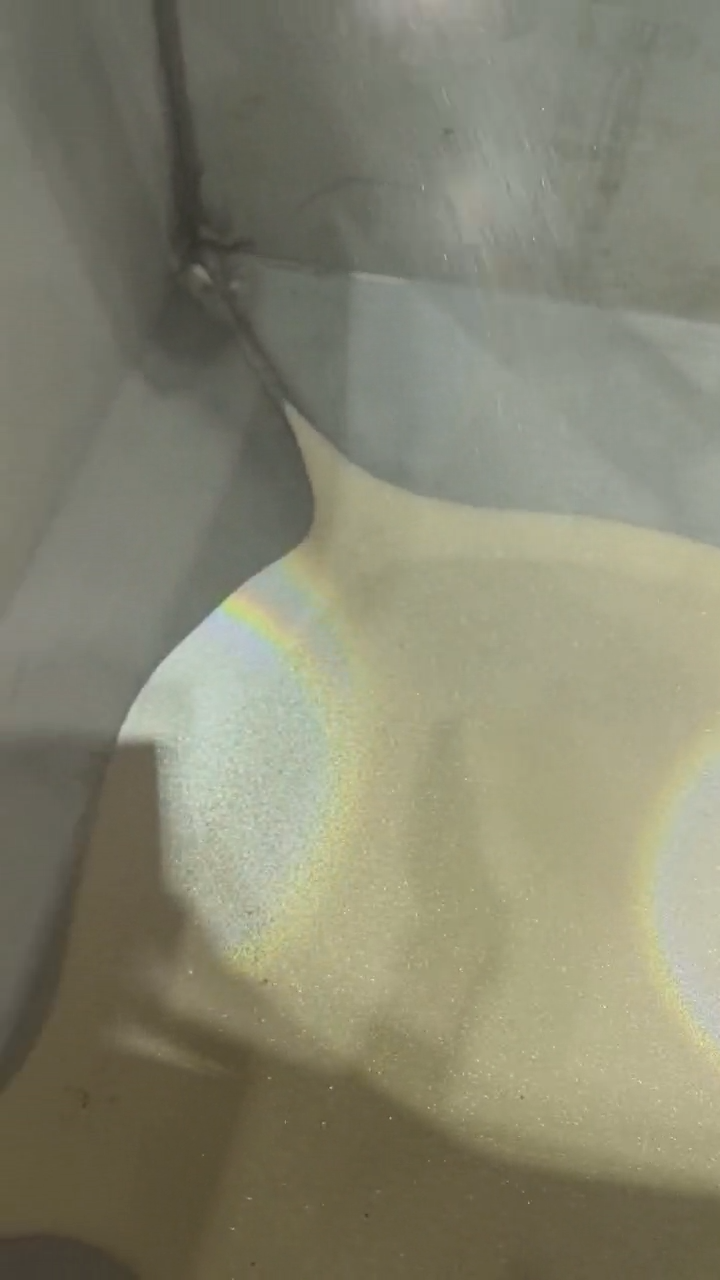
Production control determines whether the recorded scope can be repeated lot after lot.
Market signals shaping acceptance planning in 2026
Two published figures frame the procurement conversation. The global market for road marking glass beads was valued at USD 1.18 billion in 2025, and beads with a refractive index of 1.5 accounted for 54.0% of that value. Most of the volume risk therefore sits in standard-grade material, which is precisely where acceptance discipline tends to slip because the product is treated as a commodity.
The 2026 revision of AASHTO M 247 adds a second signal: specification drift. When a national standard re-cuts its type table, orders written against an older edition keep circulating for months. Suppliers with manufacturing in more than one region, such as SWARCO, which states it has produced reflective beads since 1969 with facilities in Europe, the United States and Saudi Arabia, can absorb a change of this kind more easily than a single-site producer, but no supplier can absorb a purchase order that never named the edition.
Outlook
Acceptance criteria are becoming more documentary rather than less. Buyers are asking for lot-level sieve and refractive index records, material declarations and method references, not only a certificate pack. Standard revisions will keep forcing edition-level precision into purchase orders, and recycled content will keep moving from a marketing point to a declared specification item. The teams that handle this well tend to do one simple thing: they write the standard, the edition, the type, the scope and the evidence requirement into a single clause, and they check the delivery against that clause rather than against a familiar part number.
Dylantech publishes its company profile, product families and contact details at www.dylantech.com. A corporate brochure covering production bases, capacity and certification scope is available for download: Corporate Brochure (PDF).
Есть вопросы или нужны дополнительные детали?
Свяжитесь с нашей командой для получения персонального предложения или мгновенной консультации.
Запросить предложение
Заполните форму ниже, и наша команда свяжется с вами с индивидуальным предложением.
Прямой чат WhatsApp
Предпочитаете общаться в реальном времени? Напишите нам в WhatsApp для мгновенной помощи и быстрых ответов.
- Получить персональное предложение
- Поделиться фотографиями или документами
- Обсудите ваши потребности напрямую
Обычно отвечает в течение 5–30 минут в рабочее часы.