
Acoustic Wall LED Strips: Repeat-Order Supplier Audits
Acoustic wall lighting is usually specified as part of a larger interior system: slat panels, wall finishes, lighting design, and fit-out sequencing. The LED strip inside that system is not a disposable accessory. It is a repeat-order component. A buyer who approves CA-DC24V-2835-180D-8mm-3000K for a luxury residence, a hospitality scheme, or a retail interior expects the same 3000K, 180 LEDs/m, 8 mm PCB, and Ra≥80 result when the next phase is ordered.
That expectation is the practical meaning of supplier sustainability. It is not a brand claim or a sustainability report. For an Acoustic Wall LED Strip Light, supplier sustainability is the ability to reproduce an approved specification, test record, packaging label, and certification file across repeat orders, while keeping lead time and warranty support intact.
XPUP LED, the brand of Zhongshan Xiangpai Lighting Technology Co., Ltd., is a Zhongshan-based LED strip manufacturer established in 2012. Its range includes the CA-DC24V-2835-180D-8mm-3000K, an Acoustic Wall LED Strip Light developed for slat wall panels. This article uses that model as a repeat-order audit example for buyers at the research and evaluation stage.
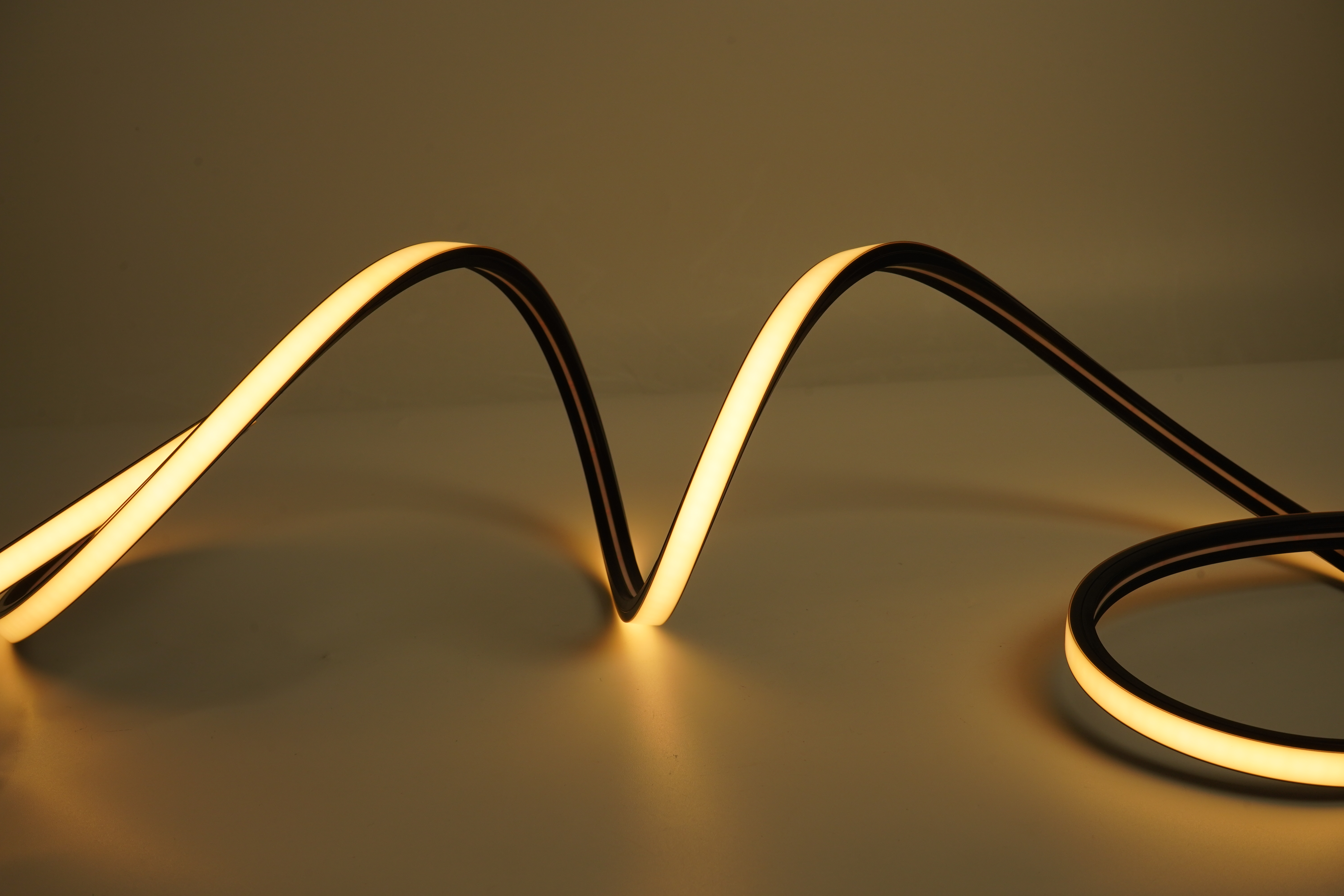
Why a sample match is not a supply guarantee
At sample stage, buyers compare light color, brightness, CRI, PCB width, and price. Those checks are necessary, but they do not answer the repeat-order question: will the same strip arrive in the next production batch, with the same documentation and the same fit?
A supplier can pass a first sample and still create problems at repeat order if the LED bin, PCB supply, label, or packaging changes without notice. The buyer then discovers the difference at installation, when the wall is already closed and the lighting sequence is fixed.
XPUP states that its standardized mass production is organized to maintain consistent color temperature and brightness and to control batch-to-batch color differences. That is a relevant capability claim for acoustic wall projects, but it should be verified through a first-article approval and repeat-order inspection, not accepted as a slogan.
The repeat-order baseline: CA-DC24V-2835-180D-8mm-3000K
The model is a defined specification, not a generic 24V strip. The table below is the baseline a buyer should freeze before the first mass-production order.
| Specification item | Baseline for repeat ordering |
|---|---|
| Product type | Acoustic Wall LED Strip Light |
| Model | CA-DC24V-2835-180D-8mm-3000K |
| SMD | 2835 |
| LED density | 180 LEDs/m |
| Rated voltage | 24V |
| Power | 11W |
| CRI | Ra≥80 |
| Color temperature | 3000K |
| PCB width | 8 mm |
| PCB material | Double-layers copper PCB |
| IP rating | IP20 |
| Strip length | 2.4 m and 3 m per strip |
| Customization | OEM and ODM |
| Material construction | Copper PCB / SMD LED |
| Listed applications | Acoustic panel lighting, luxury residential lighting, wall lighting, lighting design industry, interior fit-out industry, LED wholesalers |
The construction is Copper PCB/SMD LED, with SMD 2835 emitters on a double-layer copper PCB. The rated voltage is 24V, power is 11W, CRI is Ra≥80, color temperature is 3000K, LED density is 180 LEDs per meter, PCB width is 8 mm, ingress protection is IP20, and strip length is 2.4 m and 3 m per strip. OEM and ODM are both listed.
What each specification means at the wall
180 LEDs per meter and 3000K
Density and color temperature are the two visible specifications. At 180 LEDs/m, the strip is intended to create a tight, continuous line of light rather than a visibly dotted effect. At 3000K, the output sits in the warm-white range used in residential, hospitality, and retail interiors. The general market relevance of this range is visible in third-party data: the 3000K-4000K segment held a 33.2% revenue share in the linear LED strip fixture market (Grand View Research).
For acoustic slat walls, that combination matters because the light is often seen at close range. A lower-density strip may be acceptable behind a diffuser, but a visible linear detail needs an even line. The buyer should approve the actual wall mock-up, not just the lumen figure.
11W, 24V, and driver planning
The 24V rating is a low-voltage specification. It requires a compatible driver and does not connect directly to mains voltage. The 11W per meter figure is also a planning input: driver capacity, cable runs, and heat management must be checked against the installed length. The model is not a plug-and-play mains fixture.
This is also where repeat orders fail quietly. If the project uses a different driver batch or a changed cable length, the visible result may shift even when the strip itself matches the approved sample. Acceptance should therefore include the driver schedule, not only the strip.
Ra≥80 and the limits of color rendering
Ra≥80 is a working baseline for interior lighting. It is not a high-CRI specification. XPUP also lists other strip models at Ra≥90 and Ra≥95. A luxury residential or retail project that requires Ra≥90 or Ra≥95 should select one of those models rather than force this Ra≥80 strip into a specification it cannot meet.
For acoustic wall lighting in a hotel or a high-end residence, the difference can be visible in wood, stone, and textile finishes. The buyer should decide the CRI target before the repeat-order audit begins, because changing it later changes the model.
8 mm PCB, double-layer copper, and SMD 2835
The 8 mm PCB width and double-layer copper construction are part of the mechanical and electrical identity of the strip. The SMD 2835 emitter is the specified LED package. A repeat order that changes any of these items is not the same product, even if the color temperature and wattage appear similar.
For the buyer, the practical check is documentary and physical: the approved sample, the specification sheet, the label, and the batch record should all agree on SMD 2835, 180 LEDs/m, 24V, 11W, Ra≥80, 3000K, 8 mm PCB, and double-layer copper PCB.
IP20: indoor dry location only
IP20 is an indoor dry-location rating. It is not a waterproof or outdoor specification. The model is listed for acoustic panel lighting, luxury residential lighting, wall lighting, lighting design, interior fit-out, and LED wholesale. It should not be used in bathrooms, exteriors, façades, or wash-down areas without a different IP-rated product.
This boundary should be written into the acceptance file. If the project changes from a dry feature wall to a wet area, the model is no longer suitable, even if the visual line remains the same.
2.4 m and 3 m strip lengths
The strip is supplied in 2.4 m and 3 m lengths per strip. Those lengths are the repeat-order unit. They affect packaging, handling, connector placement, and spare-part planning. A buyer who approves a 2.4 m length should not assume that a 3 m length will behave identically on site without confirming the driver and installation layout.
13 mm/15 mm slat wall fit and black surface
The model is described as specifically developed for slat wall panels fitted at 13 mm/15 mm. Its black surface blends into the wall, and the strip is flexible to make shapes. That is a fit-driven design, not a universal acoustic panel accessory. The buyer should confirm the slat profile, the groove width, and the black finish against the actual panel sample.
This is also a continuity risk. If the panel supplier changes the groove dimension, the approved strip may still be technically correct but physically wrong for the new wall. The repeat-order audit should link the strip specification to the panel profile.
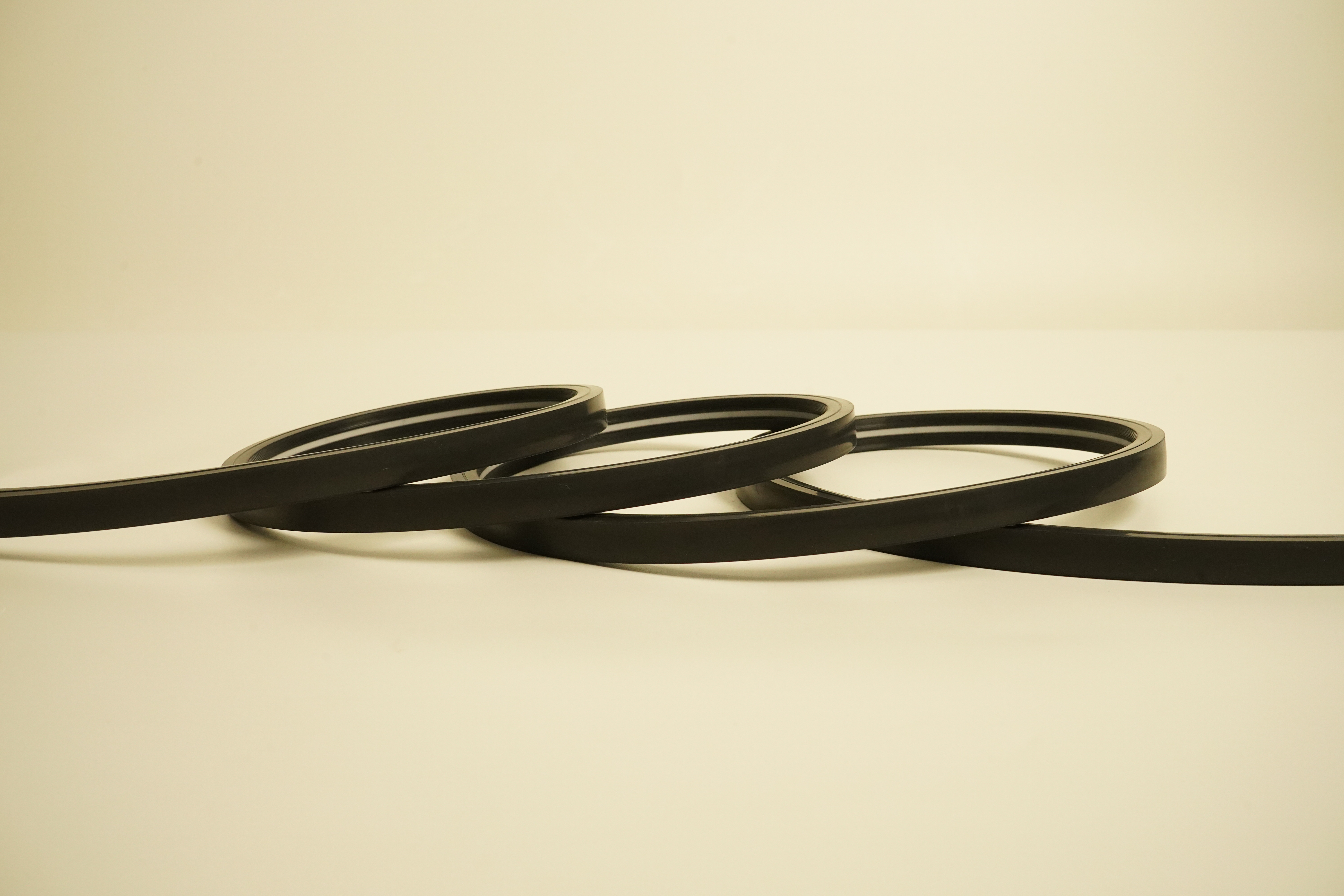
Acceptance criteria for a repeat order
Acceptance should be written against the approved first article, not against a catalogue picture. The following checks are appropriate for this acoustic wall strip.
- First-article approval. Retain a signed golden sample and a specification sheet covering SMD 2835, 180 LEDs/m, 24V, 11W, Ra≥80, 3000K, 8 mm PCB, double-layer copper PCB, IP20, and 2.4 m/3 m strip length.
- Batch color and brightness consistency. Compare each repeat batch against the golden sample under the same viewing conditions. XPUP states that standardized mass production is set up to maintain color temperature and brightness consistency and to control batch-to-batch color differences.
- Electrical verification. Record the measured 24V and 11W values against the approved sample. Confirm the driver schedule and load calculation for the installed length.
- LED count and pitch. Verify 180 LEDs per meter and the SMD 2835 package. A different count changes the visual line and should trigger a new approval.
- PCB and construction check. Confirm the 8 mm PCB width and double-layer copper PCB construction. Check that the received strip matches the approved material construction of Copper PCB/SMD LED.
- Photometric and color check. Confirm Ra≥80 and 3000K against the approved sample. If the project requires Ra≥90 or Ra≥95, this model should not be accepted as a substitute.
- Length and fit check. Verify the 2.4 m and 3 m strip lengths and the 13 mm/15 mm slat wall fit. Check the black surface finish against the panel sample.
- IP20 boundary check. Confirm that the installation location is an indoor dry area. IP20 is not a waterproof rating and should not be approved for wet or outdoor locations.
- Packaging and label check. For OEM and ODM orders, verify the exterior color scheme, outer packaging box, label, brand information, model name, and material details against the approved artwork.
- Certification and traceability file. Keep the CE, LVD, EMC, and RoHS documents with the batch record. The CE certification covers LED low-voltage and high-voltage light strip series and is issued by PTC TESTING for the EU market.
- Test and warranty record. XPUP lists 100% test and a 2-year standard warranty. The buyer should define what is tested, what record is retained, and how a non-conforming batch is handled.
The acceptance file should be short enough to use. A one-page checklist tied to the golden sample is more effective than a long document that nobody opens at goods-in inspection.
Purchasing terms that protect continuity
Commercial terms should be read as continuity tools. For this model, the stated terms are a 2,000-meter MOQ and an 18-22 day lead time. Monthly capacity is 3,000,000 meters, annual output is 35,000,000 meters, and the company reports 100% test and a 2-year standard warranty.
OEM customization covers voltage, logo, power, dimensions, materials, hardware configuration, internal circuit, color, factory specifications, nameplate, and label. ODM customization covers exterior color scheme, outer packaging box, label, brand information, model name, and material details. After-sales support includes online remote support and general technical guidance for ODM, and dedicated technical support, remote debugging, customized parameter guidance, and a 2-year warranty for OEM.
For repeat orders, buyers should add the following terms to the purchase file:
- Specification freeze. The approved CA-DC24V-2835-180D-8mm-3000K specification, including SMD 2835, 180 LEDs/m, 24V, 11W, Ra≥80, 3000K, 8 mm PCB, double-layer copper PCB, IP20, and 2.4 m/3 m strip lengths, should be frozen in writing.
- Golden sample retention. Both buyer and supplier should retain a signed sample from the approved first article.
- Change notification. Any change to LED package, PCB, label, packaging, or driver recommendation should require written approval before shipment.
- Batch traceability. Each repeat shipment should carry a batch reference that links to the test record and the approved specification.
- Warranty statement. The 2-year standard warranty should be written into the order, with the after-sales route stated for OEM and ODM supply.
- Lead-time planning. The 18-22 day lead time should be treated as a production input. For urgent small replacement needs, the 2,000-meter MOQ may not fit, so stock or distributor support should be confirmed separately.
Supplier continuity checks beyond the datasheet
A datasheet describes a product. A continuity check describes the organization behind it. XPUP was established in 2012, operates a 10,000 m² factory, employs 80 people, and has 6 engineers in its R&D team. It reports annual output of 35,000,000 meters, monthly capacity of 3,000,000 meters, a 50% export ratio, and main markets in the EU and USA. Products are exported to more than 170 countries and regions. The LED strip series is CE and RoHS certified, with certification issued by PTC TESTING for the EU market.
Two case records are relevant to acoustic wall and repeat-order continuity. A U.S. lighting brand has received ODM LED strip solutions for three years at 300,000 meters per year for private-label retail and project supply. A home decoration distributor in Germany and Italy has used acoustic panel LED strips in premium residential projects for three years at 20,000 meters per year. These are long-term supply examples, not proof that every future order will be identical; they show the type of continuity record a buyer can ask to review.
Certification continuity is part of the same audit. The CE certification covers LED low-voltage and high-voltage light strip series. The EMC file references EN IEC 55015:2019+A11:2020, EN 61547:2009, EN IEC 61000-3-2:2019+A1:2021, and EN 61000-3-3:2013+A1:2019. The LVD file references EN IEC 62031:2020+A11:2021, IEC TR 62778:2014, and EN 62471:2008. The RoHS file references IEC 62321 series standards. Certificate numbers and issuing authority should be kept with the repeat-order file.
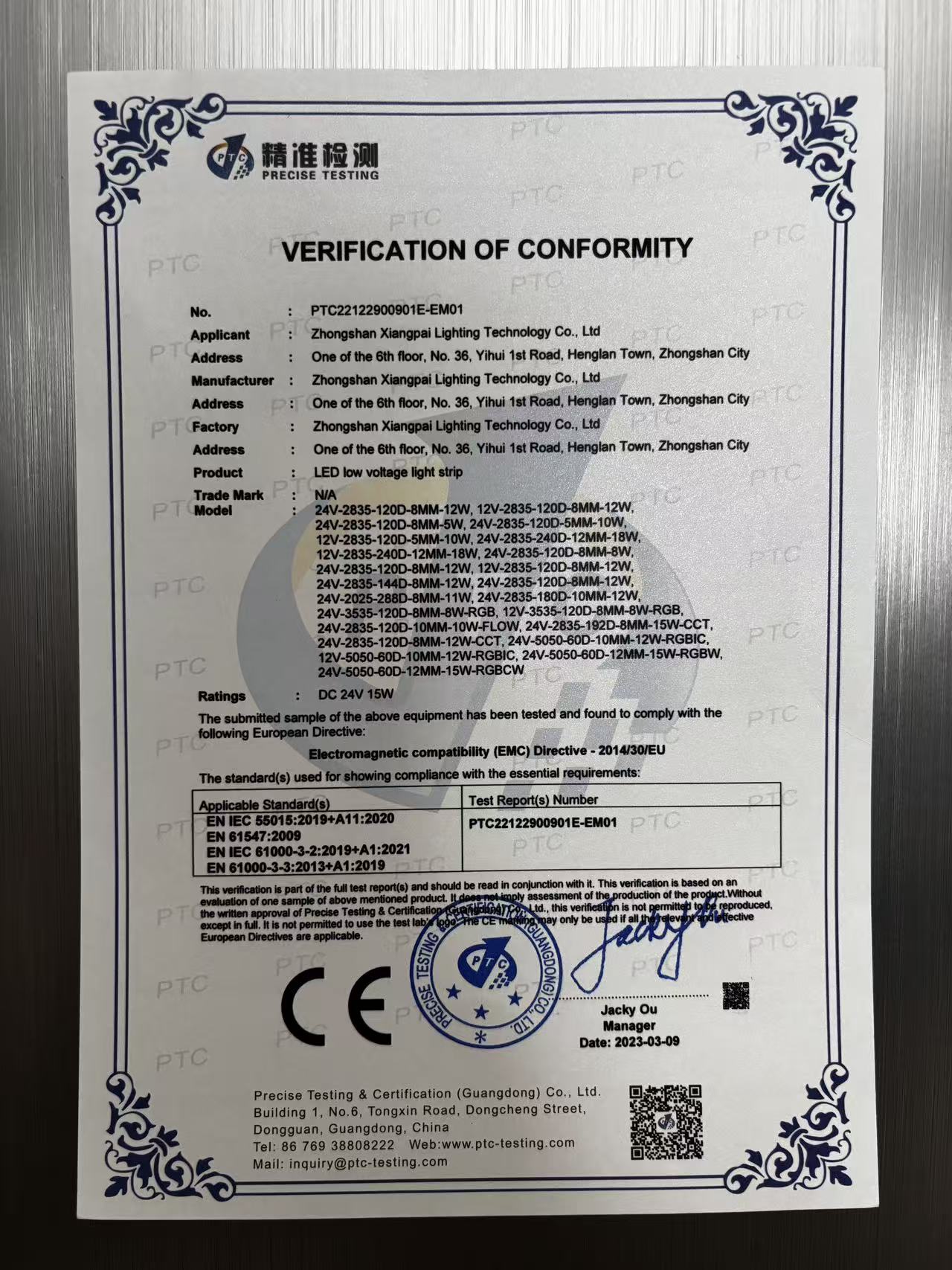
Application fit: acoustic wall, wall lighting, luxury residential, and commercial interiors
The model is listed for acoustic panel lighting, luxury residential lighting, wall lighting, the lighting design industry, the interior fit-out industry, and LED wholesalers. In commercial, hospitality, and retail interiors, acoustic slat walls are often used to control sound and create a linear visual rhythm. The lighting detail must support that rhythm without becoming a maintenance issue.
For a lighting designer, the 180 LEDs/m density and 3000K color temperature provide a continuous warm line. For an interior fit-out contractor, the 2.4 m and 3 m strip lengths and the 13 mm/15 mm slat fitment matter more than catalogue aesthetics. For an LED wholesaler, the repeat-order question is whether the same model can be supplied with the same label and packaging across projects. For a luxury residential buyer, the black surface blending into the wall and the flexible shaping are the visible benefits.
Commercial and hospitality projects can be less forgiving. If the specification requires Ra≥90 or Ra≥95, this Ra≥80 model is not the correct choice. If the wall is wet, outdoor, or subject to cleaning with water, IP20 is not appropriate. Those are not defects; they are selection boundaries.
Where the specification stops
A credible supplier evaluation includes limits. For CA-DC24V-2835-180D-8mm-3000K, the main boundaries are:
- IP20 is not waterproof. It is an indoor dry-location rating. Wet rooms, exteriors, façades, and wash-down areas require a different IP-rated product.
- 24V requires a compatible driver. The strip is not a mains-voltage fixture. Driver selection, placement, and load planning are part of the installation design.
- 11W/m and 180 LEDs/m need thermal and electrical planning. The buyer should confirm driver sizing and installation conditions with the supplier rather than treating the strip as a plug-and-play item.
- The fit is specific, not universal. The model is developed for slat wall panels fitted at 13 mm/15 mm. It is not a general retrofit strip for every acoustic panel profile.
- Ra≥80 is a baseline. Projects that require Ra≥90 or Ra≥95 should move to a higher-CRI model in the range.
- MOQ and lead time affect small repeat needs. The stated MOQ is 2,000 meters and lead time is 18-22 days. Buyers with urgent small replacement quantities should confirm stock or distributor support instead of assuming a short-run exception.
These limits are useful in procurement because they prevent a technically correct strip from being used in the wrong environment. They also make the repeat-order audit more honest: the buyer is not asking whether the product is universally suitable, but whether it is suitable for the specified wall, driver, and project phase.
Market trend: why continuity is becoming a procurement issue
The global LED strip market was valued at approximately USD 5.8 billion in 2025 and is projected to reach USD 13.2 billion by 2034, growing at a CAGR of 9.6% (Dataintelo). That growth does not make every strip interchangeable. It makes specification discipline more valuable, because more projects will involve repeat phases and replacement cycles.
Several verified data points support the relevance of this model. The 24V LED segment accounted for 52.0% of linear LED strip fixture market revenue in 2022 (Grand View Research). The 3000K-4000K color temperature segment held a 33.2% revenue share in the same market (Grand View Research). High-density variants above 120 LEDs/m account for nearly 19% of premium installations (Business Research Insights; medium reliability). Commercial applications contribute about 33.8% of global LED strip revenues (Dataintelo). Quality LED strips typically have an average lifespan of 30,000 to 50,000 hours (Business Research Insights).
Standards and compliance add another layer. IEC 60598-2-20:2022 specifies safety requirements for lighting chains including LED strips. In the United States, low-voltage LED strips at 12V/24V are classified under UL 2108. In the EU, Ecodesign and ErP requirements are part of the policy direction toward efficient LED systems. For a buyer, these are reasons to keep certification files and acceptance records with the repeat-order specification, not in a separate folder that is lost after the first shipment.
Future outlook
As the LED strip category expands from USD 5.8 billion in 2025 toward a projected USD 13.2 billion by 2034, the suppliers that remain useful to acoustic wall projects will be those that can reproduce a specification, not just quote a price. The CA-DC24V-2835-180D-8mm-3000K is a narrow example: 24V, 11W, Ra≥80, 3000K, 180 LEDs/m, 8 mm PCB, IP20, 2.4 m and 3 m strip lengths. Its repeat-order value depends on batch consistency, packaging control, certification continuity, and after-sales support.
XPUP’s 2-year standard warranty, 18-22 day lead time, 3,000,000-meter monthly capacity, and 100% test claim are the kind of terms that should be written into a supply agreement. They do not remove the need for inspection, but they give the buyer a framework for asking the right questions at the evaluation stage.
The practical next step is a documented repeat-order audit: approved sample, frozen specification, batch record, certification file, and a clear list of exclusions. That is a more durable buying decision than a one-time price comparison.
FAQ
What is the CA-DC24V-2835-180D-8mm-3000K?
It is an Acoustic Wall LED Strip Light with a 24V rated voltage, 11W power, Ra≥80 CRI, 3000K color temperature, 180 LEDs/m, 8 mm PCB, double-layer copper PCB, IP20 rating, SMD 2835 emitters, and 2.4 m and 3 m strip lengths. It is listed for acoustic panel lighting, luxury residential lighting, wall lighting, lighting design, interior fit-out, and LED wholesale applications, with OEM and ODM available.
Which specifications should be re-checked on every repeat order?
Re-check SMD 2835, 180 LEDs/m, 24V, 11W, Ra≥80, 3000K, 8 mm PCB, double-layer copper PCB, IP20, and the 2.4 m/3 m strip length against the approved first article. Also verify the label, packaging, and material construction of Copper PCB/SMD LED. If any of these items changes, the order should be treated as a new approval rather than a repeat order.
What acceptance criteria matter most for acoustic wall LED strips?
The first priority is a signed golden sample and a frozen specification. The second is batch consistency in color temperature and brightness, supported by XPUP’s stated standardized production controls. The third is the electrical check for 24V and 11W, followed by the 180 LEDs/m count, 8 mm PCB, double-layer copper construction, Ra≥80, 3000K, and the 13 mm/15 mm slat wall fit. Packaging and label checks apply to OEM and ODM orders, and the CE, LVD, EMC, and RoHS files should be retained with the batch record.
What purchasing terms support long-term supply continuity?
XPUP lists a 2,000-meter MOQ, an 18-22 day lead time, 3,000,000-meter monthly capacity, 35,000,000-meter annual output, 100% test, and a 2-year standard warranty. OEM and ODM customization are available, with after-sales support that includes online remote support, general technical guidance, dedicated technical support, remote debugging, and customized parameter guidance depending on the supply mode. Buyers should add a written specification freeze, golden sample retention, change notification, and batch traceability to these terms.
What are the limits of this 24V IP20 acoustic wall strip?
IP20 is an indoor dry-location rating, so the strip is not suitable for wet rooms, exteriors, façades, or wash-down areas. The 24V design requires a compatible driver and does not connect directly to mains voltage. The 11W/m power and 180 LEDs/m density require driver and thermal planning. The 13 mm/15 mm slat fitment is specific rather than universal. Ra≥80 is a baseline, so projects requiring Ra≥90 or Ra≥95 need a different model. The 2,000-meter MOQ and 18-22 day lead time also limit urgent small replacement orders.
How can buyers evaluate supplier sustainability beyond price?
Look for reproducible specifications, batch records, certification continuity, and after-sales support. XPUP was established in 2012, operates a 10,000 m² factory, employs 80 people, has 6 engineers, reports 35,000,000 meters of annual output and 3,000,000 meters of monthly capacity, and exports to more than 170 countries and regions, with main markets in the EU and USA. Its LED strip series is CE and RoHS certified through PTC TESTING. Case records include a U.S. lighting brand supplied with ODM LED strips for three years at 300,000 meters per year and a Germany/Italy home decoration distributor using acoustic panel LED strips for three years at 20,000 meters per year.
Reference: XPUP LED Strip Catalog (PDF) — download the catalog.
Есть вопросы или нужны дополнительные детали?
Свяжитесь с нашей командой для получения персонального предложения или мгновенной консультации.
Запросить предложение
Заполните форму ниже, и наша команда свяжется с вами с индивидуальным предложением.
Прямой чат WhatsApp
Предпочитаете общаться в реальном времени? Напишите нам в WhatsApp для мгновенной помощи и быстрых ответов.
- Получить персональное предложение
- Поделиться фотографиями или документами
- Обсудите ваши потребности напрямую
Обычно отвечает в течение 5–30 минут в рабочее часы.