
Acoustic Wall Panels: Choosing LED Strips for Linear Glow
Acoustic wall panels and linear LED lighting have converged into a single specification problem. When a wall is assembled from acoustic modules, the light line is not an accessory fitted afterwards — it runs inside a channel formed by the panel itself. That makes every property of the strip a constraint: LED density decides whether the line reads as continuous light or as a row of visible dots; voltage decides how the strip can be fed inside a cavity that is difficult to reopen; colour temperature decides whether the glow feels warm or clinical against a textured surface; and compliance evidence decides whether the finished wall can be placed on the market it is sold into.
This reference examines those constraints through one configuration built for the task — the Acoustic Wall LED Strip Light model CA-DC24V-2835-180D-8mm-3000K — and sets out its parameters, the compliance record behind the LED strip series, the application boundaries, and the ordering questions that should be settled before a panel design is frozen.
XPUP LED is the brand of Zhongshan Xiangpai (XPUP) Lighting Technology Co., Ltd., an LED strip manufacturer established in 2012 in Zhongshan City, Guangdong Province, China, operating a 10,000 m² factory with LED strip lighting as its main product line and export markets concentrated in the EU and USA.
Why Acoustic Panels Change the Lighting Brief
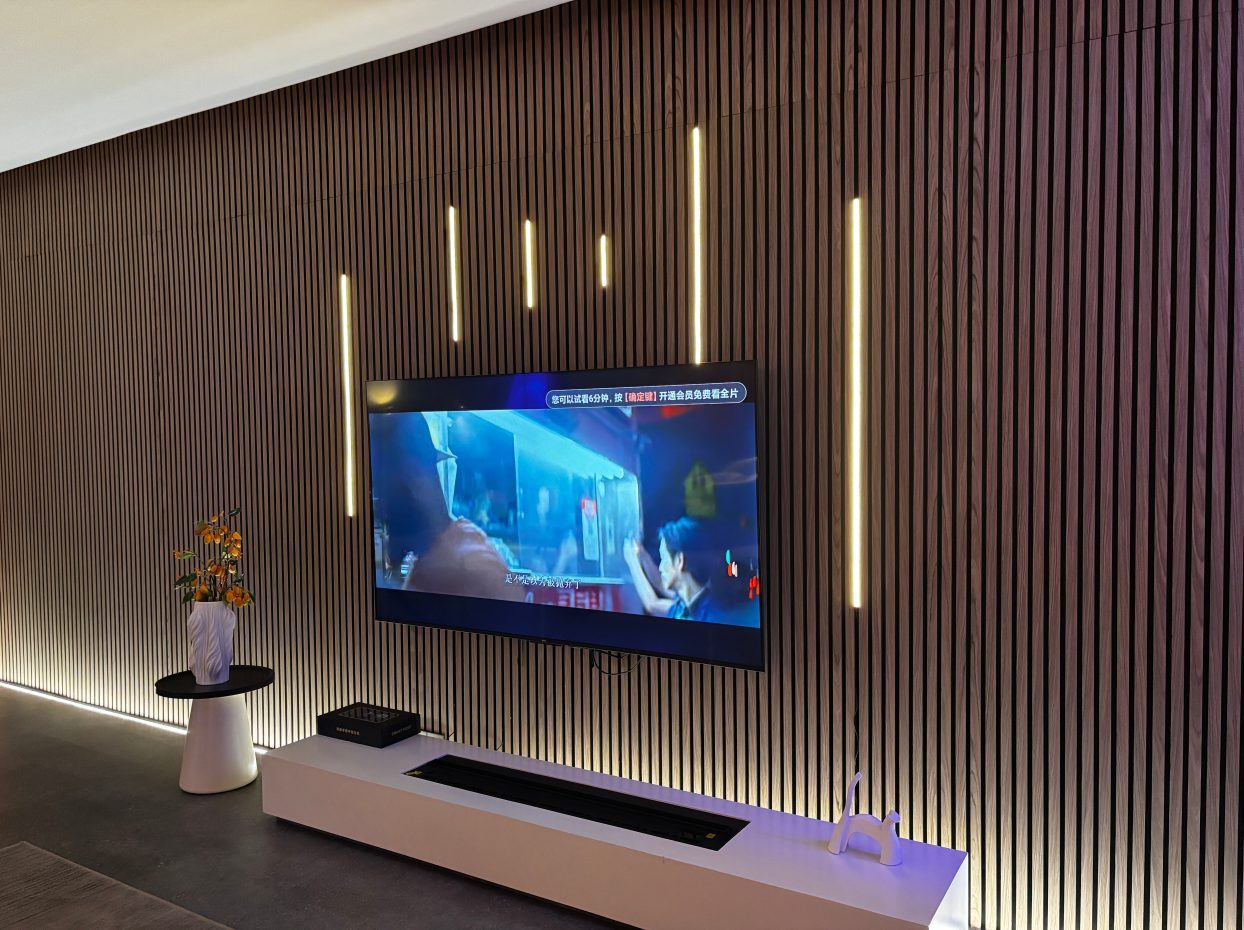
Acoustic treatment has moved from a technical add-on to a visible design element in residential and commercial interiors. Fabric-wrapped, felt and slatted panel systems are now specified as wall surfaces in their own right, and lighting is expected to sit inside them rather than in front of them. That produces a brief with three unusual characteristics.
- The diffuser is usually shallow. Panel depth is committed to acoustic performance and to the mounting structure, so the distance between the LED and the diffuser is often much smaller than in a purpose-built linear fixture. A short diffuser distance is what makes LED pitch visible.
- The light is ambient, not functional. In the recorded application profile for acoustic wall panel integration, the intended function is ambient lighting operating on a 12/7 cycle, with smart lighting control systems, LED controllers or smart controllers listed as matched equipment, and light colour and size customization recorded as the special requirement.
- The strip is difficult to service. Once panels are fixed, access to the strip and to its wiring is limited. Reliability, joint planning and driver location matter more than they do in an open ceiling or a surface-mounted profile.
Traditional low-density strips were designed for a different problem. In a deep aluminium profile with a high-transmission diffuser, an LED placed every 8 to 10 mm is invisible to the eye. In a shallow panel groove with a thin diffuser, the same strip shows its structure. The pixelation complaint is therefore not about brightness — it is about pitch measured against diffuser distance.
The 180 LEDs/m Answer: Density, Pitch and a Continuous Line
The acoustic wall configuration addresses the shallow-diffuser case by increasing LED count rather than power. At 180 LEDs per meter, an emitter is placed approximately every 5.6 mm along the board — close enough that a thin diffuser blends neighbouring emitters into a single line instead of resolving them as separate points.
The complete parameter set recorded for the model is set out below.
| Parameter | Recorded specification |
|---|---|
| Model | CA-DC24V-2835-180D-8mm-3000K |
| Product type | Acoustic Wall LED Strip Light |
| Rated voltage | 24V |
| Power | 11W |
| LED density | 180 LEDs per meter |
| LED type | SMD 2835 |
| Colour temperature | 3000K |
| CRI | Ra≥80 |
| PCB width | 8mm |
| PCB material | Double-layers copper PCB |
| Ingress protection | IP20 |
| Strip length | 2.4 m and 3 m per strip |
| Customization | OEM & ODM |
Density is not a universal specification, and the wider range shows where the alternatives sit. XP-BD15DC24V-2835-120D-5MM runs at 120 LEDs per meter on a 5 mm board, and the flexible B7-DC24V-2835-180D-10MM applies the same 180 LEDs per meter density to a 10 mm PCB. The acoustic model pairs that density with an 8 mm board and a fixed 3000K emitter.
Market data suggests density is bought when geometry demands it. High-density LED strip variants above 120 LEDs per meter accounted for nearly 19% of premium installations in 2025, according to Business Research Insights — a minority share consistent with density being a targeted specification rather than a default one.
Higher density also raises the manufacturing burden: more components, more solder joints and more inspection per metre. That is one reason a dense configuration has to be justified by the diffuser geometry rather than adopted across an entire project. In the recorded production flow for this range, every unit passes 100% test before packing, and monthly capacity is stated at 3,000,000 meters.
Why 24V DC Is the Default Inside a Panel Cavity
Voltage is the second constraint. The 24V LED segment accounted for 52.0% of linear LED strip fixture market revenue in 2022, according to Grand View Research — the dominant choice across the linear strip category, and the choice recorded for the acoustic wall model.
Inside a panel cavity, three practical considerations support that convention.
- Low-voltage circuitry inside a void. A 24V DC circuit is a low-voltage circuit. Where the strip and its wiring sit inside a closed panel cavity, working at low voltage removes mains-level hazard from the interior of the wall, which simplifies inspection and the way installers are able to work.
- Driver placement is a design decision. The strip requires an external power supply. In panel systems the driver is normally located remotely in an accessible service position, so it can be replaced without dismantling the wall.
- Board construction supports distribution. The acoustic wall model uses a double-layers copper PCB, which is the board construction recorded across the range for current distribution along an 8 mm strip.
The trade-off is explicit: a 24V strip cannot be connected directly to mains, so the driver, its capacity and its location all become part of the wall design. The application conditions for this scenario state that a proper power supply or adapter must be used to avoid overload. The portfolio also includes a 220V outdoor-type strip, XP-CH2AC220V-2025-240D-8MM, intended for landscape, garden and bridge lighting; it addresses a different environment and does not replace a low-voltage interior specification.
Colour Temperature, CRI and the Warm Textural Glow
The acoustic wall model is fixed at 3000K with a CRI of Ra≥80. That combination is the conventional starting point for wall-integrated ambient light in residential interiors: warm enough to be read as texture on the panel surface rather than as a lighting installation. The 3000K–4000K segment held a 33.2% revenue share of the linear LED strip fixture market in 2022, per Grand View Research, which indicates how much of the linear category is specified inside that band.
This is also where the clearest limitation sits. The acoustic wall strip is a single colour temperature product. If a project requires tunable white — a warm evening setting moving to a neutral daytime setting, or a higher CRI for artwork and premium finishes — the 180 LEDs/m, 3000K acoustic configuration is not the right vehicle.
The range covers that requirement elsewhere. XP-D11DC24V-2835-120D-8MM is a tunable white strip spanning 2700K to 6000K at Ra≥95 with 120 LEDs per meter, and XP-D4DC24V-2835-192D-8MM is a tunable strip at 192 LEDs per meter with Ra≥95 across 2700K–6500K. On a wider 6060 emitter, XP-C13 DC24V-6060-48D-10MM offers Ra≥90 with an IP65 rating for display cabinet and architectural lighting scenarios.
Stating that trade-off honestly is more useful than presenting a single model as universally suitable. Tunable output is achieved by fitting more than one emission colour into the same footprint, which changes board and driver design. The acoustic wall model instead commits its board area to a single 3000K emitter at high count. Buyers should decide whether the wall needs a continuous warm line or a controllable one before comparing configurations.
What the Compliance Record Shows
For wall-integrated products, certification is not documentation that arrives after the order. It is part of the buyer evaluation file. For this LED strip series, the compliance record is complete and attributable.
The LED strip light series carries CE certification issued by PTC TESTING for the EU market, with the recorded scope covering the LED low-voltage and high-voltage light strip series. The certification file covers Low Voltage Directive, EMC and RoHS scope.
| Certification | Certificate numbers | Applicable standards recorded | Market |
|---|---|---|---|
| CE – LVD | PTC22122900901S-LD01; PTC22122900902S-LD01 | EN IEC 62031:2020 + A11:2021; IEC TR 62778:2014; EN 62471:2008 | EU |
| CE – EMC | PTC22122900901E-EMB01; PTC22122900902E-EMB01 | EN IEC 55015:2019+A11:2020; EN 61547:2009; EN IEC 61000-3-2:2019+A1:2021; EN 61000-3-3:2013+A1:2019 | EU |
| RoHS | PTC22122900903C-EN01; PTC22122900905C-EN01 | IEC 62321-1:2013; IEC 62321-2:2021; IEC 62321-3-1:2013; IEC 62321-3-2:2013; IEC 62321-4:2013+AMD1:2017; IEC 62321-5:2013; IEC 62321-6:2015; IEC 62321-7-1:2015; IEC 62321-7-2:2017; IEC 62321-8:2017 | EU |
Two frameworks outside the EU file are commonly referenced in project specifications for low-voltage strips. UL 2108 is the safety standard under which 12V and 24V low-voltage LED strips are classified in the United States, and IEC 60598-2-20:2022 specifies safety requirements for lighting chains, including LED strips. On the energy side, European Commission material links EU energy efficiency requirements, including the Ecodesign framework, to the continuing shift toward LED-based lighting systems.
For a buyer, the practical reading is straightforward. The certification numbers can be matched to the model and to the destination market before a panel design is approved, and because the recorded scope covers the light strip series rather than a single item, catalogue-level compliance can be checked once rather than SKU by SKU.
Where This Configuration Fits
Acoustic wall panel integration. The recorded application profile places the strip with acoustic wall panel manufacturers and the interior and architectural lighting sector, across global and US projects, functioning as ambient lighting on a 12/7 operating pattern and matched with smart control, LED controller or smart controller equipment.
Premium residential and interior fit-out. A home decoration distributor programme covering Germany and Italy supplied 20,000 meters per year over three years, applying RGB LED strip lights and acoustic panel LED strips in premium residential projects and highlighting precision customization and acoustic panel lighting as the defining requirements. The acoustic wall model is recorded for luxury residential lighting, wall lighting, lighting design and interior fit-out industries, and for LED wholesalers.
Private-label and project supply. A three-year programme with a US lighting brand covered 300,000 meters per year for private-label retail and project supply, including product specification, colour parameters, certification requirements and packaging customization — the pattern typical of ODM supply into a branded catalogue.
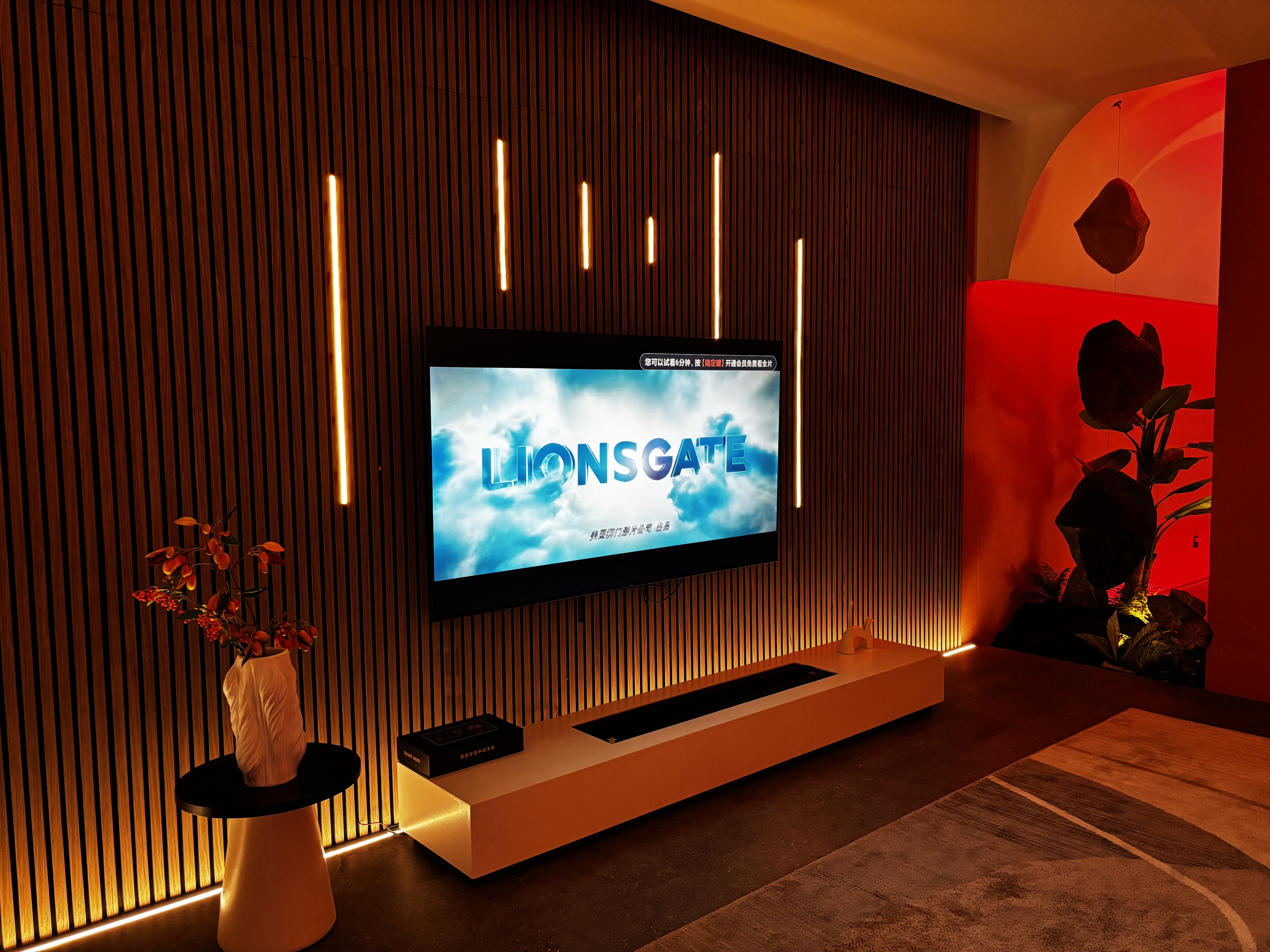
Strip length is a practical constraint that deserves attention early. The acoustic wall strip is supplied at 2.4 m and 3 m per strip, which matches common panel module dimensions. Any wall longer than the supplied length requires a planned joint or a re-feed point, and those joints should not fall in the middle of a run the eye follows continuously.
Market Signals Behind Wall-Integrated LED Strips
The global LED strip market was valued at approximately USD 5.8 billion in 2025 and is projected to reach USD 13.2 billion by 2034, growing at a CAGR of 9.6%, according to Dataintelo. Within that category, flexible LED strips represent the largest product type with a 67.4% share as of 2025, and commercial applications contribute approximately 33.8% of global revenues, per the same source.
Regional growth is skewed toward the specification-driven end of the market. Grand View Research identifies Europe as the fastest-growing regional market for linear LED strip fixtures, at a CAGR of 12.6%, while Business Research Insights estimates that over 65% of new architectural lighting installations in 2025 use LED strip technology.
Two operating characteristics explain why this matters for a wall that is difficult to reopen. Average lifespan of quality LED strips ranges between 30,000 and 50,000 hours, and LED strips consume nearly 70% less power than traditional incandescent lighting systems, according to Business Research Insights. In a panel cavity where service access is limited, service life and thermal load are not secondary considerations.
Compared With Other Wall-Lighting Approaches
Three approaches are commonly used to place light on an acoustic wall, and each imposes a different set of constraints on the panel design.
- Recessed rigid linear fixtures. Rigid aluminium fixtures provide predictable thermal behaviour and, in deep profiles, effectively hide LED pitch. Their limitation is dimensional: the panel must be redesigned around the fixture body, and changes to module size usually mean changes to the fixture specification.
- Standard-density flexible strip in a deep diffuser. This is the lowest-complexity route and works where a deep channel is available. Its limitation is geometric: in a shallow groove, low-density striping is visible as individual points regardless of output level.
- High-density low-voltage strip inside the panel groove.
Boundaries recorded for this configuration:
- IP20 — dry indoor use only. The model carries an IP20 ingress protection rating, which indicates it is not waterproof. It is not suitable for bathrooms, exterior walls or any location subject to condensation or direct moisture.
- Single colour temperature. Output is fixed at 3000K. Projects requiring tunable white or a CRI above Ra≥80 need a different model in the range.
- External driver required. The strip operates on 24V DC and depends on a separate power supply. Driver capacity, location and accessibility must be resolved inside the wall design.
- Fixed strip lengths. Units are supplied at 2.4 m and 3 m per strip, so longer runs require planned joints or re-feeding points.
- Environmental and installation conditions. The recorded operating temperature range is -20°C to +45°C. The strip must not be covered with objects, must be kept away from chemically corrosive environments, and must be connected to a proper power supply or adapter to avoid overload.
- Panel tolerance dependency. Because the strip sits in a groove formed by the panel, the final visual result depends on the panel manufacturer holding the channel geometry and diffuser distance within tolerance.
What to Expect Next
Two directions are converging on the same wall surface. On the lighting side, control is becoming standard rather than optional: wired smart LED lighting systems held 81.3% of the global smart lighting market share in 2024, according to Grand View Research, and Business Research Insights places adoption of Wi-Fi and Bluetooth integration in LED strip systems at 47% in 2025. Wired dominance is notable for wall integration, because a hard-wired control path is easier to guarantee than a wireless one inside a closed cavity.
On the interior side, acoustic panels continue to absorb the lighting layer. As that convergence continues, the specification question shifts from which fixture to mount on a wall to which strip can survive inside it — a question answered by density, voltage, colour behaviour, environmental limits and certification rather than by appearance alone.
FAQ
How many LEDs per meter are needed to avoid visible dots behind an acoustic panel diffuser?
There is no single threshold, because visibility depends on diffuser distance and diffuser material. The acoustic wall configuration in this range uses 180 LEDs per meter on an 8 mm PCB, which places an emitter approximately every 5.6 mm. Lower-density references in the same range include XP-BD15DC24V-2835-120D-5MM at 120 LEDs per meter. As a rule, the shallower the diffuser, the higher the density required to produce a visually continuous line.
Why do acoustic wall strip specifications use 24V DC rather than mains voltage?
Low-voltage DC keeps mains-level circuitry out of a closed panel cavity, which is relevant for safe installation and inspection. It also means the strip requires an external 24V power supply located in an accessible position, so the driver can be serviced without dismantling the wall. In the linear LED strip fixture market, the 24V segment accounted for 52.0% of revenue in 2022, according to Grand View Research.
Is an IP20 acoustic wall LED strip suitable for bathrooms, kitchens or exterior walls?
No. The acoustic wall model carries an IP20 rating, which indicates it is not waterproof, and it is intended for dry indoor environments. For moisture-exposed or outdoor positions, the range includes silicone and waterproof constructions with higher IP ratings, such as XP-C5DC24V-2835-120D-8MM at IP68 and XP-C818DC24V-2835-120D-8MM at IP68.
Which certifications should an EU buyer verify for wall-integrated LED strips?
At minimum, the CE file covering Low Voltage Directive, EMC and RoHS scope, together with the certificate numbers and the standards against which the product was assessed. For this LED strip series, CE certification is issued by PTC TESTING for the EU market, with recorded standards including EN IEC 62031:2020 + A11:2021, EN 62471:2008, IEC TR 62778:2014 for LVD scope, EN IEC 55015:2019+A11:2020, EN 61547:2009, EN IEC 61000-3-2:2019+A1:2021 and EN 61000-3-3:2013+A1:2019 for EMC scope, and the IEC 62321 series for RoHS. For US-bound projects, UL 2108 is the standard under which 12V and 24V low-voltage LED strips are classified.
Can the 3000K acoustic wall strip be supplied in other colour temperatures or lengths?
The acoustic wall model is recorded as a fixed 3000K product, with OEM and ODM customization available on the platform. Strip lengths are recorded at 2.4 m and 3 m per strip. Where a different colour temperature or tunable white is required as a standard product rather than a customization, the range offers separate models — XP-D11DC24V-2835-120D-8MM spans 2700K to 6000K at Ra≥95 with 120 LEDs per meter, and XP-D4DC24V-2835-192D-8MM spans 2700K to 6500K at Ra≥95 with 192 LEDs per meter.
What ordering constraints apply to this LED strip series?
Recorded commercial parameters for OEM and ODM production are a minimum order quantity of 2,000 meters, a lead time of 18–22 days, and a monthly capacity of 3,000,000 meters. Every unit passes 100% test, and the recorded after-sales terms include online remote support, general technical guidance and a 2-year standard warranty, with dedicated technical support and remote debugging on OEM programmes.
How does CRI affect the appearance of light on a textured panel surface?
CRI describes how faithfully colours are rendered under the light source. The acoustic wall model is recorded at Ra≥80. Other models in the same range reach higher values — for example XP-D11DC24V-2835-120D-8MM and XP-D4DC24V-2835-192D-8MM at Ra≥95, and XP-BD18DC24V-2835-140D-8MM at Ra≥97. Higher CRI is generally relevant where the illuminated surface has a pronounced or coloured texture and where accurate material rendering matters, or where the wall lighting forms part of a defined lighting design concept.
What installation conditions must be respected inside a panel cavity?
The recorded working conditions for this application specify an operating temperature range of -20°C to +45°C, that the strip must not be covered with objects, that it must be kept away from chemically corrosive environments, and that a proper power supply or adapter must be used to avoid overload. Because the strip sits inside a closed panel, thermal clearance and driver sizing should be confirmed before the wall is closed.
The 2026 XPUP LED Strip Catalog, covering the acoustic wall series and the wider linear strip range, is available for reference and download: 2026 XPUP LED Strip Catalog (PDF).