
Action Camera CE & FCC Compliance: Regulatory Paths for X20, Q1, Q2, Q3, and Q7
Action Camera CE & FCC Compliance: Regulatory Paths for X20, Q1, Q2, Q3, and Q7
For a WiFi-enabled action camera, “is it certified?” is the wrong first question. The useful question is narrower: which model, under which certificate number, for which market, and against which test standard?
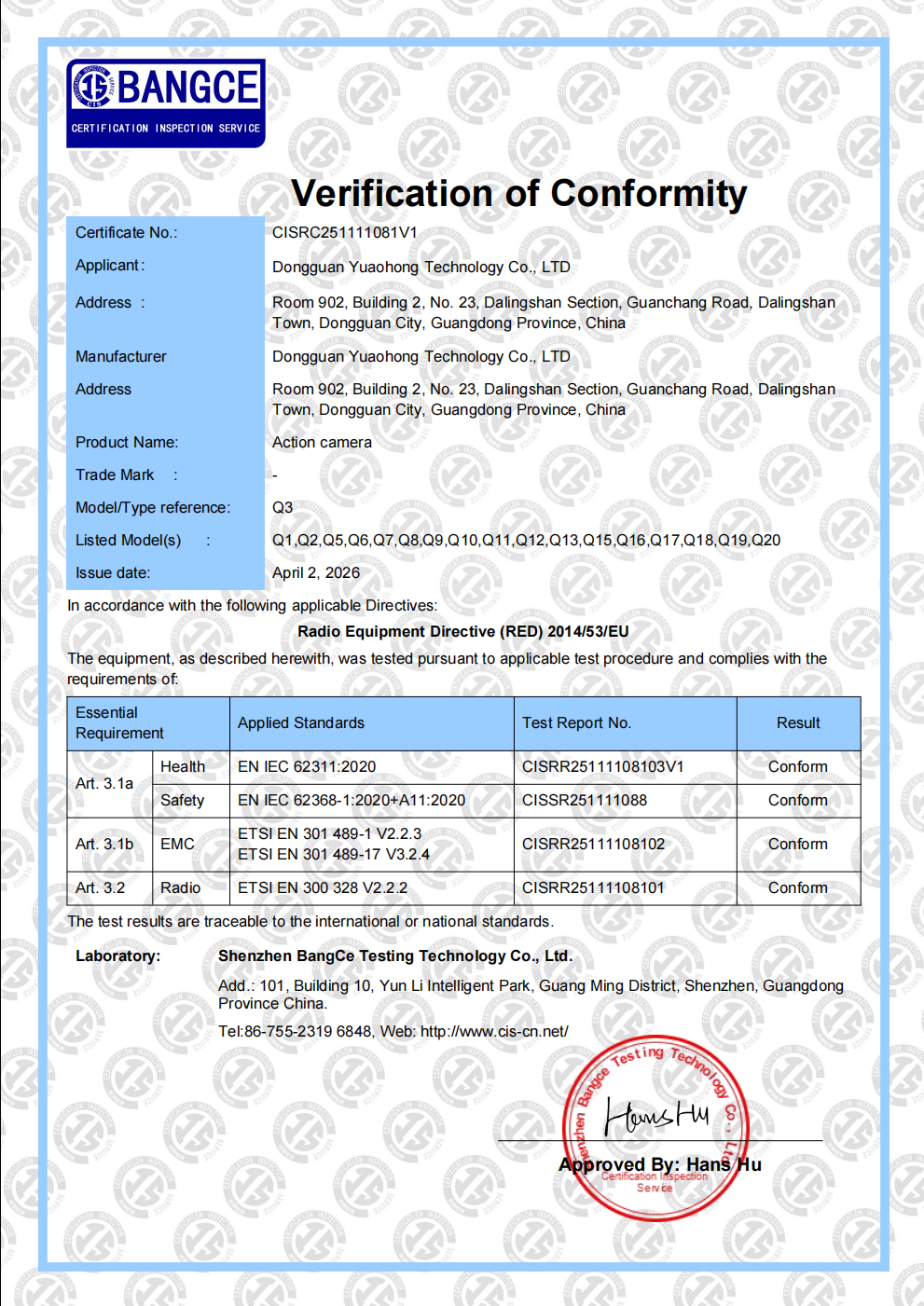
Radio compliance is scoped by function, not by image quality. An action camera that transmits over WiFi carries a 2.4 GHz wideband transmitter, and in the European Union that function is assessed against ETSI EN 300 328 V2.2.2 — the standard cited in the CE documentation held for the action camera models covered in this reference. In the United States, the same transmitter is handled through the FCC route, where the documented set references both 47 CFR Part 15, Subpart C and 47 CFR Part 15.247.
The distinction is commercial, not administrative. In 2024, China exported USD 166 million in video cameras, with the United States as the largest single destination at USD 31.8 million, according to the Observatory of Economic Complexity. North America accounted for a 34% revenue share of the global action camera market in 2025, according to Grand View Research. For an OEM buyer, the EU and US files are the entry ticket that determines whether a container can be listed and sold at all.
This reference maps the documented regulatory position of five models — X20, Q1, Q2, Q3 and Q7 — as published by Dongguan YuAoHeng Electronic Technology Co., Ltd. (YUAOHENG), an action camera, dash camera and video doorbell manufacturer based in Dongguan, China, founded in 2016, operating a 1,500 m² production facility with 300 employees, 30 R&D engineers and an annual output of 2,000,000 units, with roughly 80% of production exported to Europe, North America, Asia and South America.
Why CE and FCC Are the First Gate for WiFi Action Cameras
An action camera without valid radio documentation cannot be lawfully placed on the EU or US market, regardless of sensor quality. Two characteristics of the category make this harder than it first appears.
First, almost every current model is wireless. The X20 is designated as a 2K+WiFi action camera; the Q1 is a 4K+WiFi model; the Q2 adds WiFi with touch control and anti-shake; the Q3 is a 4K WiFi model; and the Q7 combines 4K, WiFi and anti-shake. The radio path is the default configuration across this portfolio, not an optional extra.
Second, certificates are model-specific. A CE document that names Q1 and Q9 does not automatically extend to a different chassis, antenna layout or firmware build. When a buyer changes a camera module or re-tunes the wireless section for an OEM variant, the scope of the original test evidence is the first thing that must be re-checked.
The Compliance Stack: Four Document Families, Four Different Jobs
Buyers frequently treat “CE” as a single certificate. In practice, four document families sit behind a market-ready WiFi action camera, and each answers a different question.
| Document family | What it demonstrates | Reference in the documented set |
|---|---|---|
| CE radio conformity | 2.4 GHz wireless function assessed against ETSI EN 300 328 V2.2.2 | Certificate number CISRC251111081V1; CE test reports available for the covered action camera models |
| RF test report | Laboratory measurement of radio performance for the EU market | CISRR25111108101; the Q3 RF test report is issued by BANGCE |
| EMC certificate | Emissions and immunity behaviour of the electronics | CE EMC certificate AiTSZ-240914014E-C01, tested to EN 55032:2015+A1:2020 and EN 55035:2017+A11:2020, issued by Guangdong Asia Hongke Test Technology Limited (AIT) |
| RoHS / substance compliance | Restricted substances in accordance with EU 2015/863 | Certificate number CISCC251111122 issued by BANGCE; Q1 RoHS certification issued by AiT; X20 also referenced under AiTSZ-240914015R |
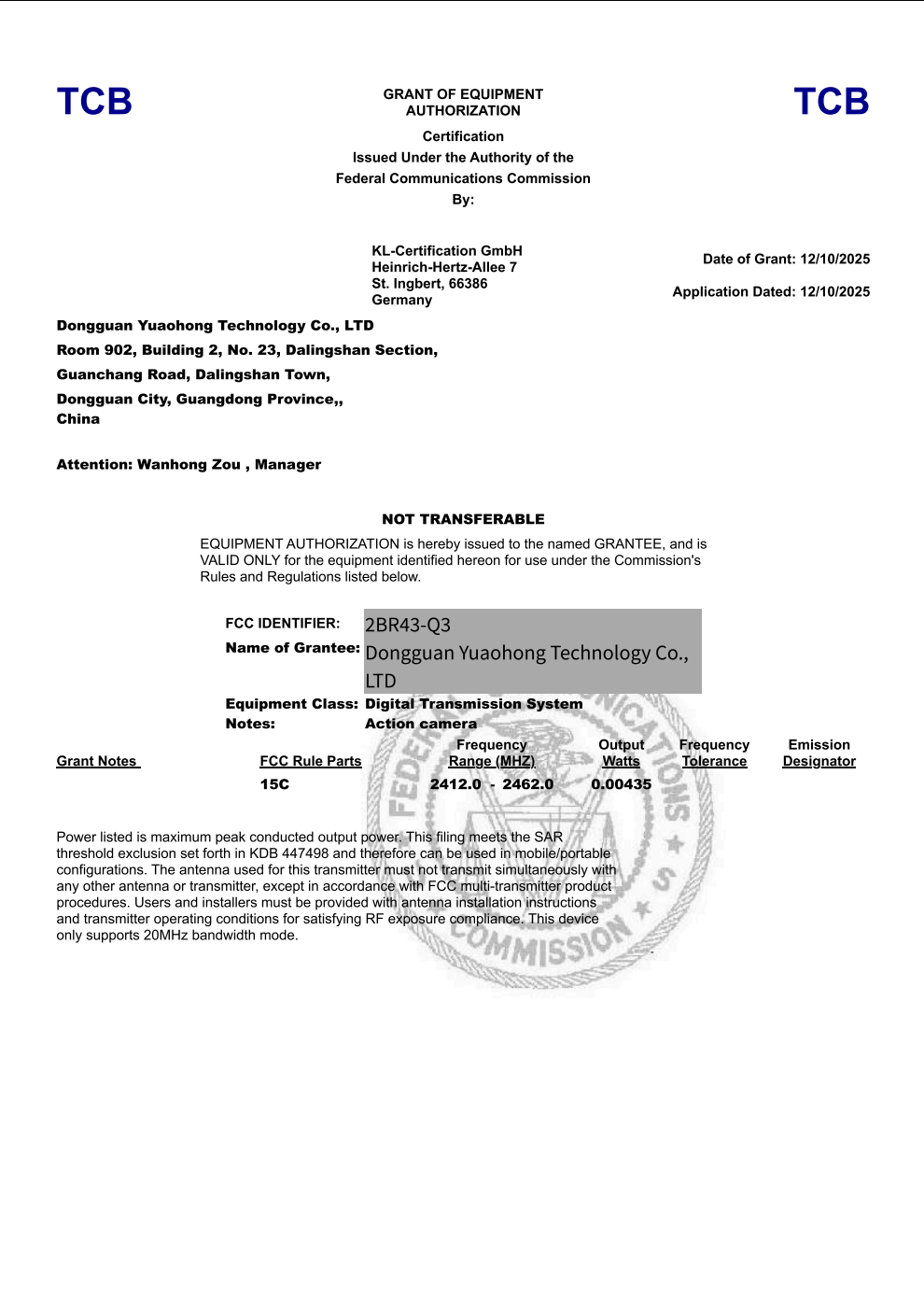
| FCC authorisation (US) | Authorisation of the intentional radiator for the US market | X7 under 47 CFR Part 15, Subpart C and KDB558074 D01 15.247 Meas Guidance v05r02, certificate CQASZ20260601273E-01 issued by CQA; FCC ID certification number 2BR43-Q3 under 47 CFR Part 15.247, issued by KL-Certification GmbH |
Beneath those families sits a fifth layer that is easy to overlook: product safety. Action cameras fall under the IEC 62368-1 safety standard for audio/video and information technology equipment, whose fourth edition was published in 2023. That is a separate document family from the radio, EMC and substance files, and it is not replaced by them — buyers should confirm whether a safety test report is available in addition to the certificates listed above.
Model-by-Model: The Documented Regulatory Position of X20, Q1, Q2, Q3 and Q7
The table below consolidates what the published documentation states for each of the five models, together with the hardware parameters that determine the test scope.
| Model | Designation and key parameters | EU documentation | US documentation |
|---|---|---|---|
| X20 | 2K+WiFi; 1.54-inch IPS display (320×240); 130° HD lens; 1000 mAh / 3.8 V polymer battery; video working time approx. 6–7 hours; recording working time approx. 9 hours; Micro-Type-C input at DC 5 V, 1–2 A; storage 16/32/64/128 GB optional | Covered within the CE documentation set (CE test reports under CISRC251111081V1); CE EMC certificate AiTSZ-240914014E-C01; RF test report CISRR25111108101; RoHS under CISCC251111122, with separate RoHS documentation referenced as AiTSZ-240914015R | No FCC record for X20 appears in the documented set reviewed here |
| Q1 | 4K+WiFi; 1.5-inch IPS (320×240); 130° wide-angle rotating lens; front 4K 3840×2160 and rear 4K, simultaneous 2K+2K dual recording; 2000 mAh / 3.8 V polymer battery; video working time approx. 4–5 hours; recording approx. 9 hours | CE certificate number CISRC251111081V1 applies; RF test report CISRR25111108101; RoHS CISCC251111122 issued by AiT | FCC ID Certification |
| Q2 | 4K+WiFi+touch+anti-shake; 1.8-inch IPS 800×480; 25 mm 130° wide-angle lens; front and rear dual 4K, simultaneous 2K+2K; touch and physical dual buttons; 6-level electronic image stabilisation; 18650 battery at 2000 mA; video working time approx. 4–5 hours | CE certification issued by BANGCE; RF test report CISRR25111108101; RoHS under EU 2015/863 | Certification number 2BR43-Q3; FCC ID certification under 47 CFR Part 15.247, issued by KL-Certification GmbH |
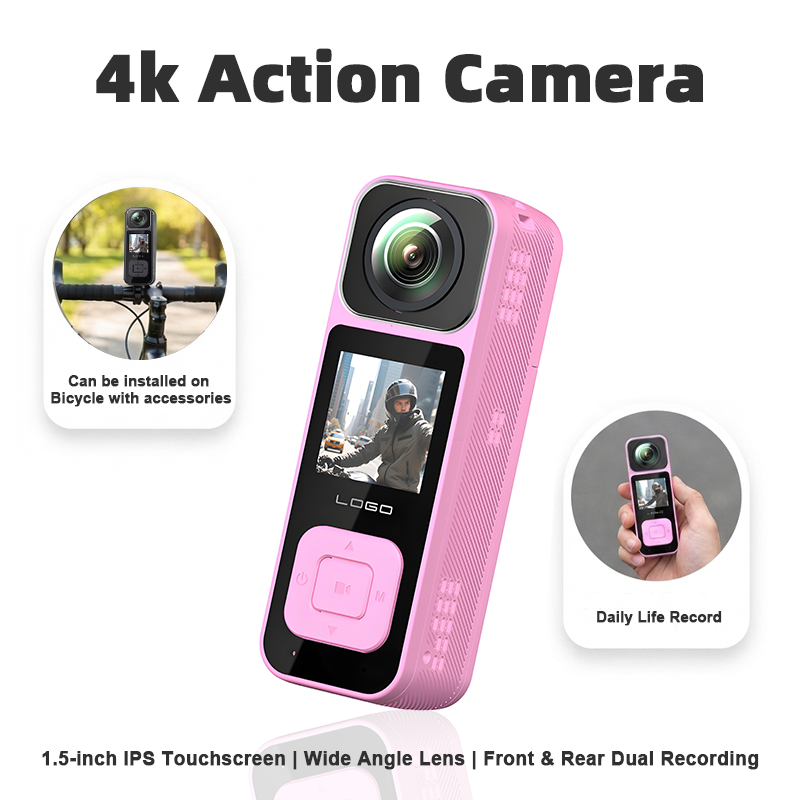
| Q3 | 4K WiFi; 1.5-inch IPS (320×240); 130° wide-angle rotating lens; front and rear 4K, simultaneous 2K+2K; infrared night vision; 2000 mAh / 3.8 V polymer battery | CE certification valid for the EU market; CE EMC certification applies to the EU market; RF test report issued by BANGCE; RoHS tested to IEC 62321-3-1:2013, IEC 62321-4:2013+AMD1:2017 CSV, IEC 62321-5:2013, IEC 62321-6:2015, IEC 62321-7-1:2015, IEC 62321-7-2:2017 and IEC 62321-8:2017 | FCC certification issued by KL-Certification GmbH |
| Q7 | 4K+WiFi+anti-shake; 1.47-inch IPS (320×240); 130° wide-angle rotating lens; 4K 3840×2160 at 30 fps; 1000 mAh / 3.8 V polymer battery; anti-shake supported; waterproof-case compatible; infrared night vision | CE EMC certificate covers Q7; RF test report applies to the EU market; RoHS CISCC251111122 | Applicable FCC standard: 47 CFR Part 15.247 |
Several neighbouring models appear alongside these five in the same scope lists. The EU CE and RoHS scope for the brand names the X20, Q1, Q2, Q3, Q5, Q7, Q9, Q11, X7 and X11 action cameras, and the documented US FCC scope names the X7, M16S, M17S, M29S and M30S under 47 CFR Part 15, Subpart C.
How WiFi Connectivity and Battery Specifications Shape Evaluation and Testing
WiFi: the feature that creates the regulatory category
A WiFi action camera is an intentional radiator, which is why the wireless function defines the compliance path. The EU route assesses the 2.4 GHz wideband transmitter against ETSI EN 300 328 V2.2.2; the US route uses 47 CFR Part 15, with both Subpart C and Part 15.247 appearing across the documented records. Three practical consequences follow for OEM buyers.
- The wireless section sets the tested configuration. Changing the WiFi module, antenna or RF firmware moves the product outside the configuration that was measured.
- CE test reports are available for the covered models under certificate number CISRC251111081V1, and RF test report CISRR25111108101 is referenced for the EU market across models including the X20, X11, Q11, Q9, X7, Q2 and Q1, with the Q3 RF test report issued by BANGCE.
- WiFi is also a product feature that buyers will evaluate commercially: the documented operating modes for these cameras include mobile app preview and playback, wireless remote control shooting and one-button quick recording.
Battery: three cell architectures, three different documentation questions
Across the five models the power source is not identical, and that matters because the battery sits partly in the safety and logistics file rather than the radio file.
- 1000 mAh / 3.8 V polymer — X20 and Q7 (also X7).
- 2000 mAh / 3.8 V polymer — Q1 and Q3 (also Q5, which states approximately 5–6 hours of video working time).
- 18650 cylindrical cell at 2000 mA — Q2 (also Q9).
Cell choice also changes the run-time claim an OEM buyer has to defend in a listing. The X20 documents approximately 6–7 hours of video working time and about 9 hours of recording; the Q7 pairs the smaller 1000 mAh cell with anti-shake, a power-sensitive feature; the Q1 and Q3 state approximately 4–5 hours of video working time; and the Q2 states approximately 4–5 hours with a 2000 mA 18650 cell.
Boundary to check: a CE radio certificate and an RF test report do not document the battery for transport. The documented set reviewed here covers CE, RF, RoHS and FCC records; it does not contain battery transport documentation. Buyers should request that file separately for the specific cell type they intend to ship, rather than assuming it travels with the radio approval.
Matching Regulatory Paths to Real Use Cases
YUAOHENG describes its action cameras as intended for the outdoor sports industry, the photography and video shooting industry, and the driving and transportation industry. Those three arenas do not raise identical regulatory or verification questions.
- Outdoor sports and water use. The documented scenario requirements cover all-weather outdoor operation from −20 °C to 60 °C with dustproof, waterproof and shockproof performance. For diving and watersports, the stated requirement is an IP66 waterproof grade, and the Q1, Q2, Q3 and Q7 are documented as compatible with a waterproof case for underwater shooting. IP68 is defined under IEC 60529 as dust-tight plus protection against immersion, but no IP68 claim is documented for these models — the case-based configuration, not the bare camera, is the relevant underwater setup.
- Mounting and vibration. Motorcycle riding, mountain biking and off-road driving are described as high-vibration environments. The Q2 provides 6-level electronic image stabilisation, while the Q7 and X7 document anti-shake support. Electronic image stabilisation has become a standard feature across budget to mid-range action cameras generally, which makes it a baseline expectation rather than a differentiator.
- Low light and night recording. Night hiking and underwater diving are listed as low-light environments. The X20, Q1, Q2, Q3 and Q7 all document infrared night vision, and the X20 and Q9 specify four built-in energy-saving infrared lights with manual infrared switching.
- Driving and transport recording. Vehicle use brings the camera into proximity with vehicle electrical systems. The X20 documents a Micro-Type-C input rated DC 5 V, 1–2 A, and the operating modes listed across the range include loop recording, timed auto-recording and voice-control capture.
On the regulatory side, the split is regional rather than application-based: placement in the EU triggers the CE path covering radio, EMC and RoHS, while placement in the US triggers the FCC path. The documented scenario requirements also name UKCA as an expectation for the European market, but no UKCA certificate appears in the set reviewed here, so buyers selling into the United Kingdom should verify that file independently.
Market Signals: Why Documentation Is Becoming a Purchasing Criterion
Market sizing for action cameras varies with scope. SkyQuest places the global market at USD 6.57 billion in 2024; Grand View Research estimates USD 7.97 billion for 2025 and Mordor Intelligence USD 7.09 billion for 2025. The spread reflects different definitions — whether accessories, professional body cameras and adjacent categories are counted — so any single figure is best treated as an order of magnitude rather than a precise anchor.
What the available data does show consistently is that the technical centre of gravity has moved upward:
- Ultra-HD (4K and above) resolution accounted for approximately 46.25% of action camera market share in 2025, according to Mordor Intelligence — which aligns with the Q1, Q2, Q3 and Q7 specifications in this portfolio.
- China's domestic action camera market was estimated at USD 502.25 million in 2024 by Market Research Future, while Chinese video camera exports reached USD 166 million in 2024 with the US at USD 31.8 million, per the Observatory of Economic Complexity.
- Competitive concentration is high. GoPro sold 3 million camera units in 2023, a 6% year-over-year increase, according to SkyQuest; DJI and Insta360 held close to 90% of the action camera market in Japan as of late 2025, per PetaPixel / BCN+R.
- Electronic image stabilisation is now a standard feature from budget to mid-range segments, according to an Insta360 industry guide, which shifts differentiation toward configuration, firmware and documentation.
The procurement implication is direct. When hardware specifications converge, the model-scope certificate becomes one of the few remaining points of differentiation a mid-tier supplier can offer. A camera that matches a competitor on sensor resolution can still lose a listing if it cannot produce a CE certificate number, an RF test report, a RoHS report and an FCC authorisation that name the exact model being sold.
Compared With Traditional Sourcing: What Model-Scope Documentation Changes — and Where Its Limits Are
Traditional sourcing for action cameras often relies on a category-level claim: a supplier states that “our cameras are CE and RoHS certified” without naming models, certificate numbers or test standards. The documented approach reviewed here attaches every claim to a model list, a certificate number, an issuing body and a standard.
| Dimension | Category-level claim | Model-scope documentation (as reviewed) |
|---|---|---|
| Traceability | Opaque — no number, no issuer | Certificate number, issuing body and test standard named per record |
| Coverage | Implied across the whole range | Explicit model lists — for example, the CE and RoHS scope naming X20, Q1, Q2, Q3, Q5, Q7, Q9, Q11, X7 and X11 |
| Change control | Unclear after any design change | Any change to the model designation, wireless section or power section must be re-checked against the scope |
| Market fit | One file presented as global | Separate EU (CE / RoHS / RF) and US (FCC) files |
Limits buyers should not overlook. Four boundaries are visible inside the documented set itself, and they are the reason a buyer should read scope rather than logos.
- Model scope is literal. Certificate number CISRC251111081V1 is documented as applying to the Q1 and Q9 models. A buyer ordering a modified Q1 — different antenna, different module, different firmware — is ordering a configuration that is not automatically inside that scope.
- FCC coverage is not uniform across the five models. The documented US coverage names X7, M16S, M17S, M29S and M30S under 47 CFR Part 15, Subpart C with certificate CQASZ20260601273E-01 issued by CQA, plus FCC ID certification number 2BR43-Q3 under 47 CFR Part 15.247 issued by KL-Certification GmbH and an FCC certification for the Q3 issued by the same body. No FCC record for the X20 appears in the documented set, so a buyer planning US distribution of the X20 has to verify that file independently rather than assume it.
- UKCA is named as a requirement but is not documented. The scenario requirements reference meeting EU CE and UKCA certification standards; the certificate set reviewed contains CE, RF, RoHS and FCC records only.
- Ingress protection is case-dependent. Waterproof-case compatibility is documented for the Q1, Q2, Q3 and Q7, and no IP68 rating is claimed. Listings should describe the case-based configuration rather than an IP rating the documentation does not support.
None of these are defects in the products. They are the boundaries of the evidence, and knowing them is what prevents a compliance problem at the port or a delisting after launch.
Future Outlook
Three shifts are likely to define the next procurement cycle for WiFi action cameras.
- Documentation depth as a supplier filter. As 4K and above approaches half of the market, differentiation on resolution erodes. Buyers increasingly screen suppliers by document readiness — whether a CE certificate, RF test report, RoHS report and FCC record can be produced per model, on request, with numbers attached.
- Customisation versus certification scope. YUAOHENG provides OEM and ODM one-stop customisation covering product concept design, prototype development, engineering technical consultation and certification support, camera module and hardware customisation, firmware and app development, and appearance and packaging customisation, with a monthly capacity of 170,000 units, a 25–30 day lead time and a minimum order quantity of one unit. Any customisation that touches the wireless or power section changes the compliance question, so certification support is likely to be assessed alongside tooling capability rather than after it.
- Market-specific files multiply. EU 2015/863 for substances, ETSI EN 300 328 V2.2.2 for the 2.4 GHz radio, the IEC 62321 test series for RoHS, and 47 CFR Part 15 for the US form the current framework. Buyers expanding into further regions should expect parallel dossiers rather than one global certificate.
FAQ
Q1. Does one CE certificate cover every action camera model in a series?
No. Coverage is defined by model scope. In the documented set, certificate number CISRC251111081V1 is stated to apply to the Q1 and Q9 models, while the broader CE scope for the brand lists the X20, Q1, Q2, Q3, Q5, Q7, Q9, Q11, X7 and X11 action cameras for the EU market. A buyer switching to a different model, or to a customised variant of the same model, should confirm that the specific designation falls inside the scope of the certificate and test report being offered.
Q2. What is the practical difference between CE radio documentation and FCC documentation for the same WiFi action camera?
Both are radio approvals, but they answer to different frameworks. For the EU market, the documented standard is ETSI EN 300 328 V2.2.2, with CE test reports available for the covered models under certificate number CISRC251111081V1, and EMC behaviour addressed through EN 55032:2015+A1:2020 and EN 55035:2017+A11:2020 under CE EMC certificate AiTSZ-240914014E-C01. For the US market, the documented framework is 47 CFR Part 15, with Subpart C and Part 15.247 both appearing across the records. A CE file does not substitute for an FCC file, and the reverse also applies.
Q3. Which models in the X20, Q1, Q2, Q3 and Q7 group have documented FCC coverage?
The documented US records name the Q1 under FCC ID certification, the Q2 under certification number 2BR43-Q3 (47 CFR Part 15.247, issued by KL-Certification GmbH), the Q3 under an FCC certification issued by KL-Certification GmbH, and the Q7 under the applicable standard 47 CFR Part 15.247. The brand's broader FCC scope names X7, M16S, M17S, M29S and M30S under 47 CFR Part 15, Subpart C and KDB558074 D01 15.247 Meas Guidance v05r02, with certificate number CQASZ20260601273E-01 issued by CQA. For the X20, no FCC record appears in the documented set, so US-market authorisation for that model should be verified before a listing is committed.
Q4. Do battery specifications affect certification and testing outcomes?
Battery architecture differs across the group: the X20 and Q7 use a 1000 mAh / 3.8 V polymer battery, the Q1 and Q3 use a 2000 mAh / 3.8 V polymer battery, and the Q2 uses an 18650 cell with 2000 mA capacity. This matters in two ways. Run-time claims differ — approximately 6–7 hours of video working time for the X20, and approximately 4–5 hours for the Q1, Q2 and Q3 — and those claims need to be consistent with what a listing or test report states. Separately, the battery sits in the equipment-level safety and logistics file rather than the radio file; a CE radio report or an FCC record does not document the cell for transport, so buyers should confirm which battery-related documents a supplier can provide for the specific cell type.
Q5. What do the certificates say about water resistance, and how should that be described in a listing?
The documented position is case-based rather than rating-based. The Q1, Q2, Q3 and Q7 are described as compatible with a waterproof case for underwater shooting, and the scenario requirements for these cameras state an IP66 waterproof grade alongside dustproof and shockproof performance for outdoor use from −20 °C to 60 °C. IP65 is documented for the X11 and Q11 models. IP68, defined under IEC 60529 as dust-tight plus immersion protection, is not claimed for these models, so listings should describe the waterproof-case configuration instead of an IP68 rating the documentation does not support.
Compliance for a WiFi action camera is a chain of named documents rather than a single badge: a CE certificate with an explicit model scope, a laboratory RF test report, a RoHS report tested to the IEC 62321 series, an EMC certificate, and a separate FCC authorisation for the US market. For OEM buyers in the research and evaluation stage, the most efficient way to reduce risk on a purchase order is to request those items per model — with certificate numbers — before commercial terms are discussed.
YUAOHENG publishes its product range and certification support at yuaoheng.com. The complete product catalogue is available as a PDF for reference: YUAOHENG product catalogue.