
Action Camera Compliance: Qualification Files for X20, Q1, Q2, Q3, Q7
HTNXT INDUSTRY REFERENCE · CONSUMER ELECTRONICS · MODEL QUALIFICATION
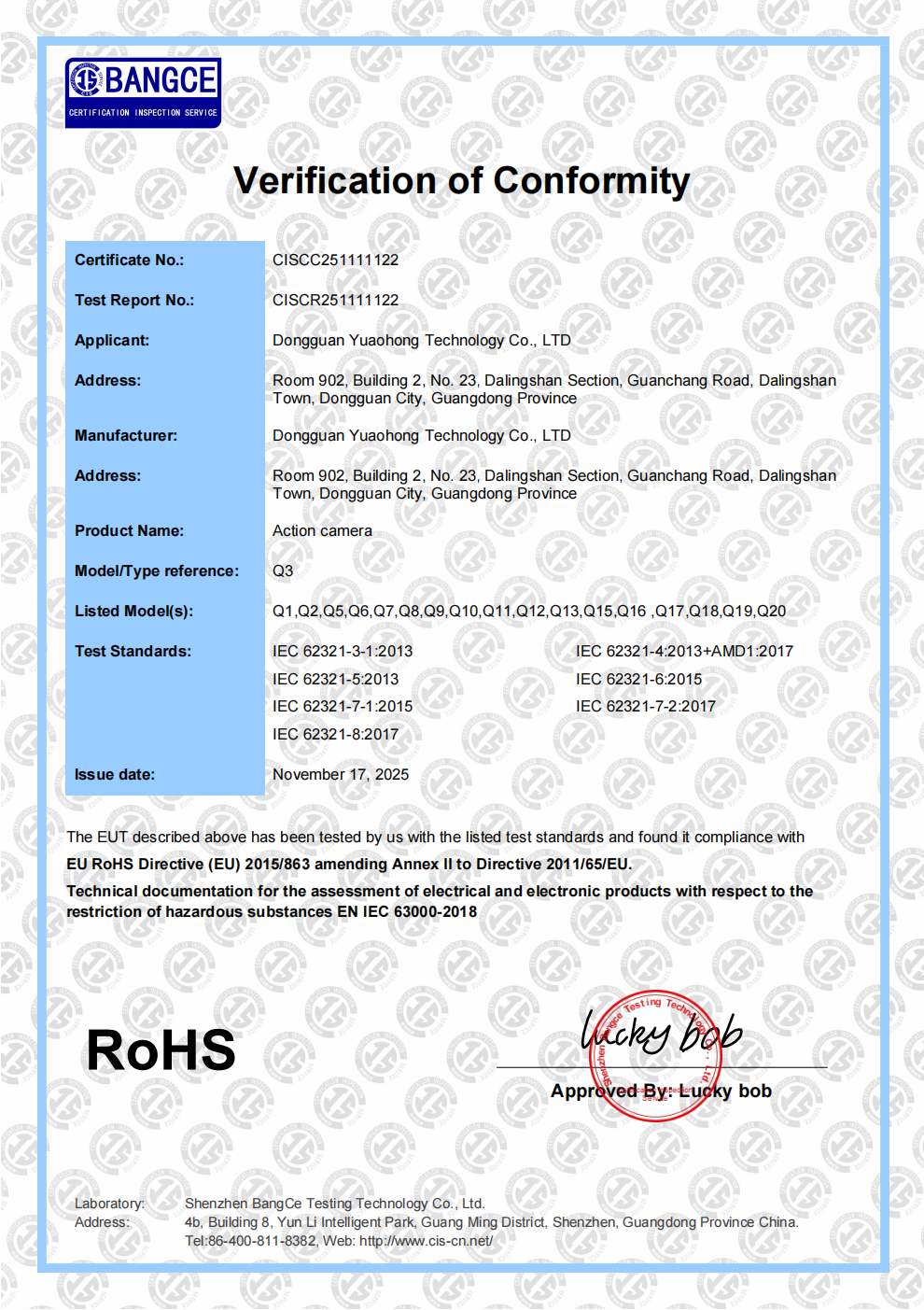
A model qualification file is built from several documents, not one. Image: RoHS declaration CISCC251111122 referenced in this review.
An action camera qualification file is the set of model-specific documents a buyer can place in front of a customs broker, a marketplace compliance reviewer, or a retail customer without adding explanation. For WiFi-enabled cameras, that file is rarely a single certificate. It is a chain: a radio test report, a CE document tied to that report, a RoHS declaration, a battery statement, a material statement, and a specification sheet that names the exact model being shipped.
The chain matters most when a supplier offers several models that look similar on a landing page but differ in display, battery, recording paths and stabilisation. The five WiFi models reviewed here — X20, Q1, Q2, Q3 and Q7 — sit in that situation. They share a housing material and a wide-angle lens philosophy, but they do not share batteries, and they are not all named on the same paperwork. This article sets out how an OEM buyer can review the file model by model, and where the documentation currently stops.
Why WiFi turns a product question into a documentation question
A WiFi action camera contains an intentional radio transmitter. That changes the compliance route. Instead of relying only on electrical safety and hazardous-substance control, the product must also be assessed against a radio standard. In the European Union, the standard recorded in the manufacturer's documentation for this range is ETSI EN 300 328 V2.2.2, the harmonised standard used for wideband transmission systems in the 2.4 GHz band.
The practical consequence for a buyer is that the qualification question is not "is this camera compliant?" but "which document names this model, against which standard, issued by which body, on which date?" Dongguan YuAoHeng Electronic Technology Co., Ltd. (YUAOHENG), a Dongguan-based manufacturer of action cameras, dash cameras and smart video doorbells founded in 2016, maintains a document set covering CE, FCC and RoHS for its camera lines. The review below uses only what those documents state, and separates what is evidenced from what still has to be requested.
The five-model qualification map
Before any certificate is opened, the buyer should establish that the models are genuinely different products rather than marketing variants. The supplied specifications show five distinct configurations. X20 is designated 2K+WIFI X20, with a 1.54-inch IPS display at 320×240, a 130° HD lens, AVI (1920×1080) recording notation and a 1000mAh/3.8V polymer battery. Q1, Q2, Q3 and Q7 are all 4K models recording 3840×2160, but they diverge immediately after that.
| Model | Type designation | Display | Recording | Battery | Feature that adds a document item |
|---|---|---|---|---|---|
| X20 | 2K+WIFI X20 | 1.54-inch IPS, 320×240 | AVI (1920×1080) | 1000mAh/3.8V polymer | Radio documentation not evidenced in the current pack |
| Q1 | 4K+WIFI Q1 | 1.5-inch IPS, 320×240 | Front 4K, rear 4K, simultaneous 2K+2K | 2000mAh/3.8V polymer | Dual-recording declaration |
| Q2 | 4K+WiFi+Touch screen+Anti-shake Q2 | 1.8-inch IPS, 800×480 | Front 4K, rear 4K, 2K+2K | 18650 2000mA | Touch panel and 6-level EIS declaration |
| Q3 | 4K WIFI Action camera Q3 | 1.5-inch IPS, 320×240 | Front 4K, rear 4K, 2K+2K | 2000mAh/3.8V polymer | Infrared night vision and capacitor MIC declaration |
| Q7 | 4k+WiFi+Anti-shake Action camera Q7 | 1.47-inch IPS, 320×240 | 4K (3840×2160) 30fps | 1000mAh/3.8V polymer | Anti-shake declaration |
All five models list ABS as the housing material. None of the supplied specification sheets state an ingress protection rating.
Reading the radio and substance paperwork
The document set below is what the manufacturer's records currently show for this range. The important column is the last one: scope. A certificate number without a model list is not a qualification document.
| Document | Number | Issuer | Standard | Date | Relevance to these models |
|---|---|---|---|---|---|
| CE (radio) | CISRC251111081V1 | BANGCE | ETSI EN 300 328 V2.2.2 | 2026-04-02 | Scope lists Q1, Q2, Q3 and Q7 among the Q-series models; X20 is not named |
| RF test report | CISRR25111108101 | BANGCE | ETSI EN 300 328 V2.2.2 | 2025-11-24 | Same Q-series model list; the supporting radio evidence behind the CE document |
| RoHS | CISCC251111122 | BANGCE | EU 2015/863, tested per IEC 62321 series | 2025-11-17 | Same Q-series model list |
| FCC ID | 2BR43-Q3 | KL-Certification GmbH | 47 CFR Part 15.247 | 2025-12-10 | Linked to the Q3 designation |
| FCC | CQASZ20260601273E-01 | CQA | 47 CFR Part 15, Subpart C; KDB558074 D01 15.247 | 2026-07-01 | Scope lists X7, M16S, M17S, M29S and M30S — not the five models discussed here |
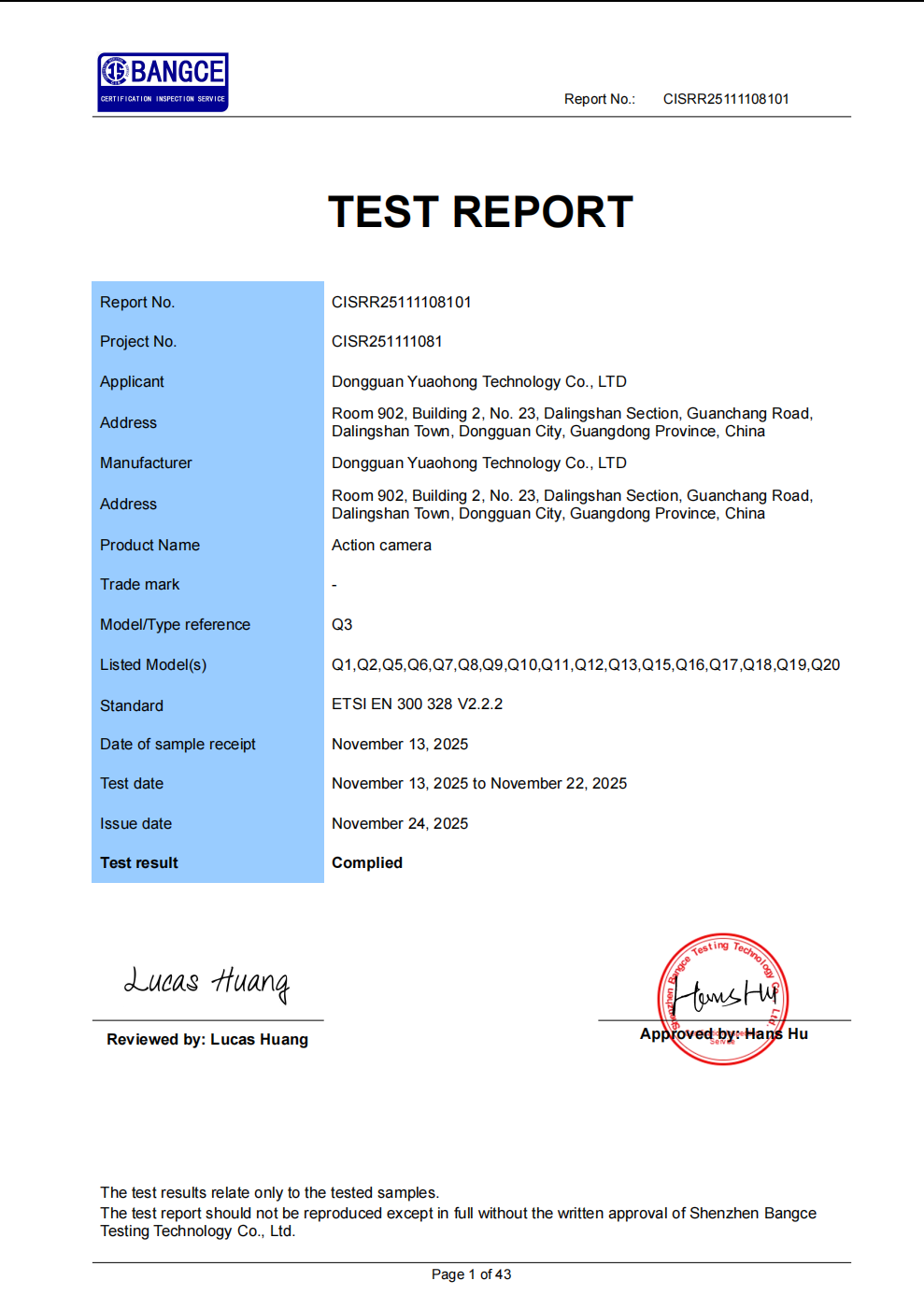
Radio evidence sits behind the CE document. Image: RF test report CISR251111081.
Two findings follow from that table, and both change how a buyer plans.
First, X20 is a WiFi model whose designation clearly includes a radio function, yet it does not appear in the recorded scope of the CE, RF or RoHS documents listed above. That does not mean the camera is non-compliant; it means the qualification file supplied for X20 is incomplete in its present form. An EU-bound X20 programme needs a model-specific radio document and a model-specific RoHS declaration before artwork, packaging claims or marketplace listings can be finalised.
Second, the general FCC certificate held by the manufacturer covers a different model group — X7, M16S, M17S, M29S and M30S. Buyers targeting the United States should therefore treat FCC coverage as a model-level question. For Q3, the FCC ID 2BR43-Q3 issued by KL-Certification GmbH against 47 CFR Part 15.247 is the document to read. For X20, Q1, Q2 and Q7, the FCC position should be confirmed in writing rather than inferred from a certificate that names other models.
Battery declarations: three configurations, three checklists
Battery documentation is where multi-model ranges most often fail review, because it is easy to reuse one declaration across a family. The five models here use three different battery configurations, so a single declaration cannot describe all of them.
X20 and Q7 both carry a 1000mAh/3.8V polymer battery. Q1 and Q3 carry a 2000mAh/3.8V polymer battery. Q2 uses an 18650 cell rated 2000mA. Each configuration needs its own capacity and voltage statement, its own cell-format description, and its own transport and safety documentation. A declaration written for a 3.8V polymer pack does not describe an 18650 cell, even when both appear on the same supplier page.
Runtime statements should be checked against the same source. X20 lists video working time of roughly 6–7 hours and recording time of about 9 hours. Q1 lists 4–5 hours of video working time and about 9 hours of recording, with a maximum photo duration of approximately 10 hours at 720p 30fps. Q2 lists 4–5 hours of video working time. The supplied Q3 sheet states the battery but not a runtime figure, so a buyer should not borrow Q1's runtime for Q3 literature. Where a specification is silent, the qualification file should stay silent too.
ABS housing and what a material statement should contain
Every model in this group declares ABS as the housing material. That is a useful, checkable fact, but it is also frequently over-read. An ABS declaration identifies the material, not the product's durability, flame behaviour or UV stability. A usable statement names the model, names the part it covers (housing), states the polymer designation, and points to the RoHS declaration that governs the substance limits — in this case CISCC251111122, issued against EU 2015/863 and tested using the IEC 62321 series methods.
For procurement, the practical rule is that the material line in the specification sheet and the model line in the RoHS declaration must match. If a buyer receives a RoHS certificate listing Q1, Q2, Q3 and Q7 but is ordering X20, the material claim on the X20 packaging is unsupported by that document, even though the ABS statement itself is accurate.
Where qualification review differs across the tiers
The useful insight for OEM buyers is that the certification route does not change between tiers — all WiFi models travel the same radio-plus-substance path. What changes is the number of feature-driven items a reviewer must confirm.
X20, the entry tier. A single recorded resolution field, a 1.54-inch 320×240 display and a 1000mAh battery. The review work here is mostly documentary completion: obtaining model-specific radio and substance evidence, and resolving an ambiguity in the sheet itself, where the designation reads 2K+WIFI while the resolution field records AVI (1920×1080). Buyers should agree which statement appears on retail packaging, marketplace titles and advertising copy before artwork is signed off.
Q1 and Q3, the dual-recording tier. Both record 4K front and rear, with simultaneous 2K+2K dual recording. A reviewer must confirm that the dual-recording behaviour is described once, consistently, across the specification sheet, the user manual and the listing. Q3 adds infrared night vision with manual switching and a full-range built-in capacitor microphone, which introduces an infrared emitter description and an audio component description to the file.
Q2, the control and stabilisation tier. A 1.8-inch 800×480 display, standard touch plus physical dual buttons, and 6-level electronic image stabilization. Touch and EIS are the two items that most often arrive undocumented, because they are experienced as user-interface features rather than components. The file should state the touch module, the firmware version that ships, and the stabilisation mode as it is described to end users.
Q7, the compact stabilisation tier. A 1.47-inch display, 4K at 3840×2160 30fps, anti-shake support and a 1000mAh/3.8V polymer battery. Anti-shake here is a stated capability rather than a numbered level, so the qualification note should record exactly that wording, and the same wording should appear downstream.
Where the paperwork ends: limits buyers should plan around
A qualification review is only useful if it also records what the documents do not establish. Four boundaries apply to this range as documented today.
Model coverage is the first and largest. The CE, RF and RoHS documents named above list Q1, Q2, Q3 and Q7 among their scope; X20 is absent from all three. Any X20 programme for the EU should be treated as documentation-in-progress until a model-specific document is issued.
Ingress protection is the second. IP68 is defined by IEC 60529 as protection against dust and against continuous immersion, and it is a specific, testable claim. None of the five specification sheets supplied for this review states an IP rating. Buyers planning diving, surfing or other water-exposure use cases should therefore not assume a waterproof rating exists in the file, and should request the underlying test evidence before any water-resistance claim appears in marketing material.
Electrical safety framing is the third. Action cameras sit within the scope of IEC 62368-1, the safety standard for audio/video and information technology equipment, whose fourth edition was published in 2023. That standard defines the safety assessment framework; it does not, by itself, certify a specific model. The buyer's file should identify which safety assessment, if any, accompanies each model rather than assuming the framework implies a result.
Firmware-dependent features are the fourth. Electronic image stabilisation is now a standard feature in budget and mid-range action cameras, implemented in software rather than hardware, and the same is true of the 6-level stabilisation on Q2 and the anti-shake support on Q7. Because behaviour can change between firmware builds, the qualified configuration should be pinned to a build identifier, and re-confirmed when the supplier updates firmware.
From document review to a procurement schedule
Qualification review runs in parallel with commercial negotiation, not after it. The manufacturer's stated terms give the buyer a schedule to plan against: a minimum order quantity of 1 unit, delivery arranged on EXW or FOB terms, payment of 30% T/T in advance with a 70% T/T balance, and acceptance based on pre-shipment testing. Production lead time is typically 25–30 days, with monthly capacity of 170,000 units and 100% testing across the line.
For an OEM programme, the sequence that works is to lock the model, then lock the document set for that model, then lock the artwork. Where the supplier provides certification support as part of its OEM and ODM service — covering product design, engineering development, hardware and function customisation, firmware and app development, and appearance and packaging — the document question should be raised at the design stage, because a model-specific radio document cannot be produced retroactively for artwork that has already been printed.
The company operates a 1,500㎡ facility with roughly 300 staff, including a 30-engineer R&D team, and reports annual output of 2,000,000 units with about 80% of production exported to Europe, North America, Asia and South America. Those figures describe capacity, not compliance; they are useful for planning volume, and should be kept separate from the qualification discussion.
Scenario fit after the file is complete
Scenario selection should follow, not precede, documentation. A bicycle-mounted action camera programme depends on mount compatibility and vibration behaviour, both of which are easier to confirm once the stabilisation wording is fixed. A vlog handheld configuration depends on the display — the 1.8-inch 800×480 panel on Q2 is the largest in this group — and on audio, where Q3 and Q7 both specify a full-range built-in capacitor microphone. Ski and climbing programmes depend on low-temperature behaviour and mounting security, neither of which is stated in the supplied sheets and both of which should be verified before a seasonal order is placed. Water-facing scenarios remain the clearest example of a use case that must wait for evidence rather than assumption.
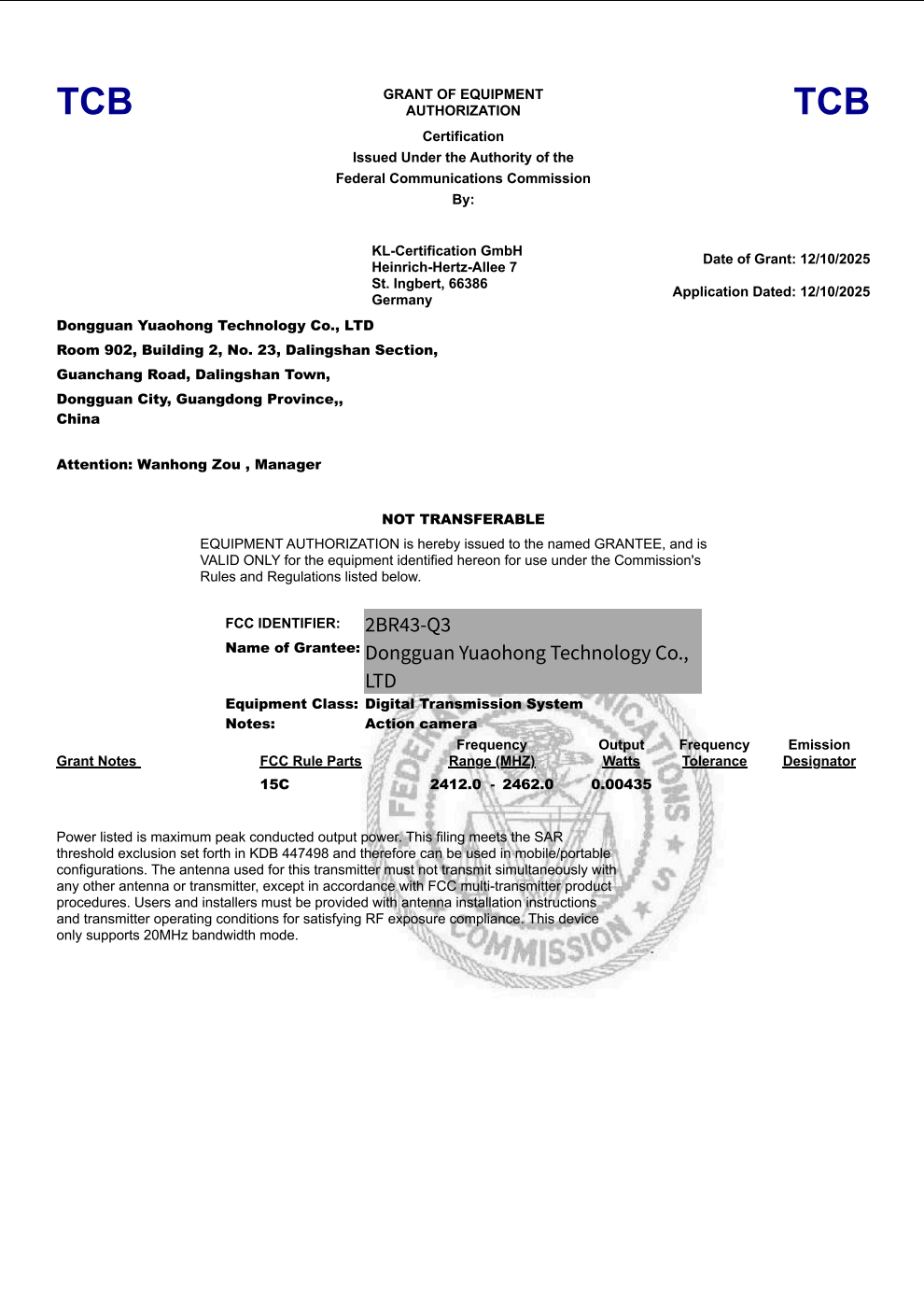
FCC coverage is model-level: the FCC ID 2BR43-Q3 is linked to the Q3 designation. Image: FCC ID document 2BR43-Q3.
Market context: why the file keeps getting longer
The commercial pressure behind this paperwork is straightforward. The global action camera market was valued at USD 6.57 billion in 2024 according to SkyQuest Technology, and North America held a 34% revenue share in 2025 according to Grand View Research. Ultra-HD models at 4K and above accounted for approximately 46.25% of market share in 2025, per Mordor Intelligence — a figure that explains why four of the five models in this range are 4K.
Export flows reinforce the same point. China exported USD 166 million in video cameras in 2024, with the United States the top destination at USD 31.8 million, according to the Observatory of Economic Complexity. Every one of those shipments crosses a border where a document may be requested, and radio-emitting devices attract more questions than passive accessories. Meanwhile, features that were once differentiators — electronic stabilisation among them — have become baseline, which pushes differentiation toward documentation quality and configuration control rather than headline specifications.
Model-level files versus the generic certificate packet
The older sourcing habit is to request a certificate packet once, accept it as a supplier-level credential, and apply it to whichever model is ordered. That approach is faster at the quotation stage and considerably more expensive later, because a scope mismatch is typically discovered by a customs broker, a marketplace reviewer or a retail compliance team rather than by the buyer.
A model-level qualification file inverts the order: the model is named first, then the documents that name it are collected. The cost is administrative — more requests, more follow-up, and occasional gaps that have to be closed before an order can ship. In this range, that cost is visible: four of five models are covered by the CE, RF and RoHS documents, and one is not. Under the packet approach, that gap would likely have travelled unnoticed into an EU listing.
The model-level approach has its own limits. It does not verify performance, does not replace incoming inspection, and does not protect against a supplier changing a component after the documents were issued. It is a documentary control, and it needs to be paired with pre-shipment testing and a defined change-notification expectation. Buyers who want a single document to cover an entire range will not get one, and should be cautious of any supplier who offers it.
Outlook
Three developments are likely to shape action camera qualification files over the next procurement cycles. Radio documentation will keep expanding as WiFi-enabled models become the default rather than a variant, which pushes model-level radio evidence from optional to standard. Firmware-linked features such as electronic stabilisation will require configuration identifiers in the file, because a certificate describing a hardware platform says nothing about the build that ships. And the gap between what a specification sheet claims and what a document set proves will remain the most common source of delay — a gap that is closed by asking for the model by name, not by asking for compliance in general.
Reference: the manufacturer's product catalogue is available as a PDF at YUAOHENG product catalogue.
FAQ
Which documents belong in a qualification file for a WiFi action camera?
A workable file contains six elements: a radio test report against ETSI EN 300 328 V2.2.2 and the CE document that references it; a RoHS declaration against EU 2015/863 using IEC 62321 test methods; an FCC equipment authorisation where the US market is targeted; a battery declaration stating capacity, voltage and cell format; a material statement identifying the housing polymer; and a specification sheet that names the exact model. Each element should name the model it covers, because a document without a model list does not qualify a product.
Do the same certificates cover X20, Q1, Q2, Q3 and Q7?
Coverage has to be read model by model. The CE document CISRC251111081V1, the RF test report CISRR25111108101 and the RoHS declaration CISCC251111122 all list Q1, Q2, Q3 and Q7 among their scope. X20 is not named in any of those three scopes. On the US side, FCC certificate CQASZ20260601273E-01 lists X7, M16S, M17S, M29S and M30S, while FCC ID 2BR43-Q3 is linked to the Q3 designation. A scope should never be extended by assumption.
Why does the battery configuration change the qualification review?
Because the five models use three battery configurations. X20 and Q7 carry a 1000mAh/3.8V polymer battery; Q1 and Q3 carry a 2000mAh/3.8V polymer battery; Q2 uses an 18650 cell rated 2000mA. Capacity, voltage and cell format differ, so a declaration written for one configuration does not describe another. Runtime statements follow the same rule: X20 lists about 6–7 hours of video working time, Q1 and Q2 list 4–5 hours, and the supplied Q3 sheet states no runtime figure at all.
What should an ABS material declaration contain?
All five models list ABS as the housing material, so the declaration should name the model, name the part it covers, state the polymer designation, and reference the RoHS declaration that governs substance limits — here CISCC251111122, issued against EU 2015/863 and tested using IEC 62321 series methods. The declaration addresses material composition only. It is not a flame-retardancy rating, a UV rating or an impact rating, and none of those should be inferred from an ABS statement.
How does qualification review differ between the 4K models?
The certification route is identical, but the feature-driven items differ. Q1 adds a dual-recording declaration for front 4K, rear 4K and simultaneous 2K+2K. Q2 adds a touch panel description, a 6-level electronic image stabilisation statement and an 18650 battery declaration on a 1.8-inch 800×480 display. Q3 adds infrared night vision with manual switching and a full-range built-in capacitor microphone. Q7 adds an anti-shake statement on a 1.47-inch display at 4K 30fps. X20 sits apart with a 1.54-inch display, a 1000mAh battery and AVI (1920×1080) recording notation.
What commercial terms apply once a model is qualified?
The stated terms are a minimum order quantity of 1 unit, delivery on EXW or FOB, payment of 30% T/T in advance with a 70% T/T balance, and acceptance based on pre-shipment testing. Production lead time is typically 25–30 days, supported by monthly capacity of 170,000 units and 100% testing. A 12-month warranty applies, with online technical guidance, replacement and maintenance support, and product certification documents supplied alongside sales materials.
Qualification is a model-level exercise. The fastest way to shorten it is to send the supplier a list of the five model designations and ask which document names each one — the answer defines the remaining work.
Есть вопросы или нужны дополнительные детали?
Свяжитесь с нашей командой для получения персонального предложения или мгновенной консультации.
Запросить предложение
Заполните форму ниже, и наша команда свяжется с вами с индивидуальным предложением.
Прямой чат WhatsApp
Предпочитаете общаться в реальном времени? Напишите нам в WhatsApp для мгновенной помощи и быстрых ответов.
- Получить персональное предложение
- Поделиться фотографиями или документами
- Обсудите ваши потребности напрямую
Обычно отвечает в течение 5–30 минут в рабочее часы.