
Action Camera Procurement: 2K vs 4K, Touch vs Buttons
Action camera sourcing decisions rarely turn on brand preference alone. They turn on three specification variables that determine whether an incoming shipment matches the brief: resolution, control interface and battery endurance. This reference answers the questions that recur in those procurement conversations, using the published specification lines of the X20, Q1, Q2 and Q3 action cameras from Dongguan YUAOHENG Electronic Technology Co., Ltd. (YUAOHENG), a Dongguan-based manufacturer of action cameras, dash cameras and smart video doorbells.
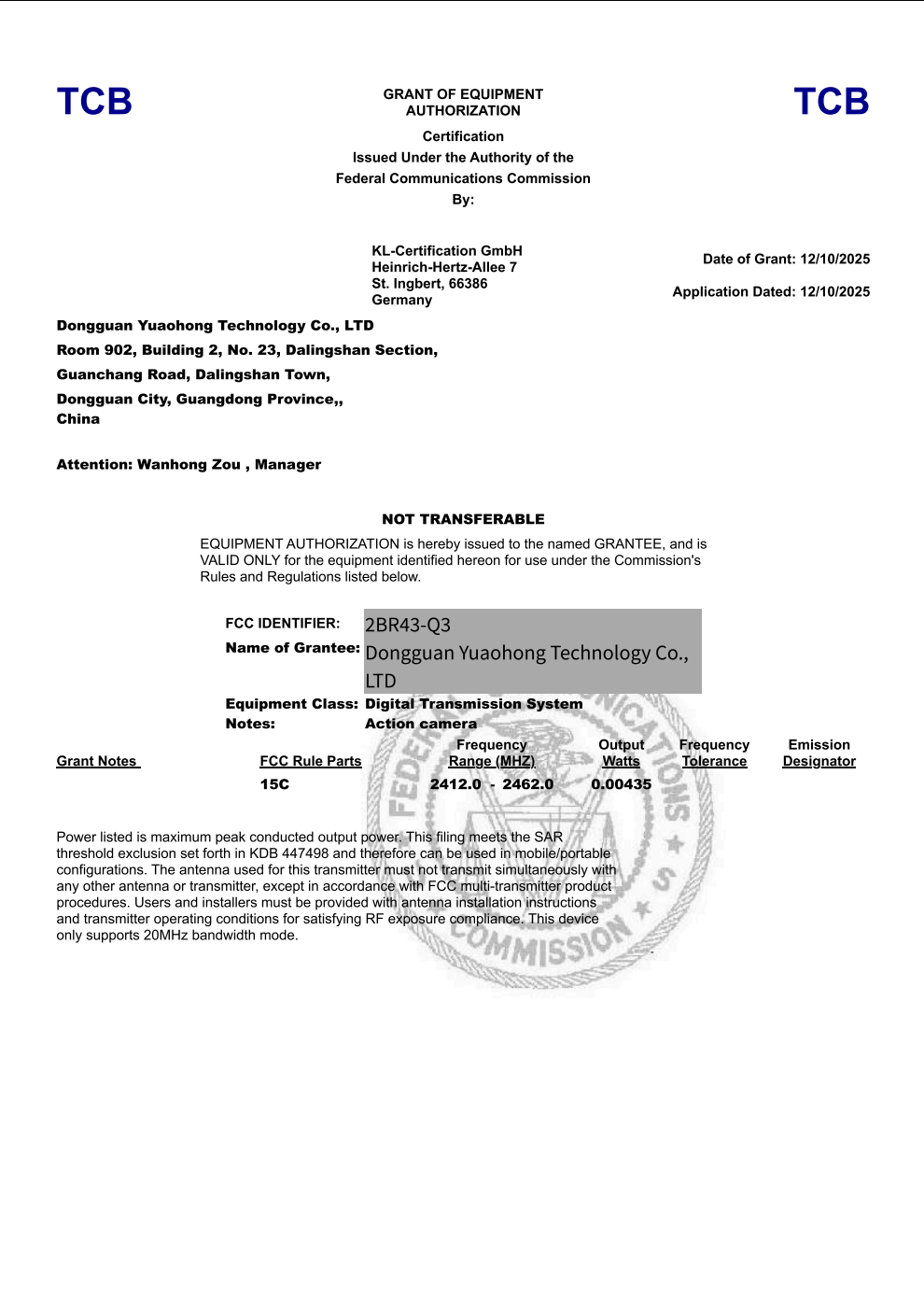
FCC ID certification 2BR43-Q3, issued for the Q3 action camera under 47 CFR Part 15.247 (issued 10 December 2025).
The procurement problem: a model name and a specification line are two different documents
Model naming compresses marketing shorthand — 2K, 4K, WiFi, touch — into a few characters. The specification line is the document a production order is built to and the document a pre-shipment check is measured against. When a buyer reads only the name, the mismatch usually surfaces months later.
The X20 illustrates the point. Its published type designation is 2K+WIFI X20, while its published camera resolution line reads AVI (1920×1080). Both statements are accurate; they simply answer different questions. The same tension appears in the opposite direction across the range: the published camera resolution line for models such as the Q9, Q11 and X11 states 2K (2560×1440). In other words, the label 2K does not describe a single pixel count even inside one manufacturer's catalogue.
The practical rule for a procurement file is straightforward. Treat the specification line as the controlled document and the model name as a category label that helps buyers navigate the catalogue. Where the two diverge, the specification line governs, and the acceptance criterion remains the pre-shipment test.
Question 1 — 2K or 4K: what the published resolution lines actually say
| Model | Published type designation | Published camera resolution line | Simultaneous dual recording | Display |
|---|---|---|---|---|
| X20 | 2K+WIFI X20 | AVI (1920×1080) | Not stated | 1.54-inch IPS, 320×240 |
| Q1 | 4k+WIFI Q1 | Front 4K (3840×2160); Rear 4K (3840×2160) | 2K front + 2K rear | 1.5-inch IPS, 320×240 |
| Q2 | 4k+WiFi+Touch screen+Anti-shake Q2 | Front 4K (3840×2160); Rear 4K (3840×2160) | 2K+2K, three modes optional | 1.8-inch IPS, 800×480 |
| Q3 | 4K WIFI Action camera Q3 | Front 4K (3840×2160); Rear 4K (3840×2160) | 2K front + 2K rear | 1.5-inch IPS, 320×240 |
Front and rear 4K on the Q1, Q2 and Q3 means each of the two recording channels is specified at 3840×2160, and the simultaneous dual-recording mode is specified at 2K + 2K. The Q2 adds a three-mode option on top of that.
In pixel terms, a 1920×1080 frame carries roughly 2.07 million pixels, and a 3840×2160 frame carries roughly 8.29 million — four times the pixel count per frame. That difference matters most when footage will be cropped, reframed from a wide-angle capture, or delivered to a channel that expects oversampled source material. It matters less when the deliverable is a fixed-framing clip watched on a handheld screen.
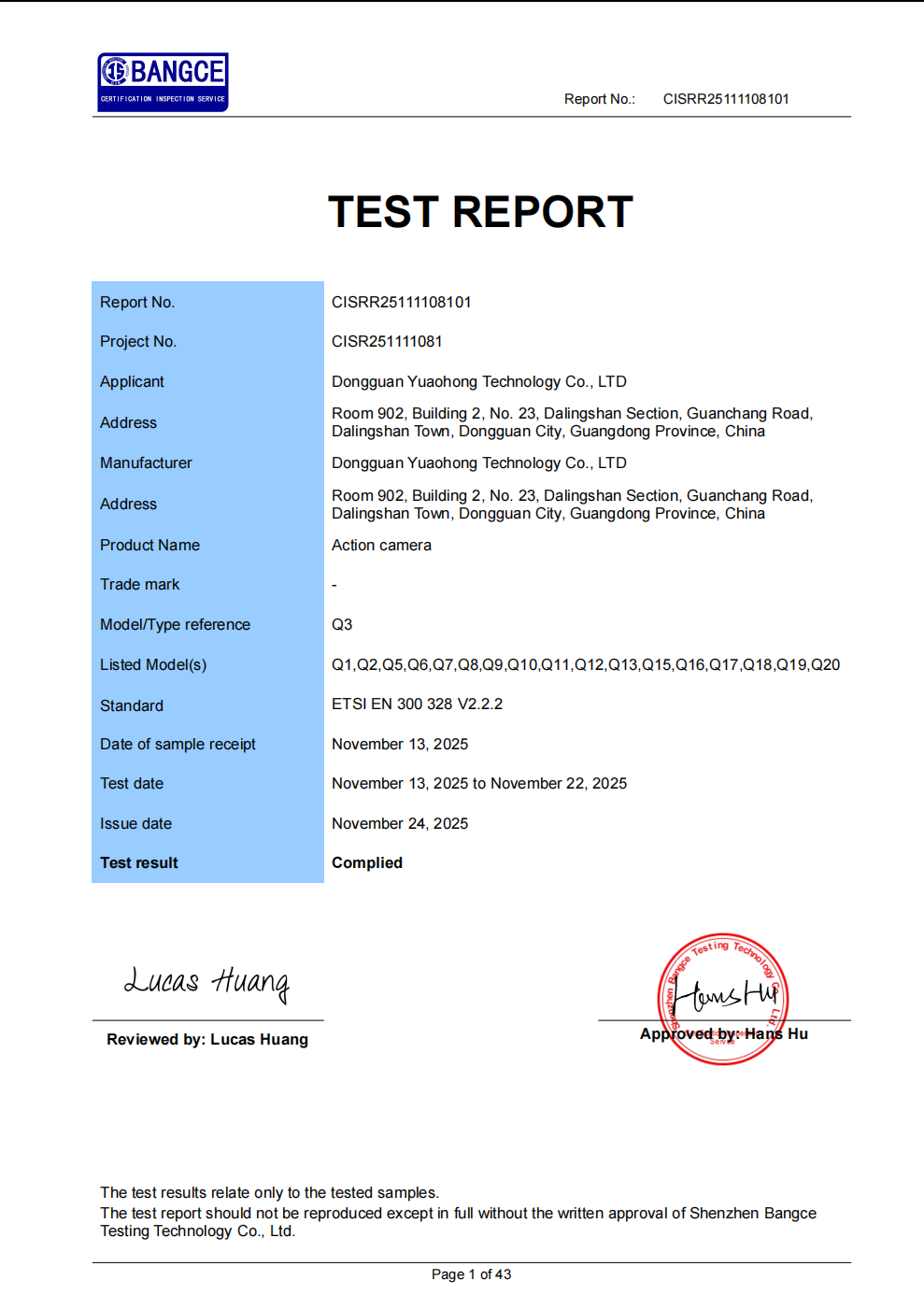
RF test report CISR251111081, issued against ETSI EN 300 328 V2.2.2 — the radio standard cited for the WiFi-enabled Q-series models.
Decision rule. Specify the 4K models when post-production flexibility or platform delivery standards drive the brief. Specify the 1080-line model when file handling, transfer time and runtime carry more weight than pixel count.
Question 2 — Touch screen or physical buttons: reading the interface line
Control interface is an ergonomics decision that eventually shows up in support conversations. The Q2 specification line reads Standard touch & physical dual buttons, paired with a 1.8-inch IPS display at 800×480 resolution. It is the only model in this comparison whose published specification lists a touch interface, and it combines that with a 6-level electronic image stabilization function.
The Q1 and Q3 specification lines list 1.5-inch IPS displays at 320×240 and do not list a touch interface, so buyers should plan for conventional physical controls on those models. The X20 lists a 1.54-inch IPS display at 320×240 and likewise does not list a touch interface.
In the field, the two control types solve different problems. Touch input is efficient for menu navigation, settings changes and reviewing footage on a larger, higher-resolution panel. Physical buttons are what an operator uses to start and stop recording without looking at the screen, and they remain the more reliable input when hands are gloved, wet or moving. A dual-input design such as the Q2's allows a workflow to assign each task to whichever input suits it.
The stabilization line on the Q2 also deserves context. Electronic image stabilization has become a standard feature in budget to mid-range action cameras, using software algorithms to correct motion. Its presence is therefore a baseline expectation rather than a differentiator on its own.
Decision rule. Specify touch plus physical dual buttons where operators will change settings frequently and shoot in mixed conditions. Specify the physical-only interface where simplicity, cost control and glove-friendly operation dominate, and confirm during sampling that screen size and resolution still meet the review workflow.
Question 3 — Battery trade-offs: why 1000mAh and 2000mAh do not settle the argument
| Model | Published battery | Published video working time | Published recording working time |
|---|---|---|---|
| X20 | 1000mAh / 3.8V polymer | About 6–7 hours | About 9 hours |
| Q1 | 2000mAh / 3.8V polymer | About 4–5 hours | About 9 hours; maximum photo duration approximately 10 hours at 720p 30fps |
| Q2 | 18650, 2000mA | About 4–5 hours | Not stated |
| Q3 | 2000mAh / 3.8V polymer | Not stated in the published specification | Not stated |
Ranking models by cell capacity produces the wrong answer, because capacity is a property of the cell while runtime is a property of the workload. Two observations follow from the published figures.
First, the smaller 1000mAh cell in the X20 is paired with the longest published video working time in the group, about 6–7 hours, which is consistent with its lower published resolution line: fewer pixels per frame and a lighter processing load draw less energy per hour. Second, the recording working time figure of about 9 hours appears on both the X20 and the Q1 despite different cells, resolutions and interfaces. Buyers should therefore establish what that term covers — resolution, screen state, WiFi state and duty cycle — before placing it in a comparison table.
Catalogue consistency is a third consideration. The Q3 carries a 2000mAh/3.8V polymer battery but its published specification does not state a working time figure at all, which is normal across product ranges but means a procurement comparison cannot be completed from a capacity column alone.
Decision rule. Compare runtime at the resolution and mode the shipment will actually use. Where endurance is the binding constraint, write the runtime figure, the resolution and the mode into the specification, then validate it with a sample under the intended duty cycle.
Infrared night vision: a model-level attribute, not a range-wide assumption
Among the models compared here, the Q3 specification line documents infrared night vision, with infrared switching described as hand regulation — that is, manual switching — alongside a full-range built-in capacitor microphone. Other models in the published document set, including the Q5, Q9, Q11 and X11, also state infrared night vision, with switching described as manual adjustment or one-button control depending on the model.
The published specification lines for the X20, the Q1 and the Q2 do not list infrared night vision. Buyers whose brief includes low-light or night recording should therefore treat night capability as a model-level attribute: specify the model whose published line documents it, and confirm the switching method during sample validation, because manual switching and one-button control change how an operator works in the dark.
How YUAOHENG's published capability maps to these questions
Dongguan YUAOHENG Electronic Technology Co., Ltd. was founded in 2016 and operates a 1,500㎡ standardized production facility with 300 employees, including a 30-engineer R&D team, and an annual output of 2,000,000 units. Approximately 80% of output is exported to Europe, North America, Asia and South America, and the company's products hold FCC, CE and RoHS certification. Product and capability documentation is maintained at yuaoheng.com.
The company provides OEM and ODM production services with a stated monthly production capacity of 170,000 units. Customization covers four defined areas: product design and R&D services, including product concept design, prototype development, engineering technical consultation and certification support; hardware and function customization, covering camera modules, sensors and detection functions; software and intelligent function customization, covering firmware development, intelligent functions, APP and cloud services; and appearance and packaging customization, covering product colour, material, logo engraving, brand logo, size and structure, retail packaging, instructions and accessories.
For buyers moving from evaluation into execution, the published commercial terms are equally specific. The minimum order quantity is 1 unit, which makes sample validation possible before volume is committed. Delivery is arranged through EXW and FOB methods, acceptance criteria are based on pre-shipment test, and the accepted payment method is 30% T/T in advance with a 70% T/T balance payment. Quality control is described as 100% test, and after-sales support includes a 12-month official warranty, online technical guidance and troubleshooting, replacement and maintenance services, and the provision of certification documents, sales materials and long-term technical iteration support.
An execution example from the company's case record: a US-based action camera brand has ordered 5,000 units within a five-year supply relationship, for applications covering travel vlog shooting, outdoor hiking and camping recording, and daily life video blogging.
Market context: why specification clarity is becoming the differentiator
The global action camera market was valued at USD 6.57 billion in 2024 (SkyQuest, Action Camera Market Size & Growth Report 2032). Published valuations vary by research scope — accessories, professional body cameras and adjacent categories are included or excluded differently across houses — so any single number should be treated as scope-dependent.
Resolution has already moved past the tipping point. The ultra-HD segment, covering 4K and above, accounted for approximately 46.25% of action camera market share in 2025 (Mordor Intelligence). When roughly half the category is already specified at 4K or better, resolution stops being the selection argument and becomes a baseline requirement, which pushes the actual decision back to interface ergonomics, runtime at the target resolution and documentation quality.
Two further signals support that reading. Electronic image stabilization has become a standard feature in budget to mid-range action cameras, using software algorithms to correct motion, so its presence is no longer a differentiator. And the branded tier is heavily consolidated in some markets: GoPro sold 3 million camera units in 2023, a 6% increase over the previous year, while DJI and Insta360 together held nearly 90% of action camera market share in Japan as of late 2025 (PetaPixel / BCN+R). Private-label and OEM programmes therefore compete less on brand share and more on specification transparency, configurability and supply continuity.
Trade data points the same way. In 2024, China exported USD 166 million in video cameras, with the United States the top destination at USD 31.8 million (OEC). Buyers sourcing from Chinese manufacturing bases are working with a concentrated supply side and an increasingly specification-literate one.
Compared with traditional single-configuration sourcing
Older sourcing practice treated headline resolution as the buying decision: one fixed configuration, selected by name, with limited sample validation and few written assumptions about interface or runtime. That approach still works for a single SKU aimed at a single, well-understood application. It breaks down when a private-label programme spans several models with different resolution lines, interfaces and battery configurations.
What changes under a specification-led process is mostly what gets written down. The specification line rather than the model name becomes the acceptance reference, measured against a pre-shipment test. Interface, runtime and night capability are treated as model-level attributes to be specified individually rather than as range-wide features to be assumed. Sample validation becomes possible at a minimum order quantity of 1 unit, so configuration risk can be examined before volume is committed.
Limitations buyers should plan around:
- Capability coverage is not uniform across the range. Infrared night vision with manual switching is documented on the Q3 and on other models such as the Q5, Q9, Q11 and X11, but it is not listed on the published specification lines for the X20, the Q1 or the Q2. A night-recording brief therefore narrows the eligible model list.
- Published runtime is manufacturer-stated. The X20, Q1 and Q2 figures were produced under the manufacturer's conditions, not the buyer's duty cycle. They are a starting point for validation rather than a contract metric on their own.
- The specification lines cited here do not state an ingress protection rating. Where immersion is part of the requirement, an IP rating as defined by IEC 60529 — IP68 being dust-tight and protected against immersion — should be confirmed in writing for the specific model.
- Sample quantity is not volume. A minimum order quantity of 1 unit supports validation; typical production lead time is 25–30 days, and customization scope adds engineering steps such as concept design, prototyping, firmware work or packaging development before mass production begins.
- Safety and compliance scope must be matched to the model. Action cameras sit within the scope of IEC 62368-1, the safety standard for audio/video and information technology equipment, whose 4th edition was published in 2023; confirming the applicable edition and any national deviation remains part of the buyer's due diligence.
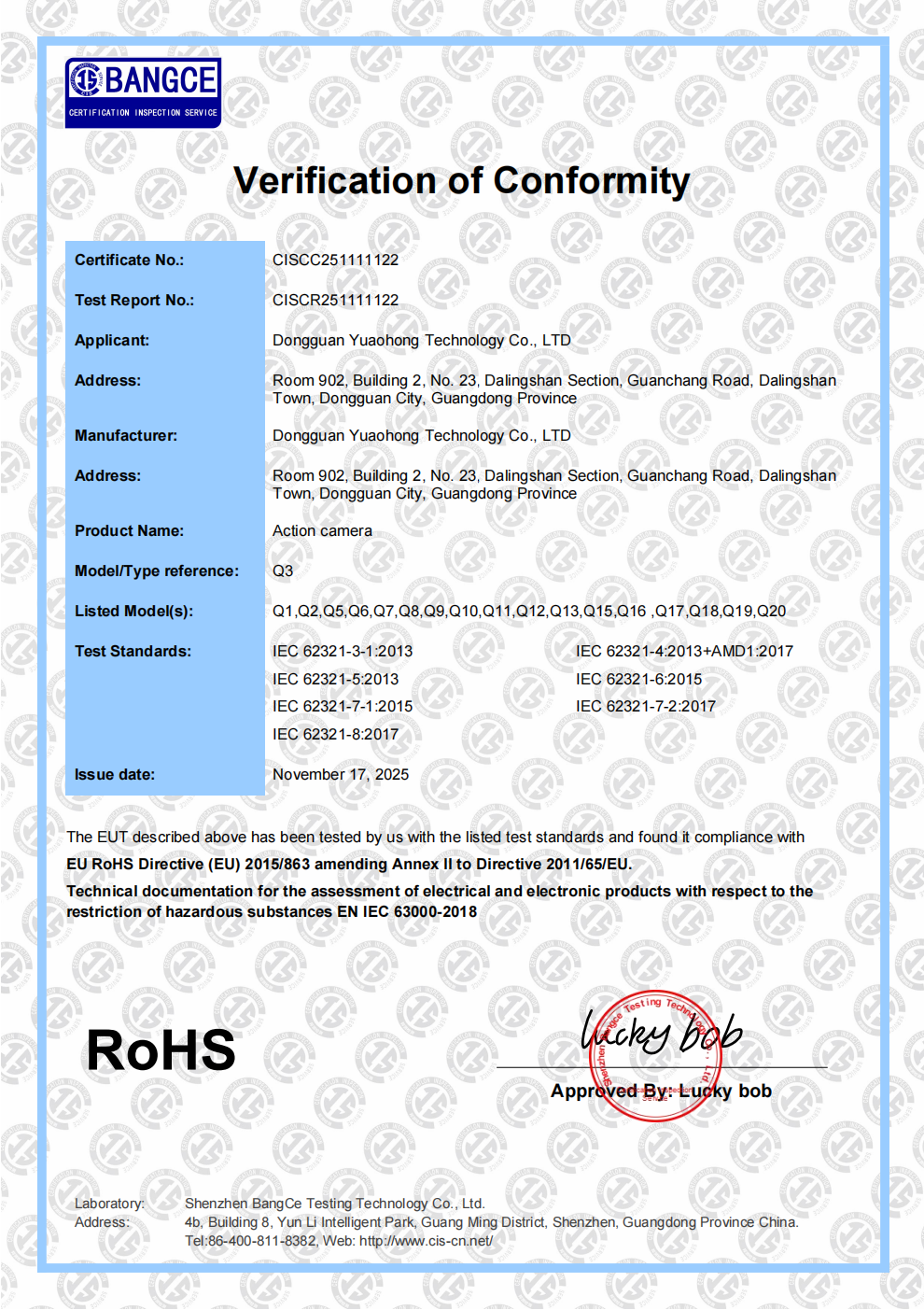
RoHS certificate CISCC251111122, issued under EU 2015/863 (issued 17 November 2025) — certificate scope should be matched to the exact model number on the purchase order.
Future outlook
The direction of travel is toward fewer arguments and more annexes. Dual-recording configurations with front and rear 4K paired with simultaneous 2K + 2K modes are already standard across the Q1, Q2 and Q3 lines, and with the ultra-HD segment holding roughly 46.25% of market share in 2025, buyers are shifting the question from whether to specify 4K to which configuration delivers the required runtime at that resolution.
Interface choice will stay contested rather than converge. Touch panels are getting larger and higher-resolution — the Q2's 1.8-inch 800×480 panel against the 1.5-inch 320×240 panels on the Q1 and Q3 shows how quickly that variable moves — while physical controls remain the input operators trust in gloves, water and motion. Dual-input designs that accommodate both are likely to become the default expectation rather than a premium option.
Documentation is the third shift. As private-label programmes scale, buyers are treating specification lines and certificate scopes as contractual annexes rather than marketing material, matching each certificate to the exact model number before a purchase order is issued. Manufacturers who can supply consistent specification lines, current certification documents and stable technical iteration support will find that documentation quality becomes a commercial advantage, not an administrative cost.
Frequently asked questions
What is the minimum order quantity, and can a single unit be ordered for evaluation?
The minimum order quantity is 1 unit, which allows a buyer to obtain a sample before committing to volume. Delivery is arranged through EXW and FOB methods, acceptance criteria are based on pre-shipment test, and the accepted payment method is 30% T/T in advance with a 70% T/T balance payment.
Which models in this comparison are specified at 4K, and which are not?
The Q1, Q2 and Q3 specification lines state front recording and rear recording at 4K (3840×2160) with simultaneous dual recording at 2K + 2K; the Q2 additionally lists three selectable modes. The X20 is designated 2K+WIFI X20 and its published camera resolution line reads AVI (1920×1080). Buyers comparing 2K and 4K should compare these specification lines rather than the model designation.
How do the Q1 and Q2 control interfaces differ?
The Q2 specification lists a 1.8-inch IPS display at 800×480, standard touch and physical dual buttons, and a 6-level electronic image stabilization function. The Q1 lists a 1.5-inch IPS display at 320×240 and does not list a touch interface, so the Q1 is operated through its conventional physical controls.
The X20 lists a 1000mAh battery and the Q1 and Q3 list 2000mAh — does that decide runtime?
Not on its own. The X20's published video working time is about 6–7 hours with a recording working time of about 9 hours. The Q1's published video working time is about 4–5 hours, with a recording working time of about 9 hours and a maximum photo duration of approximately 10 hours at 720p 30fps high-quality video. The Q2 states about 4–5 hours of video working time. The Q3 specification does not state a working time figure. Runtime depends on resolution, recording mode and duty cycle, so figures should be confirmed for the configuration actually ordered.
Do all models support infrared night vision with manual switching?
Infrared night vision with hand regulation — manual switching — is documented on the Q3 specification line, which also lists a full-range built-in capacitor microphone. Models including the Q5, Q9, Q11 and X11 also state infrared night vision. The published specification lines for the X20, Q1 and Q2 do not list infrared night vision, so night capability should be specified per model rather than assumed across the range.
What does an OEM or ODM engagement cover?
Four published areas. Product design and R&D services cover product concept design, prototype development, engineering technical consultation and certification support. Hardware and function customization covers camera modules, sensors and detection functions. Software and intelligent function customization covers firmware development, intelligent functions, APP and cloud services. Appearance and packaging customization covers product colour, material, logo engraving, brand logo, size and structure, retail packaging, instructions and accessories.
What production capacity, lead time and quality control apply?
Monthly production capacity is 170,000 units and typical production lead time is 25–30 days. Quality control is described as 100% test. After-sales support includes a 12-month official warranty, online technical guidance and troubleshooting, replacement and maintenance services, and the provision of certification documents, sales materials and long-term technical iteration support.
Which certificates cover the models discussed here?
CE certification CISRC251111081V1, issued by BANGCE under ETSI EN 300 328 V2.2.2, covers the Q3, Q1, Q2, Q5, Q7 and other Q-series models. RoHS certificate CISCC251111122, issued by BANGCE under EU 2015/863, covers the same Q-series scope. FCC ID certification 2BR43-Q3 covers the Q3 under 47 CFR Part 15.247. A further FCC certification, CQASZ20260601273E-01 under 47 CFR Part 15, Subpart C, covers the X7, M16S, M17S, M29S and M30S. Certificate scope should be matched to the exact model number on the purchase order.
Reference document: YUAOHENG product catalogue (PDF).