
Action Camera Shortlist: Five Models Worth Comparing for OEM Buyers
Action Camera Shortlist: Five Models Worth Comparing for OEM Buyers
OEM buyers rarely struggle to find an action camera. What takes time is narrowing five credible models down to the one that fits a specific project — a diving housing line, a motorcycle mount bundle, a vlog kit, or a fleet dash-cam program. This shortlist compares the YUAOHENG X20, Q1, Q2, Q3, and Q7 on specification data and on the scenario each model is built around, not on performance claims that cannot be checked before sampling.
The category is mature enough that specification overlap is the norm rather than the exception. Five models from one production base can share lens geometry, screen technology, and audio architecture while behaving very differently in the field. The differences that matter to a buyer are narrower than a spec sheet suggests: how the infrared light is triggered, whether the lens rotates, how large the battery is, and whether the unit takes a case.
Why a Five-Model Shortlist Is Harder Than a Ten-Model Catalogue
A catalogue is built to show range. A shortlist is built to show fit, and those are different jobs. When a buyer receives twenty models with forty attributes each, the comparison collapses into a spreadsheet exercise where price and resolution become the only variables anyone can actually weigh. The result is usually the same: the cheapest 4K unit wins the sample request, and the scenario requirement is discovered later, during field testing.
A shorter list forces the opposite discipline. Five models is roughly the maximum a procurement team can evaluate against real use conditions — outdoor sports, driving and transportation, photography and video shooting, and low-light recording — without the comparison turning back into a catalogue.
The opportunity sits in that constraint. Ultra-HD (4K and above) resolution accounted for approximately 46.25% of action camera market share in 2025, according to Mordor Intelligence. When roughly half the category is specified at 4K, the remaining decisions stop being about resolution and start being about everything else: battery, mounting, stabilization, infrared control, and whether the body takes a waterproof case. Those are the axes this shortlist is organised around.
The Production Base Behind the Shortlist
Dongguan YUAOHENG Electronic Technology Co., Ltd. is an action camera, dash camera, and smart video doorbell manufacturer based in Dongguan, China, founded in 2016. The company operates a 1,500㎡ production facility with around 300 employees, reports annual output of 2,000,000 units and a 30-engineer R&D team, and exports roughly 80% of output to Europe, North America, Asia, and South America. Its products carry FCC, CE, and RoHS certification.
For a buyer, the relevant point is not scale. It is that all five models below come from one production base, which matters when a project needs consistent tooling, packaging, and documentation across two or three variants sold into the same channel. YUAOHENG also runs OEM and ODM customization covering product design and R&D, hardware and function customization, firmware and app development, and appearance and packaging design, with a stated lead time of 25–30 days and a minimum order quantity of one unit for sampling.
X20 — A 2K+WiFi Model Built Around Manual Infrared Control
The X20 is a 2K+WiFi action camera built on a 1.54-inch IPS display at 320×240. Its 130° HD lens is paired with four integrated energy-saving infrared lights, and infrared switching is manual rather than automatic — the operator decides when the fill light comes on instead of leaving it to a threshold the firmware sets.
Power comes from a 1000mAh/3.8V polymer battery, with a stated video working time of about 6–7 hours and a recording working time of about 9 hours. Maximum photo duration is quoted at approximately 12 hours at 720p 30fps. Input is Micro-Type-C at DC5V-1A to 2A, storage supports 64GB, 32GB, 16GB, or 128GB cards, the interface is high-speed Mini USB 2.0, and audio runs through a full-range built-in capacitor microphone.
Manual infrared control is the detail worth pausing on. Automatic switching is convenient in a demo and unreliable in the field, because it triggers on ambient light rather than on what the operator is trying to record. A manual switch keeps the decision with the person holding the camera, which suits night hiking routes, roadside recording, and any program where the end user has a fixed idea of when the fill light should be active.
Q1 — A 4K+WiFi Model With Front and Rear Lenses
The Q1 records 4K (3840×2160) from a front lens and 4K (3840×2160) from a rear lens, and supports simultaneous dual recording at 2K + 2K. The lens is a 130° HD wide-angle unit with a rotating direction, mounted on a 1.5-inch IPS display at 320×240.
Power is a 2000mAh/3.8V battery, with approximately 4–5 hours of video working time and about 9 hours of recording time. Maximum photo duration is quoted at roughly 10 hours at 720p 30fps. The Q1 is compatible with a waterproof case for waterproof shooting, supports infrared night vision, and uses a full-range built-in capacitor microphone with a high-speed Mini USB 2.0 interface.
The rotating lens changes how the unit mounts. A fixed lens forces the whole body into a specific orientation, which is often the constraint that ruins a handlebar or chest-harness bracket. A rotating lens lets the body sit flat and the optics point where they need to point.
Q2 — A 4K WiFi Model With Touch Screen and Electronic Stabilization
The Q2 is positioned as a 4K WiFi action camera with a touch screen and electronic image stabilization rated at six levels. It is compatible with a waterproof case for wet and underwater shooting.
The touch screen changes the operator workflow more than it changes the specification. Settings that would otherwise require a phone connection or a button sequence are changed directly on the display, which matters in the field where gloves, weather, and time all argue against opening an app. The six-level EIS is the second half of that workflow argument: stabilization is what makes handheld and body-mounted footage usable without a gimbal.
Electronic image stabilization has moved from a premium differentiator to a standard expectation in the budget-to-mid-range tier, a shift Insta360 documents in its EIS guidance material. For a buyer, that means EIS is no longer a selling point on its own — it is a baseline the Q2 meets, and the differentiation has to come from how the stabilization interacts with the rest of the package.
Q3 — A 4K WiFi Model Built for Two Simultaneous Viewpoints
The Q3 records 4K (3840×2160) from the front lens and 4K (3840×2160) from the rear lens, with simultaneous dual recording at 2K + 2K. It pairs that with a 1.5-inch IPS display at 320×240, a 130° HD wide-angle lens with rotating direction, infrared night vision with manual switching, a full-range built-in capacitor microphone, and a 2000mAh/3.8V battery.
Two 4K-capable lenses recording at once is a different product category from a single-lens camera with a wide field of view. It is the difference between covering a scene and covering two scenes — the road ahead and the cabin behind, the trail and the rider, the demonstration and the reaction.
Q7 — A 4K WiFi Model With Stabilization and Rotating Optics
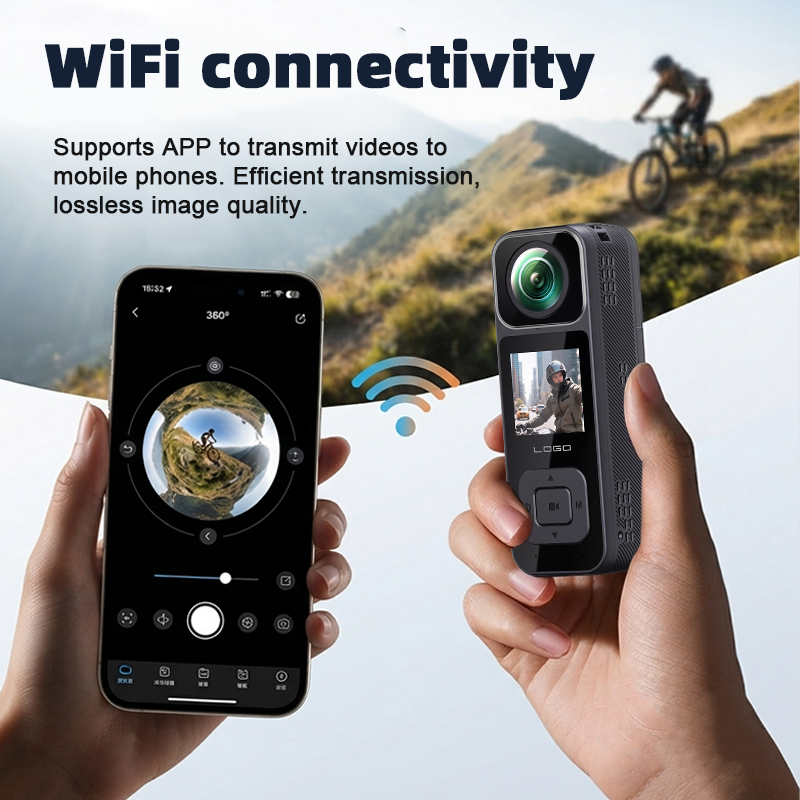
The Q7 records 4K (3840×2160) at 30fps with image stabilization support, on a 1.47-inch IPS display at 320×240. The 130° HD wide-angle lens rotates, infrared night vision is supported, audio is handled by a full-range built-in capacitor microphone, and the battery is a 1000mAh/3.8V polymer pack. The Q7 is compatible with a waterproof case for waterproof shooting and uses a high-speed Mini USB 2.0 interface.
The capacitor microphone is a quieter detail with real consequences. Capacitor (electret condenser) capsules generally deliver a wider frequency response than the small dynamic microphones used in low-cost housings, and the full-range specification on the Q7 is the audio counterpart to its stabilization: both are aimed at footage that does not need post-processing rescue.
Specification Comparison Across the Five Models
The table below lists only attributes confirmed in the product specification set. Where an attribute is not part of the confirmed data, it is left blank rather than estimated.
| Model | Video & Wireless | Display | Lens & Night Vision | Battery | Primary Fit |
|---|---|---|---|---|---|
| X20 | 2K + WiFi | 1.54" IPS, 320×240 | 130° HD; four infrared lights, manual switching | 1000mAh/3.8V; approx. 6–7 h video | Controlled low-light and entry-tier bundles |
| Q1 | 4K + WiFi; front 4K + rear 4K; simultaneous 2K + 2K | 1.5" IPS, 320×240 | 130° rotating; infrared night vision | 2000mAh/3.8V; approx. 4–5 h video | Travel vlog, hiking and camping |
| Q2 | 4K + WiFi; touch screen; six-level EIS | Touch screen | Waterproof-case compatible | — | Handheld and body-mounted stabilized shooting |
| Q3 | 4K + WiFi; front 4K + rear 4K; simultaneous 2K + 2K | 1.5" IPS, 320×240 | 130° rotating; infrared night vision, manual switching | 2000mAh/3.8V | Driving and transportation dual-view programs |
| Q7 | 4K (3840×2160) 30fps + WiFi; image stabilization support | 1.47" IPS, 320×240 | 130° rotating; infrared night vision | 1000mAh/3.8V | High-vibration outdoor sports and case-based waterproofing |
What the Specification Differences Mean on a Production Line
Screen size is the first thing buyers discount and the last thing they should. The X20 at 1.54 inches, the Q1 and Q3 at 1.5 inches, and the Q7 at 1.47 inches are close enough to look interchangeable on paper. In a housing, they are not. Every display dimension shifts the internal stack, the sealing geometry, and — for programs that resell a case separately — whether an existing mould can be reused across two SKUs. That single millimetre is the difference between one tooling investment and two.
Rotating optics carry a similar hidden cost. The Q1, Q2, Q3, and Q7 all use rotating designs, while the X20 uses a fixed 130° HD lens. A rotating lens reduces the number of bracket variants a program needs, because the body can be mounted flat in more positions. A fixed lens is simpler to seal and cheaper to assemble in volume. Neither is better in isolation — the choice depends on whether the channel sells mounts or sells housings.
Battery capacity divides the line cleanly. The Q1 and Q3 carry 2000mAh/3.8V packs, while the X20 and Q7 carry 1000mAh/3.8V polymer packs. That is not a defect in the smaller cells; it is a weight and form decision that shows up as roughly 6–7 hours of stated video working time on the X20 against approximately 4–5 hours on the Q1. Buyers who compare raw milliamp-hours without matching them to the housing size and the mounting load will pick the wrong unit for a helmet or handlebar application.
Infrared switching is the specification most likely to be silently changed during production. Both the X20 and Q3 use manual switching, and both use four enhanced energy-saving lights — the X20 with infrared emitters and the Q3 with infrared night vision support. Manual control must be written into the acceptance criteria, or a later build can drift toward automatic triggering without anyone flagging it.
Scenario Fit: Outdoor Sports, Driving, Photography, and Low Light
Outdoor sports equipment
Outdoor programs run from -20°C to 60°C, in dustproof, waterproof, and shockproof conditions, across high-vibration scenarios such as motorcycle riding, mountain biking, and off-road driving, and high-speed environments such as skiing and skydiving. Within that envelope, the Q7 is the closest fit for vibration-heavy work because stabilization is specified as a supported function; the Q1 covers programs where a self-facing second view matters more than a stabilized single view; and the Q2 addresses the sub-segment that reconfigures settings on the device rather than through an app.
Driving and transportation
In vehicle and transportation use, the camera functions as a dash cam for safety monitoring, and the requirement shifts from image quality to repeatability. The Q3 is the most direct match in this shortlist: front 4K plus rear 4K with simultaneous 2K + 2K recording covers two viewpoints in one body, which is the configuration rideshare, fleet, and motorcycle programs keep asking for. The 2000mAh/3.8V battery supports the continuous duty those installations assume.
Photography and video shooting
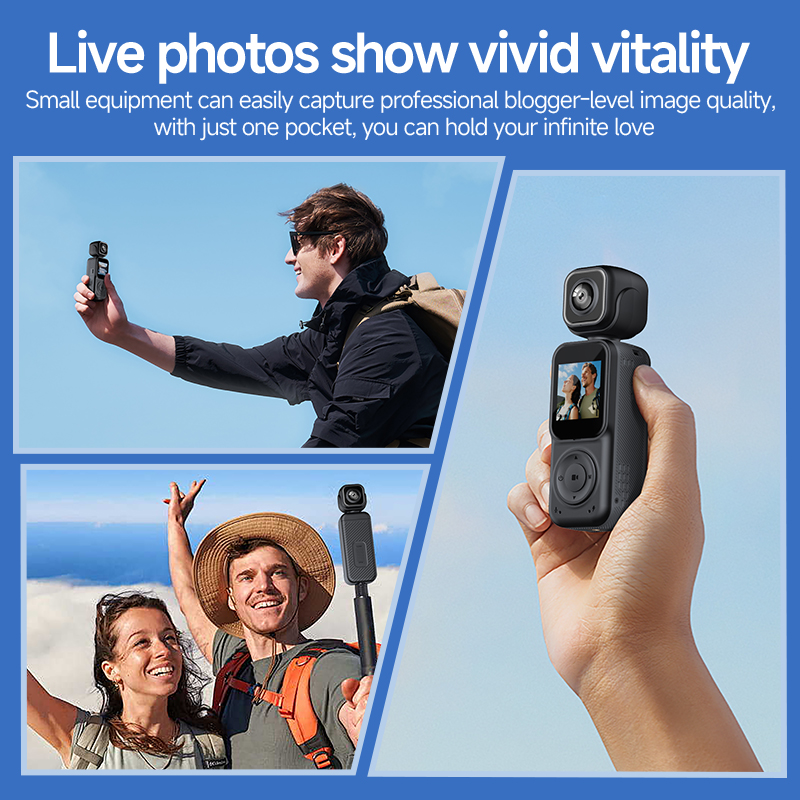
Travel vlog shooting, outdoor hiking and camping recording, and daily life video blogging form the third cluster. A US-based action camera brand OEM has run this application on the YUAOHENG line for five years on orders in the region of 5,000 units — a reference point for how the category is bought rather than a performance claim. For this cluster, the Q1 is the natural entry because front and rear 4K in one body removes the second camera from the kit list, and the Q2 covers the handheld segment where the touch screen and six-level EIS carry the workflow.
Low light and underwater
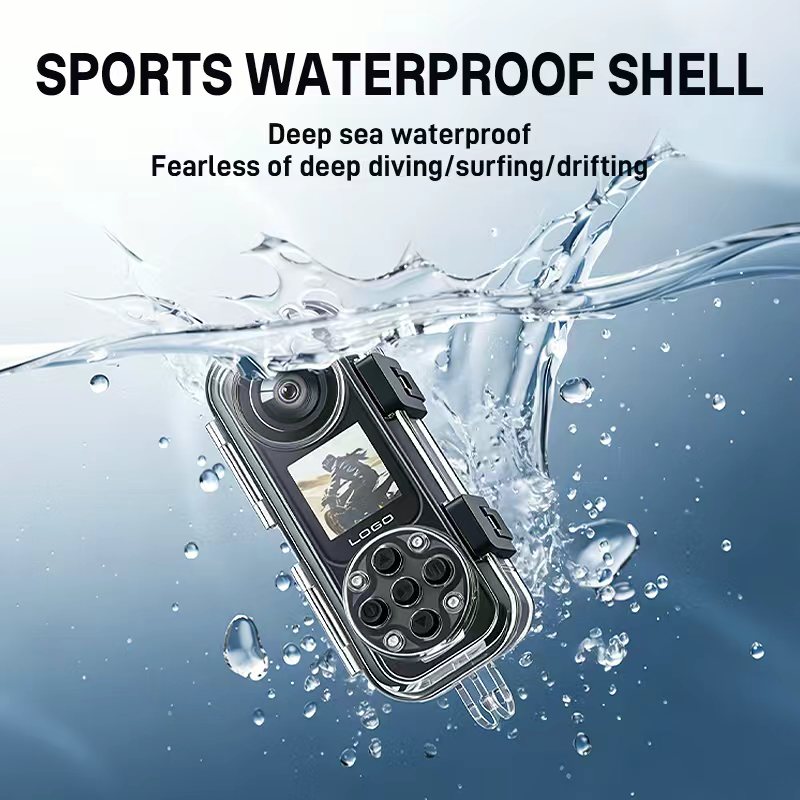
Low-light environments such as night hiking and underwater diving are where infrared control and case compatibility separate the models. The X20's manual infrared switch is designed for exactly this condition. Underwater work depends on the housing rather than the body: the Q1, Q2, and Q7 are specified as compatible with a waterproof case for waterproof shooting, so the case becomes a line item in the program rather than an accessory. Buyers should confirm case availability with the supplier before committing a dive-specific SKU.
Market Trends Shaping the 2026 Shortlist
Estimates of the global action camera market vary by scope. SkyQuest Technology values the market at USD 6.57 billion for 2024, while Grand View Research places the 2025 figure at USD 7.97 billion and Mordor Intelligence at USD 7.09 billion. The spread reflects differences in what each study counts — accessories, professional body cameras, and adjacent categories — rather than disagreement about direction. North America held a 34% revenue share in 2025 according to Grand View Research.
China's role in that market is concentrated on the supply side. OEC data records USD 166 million in Chinese video camera exports for 2024, with the United States as the top destination at USD 31.8 million. China's domestic action camera market was estimated at USD 502.25 million in 2024 by Market Research Future.
Two structural shifts matter for buyers assembling a shortlist. First, 4K has become the default specification rather than a premium one, which compresses the price premium a 4K unit can command and pushes differentiation toward battery, stabilization, and mounting flexibility. Second, brand concentration has intensified in specific markets — DJI and Insta360 held nearly 90% of the action camera market share in Japan as of late 2025, per PetaPixel reporting on BCN+R data. For OEM programs, that concentration is not a threat so much as a map: the channels those brands dominate are not the channels an OEM shortlist is aimed at.
Limits, Trade-offs, and Where These Models Should Not Be Used
The traditional sourcing instinct is to pick one chassis and push it across every channel, on the theory that a single SKU simplifies inventory and after-sales. That approach has a real cost the five-model structure avoids, but the five-model structure carries costs of its own, and buyers should be clear about them.
The clearest limit is battery. The Q7 and X20 carry 1000mAh/3.8V polymer packs, and neither should be the primary unit for continuous multi-hour recording in a fixed installation. Programs that assume eight hours of unattended capture need the 2000mAh platform found in the Q1 and Q3, and even there the stated figures — approximately 4–5 hours of video working time on the Q1 — should be validated against the actual recording mode and ambient temperature before they are written into a specification sheet.
The second limit is resolution tier. The X20 is a 2K+WiFi model. If a tender, marketplace listing, or retail partner requires a 4K specification, the X20 is disqualified on the first line of the brief regardless of how well its manual infrared control suits the use case. That is not a shortcoming of the model; it is a reminder that scenario fit and specification thresholds are separate filters, and both have to be applied.
The third limit concerns waterproofing. Compatibility with a waterproof case is not the same as a sealed, pressure-rated body. The Q1, Q2, and Q7 are specified as case-compatible; underwater programs must therefore treat the housing as a separately qualified component with its own sampling and acceptance process. Buyers who assume case compatibility equals immersion readiness will discover the difference at the worst possible moment.
Future Outlook
The direction of travel is toward fewer differentiators, not more. Stabilization, WiFi, and 4K are converging into the baseline, and the attributes that will separate 2027 shortlists from 2026 ones are the ones currently treated as secondary: the configurability of infrared behaviour, the serviceability of the battery platform, the reusability of housings across SKUs, and the traceability of firmware versions across production batches.
Regulatory pressure is a quiet but persistent factor. IEC 62368-1, the safety standard covering audio/video and information technology equipment, published its 4th edition in 2023, and action cameras fall within its scope. IP ratings are defined separately under IEC 60529, which sets out the IP68 designation for dust and immersion protection. Buyers operating in the EU and UK will also need to confirm that CE and UKCA documentation on file matches the exact build being ordered, since the certification is attached to a configuration, not to a model name.
For OEM programs, the practical implication is that the shortlist document is becoming a compliance document as much as a product document. The five models here are a starting structure; the buyer's job is to keep the specification table and the acceptance criteria in the same file.
Purchasing Terms and Acceptance Criteria to Confirm Before Requesting Samples
The checklist below is deliberately narrow. It covers the terms where a mismatch between order and confirmation is most expensive to correct after tooling starts.
- Model and configuration lock. Confirm the exact model designation and the build being quoted, including screen size (1.54", 1.5", or 1.47"), lens type (fixed or rotating), and infrared switching mode (manual or automatic).
- Battery specification in writing. State capacity and chemistry — 2000mAh/3.8V versus 1000mAh/3.8V — and the recording mode used to derive the quoted working time. Require both figures on the confirmation document.
- Video resolution and frame rate. For dual-lens models, specify front and rear resolution separately, plus the simultaneous dual-recording mode. Confirm the interface standard: high-speed Mini USB 2.0 on the Q1, Q3, Q7, and X20; Micro-Type-C DC5V-1A to 2A input on the X20.
- Storage and accessory scope. Confirm supported card capacities (the X20 supports 64GB, 32GB, 16GB, or 128GB) and whether the waterproof case, mounts, and selfie stick are in-scope or sold separately.
- Certification and documentation package. Confirm FCC, CE, and RoHS documentation is available for the exact build, and that the test reports reference the configuration being ordered rather than a sibling model.
- Commercial terms. Minimum order quantity, unit price at each volume band, stated lead time (25–30 days for YUAOHENG OEM and ODM programs), payment terms, and Incoterms.
- Customization scope. If branding, colour, packaging, or firmware changes are required, confirm which of the four customization layers applies — design and R&D, hardware and function, software and firmware, or appearance and packaging — and how each affects lead time.
- After-sales terms. Confirm warranty duration, replacement procedure, spare parts availability, and the technical support channel. YUAOHENG states a 12-month official warranty with online technical guidance and after-sales troubleshooting.
- Sample acceptance criteria. Define pass/fail before the sample ships: button response, screen visibility at 320×240 under daylight, infrared switching behaviour, rotation smoothness on rotating-lens models, recorded audio level, and battery runtime under the intended recording mode.
- Batch consistency clause. Agree how component substitutions will be communicated and approved, and require written notice before any change to the lens, battery cell, or microphone specification.
A buyer who completes this list before requesting samples converts a product comparison into a procurement decision. The models themselves are straightforward; the risk sits in the gap between what a catalogue says and what a confirmation document states.
Frequently Asked Questions
How should a buyer match an action camera model to a project scenario?
Match on the constraint that is hardest to change, not on the specification that looks most impressive. For vibration-heavy outdoor programs, that constraint is stabilization. For dual-viewpoint driving programs, it is the ability to record front and rear simultaneously — the Q3 records front 4K and rear 4K with simultaneous 2K + 2K dual recording. For controlled low-light work, it is infrared switching behaviour, where the X20 and Q3 use manual adjustment. Resolution, WiFi, and screen size are secondary filters applied after the scenario constraint is satisfied.
Which models suit high-vibration applications such as motorcycle riding, mountain biking, and off-road driving?
High-vibration environments are explicitly part of the intended operating envelope, alongside dustproof, waterproof, and shockproof conditions and an operating temperature range of -20°C to 60°C. Within this shortlist, the Q7 specifies image stabilization support and records 4K at 30fps with a rotating 130° lens, which suits vibration-heavy mounting positions. The Q2 provides six-level electronic stabilization on a touch-screen 4K WiFi platform. The Q1 and Q3 provide a 2000mAh/3.8V battery platform that supports longer continuous duty, which matters when the vibration scenario also involves extended recording.
How does the X20 differ from the Q3 for low-light and night recording?
Both use manual infrared switching. The X20 is a 2K+WiFi model with four integrated energy-saving infrared lights on a 1.54-inch IPS display, and it carries a 1000mAh/3.8V battery with approximately 6–7 hours of stated video working time. The Q3 is a 4K WiFi model that adds front and rear lenses with simultaneous 2K + 2K dual recording, a 1.5-inch IPS display, a rotating 130° lens, and a 2000mAh/3.8V battery. The X20 is the simpler single-view night unit; the Q3 is the dual-view night unit with a larger power reserve.
Is a 2K action camera still relevant when 4K is now the market default?
Yes, in specific positions. Ultra-HD at 4K and above accounted for approximately 46.25% of the action camera market in 2025, which means more than half the market still sits below that threshold. A 2K+WiFi platform such as the X20 competes on attributes other than resolution: manual infrared control, a stated 6–7 hours of video working time, Micro-Type-C input at DC5V-1A to 2A, and support for 64GB, 32GB, 16GB, or 128GB cards. Where a 4K specification is a contractual requirement, the X20 does not qualify — that is a filter question, not a performance question.
When does a project need a waterproof case rather than a sealed body?
Case compatibility is a program decision, not a product feature. The Q1, Q2, and Q7 are specified as compatible with a waterproof case for waterproof shooting. That arrangement suits programs where the same camera is sold into both dry and wet use, because the housing can be bundled only with the dive-oriented SKU rather than engineered into every unit. It also means the case must be qualified separately: pressure performance, seal integrity, and lens port clarity all belong in the acceptance criteria for the housing rather than for the camera.
What should an OEM buyer confirm before requesting samples?
Confirm the configuration to the component level: model designation, screen size, lens type, infrared switching mode, battery capacity and chemistry, video resolution and frame rate for each lens, and storage support. Confirm the commercial frame: minimum order quantity, volume pricing, lead time, payment terms, and the customization layers in scope. Confirm the compliance package — FCC, CE, and RoHS documentation tied to the exact build — and the after-sales terms, including warranty duration and spare parts availability. Finally, write the sample acceptance criteria before the sample ships, covering button response, display visibility, infrared behaviour, rotation smoothness, audio level, and battery runtime in the intended recording mode.
Reference Material
YUAOHENG publishes a full product catalogue covering action cameras, dash cameras, and smart video doorbells, including the models discussed above. The catalogue is available for public download: YUAOHENG product catalogue (PDF).
Company profile references: Dongguan YUAOHENG Electronic Technology Co., Ltd., founded 2016, 1,500㎡ facility, approximately 300 employees, 2,000,000 units annual output, 30-engineer R&D team, FCC/CE/RoHS certification, OEM and ODM customization with a stated 25–30 day lead time.
Есть вопросы или нужны дополнительные детали?
Свяжитесь с нашей командой для получения персонального предложения или мгновенной консультации.
Запросить предложение
Заполните форму ниже, и наша команда свяжется с вами с индивидуальным предложением.
Прямой чат WhatsApp
Предпочитаете общаться в реальном времени? Напишите нам в WhatsApp для мгновенной помощи и быстрых ответов.
- Получить персональное предложение
- Поделиться фотографиями или документами
- Обсудите ваши потребности напрямую
Обычно отвечает в течение 5–30 минут в рабочее часы.