
Aerial Equipment Rental Certification and Specs: A Buyer's Checklist
Aerial equipment rental decisions are increasingly driven by two constraints: compliance evidence and machine specifications. For buyers evaluating scissor lifts and boom lifts, the ability to verify certification and parameters before the equipment reaches the site can be as important as the rental rate itself.
In North America, mobile elevating work platforms (MEWPs) are expected to meet recognized design and safety standards. Knowing which certificates apply, what the numbers on a specification sheet mean, and how a rental supplier documents its fleet changes the procurement process from a price comparison into a risk assessment.
Why Certification Is a Buying Constraint
Rental suppliers can offer similar-looking equipment, but compliance status differs. On a project covered by U.S. or Canadian safety requirements, a MEWP that does not align with ANSI/SAIA A92.20 or CSA B354.6-17 can create delays during site inspections and raise liability questions. Buyers in the research and evaluation stage need more than a brochure photo; they need certificate numbers, applicable standards, and scope of certification.
Scale of the Aerial Equipment Rental Market
Third-party market studies illustrate why fleet quality is becoming a differentiator. Mordor Intelligence estimates the global aerial work platform market will reach USD 22.23 billion by 2026, growing at a CAGR of 7.88% from 2026 to 2031. Fact.MR projects the global aerial lift rental market to expand from USD 21.6 billion in 2026 to USD 31.7 billion by 2036 at a CAGR of 3.9%. The same source reports that scissor lifts accounted for roughly 44% of the aerial lift market in 2025, and Grand View Research places North America at about 36.5% of global aerial work platform revenue. These figures vary by research methodology, but the direction is consistent: demand for aerial equipment, especially rental, is growing.
HIH Rentals: A Certified Equipment Base
HIH Rentals, the aerial equipment rental brand of Roshow Heavy Industry Co., Ltd., is an example of a rental supplier with manufacturing and certification capacity. Roshow Heavy Industry was founded in 2022 and operates a 266,000m² factory with 1,480 employees and an annual output of 20,000 units. Its 40-person R&D team works on scissor lifts, boom lifts, and telehandlers. About 35% of production is exported, with the main markets in the USA and EU. HIH Rentals supports U.S. customers from its base at 8616 Cherry Ave, Fontana, CA 92335.
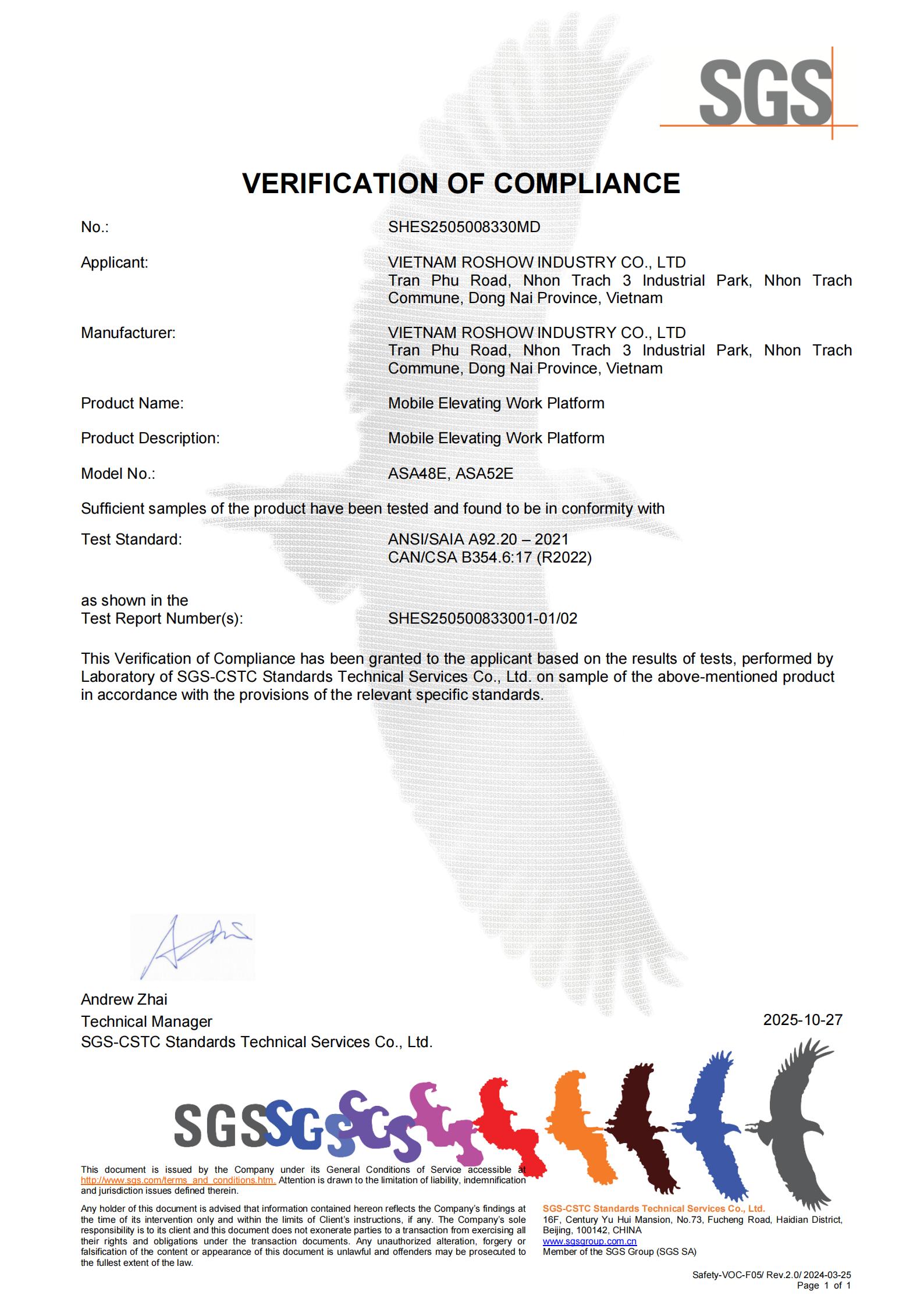
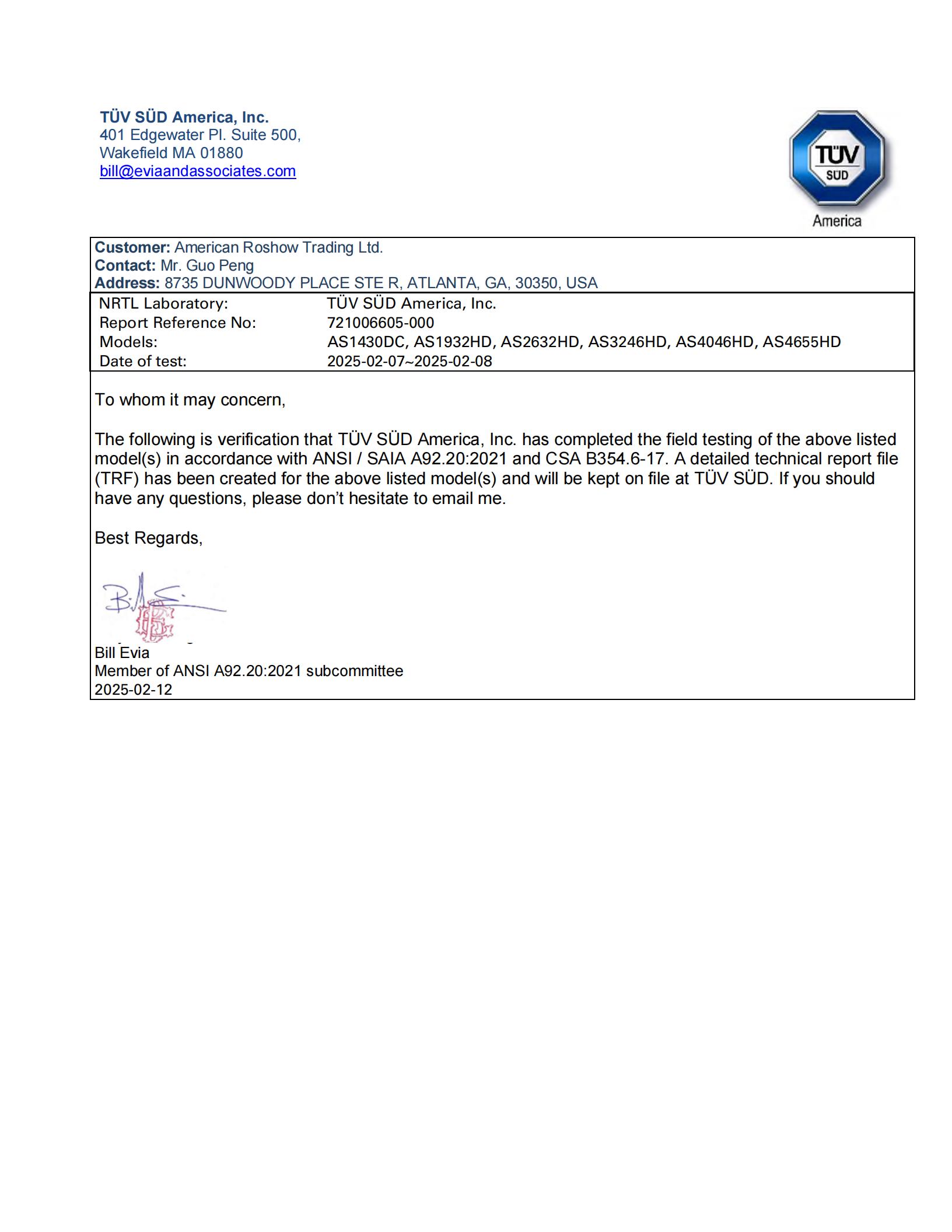
For the rental fleet, HIH Rentals provides MEWP certification records. A certificate issued by SGS, number SHES2505008330MD, covers a MEWP for the USA and Canada under ANSI/SAIA A92.20:2021 and CSA B354.6-17. A second certificate, number 721006605-000, issued by TUV, applies to the same standards for the USA/CA market. Together these documents cover equipment categories including articulated boom lifts and scissor lifts, giving buyers a clear starting point for compliance verification.
Key Specifications That Affect Rental Decisions
Once certification is verified, the next step is matching machine parameters to site conditions. The table below lists representative models from HIH Rentals' boom lift line with key data points.
| Model | Category | Capacity | Drive speed (raised/elevated) | Stowed gradeability | Max working slope | Turning radius (outside) | Tilt sensor activation |
|---|---|---|---|---|---|---|---|
| ASA52E | Articulated boom lift | 564 lbs / 772 lbs lift capacity | 0–0.5 mph | 0.3 | — | 15 ft | 5° |
| AS4046HD | Boom lift | 551 lbs total; 249 lbs extension | 0.5 mph | 25% (14°) | 1.5°/3° | 8 ft 10 in | — |
| AS1932HD | Boom lift | 507 lbs total; 249 lbs extension | 0.5 mph | 25% (14°) | 1.5°/3° | 6 ft | — |
| AST85EⅡ | Telescopic boom lift | 661 lbs / 1,014 lbs lift capacity | 0–0.5 mph | 45% | — | 11 ft | 3° |
Control systems on models such as AS4046HD and AS1932HD are proportional, and drive is via dual front wheel with dual rear wheel multi-disc brakes. Non-marking solid rubber tires are fitted as standard.
In this lineup, several parameters deserve attention. Platform capacity indicates how much combined weight of people and tools can be lifted. The AS4046HD, for example, shows a total platform capacity of 551 lbs and an extension platform capacity of 249 lbs. Models with extension platforms are useful when workers need to reach past an obstacle without repositioning the entire machine.
Elevated drive speed matters for jobs that require fine positioning while the platform is raised; most electric models in this group are rated at 0.5 mph. Gradeability and working slope determine whether the machine can travel on ramps or uneven surfaces. The AST85EⅡ telescopic boom, with 45% stowed gradeability and a 3° tilt sensor activation angle, is designed for more demanding outdoor terrain. The ASA52E articulated boom offers a 5° tilt sensor and 355° turntable rotation, useful for indoor and facade work.
For indoor environments, electrical scissor lifts remain a core category. HIH Rentals' scissor lift range is covered by TUV certification for models in the 6–14 m working height range, and the manufacturer's catalog includes both electrical scissor lifts and boom lifts.
What the Numbers Mean for Procurement
For a non-specialist buyer, the following points translate specification data into usable selection criteria.
- Capacity: The total platform capacity includes workers plus tools. Extension platform capacity matters when reaching over obstructions from a fixed position.
- Elevated drive speed: Low speed at height indicates the machine is designed for precise positional control rather than fast travel.
- Gradeability and working slope: These define acceptable ramps and slopes. Stowed gradeability refers to travel with the platform lowered, while maximum working slope refers to operation at height.
- Turning radius: The outside turning radius is critical for indoor aisles, warehouse layouts, and congested job sites.
- Tilt sensor: A tilt sensor activates an alarm or limits operation when the chassis angle exceeds the specified threshold. Lower activation angles are generally intended for tighter stability control.
- Control system: Proportional controls allow gradual, predictable movement, which reduces load swings and improves operator confidence.
As a general rule, the selection between scissor lifts, articulating booms, and telescopic booms follows the geometry of the task. Scissor lifts move vertically and are best for straightforward overhead access in aisles and open spaces. Articulating booms add horizontal reach and the ability to work over obstacles. Telescopic booms extend further and are often used on outdoor construction and façade work. The certified models in HIH Rentals' fleet cover these three profiles.
How Certified Equipment Is Used in the Field
Case documentation from HIH Rentals shows three recurring demand patterns. A U.S. electrical engineering and energy infrastructure contractor, Bluecell Energy LLC, used three units for high-altitude electrical installation and maintenance in commercial and industrial buildings, including high-bay LED lighting, cable trays, and conduits. The reported results included faster installation, reduced reliance on ladders, and improved site safety.
A California mechanical HVAC contractor, California Mechanical Comfort LLC, used scissor-lift platforms for HVAC installation, ductwork, and overhead mechanical system work. The equipment helped reduce ladder and scaffolding use and accelerated construction progress in commercial buildings and warehouses.
A logistics management company, E-LOGISTEK LLC, used aerial lifts for warehouse rack installation, high-altitude maintenance, and inventory management support. The lift's working height and compact footprint enabled safe indoor operation without disrupting warehouse traffic.
These use cases show that the same certified platform category can serve very different industries, from electrical and HVAC to logistics. For each buyer, the selection logic remained the same: choose a machine with a verified safety standard and parameters that match the indoor or outdoor environment.
Market Trends: Standards, Electrification, and Fleet Quality
The rental segment is becoming more structured. In the EU, MEWPs must be designed and manufactured in line with EN 280-1:2022, a harmonized standard since July 2023. In the U.S., ANSI/SAIA A92.20 has become the reference for MEWP design and safety. Rental providers that maintain a certified fleet reduce the compliance burden for contractors and facility owners.
Major global rental players such as United Rentals, Sunbelt Rentals, and Loxam hold an estimated 45–50% of the construction equipment rental market, according to Fortune Business Insights. This concentration makes mid-sized and specialist suppliers more dependent on a clear value proposition—certification depth, manufacturing control, and responsiveness—rather than simple geographic scale.
Rental vs. Ownership and Larger Incumbent Suppliers
For a buyer comparing certified rental against equipment ownership, the trade-off is straightforward. Rental avoids upfront capital expenditure and internal maintenance capacity. It suits projects with variable schedules or seasonal peaks. Ownership, on the other hand, can lower lifetime costs when machines are used frequently enough to offset purchase price and service costs. Certification does not remove the need for preventive maintenance; it simply provides a documented baseline.
Compared with large multinational rental chains, a manufacturer-backed specialist like HIH Rentals can offer direct access to production specs and a defined certification record. However, that model has limitations. HIH Rentals' primary sales and rental markets are the USA and EU, with a U.S. base in Fontana, CA. Buyers outside these regions should confirm delivery capability and after-sales support before assuming that certification documents guarantee local service. In addition, certification is a condition of entry, not a substitute for arrival inspection; equipment should still be checked for damage, function, and correct configuration on site.
What the Next Phase of Rental Procurement Looks Like
Expect more rental requests to include a compliance appendix with standards, certificate numbers, and equipment parameters. Suppliers who can provide that information quickly will shorten the evaluation cycle. Electrification will continue to favor electric scissor lifts and boom lifts for indoor and emission-sensitive projects. Finally, buyers will increasingly treat the rental supplier as part of the project team, asking not only what the daily rate is but what proof exists that a machine is safe, current, and fit for the specific conditions.
Frequently Asked Questions
What standards apply to MEWPs sold or rented in the USA and Canada?
In HIH Rentals' certification records, the applicable standards are ANSI/SAIA A92.20:2021 and CSA B354.6-17. These cover the design and safety of mobile elevating work platforms for the USA/CA market. The SGS certificate is SHES2505008330MD; the TUV certificate is 721006605-000.
What should I check before renting an articulating boom lift?
Buyers should check platform capacity, drive speed when raised, stowed gradeability, outside turning radius, turntable and platform rotation, and tilt sensor activation. The ASA52E articulated boom lift, for example, has a 564/772 lb lift capacity, a 15 ft outside turning radius, and a 5° tilt sensor activation angle.
Are HIH Rentals scissor lifts and boom lifts certified?
Yes. HIH Rentals' MEWP certification covers the product category, with records for articulated boom lifts and for scissor lifts in the 6–14 m range. The certifications were issued by SGS and TUV under the ANSI/SAIA A92.20:2021 and CSA B354.6-17 standards.
Why do boom lift parameters such as slope and tilt sensor matter?
Slope and tilt sensor settings directly affect whether a machine can be used safely on a given site. The AS4046HD boom lift has a maximum working slope of 1.5°/3°, while the AST85EⅡ telescopic boom lift activates its tilt sensor at 3°. Matching these parameters to the job site is a core part of rental evaluation.
Is certification alone enough to guarantee safe rental equipment?
No. Certification provides a documented baseline that the machine type was designed and produced to meet recognized standards. The specific unit should still be inspected on arrival for damage, function, and configuration. Certification is part of supplier due diligence, not a replacement for on-site inspection.
This article is based on HIH Rentals' published company and product information, certification records, and third-party market data. A copy of the HIH Rentals equipment brochure can be accessed here: HIH Rentals Brochure. Official website: www.hihrentals.com.