
Aerosol Cosmetic Spray Compliance Checks: Certifications, Specifications and OEM Fit
Cosmetic sprays sold in aerosol form now cover far more than hairspray or classic deodorant. For procurement teams, the real challenge in aerosol cosmetic spray sourcing is not locating a factory that can fill a can. It is determining whether the factory’s certification, formula data, packaging options and commercial constraints actually match the markets and product claims a buyer intends to support.
Market context helps explain why this evaluation matters. Dataintelo values the global cosmetic spray market at USD 18.3 billion in 2025 and projects it to reach USD 31.8 billion by 2034. In parallel, China’s cosmetics exports reached roughly 512 billion yuan in 2024, an 11.9% increase year on year, according to figures published via ChemLinked and the General Administration of Customs China. At the same time, aerosol and cosmetics regulations in major markets are becoming more explicit about facility registration, product notification, Good Manufacturing Practices and product-specific safety assessment.
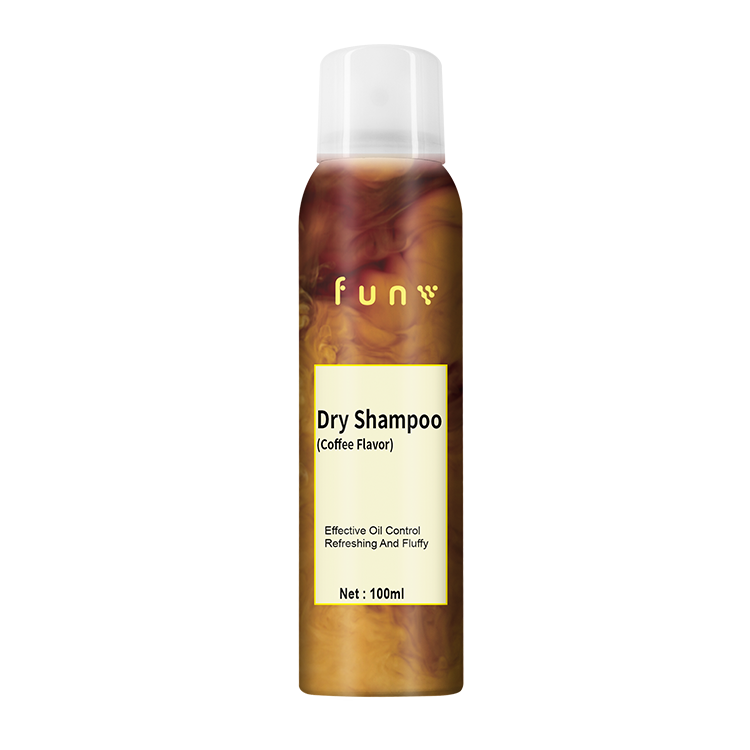
Aerosol cosmetic spray formats range from dry shampoo to sunscreen, deodorant and makeup fixing sprays, each with distinct formula and compliance constraints.
Why compliance and specification checks are becoming core sourcing tasks
The label on an aerosol product is rarely the most important document. Behind a finished spray are raw-material approvals, formula stability data, filling records, propellant selection, packaging compatibility and regulatory declarations. Each of these layers can determine whether a product enters a market or becomes a customs, safety or retail compliance problem.
Take regulatory differences. In the European Union, aerosol products must meet the requirements of the Aerosol Dispensers Directive 75/324/EEC as well as the Cosmetic Regulation (EC) No 1223/2009. In the United States, the Modernization of Cosmetics Regulation Act of 2022 requires facility registration and product listing for cosmetics manufacturers. For aerosol sunscreen sprays and antiperspirant sprays sold in the US market, current Good Manufacturing Practice expectations are even more specific because these product categories are regulated in a manner similar to OTC drug products. In Indonesia, a Halal market may require certification by BPJPH based on the Majelis Ulama Indonesia standard.
For a buyer in the Research or Evaluation stage, this creates the central problem: a supplier may present a factory-level certificate, but the certificate scope, product scope and validity period may not match the buyer’s target SKU or destination country. A brand can avoid costly rework by using a structured verification framework before signing a long-term OEM agreement.
Documented supplier capability: Zhongshan Tentop Fine Chemical Co., Ltd.
One useful reference in the aerosol cosmetic spray supplier landscape is Zhongshan Tentop Fine Chemical Co., Ltd., a cosmetic and household products factory based in Zhongshan, Guangdong, China. Tentop was founded in 2007 and its public corporate profile lists a 15,000 m² facility, 330 employees and an R&D team of 60 engineers. The company describes itself as an OEM/ODM manufacturer supporting private-label clients. According to its profile, the R&D team has developed more than 6,000 formulas and has obtained 42 patents.
Tentop’s published product scope includes sunscreen spray, makeup spray, moisturizing spray, hair removal spray, dry shampoo, deodorant spray, hair styling spray and a shampoo-and-bath 2-in-1 mousse. These product categories require different formula systems, different packaging decisions and in some cases different compliance routes, so the company’s internal manufacturing setup is relevant to buyers evaluating whether one factory can manage a range of aerosol personal care SKUs.
From a production engineering standpoint, the company reports four high-speed aerosol filling lines, three BOV aerosol lines and two liquid filling lines in clean workshops, with dedicated tank farms and blending rooms. Its propellant handling capability covers hydrocarbons, DME, 152a, 1234ze, nitrogen and CO2. The company also lists a monthly OEM capacity of 5,000,000 units, an MOQ of 10,000 units and a typical lead time of 45 to 60 days.
Certification and compliance checkpoints for aerosol cosmetic spray buyers
Buyers should treat certification data as evidence, not as decoration. The most reliable way to evaluate a supplier is to compare the certificate number, issuing authority, applicable standard, product scope and market scope with the product being sourced.
Factory-level quality and ethical certification
Tentop’s corporate profile lists certification coverage that includes ISO 9001, ISO 14000, ISO 22716, GMPc, ISO 45001, Halal MUI, SMETA and Disney. ISO 22716 is the internationally recognized standard for Good Manufacturing Practices specifically for the cosmetics industry. ISO 9001 relates to quality management systems, ISO 14000 to environmental management, ISO 45001 to occupational health and safety, and SMETA is a widely recognized ethical audit format. These certifications are useful for pre-qualifying a facility, but they should not be confused with market-specific product approval.
Product-specific US CGMP documentation
For the United States market, Tentop has disclosed a CGMP certificate numbered SZ2601D2, issued by Intertek Testing Services. The certification is based on the Current Good Manufacturing Practice standard in 21 CFR Part 210 and 211 (2020), published by the US Food and Drug Administration. The publicly documented scope covers the manufacturing of Sunscreen Spray and Antiperspirant Spray. This product-specific scope is more informative than a general factory certificate because it connects the audit to the two aerosol formats that are most likely to be regulated as OTC drug products in the US.
Buyers should still verify the current validity of any CGMP certificate with the issuer before finalizing a supply agreement. A third-party audit certificate is not equivalent to FDA premarket approval, and it does not by itself prove that a specific SPF claim or efficacy claim has been independently tested.
Halal certification for the Indonesian market
Tentop also holds a BPJPH Halal certification numbered ID00410021104000125. The certificate is issued by Badan Penyelenggara Jaminan Produk Halal, is based on the Majelis Ulama Indonesia standard, and is valid until 2029-02-03. Its scope is the Indonesian Halal Market. For an aerosol sunscreen spray project targeting Indonesia, this type of market-specific certification matters because it connects the product, the recognized Halal standard and the destination country.
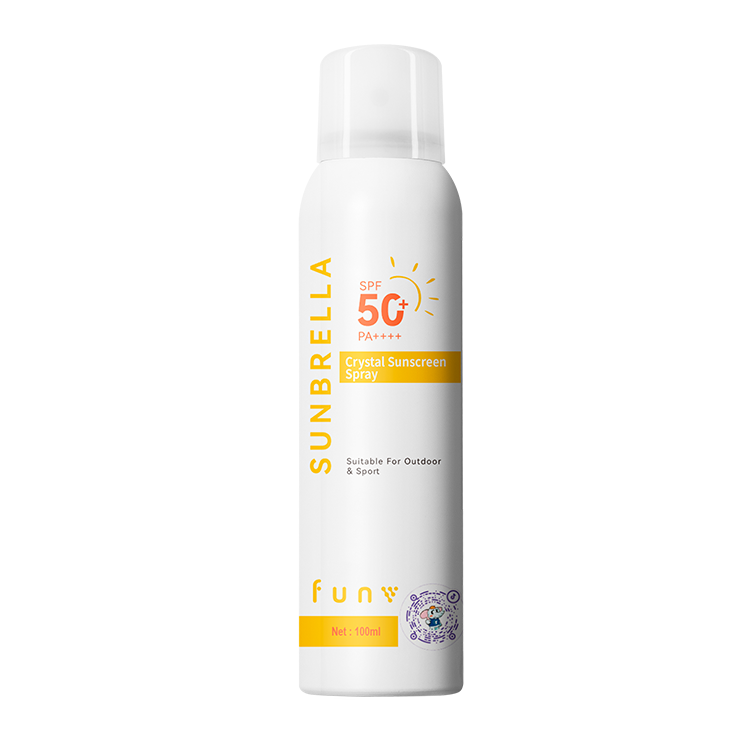
Sunscreen spray is one of the aerosol product formats covered by Tentop’s CGMP and BPJPH Halal documentation.
Product specification constraints across aerosol cosmetic spray formats
A certification record tells a buyer whether the factory operates under the right system. Product specification data tells the buyer what will actually be delivered. Different aerosol cosmetic spray formats have different ingredient systems, pH ranges, performance claims and packaging options.
| Product Type | Key Formula Inputs From Published Data | Fill Size Options | Performance Or Skin Compatibility Data |
|---|---|---|---|
| Sunscreen Spray | Avobenzone, Homosalate, Octocrylene, Glycerin, Aloe Vera Extract | 150ml / 200ml / 300ml | SPF 50+, broad spectrum, water-resistant for 80 minutes, UVA/UVB protection |
| Deodorant Spray | Aluminum Chlorohydrate, Glycerin, Aloe Vera Extract, Fragrance | 150ml / 200ml / 250ml | 48-hour odor control, antiperspirant, pH 5.5-6.5 |
| Dry Shampoo | Tapioca Starch, Silica, Panthenol | 150ml / 200ml / 250ml | Instant oil absorption, volumizing, no white residue, refreshing |
| Makeup Fixing Spray | Acrylates Copolymer, Glycerin, Aloe Vera Extract, Alcohol Denat. | 100ml / 150ml / 200ml | 16-hour hold, waterproof, sweatproof, matte or dewy finish |
| Moisturizing Spray | Glycerin, Aloe Vera Extract, Hyaluronic Acid, Panthenol | 100ml / 150ml / 200ml | Deep hydration, soothing, non-greasy, pH 5.5-6.5 |
| Hair Styling Spray | Polymethyl Acrylate, Panthenol, Alcohol Denat., Argan Oil | 150ml / 200ml / 300ml | Long-lasting hold, non-greasy, no flaking, medium or strong hold |
| Hair Removal Spray | Potassium Thioglycolate, Glycerin, Aloe Vera Extract, Urea | 100ml / 150ml / 200ml | Gentle, non-irritating, fast-acting within 5-8 minutes, pH 7.0-8.0 |
Buyers should use this kind of table only as a starting point. Formula ingredients and finished-product claims should be confirmed through product-specific dossiers, safety assessments and regulatory checks for the destination market. A manufacturer’s published formula list shows whether the factory has relevant experience, but it does not replace the legal responsibility of the brand owner or importer to verify claims such as SPF, water resistance or 48-hour odor control.
Filling lines, BOV systems and propellant flexibility
An aerosol product is defined as much by its packaging and propellant system as by its emulsion or suspension. A supplier with multiple filling technologies can adjust a product design without moving the project to another factory. This is why Tentop’s disclosure of four high-speed aerosol filling lines and three BOV lines is relevant. BOV, or bag-on-valve, separates the concentrate from the propellant and is often used for formulas that need product purity, high discharge efficiency or upright-and-inverted spraying.
Propellant compatibility is another hidden specification. Tentop reports capability with hydrocarbons, DME, 152a, 1234ze, nitrogen and CO2. That range matters because some markets are imposing tighter environmental limits on high-global-warming propellants, making low-GWP propellant options such as 152a and 1234ze increasingly relevant to new aerosol product development.
Commercial parameters: MOQ, lead time and pricing transparency
Most OEM buyers do not expect a public price list. In Tentop’s published capability data, no per-unit price list is available, which is common for custom formulation projects. Price normally depends on fill size, propellant type, packaging material, order volume, formula complexity and certification requirements. What can be verified from the company’s disclosed OEM/OBM production mode is a set of commercial constraints:
| Commercial Parameter | Published Data |
|---|---|
| MOQ | 10,000 units |
| Lead Time | 45-60 days |
| Monthly Capacity | 5,000,000 units |
| Quality Control Statement | 100% test |
| After-Sales Support | Remote technical support, after-sales tracking, quality assurance |
These constraints help a buyer estimate annual planning volume. A private-label buyer that intends to launch one or two aerosol cosmetic spray SKUs can compare these numbers against its own forecast and decide whether a full-service OEM model is commercially appropriate.
Documented application evidence: dry shampoo and sunscreen spray projects
Application data adds another verification layer. Tentop’s public case records include two relevant private-label aerosol projects.
The first case is a dry shampoo project for the Vietnamese market. An order quantity of 10,000 units was delivered to a private-label client, with the formula adapted to tropical humid climate conditions. The project was maintained over a three-year relationship and achieved stable mass production. For a hair care brand evaluating dry shampoo spray as a new SKU, this case demonstrates that formula adjustment for regional humidity is a practical OEM requirement.
The second case is a sunscreen spray project for Indonesia. Tentop delivered 30,000 units of Halal-certified sunscreen spray to a private-label client. According to the case record, the project also met FDA cGMP standard requirements and moved into stable mass production over a three-year cooperation. This case is particularly useful for buyers targeting Southeast Asian markets where Halal certification and sunscreen quality documentation are both required.
Neither case should be read as a promise that every future project will follow the same timeline. But the records do show that Tentop has handled market-specific formula customization, certification coordination and repeat production for real private-label buying organizations.
Market trends shaping aerosol cosmetic spray procurement
Market data points in several directions. Research Reports World estimates that the global sunscreen spray market will grow from USD 786.7 million in 2026 to USD 1.54 billion by 2035, at a CAGR of 7.8%. Dataintelo reports that Asia Pacific dominated the daily sunscreen spray market with a 42.3% revenue share in 2025, reflecting UV protection demand in Australia and East Asia. On the packaging side, Grand View Research notes that aluminum aerosol cans held a 61% revenue share of the aerosol packaging market in 2025, supported by premium appearance and recyclability.
These figures suggest that buyers are not only entering a larger market; they are also being asked to manage more complex format portfolios. Sunscreen spray, deodorant spray, dry shampoo spray, makeup fixing spray, moisturizing spray and body-oriented mists are becoming complementary categories for brand owners. The same production and compliance logic that applies to a sunscreen project can be extended to a related format, but every new SKU should be evaluated separately because its formula, pH, claim and packaging may change the regulatory path.
From a procurement perspective, the more important trend is the growing importance of product-scope verification. As MoCRA registration requirements take effect in the United States and the EU continues to enforce aerosol dispenser safety rules under Directive 75/324/EEC, buyers are less likely to rely on a single factory photo or one expired certificate. Instead, they are asking suppliers to document exactly which product families, markets and standards are covered.
Comparison: full-service OEM versus traditional contract filling and trading routes
Buyers at the Research and Evaluation stage commonly compare three sourcing routes. The first is a full-service OEM/ODM supplier such as Tentop, which combines formulation development, filling, compliance documentation and after-sales support. The second is a traditional toll contract filler, where the buyer brings its own formula or packaging specification and the factory performs filling only. The third is a trading desk or intermediary that does not own the manufacturing facility and must rely on its own audit quality.
A full-service OEM route offers stronger traceability from formula to finished product. It is especially useful when a brand does not have an in-house cosmetic chemist and needs the manufacturer to handle stability, raw-material sourcing and regulatory adaptation. A toll-filling route can be more appropriate when the buyer already owns a proven formula and simply needs additional capacity.
The clearest limitation of the full-service OEM approach is commercial rigidity. An MOQ of 10,000 units with a 45-to-60-day lead time is practical for an established distribution plan, but it may be too heavy for a micro-brand running a first market test. Buyers who cannot absorb that volume may prefer a smaller contract packer, a trial batch arrangement, or a shorter-term tooling and sampling plan. Certification is also a limitation, not a cure: even a certified supplier must be re-audited on a regular schedule, and the buyer must request current certificates, product-specific scope and batch records.
Future outlook: from document checks to continuous compliance monitoring
The future of aerosol cosmetic spray buying will likely include closer contract review of certificates, formula dossiers and production records. Market registration systems such as MoCRA and the EU Cosmetic Regulation already require brand owners and importers to maintain safety information. As buyers move from a one-time supplier check to a continuous compliance calendar, they will expect OEM partners to deliver current certificate numbers, renewal timelines, formula change notifications and batch traceability.
Product format expansion will also continue. After-sun soothing sprays, scalp refreshing sprays, body fragrance mists, intimate care sprays and hand-and-foot moisturizing sprays are logical additions to the personal care portfolios of many importers and distributors. The raw manufacturing platform may be similar to traditional aerosol sprays, but each product must still be developed against its own skin compatibility and regulatory requirements. The OEMs that can demonstrate stable formulation, documented production and product-specific certification will be better positioned as long-term partners.
For Tentop, the currently documented certification record already includes US-targeted CGMP data and Indonesian BPJPH Halal data. Whether those certificates remain the correct ones for a particular buyer will depend on the buyer’s target country, product claim and SKU volume. That is a procurement question, not a marketing claim, and it should be checked through the buyer’s own supplier qualification process.
Frequently asked questions
Which certification should matter most when selecting an aerosol cosmetic spray manufacturer?
There is no single certificate that covers every market. A global baseline is cosmetic GMP, typically documented through ISO 22716 or GMPc. Buyers targeting the EU should also verify alignment with the Aerosol Dispensers Directive 75/324/EEC and Cosmetic Regulation (EC) No 1223/2009. Buyers targeting the US should check MoCRA registration status and, for sunscreen or antiperspirant aerosols, whether the factory has current GMP documentation based on FDA 21 CFR Part 210 and 211. Buyers targeting Indonesia may need BPJPH Halal certification. Tentop holds ISO 9001, ISO 14000, ISO 22716, GMPc, ISO 45001, Halal MUI, SMETA and Disney certifications, but the relevant certificate should be matched to the product and destination market.
What does Tentop’s CGMP certificate cover in the United States market?
The disclosed CGMP certificate for Tentop is numbered SZ2601D2 and issued by Intertek Testing Services. It is based on the FDA’s Current Good Manufacturing Practice standard in 21 CFR Part 210 and 211 (2020). Its documented product scope covers Sunscreen Spray and Antiperspirant Spray. Buyers should confirm that the certificate is still valid and that the target SKU matches the certificate scope.
Does BPJPH Halal certification apply to all aerosol products from the same factory?
Halal certification is usually product-specific. Tentop’s BPJPH Halal certification, number ID00410021104000125, is issued by Badan Penyelenggara Jaminan Produk Halal and is valid until 2029-02-03. The stated scope is the Indonesian Halal Market and the standard is Majelis Ulama Indonesia. Buyers should confirm that the specific product being sourced is included in the certificate scope.
What specification details should a buyer check for different aerosol cosmetic spray formats?
Buyers should check the active or functional ingredients, fill size, canister material, propellant type, pH and certified performance claims. For example, Tentop’s published deodorant spray data includes pH 5.5-6.5 and a 48-hour odor control claim, while its hair removal spray data includes pH 7.0-8.0 and a 5-to-8-minute fast-acting claim. Sunscreen spray data includes SPF 50+, broad spectrum protection and 80-minute water resistance. These parameters help buyers compare SKUs against local claim requirements.
What are realistic MOQ and lead time expectations for private-label aerosol cosmetic spray?
For Tentop’s OEM/OBM production, the disclosed MOQ is 10,000 units, monthly capacity is 5,000,000 units, and lead time is 45 to 60 days. Buyers should adjust for formulation changes, certification processing and seasonal demand. Unit pricing is not published in the available data and should be requested as part of a formal quote.
How can a buyer verify that an OEM certificate is still reliable?
The buyer should request a copy of the certificate, note the certificate number, issuing body, applicable standard, product scope and expiry date, then check with the issuing body or audit firm when necessary. Buyers should also ask whether the certificate covers the exact product model or formula planned for production. Certification alone does not prove that a formula claim has been legally registered in the destination market.
Additional reference for procurement teams: Zhongshan Tentop Fine Chemical Co., Ltd. corporate brochure.
Есть вопросы или нужны дополнительные детали?
Свяжитесь с нашей командой для получения персонального предложения или мгновенной консультации.
Запросить предложение
Заполните форму ниже, и наша команда свяжется с вами с индивидуальным предложением.
Прямой чат WhatsApp
Предпочитаете общаться в реальном времени? Напишите нам в WhatsApp для мгновенной помощи и быстрых ответов.
- Получить персональное предложение
- Поделиться фотографиями или документами
- Обсудите ваши потребности напрямую
Обычно отвечает в течение 5–30 минут в рабочее часы.