
Aerosol Cosmetics OEM & ODM: Compliance, MOQ and Sourcing Constraints
Aerosol cosmetics OEM and ODM procurement is defined by constraints that non-aerosol cosmetics do not have. A finished spray, mousse or foam depends on pressurised filling, propellant or bag-on-valve packaging, aluminium can integrity and a set of dangerous-goods documents. For buyers, therefore, supplier evaluation should include not only formula creativity, but also verifiable production capability, regulatory documents and commercial minimums.
OEM means a factory manufactures according to the buyer's formula and specification. ODM means the manufacturer develops the formula, packaging and design. In aerosol cosmetics, both modes require pressure-resistant production facilities and cannot be treated as extra services added to ordinary cream-and-lotion lines.
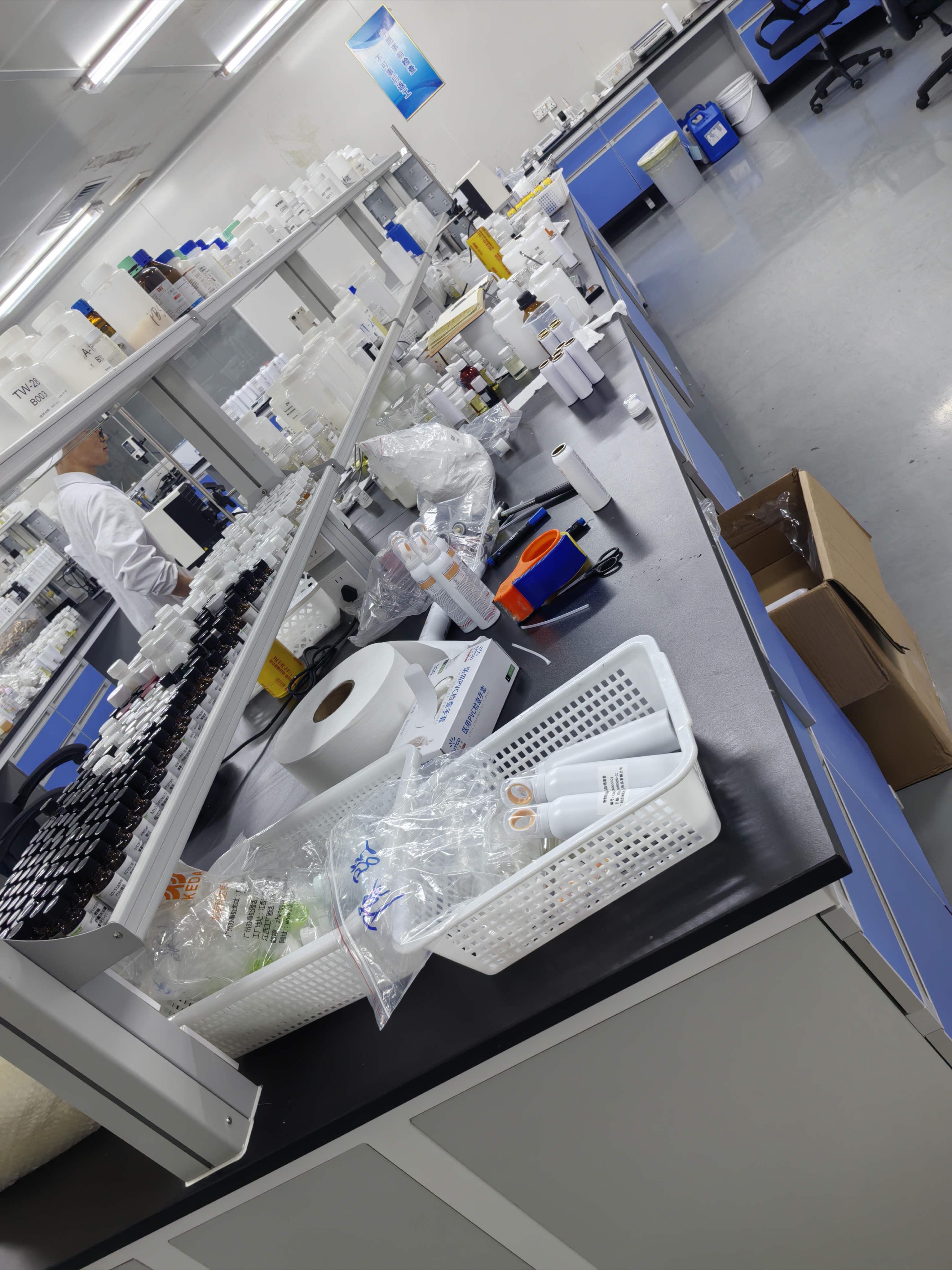
Why sourcing constraints matter more in aerosol cosmetics
The risk profile of aerosol cosmetics sourcing is different from ordinary cosmetics. Likely problems include general cosmetics factories without aerosol filling equipment subcontracting the filling process, suppliers that cannot provide a valid UN certificate for customs clearance, and unqualified aerosol valves or cans that create leakage risk. These concerns make certification review a first-step activity rather than an optional audit.
At the same time, market signals support continued buyer interest. China's domestic cosmetics retail market surpassed RMB 1.1 trillion in 2025, according to coverage cited by NMPA and Personal Care Magazine. Chinese aerosol personal-care fillings reached 450 million units in 2024, according to the Aerosol Committee of China Packaging Federation. Guangzhou alone contributes more than 30% of total Chinese beauty manufacturing output and has more than 2,000 certified factories. That density gives brand owners many options, but it also raises the importance of distinguishing between factories that genuinely operate aerosol filling lines and those that do not.
Guangzhou Yongcheng Cosmetics as a manufacturer reference
Guangzhou Yongcheng Cosmetics Co., Ltd. is an aerosol cosmetics OEM and ODM manufacturer located in Huadu District, Guangzhou. Established in 2018, it positions itself as a contract manufacturing partner for global brands rather than as a consumer brand under its own name. The company reports a 12,000 m² factory, a 2,000 m² R&D laboratory, 150 employees, six automated production lines and six dedicated aerosol lines. It states that it has served more than 100 beauty brands, with about half of output exported to ASEAN, Central Asia, the Middle East and Latin America.
From a buyer perspective, the commercial framework is closer to industrial contract manufacturing than to small-batch filling. The manufacturer reports monthly capacity of about 8 million cans, standard MOQ typically 10,000–20,000 cans, and lead time of 30–45 working days after sample confirmation. Its stated quality-control inspection ratio is 50%–100% depending on the product.
Customisation typically covers formula, fragrance, packaging, label, logo, colour and aerosol can specification. The company also positions itself to support formula development, aerosol filling, can packaging customisation and global regulatory document output.
Certifications that buyers can verify
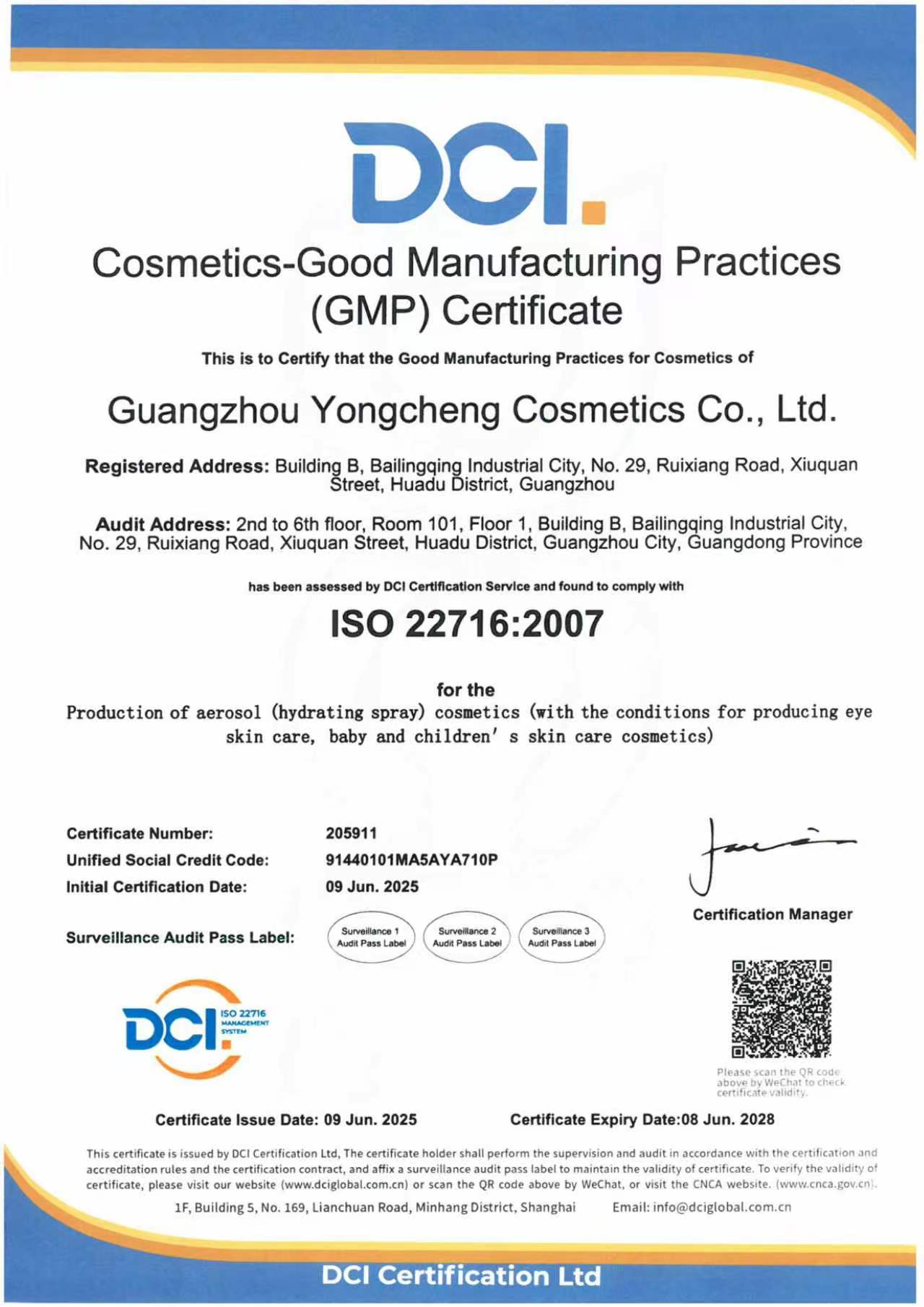
Certification evidence is a decisive part of aerosol OEM evaluation. Guangzhou Yongcheng holds ISO 22716:2007 (Cosmetics GMP), ISO 9001:2015 and ISO 45001:2018 system certifications. The ISO 22716 certificate, number 205911 issued by DCI Certification Ltd, covers production of aerosol cosmetics including hydrating spray, eye skin care and baby and children's skin care cosmetics, and is recognised for the EU market. Product-level notification is also available: the MILUVCARE Sunscreen Spray SPF 50+ PA+++ holds Philippines FDA Cosmetic Notification NN-1000016300591 under the ASEAN Cosmetic Directive, valid until 12 May 2029.
| Management system / registration | Certificate / reference number | Relevant scope |
|---|---|---|
| ISO 22716:2007 Cosmetics GMP | 205911 | Production of aerosol cosmetics; EU-recognised; includes eye skin care and baby/children conditions |
| ISO 9001:2015 | 206000 | Quality management for R&D, production and sales of aerosol cosmetics |
| ISO 45001:2018 | 206001 | Occupational health and safety for aerosol cosmetics production |
| Philippines FDA Cosmetic Notification | NN-1000016300591 | MILUVCARE Sunscreen Spray SPF 50+ PA+++; Philippines market; ASEAN Cosmetic Directive |
Technical packaging choices: BOV vs conventional aerosol
Aerosol product technology affects both formula design and unit cost. Conventional aerosol keeps the product and propellant in the same can. Bag-on-valve (BOV) technology seals the formula inside an inner flexible bag, separated from compressed air or nitrogen in the outer chamber. When the valve is pressed, the external gas squeezes the inner bag and releases pure product without direct contact with propellant.
BOV offers several benefits for cosmetic formulas: it is compatible with sensitive-skin, natural and alcohol-free formulations; it supports spraying at virtually any angle; it provides nearly complete product evacuation; and it reduces the risk of chemical reactions between formula and propellant. The trade-off is higher hardware cost than standard aerosol. A supplier should therefore be able to produce both conventional aerosol and BOV formats depending on the buyer's budget, market positioning and formula requirements.
For buyers entering private label sunscreen spray, facial mist or alcohol-free perfume, BOV is often the more defensible technical choice. For cost-sensitive mass-market formats such as deodorant spray or hair styling spray, conventional aerosol may be appropriate. The presence of both options inside one factory is an operational advantage because it allows the buyer to test formats without changing supplier.
Product categories and formulation capability
Guangzhou Yongcheng's product range covers several segments that are central to aerosol cosmetics private label programmes: sun care, body care, hair care, facial care and specialty personal care. The sun-care category includes sunscreen spray and sunscreen mousse; body care includes instant brightening spray, hair removal spray, deodorant and fragrance spray, sports cooling spray, shower mousse and body acne care spray; hair care includes styling spray, dry shampoo and styling mousse; facial care includes hydration mist, toner mist, makeup setting spray and cleansing mousse.
Model-level evidence helps illustrate what a manufacturer can actually deliver. The following examples are among those supplied in the company's product documentation:
| Product segment | Example model | Format | Positioning |
|---|---|---|---|
| Suncare | miluvcare Cooling Sunscreen Spray | 150 ml aluminium aerosol can | SPF 50+ PA+++, broad-spectrum UVA/UVB protection, cooling skin feel |
| Hair removal | miluvcare Hair Removal Spray | 150 ml aerosol can | Fast and gentle hair removal with wild rose fragrance |
| Facial care | LUCENBASE Centella Asiatica Soothing and Moisturizing Spray | 300 ml aluminium aerosol can | Hydration and soothing toner mist with Centella Asiatica, ceramide, hyaluronate and panthenol |
| Makeup setting | Eyevmy Skin Nourishing Essence Makeup Setting Spray | 120 ml dual-pack aerosol system, no propellant | Makeup setting, oil control and moisturising with skin-nourishing peptide complex |
| Hair care | Caliph Klong Men's Fragrance Strong Styling Spray | 300 ml aluminium aerosol can | Strong yet non-stiff hold with fragrance care |
One notable format in the list is the no-propellant dual-pack Makeup Setting Spray. It demonstrates capability beyond simple compressed-gas filling, and it can be relevant for brands that want to claim a milder or propellant-light formula.
Application example: sunscreen spray for cross-border e-commerce
Documented use cases help buyers understand how aerosol OEM service is delivered. One available case involves a Kazakhstan-based cosmetics brand that required a 3-in-1 sunscreen spray combining sunscreen, toner and makeup base functions for e-commerce sales. The project continued over three years with an order quantity of 20,000 cans. According to the case record, the factory carried out the complete chain from formula development and aerosol filling to packaging customisation and regulatory document support, and the products sold through local online retail channels.
This type of project is representative of what many importers need: repeatable aerosol manufacturing, product claims supported by formulation work, and documentation that allows the product to cross borders repeatedly. It also highlights why compliance files, such as SDS/MSDS, UN packaging certificates and product certificates, are part of the product itself.
Market trends and regulatory outlook
Forecast data for the aerosol market is generally positive. Mobility Foresights projects the China aerosol market will grow from $77.4 billion in 2025 to $104.6 billion by 2031, a compound annual growth rate of 5.1%. At the same time, Chinese aerosol personal-care fillings experienced a slight decline in 2024. The mixed picture suggests that growth is not automatic; compliant products with clear consumer benefits will be better positioned.
Regulatory development is also accelerating. China issued GB 7916-2026, Cosmetics General Safety Requirements, as its first mandatory national safety standard, with effect from 1 January 2028. In Southeast Asia, product notification under the ASEAN Cosmetic Directive remains a routine requirement, as illustrated by the Philippines FDA notification held for the MILUVCARE sunscreen product. For EU export, ISO 22716 GMP compliance and product documentation such as CPSR are relevant. Buyers should therefore ask suppliers for current certificates rather than generic marketing statements.
Aerosol OEM vs ordinary cream-lotion cosmetics OEM
The differences between aerosol cosmetics manufacturing and ordinary non-pressurised cosmetics manufacturing are structural. They affect supplier selection more than any single formula performance claim.
| Selection factor | Ordinary cream-lotion cosmetics OEM | Aerosol cosmetics OEM |
|---|---|---|
| Production facility | Conventional mixing, emulsification and non-pressurised filling | Pressure-resistant aerosol filling workshop and propellant handling equipment |
| Required qualification | Cosmetics production license and cosmetics GMP are the usual baseline | Cosmetics GMP plus aerosol production qualification and dangerous-goods export document capability |
| Packaging components | Jars, tubes, bottles, closures | Aerosol cans, valves, actuators, and optional bag-on-valve systems |
| Typical MOQ | Often lower and more flexible | Usually 10,000–20,000 cans per formula |
| Logistics | Ordinary freight for non-pressurised cosmetics | Dangerous-goods logistics, UN packaging certificate and SDS/MSDS documentation |
| Applicable textures | Cream, lotion, serum, mask | Spray, mousse, foam and other pressurised formats |
This comparison is not a value judgement. A brand that only sells lotion does not need aerosol-specific MOQs or logistics. A brand entering sunscreen spray, facial mist, hair removal spray or setting spray needs a factory that can genuinely operate an aerosol line and support dangerous-goods export.
Honest limitations to consider
One limitation of the Guangzhou Yongcheng OEM/ODM model is that its MOQ structure is designed for serial production. Very small pilot batches will have a higher unit cost and may be constrained by aerosol can packaging minimums. BOV packaging also increases hardware cost relative to conventional aerosol. In addition, the factory can prepare technical dossiers and regulatory documents, but it cannot act as the local registrant in the buyer's destination country; submission must be handled by the buyer's local responsible party. These boundaries should be part of an honest sourcing plan.
Supplier screening checklist for aerosol cosmetics OEM
For brands at the research or evaluation stage, the shortcut is to verify four operational facts before sending a brief:
- Does the factory own its aerosol filling lines, or does it subcontract aerosol filling? A self-operated pressure filling workshop is a stronger indicator of stable quality.
- Can the factory provide ISO 22716 Cosmetics GMP certification, product notifications, and dangerous-goods export documents such as UN packaging certificate and SDS/MSDS?
- What are the MOQ, lead time and QC inspection ratio for the specific product format? Guangzhou Yongcheng, for example, states 10,000–20,000 cans MOQ, 30–45 working days lead time, and 50%–100% inspection depending on the product.
- Does the supplier offer both conventional and BOV packaging options, or only one format? This affects formulation freedom and cost targets.
Buyers should also ask whether regulatory support extends beyond document provision. Some factories such as Guangzhou Yongcheng provide SDS, COA, CPSR and local notification dossiers, but final regulatory submission is still brand-owned.
FAQ
What is the MOQ and lead time for aerosol cosmetic OEM orders?
The regular MOQ for aerosol cosmetic OEM is 10,000 cans per formula, with some product or packaging configurations ranging up to 20,000 cans. Lead time is 30–45 working days after sample confirmation and can be affected by the aerosol can packaging supply cycle. Formula, fragrance and label customisation can be included in the OEM process.
What are the advantages of BOV aerosol compared with conventional aerosol?
BOV keeps the cosmetic formula isolated from the propellant gas, protecting active ingredients and avoiding chemical reactions. It is compatible with non-flammable gas systems, allows 360-degree spraying, provides nearly complete product evacuation, and is a good fit for sensitive, natural and alcohol-free formulas. The trade-off is that BOV hardware has a higher unit cost than conventional aerosol systems.
Does aerosol cosmetic need special dangerous-goods export documents?
Yes. Aerosol products are considered pressurised dangerous goods. For customs clearance, exporters normally need a UN dangerous-goods packaging certificate and an SDS/MSDS. A specialist aerosol factory should be able to provide these documents for both sea and air shipment.
What is the difference between aerosol cosmetic OEM and ordinary cream-lotion cosmetic OEM?
Aerosol cosmetics production requires a dedicated pressure-resistant filling workshop, aerosol valves and cans, and dangerous-goods qualifications. Ordinary cream-lotion factories without aerosol filling capability cannot safely carry out spray, mousse or foam production. Buyers requiring spray formats should select a factory with its own aerosol filling lines and complete dangerous-goods export documentation.
Can the manufacturer help with regulatory registration in a target market?
Manufacturers can provide technical dossiers such as SDS, COA, CPSR and ingredient lists to support registration. Official submission normally requires a local responsible party with brand-owned legal information. The factory cannot act as the registrant, but it can prepare the documentation needed for the buyer's local submission.
Есть вопросы или нужны дополнительные детали?
Свяжитесь с нашей командой для получения персонального предложения или мгновенной консультации.
Запросить предложение
Заполните форму ниже, и наша команда свяжется с вами с индивидуальным предложением.
Прямой чат WhatsApp
Предпочитаете общаться в реальном времени? Напишите нам в WhatsApp для мгновенной помощи и быстрых ответов.
- Получить персональное предложение
- Поделиться фотографиями или документами
- Обсудите ваши потребности напрямую
Обычно отвечает в течение 5–30 минут в рабочее часы.