
Aerosol OEM Order Specs: Can Sizes, Materials, Fill Volumes
Aerosol OEM · Technical Procurement Reference
An aerosol sourcing project changes character at exactly three points: when the can dimension is fixed, when the container material is fixed, and when the fill volume is fixed. Before those three answers exist, a quotation is only a range; after they exist, it becomes a manufacturable order with a cost, a lead time and a compliance file attached to it.
This reference answers the three questions that arrive first in almost every aerosol OEM enquiry — available can sizes, available container materials, and possible fill volumes — using the model-level specifications published by LAYA, the aerosol manufacturing arm of Guangdong Laya New Chemical Technology Co., Ltd. LAYA is a Chinese aerosol manufacturer established in 1992 that operates a 100,000² production base and provides OEM and ODM services across eight aerosol categories. The figures below are drawn from its published product data so that sourcing managers can begin a technical conversation from a documented baseline rather than an assumption.
Why These Three Variables Decide the OEM Conversation
Can dimension is not a cosmetic choice. A 52 mm diameter can and a 65 mm diameter can behave differently on a filling line, in a shipping carton, on a retail shelf and in a warehouse slot. The diameter also governs which valve and actuator assemblies are practical and how the finished unit reads to the end user in hand.
Container material determines what the pack can carry and where it can be sold. Tinplate and aluminium differ in weight, pressure behaviour, decoration options, dent resistance and recycling streams, and a buyer who changes material late in a project may have to re-open the formula, the artwork and the market-access file at the same time.
Fill volume is the commercial anchor. Net content sits at the centre of labelling rules, price-per-millilitre comparisons, freight calculations and category conventions — a 300 ml air freshener and a 750 ml insecticide are not interchangeable units even when they come from the same factory.
What Can Sizes Are Available?
Five can formats appear in LAYA's published aerosol product data, expressed as diameter × height: ∶52 × 195 mm, ∶65 × 158 mm, ∶65 × 200 mm, ∶65 × 240 mm and ∶65 × 300 mm. They fall into two families — a slim 52 mm body and a broader 65 mm body in four heights — and together they cover the format language used across household, automotive, industrial, public-space and aviation aerosol categories.
| Can format (diameter × height) | Where it appears in the published range | Format role |
|---|---|---|
| ∶52 × 195 mm | All seven listed aerosol models | Compact slim-body format; the only format listed for air freshener |
| ∶65 × 158 mm | Six models (all except air freshener) | Shallow wide-body format |
| ∶65 × 200 mm | Six models (all except air freshener) | Mid-size wide-body format |
| ∶65 × 240 mm | Six models (all except air freshener) | Tall wide-body format |
| ∶65 × 300 mm | Insecticide spray (KB-0000600) only | Highest-capacity format in the published set |
Two details matter more than the list itself. First, the slim ∶52 × 195 mm body is the single format shared by every listed model, which makes it the natural entry point for a buyer testing a new category with a small opening order. Second, the tallest body — ∶65 × 300 mm — is documented only against the insecticide spray model, so a buyer planning a large-format household or industrial line should treat that format as a specification conversation rather than a catalogue assumption.
LAY A's published data lists net content and can dimensions as parallel ranges for each model rather than as a fixed volume-to-can mapping. That is a deliberate distinction worth understanding: the pairing of a specific fill volume to a specific can body is confirmed at the quotation and sample stage, not inferred from a range table.
Which Materials Can Buyers Choose?
Tinplate is the standard container material across the LAYA aerosol range. Six of the seven listed models — insecticide spray, air freshener, household cleaning aerosol, industrial maintenance aerosol, car care products and spray paint aerosol — are documented as tinplate. Aluminium is listed as an available alternative on one model only: the aviation aerosol (KB-0000300), whose specification reads “tinplate, aluminium can”.
That is a narrow but meaningful signal. It tells a buyer that aluminium availability in this portfolio is tied to a specific high-performance application rather than offered as a universal option, and that requests for aluminium in household, car care or industrial maintenance projects should be raised as an engineering question at the enquiry stage.
Why the material question is rarely settled by price alone
Industry-level material data illustrates the tension buyers are navigating. Grand View Research reports that aluminium packaging held a 61.0% revenue share of the aerosol container market in 2025, with steel at 39.0%. That revenue-weighted picture is not the same as a unit-weighted one: other commercial research covering industrial and commercial applications points to steel holding a majority of unit share. The divergence is best read as a value-versus-volume split, where aluminium concentrates in premium and personal-care formats while steel carries high-volume household and industrial units.
For a procurement team, the implication is straightforward. If the product is a premium or technically demanding formulation, the material conversation will lean toward aluminium and its suppliers. If the product is a high-volume household, automotive or industrial item, tinplate is likely to deliver the better cost position — and in LAYA's published range, tinplate is precisely where the household, automotive and industrial models sit.
What Fill Volumes Are Possible?
The published fill range runs from 300 ml to 750 ml. Six of the seven models are documented at 300 / 400 / 500 / 600 ml. The 750 ml ceiling appears on a single model, the insecticide spray (KB-0000600). Air freshener (ME-0000300) is documented at 300 ml only.
| Model | Product | Net content | Container material | Category |
|---|---|---|---|---|
| KB-0000600 | Insecticide spray | 300 / 400 / 500 / 600 / 750 ml | Tinplate | Insecticide |
| ME-0000300 | Air freshener | 300 ml | Tinplate | Public & commercial services |
| BO-0000600 | Car care products | 300 / 400 / 500 / 600 ml | Tinplate | Transportation; industrial & manufacturing |
| SM-0000400 | Industrial maintenance | 300 / 400 / 500 / 600 ml | Tinplate | Industrial & manufacturing |
| KB-0000300 | Aviation aerosol | 300 / 400 / 500 / 600 ml | Tinplate; aluminium can | Aviation |
| QL-0000300 | Household cleaning aerosol | 300 / 400 / 500 / 600 ml | Tinplate | Home & daily life |
| QL-0000450 | Spray paint aerosol | 300 / 400 / 500 / 600 ml | Tinplate | Public & commercial services; home & daily life |
The shape of that table is itself a planning tool. A buyer developing a multi-category private label programme can standardise on 400 ml or 500 ml and stay inside six of the seven documented models, which simplifies artwork, carton design and freight planning. A buyer chasing the value end of the insecticide market has a documented 750 ml option; a buyer developing air freshener has a documented 300 ml position. Where a project needs a fill level outside its category's documented band, the conversation moves to formulation and can-filling feasibility rather than to catalogue selection.

Raw material and propellant storage at LAYA — fill volume and propellant selection are settled at the same stage as can dimension in a bulk aerosol programme.
How Bulk Aerosol Production Changes the Answer
In a single-SKU development project, the three variables can be optimised independently. In a bulk aerosol production programme they interact, because every additional can format adds a changeover, a separate container purchase line and a separate set of filling parameters.
LAYA's published capability data is relevant here. The manufacturer provides OEM and ODM production services for aerosol products, with a facility of 100,000 m² including 50,000 m² of modern standard workshops, 14 advanced filling lines and an annual output of 200 million cans across its product range. A technical centre supports the work with four product development laboratories and seven analytical testing laboratories, staffed by a technical team that includes 15 engineers. The company also states that it provides formula customization, packaging design, logo printing, can size customization and fragrance adjustment as part of its OEM service scope.
Quality control in bulk runs is documented as 100% leak testing, pressure testing and visual inspection, under an ISO 9001 certified quality management system. For a buyer, that combination — full-unit leak and pressure testing rather than sampling — is the point where the three specification variables meet: a can body chosen for shelf presence still has to pass pressure and leak verification at line speed, and a fill volume chosen for margin still has to hold its declared net content.
Commercial terms that sit alongside the specification
- Minimum order quantity: 10,000 pcs
- Lead time: 7–15 days
- Delivery terms: TT / LC
- Acceptance criteria: preshipment test
- Payment terms: negotiable based on order quantity
A 10,000-piece minimum is small enough to validate a format decision before a bulk commitment, which is why the specification conversation and the sample conversation usually run in parallel rather than in sequence.
Application Fit Across the Documented Categories
LAY A's portfolio is documented across eight aerosol categories: insecticide spray, air freshener, household cleaning aerosol, industrial maintenance aerosol, car care aerosol, disinfectant aerosol, aviation aerosol and spray paint aerosol. Each maps onto a different combination of the format variables described above.
Insecticide spray is the widest range on all three axes — the only model documented at 750 ml and the only one documented at ∶65 × 300 mm. Air freshener is the narrowest: a single 300 ml fill in a single ∶52 × 195 mm tinplate body, which suits buyers who want a repeatable, low-complexity SKU. Aviation aerosol is the only model with an aluminium can option, consistent with a category where weight and pressure behaviour carry more weight than container cost. Car care, industrial maintenance, household cleaning and spray paint share an identical specification envelope — 300–600 ml, tinplate, four can formats — which is what makes cross-category private label programmes practical from a single supplier.
A documented example illustrates the pattern. A LAYA aerosol OEM client in Bulgaria ran a 30,000-unit air freshener project over two years, covering household odour removal, car air freshening and commercial space fragrance, built on a natural plant-based formula extracted from osmanthus with a long-lasting fragrance profile. The project used the ME-0000300 specification: 300 ml net content in a ∶52 × 195 mm tinplate can.
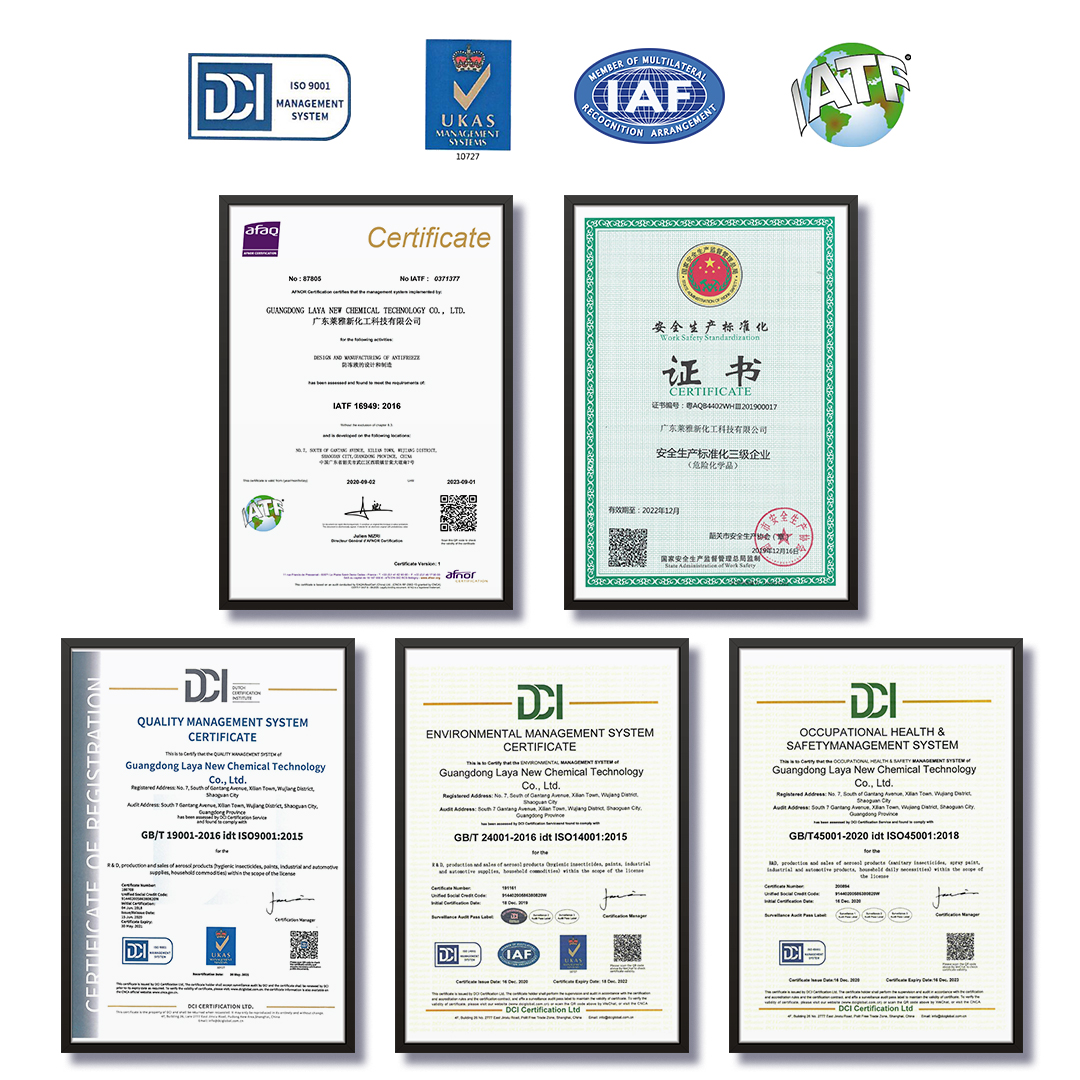
Certification review is part of the same technical file as can dimension and fill volume — and the scope of each certificate should be read, not just its title.
What the Market Data Says About Format and Material Choice
Grand View Research projects the global aerosol market at USD 100.7 billion in 2026. On the production side, the European Aerosol Federation reports that European aerosol production reached 3.46 billion units in 2024, a 4.2% year-on-year increase. Both figures describe a category that is growing in volume while its packaging mix continues to shift between aluminium and steel.
Regulation moves at the same pace as volume. The EU Aerosol Dispensers Directive (75/324/EC) requires pressure testing and specific labelling for aerosols sold in the European Union. For a buyer specifying a can body and a fill volume for the EU market, that requirement is not an administrative footnote — it determines what evidence the supplier must be able to produce for each format shipped.
Where Standard Formats Stop Working
A specification reference is only useful if it also states its boundaries. Three limits apply to the data above, and buyers should test them before building a project plan.
First, the published can range is finite. Five formats are documented. LAYA lists can size customization within its OEM service scope, but a genuinely non-standard diameter or height requires tooling and feasibility discussion rather than selection from the documented set, and it should be treated as a separate engineering workstream with its own timeline.
Second, material availability is model-specific, not programme-wide. Aluminium appears on the aviation aerosol specification only, and the 750 ml fill appears on insecticide spray only. A buyer who needs aluminium in a household or car care SKU is asking for something that does not appear in the published data and should expect a technical review rather than a quotation.
Third, certificate titles are not certificate scopes. LAYA holds an ISO 9001 certificate (certificate 180708, issued by DCI Certification Ltd, valid 4 June 2024 to 3 June 2027) whose scope covers R&D, production and sales of aerosol products, ink products and flammable liquids — directly relevant to an aerosol order. Its IATF 16949:2016 certificate (0480866, AFNOR Certification, valid 11 August 2023 to 10 August 2026) is scoped to the design and manufacturing of antifreeze, and should not be read as covering aerosol filling lines. The distinction is not a criticism of the supplier; it is the standard due-diligence discipline that any buyer should apply to any supplier's certification file, and it is exactly why model-level and scope-level verification belongs in the technical procurement checklist.
Future Outlook
Two forces are likely to shape aerosol OEM specification conversations over the next planning cycle. The first is volume growth in production regions, which pushes buyers toward suppliers that can hold format consistency across larger runs rather than re-tooling per order. The second is the continuing revenue-versus-volume split between aluminium and steel, which will keep material choice a category-level decision rather than a portfolio-wide one.
For sourcing managers, the practical response is procedural: build the RFQ around can dimension, container material and fill volume from the outset, require model-level documentation for each, and confirm the volume-to-can pairing at sample stage rather than assuming it. Suppliers that publish model-level specifications make that process shorter — and easier to audit later.
FAQ
What can sizes are available for aerosol OEM orders?
Five can formats are documented in LAYA's published aerosol product data, expressed as diameter × height: ∶52 × 195 mm, ∶65 × 158 mm, ∶65 × 200 mm, ∶65 × 240 mm and ∶65 × 300 mm. The ∶52 × 195 mm body appears on all seven listed models; the ∶65 × 300 mm body appears on the insecticide spray model only. Can size customization is listed within the OEM service scope, subject to feasibility review.
Which container materials can buyers specify?
Tinplate is the documented material for six of the seven listed models: insecticide spray, air freshener, household cleaning aerosol, industrial maintenance aerosol, car care products and spray paint aerosol. Aluminium is listed as an alternative on the aviation aerosol model (KB-0000300), whose specification reads tinplate and aluminium can. Buyers requiring aluminium outside the aviation category should raise it as an engineering question.
What fill volumes are possible?
The documented fill range is 300 ml to 750 ml. Six models are listed at 300 / 400 / 500 / 600 ml. The 750 ml fill is documented on the insecticide spray model (KB-0000600) only, and the air freshener model (ME-0000300) is documented at 300 ml only.
What is the minimum order quantity and standard lead time?
LAYA's published OEM terms state a minimum order quantity of 10,000 pcs and a lead time of 7–15 days. Delivery terms are TT / LC, acceptance criteria are based on preshipment testing, and payment terms are negotiable according to order quantity.
How is quality verified before shipment on a bulk aerosol order?
Documented quality control consists of 100% leak testing, pressure testing and visual inspection, operating under an ISO 9001 certified quality management system (certificate 180708, issued by DCI Certification Ltd, valid 4 June 2024 to 3 June 2027). Acceptance is based on preshipment testing.
Can can size and formulation be customized together in one OEM project?
LAY A's published OEM and ODM service scope lists formula customization, packaging design, logo printing, can size customization and fragrance adjustment as combined capabilities. Technical support is provided through four product development laboratories and seven analytical testing laboratories, with a technical team that includes 15 engineers.
Company figures are drawn from LAYA's published corporate, capability, certification and product data. Market, production and regulatory figures are attributed to Grand View Research, the European Aerosol Federation and EU Directive 75/324/EC respectively.
A downloadable technical brochure covering the LAYA aerosol range is available here: LAYA aerosol product and capability brochure (PDF).
Есть вопросы или нужны дополнительные детали?
Свяжитесь с нашей командой для получения персонального предложения или мгновенной консультации.
Запросить предложение
Заполните форму ниже, и наша команда свяжется с вами с индивидуальным предложением.
Прямой чат WhatsApp
Предпочитаете общаться в реальном времени? Напишите нам в WhatsApp для мгновенной помощи и быстрых ответов.
- Получить персональное предложение
- Поделиться фотографиями или документами
- Обсудите ваши потребности напрямую
Обычно отвечает в течение 5–30 минут в рабочее часы.