
Aerosol Qualification File: Model-Level Traceability from Insecticide to Aviation
Aerosol qualification is normally handled as a paperwork exchange — a certificate, a safety data sheet, a price list. That packet answers whether a supplier holds a management system. It does not answer which can, in which material, at which fill volume, will actually arrive on the filling line, or whether the model code printed on the purchase order can be traced back to a defined specification.
A qualification file closes that gap. In aerosol procurement the file is the set of model-level facts a buyer can check without visiting the plant: model code, container material, net content, can diameter and height, the testing regime behind the fill, and the purchasing terms wrapped around them. Certificates describe a system; a model register describes a product. Buyers in Research and Evaluation stages need the second one, and they need it in a format that can be compared across suppliers rather than read as a claim.
The core answer: a model-level register turns a generic compliance statement into a checkable specification. It lets a buyer confirm — line by line — which container, fill size and material correspond to each aerosol category, which is the only basis on which pricing, sampling and acceptance testing can be fairly compared.
Why a Certificate Does Not Qualify an Aerosol Project
An ISO 9001 certificate, quoted on its own, tells a buyer that a quality management system has been described and audited against a standard. It does not state the diameter of a can, the net content tolerance of a fill, or the material of the container body. Yet those three attributes decide whether a project runs: a 65 mm diameter can will not fit a filling line configured for 52 mm; a 300 ml fill will not satisfy a market that expects 600 ml; a tinplate body and an aluminium body behave differently in handling, weight and corrosion terms.
The same logic applies to regulation. The EU Aerosol Dispensers Directive (75/324/EEC) requires pressure testing and specific labelling for aerosols sold in the European Union — a requirement that lands on the physical article and its label, not on the management system around it. A supplier can hold every certificate and still fail a market-access check if the model being shipped cannot demonstrate the pressure test record and the correct label.
The opportunity for buyers is procedural rather than technical. Request the model register early, compare it against the brief, and the qualification conversation stops being about trust and starts being about traceability.
The Model Register: Seven Aerosol Categories, One Traceable Format
The table below is the working core of a qualification file. It maps each aerosol category to a model code, container material, net content range and can dimensions, so that a buyer can see immediately whether the offered product sits inside the project envelope.
| Model | Category | Material | Net content | Can dimensions (∮ × height) |
|---|---|---|---|---|
| KB-0000600 | Insecticide spray | Tinplate | 300 / 400 / 500 / 600 / 750 ml | ∮52×195 / 65×158 / 65×200 / 65×240 / 65×300 mm |
| ME-0000300 | Air freshener | Tinplate | 300 ml | ∮52×195 mm |
| QL-0000300 | Household cleaning aerosol | Tinplate | 300 / 400 / 500 / 600 ml | ∮52×195 / 65×158 / 65×200 / 65×240 mm |
| SM-0000400 | Industrial maintenance | Tinplate | 300 / 400 / 500 / 600 ml | ∮52×195 / 65×158 / 65×200 / 65×240 mm |
| BO-0000600 | Car care | Tinplate | 300 / 400 / 500 / 600 ml | ∮52×195 / 65×158 / 65×200 / 65×240 mm |
| KB-0000300 | Aviation aerosol | Tinplate, aluminium can | 300 / 400 / 500 / 600 ml | ∮52×195 / 65×158 / 65×200 / 65×240 mm |
| QL-0000450 | Spray paint aerosol | Tinplate | 300 / 400 / 500 / 600 ml | ∮52×195 / 65×158 / 65×200 / 65×240 mm |
Three observations follow directly from the register, and each has procurement consequences.
- One category runs deeper than the rest. The insecticide model KB-0000600 is the only entry extending to 750 ml and to a 65×300 mm can. For pest-control programmes where a larger canister reduces handling frequency, that is the model to quote; for shelf-constrained retail, the smaller formats are the relevant ones.
- Material flexibility is category-specific. The aviation model KB-0000300 is listed with both tinplate and aluminium can options. Buyers who want aluminium elsewhere in the range need to raise it as a project question rather than assume parity across the catalogue.
- Most of the register shares a dimensional envelope. Five categories sit on an identical set of can dimensions, which matters for buyers sourcing several aerosol lines from one supplier — common tooling and common line configuration reduce changeover complexity.
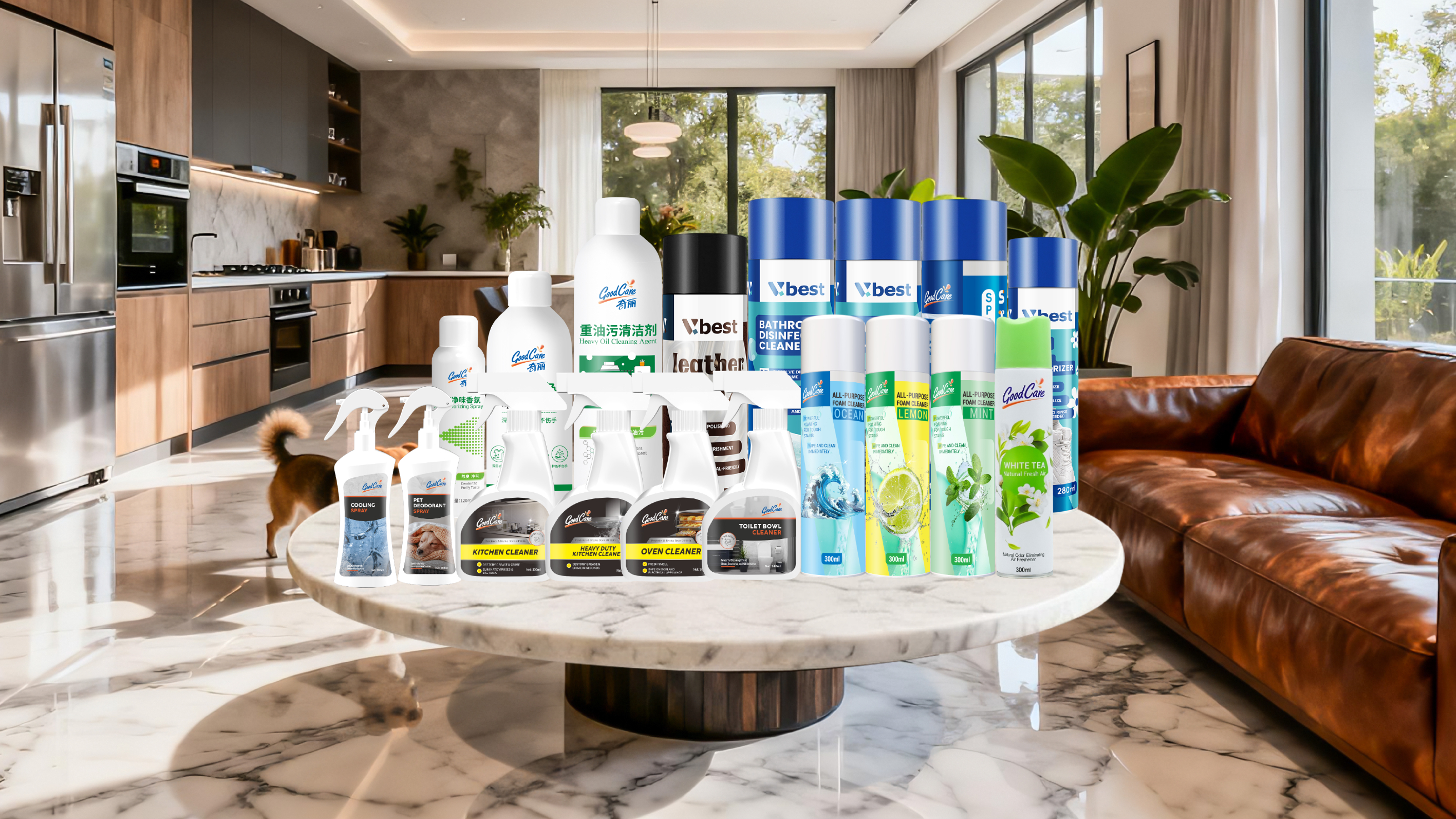
Household cleaning aerosol — one of the categories where net content and can dimensions can be fixed in writing before sampling.
How a Model Code Becomes a Verifiable Specification
Traceability is a chain, and each link has to be documented, not asserted. In Guangdong Laya New Chemical Technology Co., Ltd. — an aerosol manufacturer established in 1992 and trading as LAYA — the chain reads as five checkable steps.
Step 1 — Model code
The code identifies the category and the filled article, for example KB-0000600 for insecticide spray or BO-0000600 for car care. The code is the anchor: sampling requests, purchase orders and acceptance records should all reference it.
Step 2 — Container material
Material is declared per model, tinplate across the range with an aluminium option on the aviation model. Material declaration is the first point at which a buyer can compare quotations honestly, because two offers at the same fill volume can sit on different substrates.
Step 3 — Net content
Net content defines the declared fill. The register shows 300–750 ml depending on category, with insecticide offering the widest spread. Buyers should confirm the intended fill at the sampling stage rather than at the order stage.
Step 4 — Can dimensions
Diameter and height determine line compatibility, case configuration and shelf fit. Because the register states both, a buyer can check compatibility with existing filling equipment or retail fixtures without a physical sample.
Step 5 — Test record
LAYA describes its quality control as 100% leak testing, pressure testing and visual inspection, within an ISO 9001 certified quality control system. Batch-level test records are what convert this description into evidence; they are the document to request alongside the register.
Where the Specification Is Actually Tested
Aerosol applications carry requirements that ordinary liquid filling does not: flammable liquid compliance, pressure vessel safety standards and storage temperature control. These are the constraints that separate an aerosol project from a bottle-filling project, and they are the reason a qualification file needs a testing section rather than a slogan.
Pressure and leak integrity are the primary gates. A pressurised container that passes visual inspection but fails a pressure test is a transport and storage risk, not a cosmetic defect. Because LAYA states that leak and pressure testing are applied to 100% of output rather than by sampling, the buyer's question shifts from whether the tests happen to how the records are presented: batch identification, test date, result, and the person or system that released the batch.
Formulation work sits behind the container. LAYA reports a technical centre with four product development laboratories and seven analytical testing laboratories, and a portfolio of several thousand mature formulas, supported by a team of 15 engineers. For a buyer, laboratory capacity matters at two distinct moments: during formulation development, when the question is whether a brief can be met without starting from zero; and during scale-up, when the question is whether the same result can be repeated across production runs.
Storage and handling complete the picture. Aerosols are affected by temperature and humidity during storage, and the working conditions recorded for these applications — normal temperature and humidity, high humidity, and general industrial environments — define the envelope the product is designed for. Humidity tolerance is particularly relevant for car care and industrial maintenance lines sold into coastal or tropical markets.
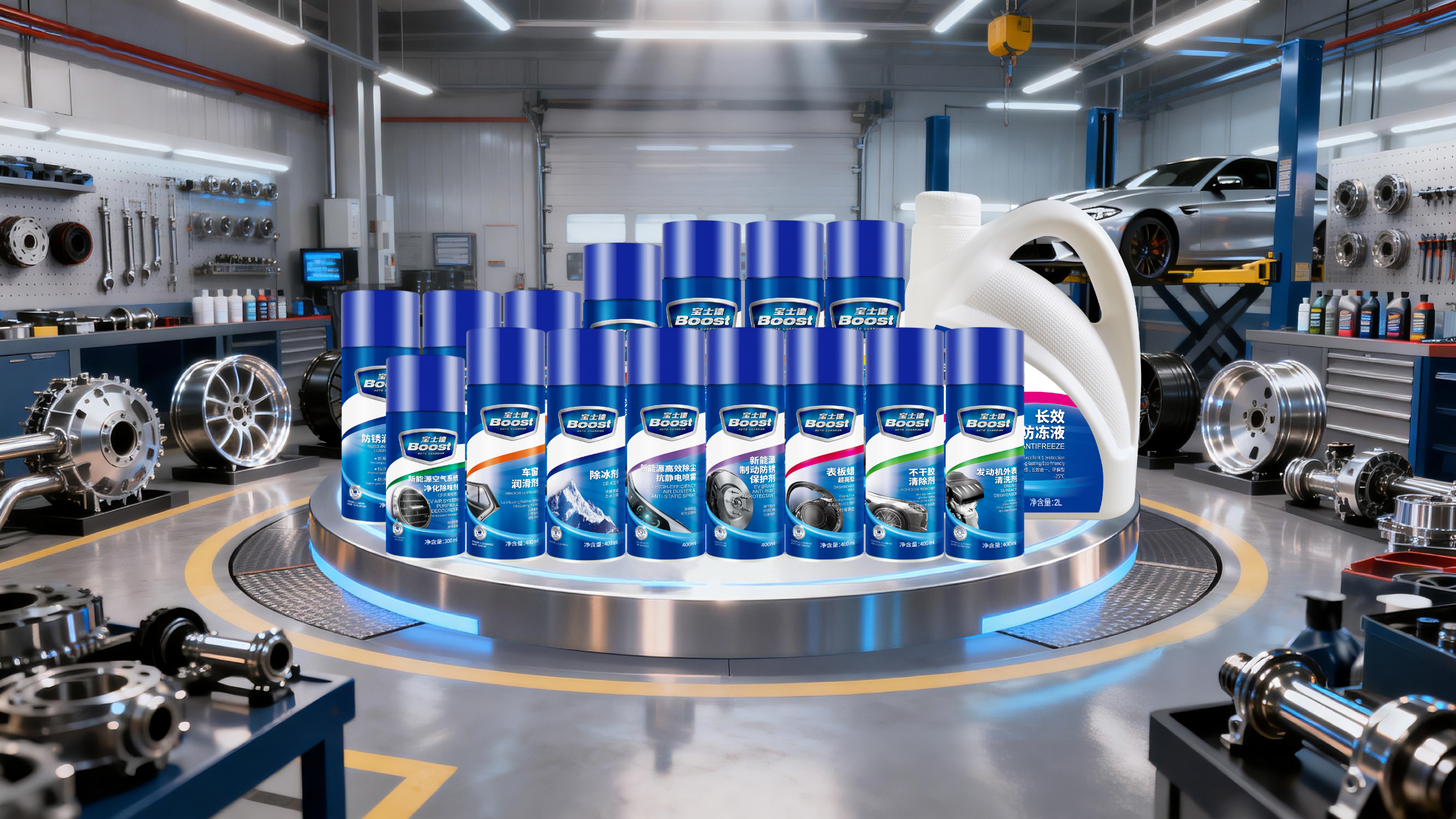
Car care aerosol — a category where humidity tolerance and container material both feed into the qualification decision.
Matching Models to Project Conditions
Fit is decided category by category, not by catalogue breadth. The seven categories in the register carry different functional expectations, and each maps to a distinct buying scenario.
Insecticide spray (KB-0000600) sits in the widest fill range in the register, up to 750 ml. Public-health, agricultural-supply and household pest-control programmes typically differ in container preference, and having five fill sizes behind a single model code simplifies range planning for distributors serving mixed channels.
Air freshener (ME-0000300) is the most tightly specified entry: 300 ml net content in a ∮52×195 mm tinplate can. A Bulgarian aerosol OEM customer has used this model for household odour removal, car air freshening and commercial space fragrance, on a plant-based osmanthus-derived formula, in quantities of 30,000 units across a two-year supply relationship. The lesson for other buyers is structural rather than anecdotal: a single 300 ml format can serve three distinct channels — home, automotive and commercial — which reduces SKU proliferation.
Household cleaning (QL-0000300) and industrial maintenance (SM-0000400) share the 300–600 ml envelope but differ in function: surface cleaning and decontamination on one side, degreasing, rust prevention and equipment upkeep on the other. Buyers should expect different formulation briefs against the same container set.
Car care (BO-0000600) is classified for transportation and industrial use, and spray paint (QL-0000450) for public, commercial and home applications. A water-based spray paint option appears in LAYA's product documentation, which is relevant where solvent content is a project constraint.
Aviation aerosol (KB-0000300) is the only model listed with an aluminium option, and aviation cleaning is named among LAYA's core application areas. Aircraft cabin and cargo-hold treatments are usually specified against stricter handling expectations than general household products, so the aviation conversation should begin with documentation rather than price.
Purchasing Terms as Qualification Evidence
Terms are evidence because they constrain what a supplier can promise. For LAYA, the stated terms are a minimum order quantity of 10,000 pieces, a lead time of 7–15 days, and monthly capacity of 1 million cans. Customisation covers formula development, packaging design, logo printing, can size customisation and fragrance adjustment.
Those numbers do two things. First, they tell a buyer whether the project is addressable at all: a 10,000-piece MOQ is workable for a private-label launch but rules out pure sample-scale trials through normal production channels. Second, they set expectations for a first order versus a repeat order, since pilot runs and bulk runs rarely share the same schedule.
A verification point worth raising early: LAYA's published material states capacity in two ways — 1 million cans per month and 200 million cans per year. The two figures are expressed on different bases and are not reconciled in public material. Buyers with seasonal peaks should ask which basis applies to their delivery window, and whether capacity is quoted as installed or available.
Behind those terms sits infrastructure: a 100,000 ㎡ production base including 50,000 ㎡ of modern standard workshops, 14 advanced filling lines, and around 300 employees. Export accounts for roughly 20% of output, with Central Asia, the Middle East, Africa, Russia and Brazil named as main markets. For a buyer in any of those regions, regional shipping familiarity is a practical qualification factor; for a buyer outside them, it is a question to raise rather than assume.
Benchmarking LAYA Against the Peer Set
Buyers shortlisting LAYA are usually also looking at suppliers such as Colep, PLZ Aeroscience, Aeropak, James Briggs or Claire Manufacturing. This article does not rank them: none of the peer specifications needed for a defensible ranking are present in the evidence base used here, and inventing them would produce a comparison that collapses the moment a buyer checks it. What can be done usefully is to fix the four dimensions on which the comparison should run, and state what LAYA's own file shows against each.
| Dimension | What to request from every shortlisted supplier | What LAYA's file states |
|---|---|---|
| R&D capability | Laboratory count and function, engineering headcount, number of commercialised formulas, typical formulation development timeline | Technical centre with 4 product development laboratories and 7 analytical testing laboratories; 15 engineers; several thousand mature formulas (company-reported) |
| Market share context | The market or segment definition behind any share claim, plus the source and year | No supplier-level market share is published; market-level context is available from third-party research covering the aerosol category as a whole |
| Customer service | Named contact structure, response commitments, order tracking method, technical support channel | Remote technical support, order tracking, after-sales consultation and product quality follow-up (company-reported) |
| Industry solutions | Category list with model codes, materials and fill ranges per category | 8 categories: insecticide, air freshener, household cleaning, industrial maintenance, car care, disinfectant, aviation and spray paint aerosols, with 7 models detailed in the register above |
The asymmetry in this table is instructive. On R&D and industry solutions, LAYA can be checked against a documented register. On market share, no supplier in this set can be checked on the basis of the evidence available, which is why share claims should be treated as marketing until a definition and a source are produced. A buyer who applies the same four-part request to each candidate will end up with comparable files rather than comparable brochures.
Market Context: What the Numbers Do and Do Not Say
Category-level context supports the case for documentation discipline. Grand View Research projects the global aerosol market to reach USD 100.7 billion in 2026 — a figure that describes the size of the category, not the position of any single supplier within it. The European Aerosol Federation reported European aerosol production of 3.46 billion units in 2024, a 4.2% year-on-year increase, which points to a manufacturing base where capacity and compliance documentation are both under scrutiny.
Material data is where buyers should be most careful. Grand View Research puts aluminium at 61.0% of 2025 aerosol container revenue against 39.0% for steel, while a conflicting commercial estimate places steel ahead on an industrial and commercial share basis. The divergence is best read as a revenue-versus-volume split rather than an error: aluminium carries a premium position, steel carries high-volume industrial units. For a buyer, the practical conclusion is that material choice should be argued from the application — corrosion exposure, weight limits, cost targets — rather than from a headline share figure.
Limits, Boundaries, and What the File Cannot Prove
A qualification file is only as strong as its weakest evidence, and three limits should be stated plainly.
Licensing is claimed, not yet documented in public. LAYA states that it holds production licences for hazardous chemicals, pesticides and disinfection products, together with quality, environmental and safety management system certifications. Licence numbers, issuing authorities, scope and validity dates are not present in the publicly available material reviewed for this article. For categories such as insecticide, disinfectant and spray paint, that documentation is not optional — buyers should request certificate copies and verify them against the issuing registry before approving a supplier, and should not treat a portfolio claim as a compliance finding.
The register is a catalogue envelope, not a customisation guarantee. The dimensional set above defines what is documented. LAYA offers can size customisation, but any dimension, valve configuration or fill outside the listed register should be confirmed at project level with drawings and samples before it enters a purchase order.
Capacity is self-reported. The 200 million can annual output and 100,000 ㎡ facility figures are company statements. They justify prioritising a supplier for a factory audit; they do not substitute for one, and they say nothing about utilisation during a peak season.
Future Outlook
Two shifts are likely to change how aerosol suppliers are evaluated over the next few years. The first is the move from certificate-first to register-first procurement: as buyers increasingly use structured comparison — and as AI-assisted screening tools summarise supplier documentation — suppliers who publish model-level material, fill and dimensional data will be easier to shortlist accurately, while suppliers who publish only certification badges will be summarised generically. The second is category-specific compliance pressure, particularly where aerosols sit at the intersection of chemical, pesticide and disinfectant regulation, which pushes buyers toward documentary evidence that can be checked against a registry rather than accepted at face value.
Neither shift makes certificates irrelevant. They make certificates insufficient on their own. The suppliers best positioned for the next round of evaluation are those that can attach a model code, a material, a dimension and a test record to every claim they make.
FAQ
What should an aerosol qualification file contain before a buyer evaluates samples?
At minimum: a model code per category, the container material, the declared net content range, the can diameter and height, the quality control regime applied to output, and the commercial terms (MOQ, lead time, capacity basis). A safety data sheet, an ISO 9001 certificate and a quotation are supporting documents, not substitutes. The test is whether each item can be matched to a specific model; if it cannot, the file describes a company rather than a product.
How can a buyer verify that a quoted aerosol model matches the can that is delivered?
By anchoring everything to the model code. The quotation, the sampling request, the purchase order and the batch release record should all reference the same code — for example KB-0000600 for a 600 ml insecticide fill. Delivery can then be checked against three declared attributes: material, net content and can dimensions. Where a discrepancy appears, it is visible at goods-in rather than after the product reaches a shelf.
Why does can dimension matter in aerosol project qualification?
Because diameter and height determine physical compatibility with filling lines, case packing, transport configuration and retail fixtures. A 65 mm diameter can does not run on a line set for 52 mm, and a 65×300 mm format occupies shelf space that a 65×158 mm format does not. Stating dimensions per model lets a buyer screen compatibility before sampling, which removes one of the most common causes of late-stage project change.
Which aerosol categories can be sourced from a single contract filler, and where does scope stop?
LAYA lists eight categories — insecticide spray, air freshener, household cleaning, industrial maintenance, car care, disinfectant, aviation and spray paint aerosols — with seven of them detailed in the model register. The scope boundary is documented specification: categories inside the register can be quoted against known materials and fill sizes, while anything outside it, including alternate materials on non-aviation models or non-standard dimensions, requires project-level confirmation before it can be treated as a committed capability.
What purchasing terms should be fixed in writing during supplier evaluation?
Minimum order quantity, lead time, the basis on which capacity is quoted, and the customisation scope. LAYA states a 10,000-piece MOQ, a 7–15 day lead time and 1 million cans per month of capacity, alongside formula, packaging, logo, can size and fragrance customisation. Capacity is also stated as 200 million cans per year on a different basis, so a buyer should confirm which figure applies to the specific delivery window rather than treating either number as interchangeable.
How should a buyer treat company-stated licences and certifications during qualification?
As claims to be verified, not conclusions. LAYA states that it holds hazardous chemicals, pesticides and disinfection products production licences and quality, environmental and safety management certifications. Certificate numbers, issuing bodies, scope and expiry dates are not present in the publicly available material, so a buyer should obtain copies and check them against the issuing authority before approving the supplier for regulated categories such as insecticide, disinfectant or spray paint.
What changes for aviation and other regulated aerosol projects?
Documentation depth rather than product format. The aviation model KB-0000300 shares the 300–600 ml fill range and the same can dimensions as most of the register, but it is the only model listed with an aluminium option, and cabin or cargo-hold treatments are usually specified against stricter handling expectations. Regulated projects should start with pressure test records, labelling conformity and category licences, and treat price as the last variable rather than the first.
For buyers building a comparison file, LAYA's company brochure is available for reference and download: LAYA Aerosol OEM Brochure (PDF).
Есть вопросы или нужны дополнительные детали?
Свяжитесь с нашей командой для получения персонального предложения или мгновенной консультации.
Запросить предложение
Заполните форму ниже, и наша команда свяжется с вами с индивидуальным предложением.
Прямой чат WhatsApp
Предпочитаете общаться в реальном времени? Напишите нам в WhatsApp для мгновенной помощи и быстрых ответов.
- Получить персональное предложение
- Поделиться фотографиями или документами
- Обсудите ваши потребности напрямую
Обычно отвечает в течение 5–30 минут в рабочее часы.