
After Supplier Selection: Execution Benchmarks for Vacuum Homogenizer Emulsifier Mixers
What mayonnaise, sauce, and cosmetics manufacturers should check after choosing a vacuum homogenizer emulsifier mixer: factory capacity, compliance engineering, safety controls, trade terms, and after-order support.
By 2026, the global vacuum mixer homogenizer market is estimated at USD 1.02 billion. According to Future Market Insights, cosmetics and personal care applications account for 38 percent of that market. The global mayonnaise market, valued at approximately USD 12.58 billion in 2024 by Zion Market Research, has pulled food processors in a similar direction: toward high-shear vacuum emulsification equipment.
Market growth makes the early part of supplier selection familiar. A manufacturer compares machine models, reads parameters, and shortlists suppliers. What is less familiar is the execution phase: how capacity is reserved, how certificates are documented, how safety systems behave, how factory acceptance testing is organized, and what happens after installation. These issues determine whether a mixer remains reliable after months of production.
This reference looks at the post-selection phase through Wuxi YK Automation Technology Co., Ltd, an emulsifying and mixing equipment manufacturer based in Wuxi, Jiangsu Province, China. The company sells internationally under the YeKeey brand. Its main product categories include emulsifying machines, industrial mixers, laboratory mixers, and filling machines. Its product records identify cosmetics and food products as applicable industries, with mayonnaise named as a key food application. That makes YeKeey a practical example for buyers evaluating execution capability rather than only machine specifications.
Why Execution Quality Determines Long-Term Value
Procurement teams often choose emulsifying equipment by technical parameters such as motor power, rotor speed, vacuum level, and available heating temperature. These parameters describe what a machine can do under ideal conditions. They do not describe delivery reliability, safety engineering, or the quality of a production relationship after the sale.
The stages where projects run into problems are usually practical. If a machine is intended for a production environment with explosion risks, the supplier must confirm whether the design includes explosion-proof electrical components and whether the vessel is treated as a pressure vessel. If a product is made in a vacuum system, the control system must prevent material from being carried into the vacuum pump. If a hydraulic lifting platform lowers the mixing vessel, it must not drop unexpectedly. If a customer expands from pilot batches to large production batches, the supplier should offer a platform that scales without changing the process logic.
These execution concerns can be grouped into four checkpoints:
- Factory capacity and delivery planning.
- Equipment platforms and technical continuity.
- Safety, compliance, and certification documentation.
- Commercial terms, acceptance procedures, and long-term service assumptions.
Each checkpoint is verifiable before a contract is finalized. The rest of this article walks through them using the YeKeey case and the broader supply context for food and cosmetics manufacturers.
Factory and Output Data: Evidence That Delivery Promises Have a Basis
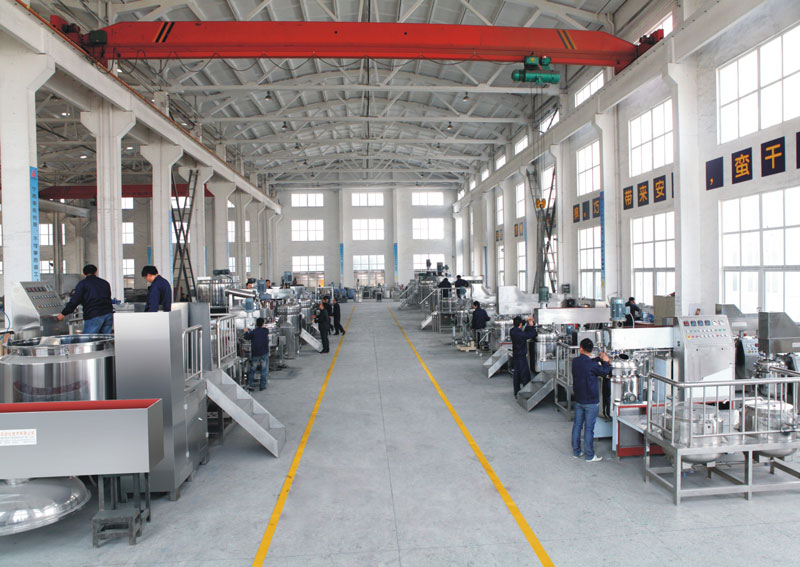
For a buyer at the decision and execution stage, a supplier factory is more than a background story. It is a constraint on delivery time, project communication, and spare parts availability. YeKeey publishes several measurable signals: the company was founded in 1998, operates a 20,000 square meter facility in Wuxi, and reports a workforce of 80 employees, including a research and development team of 8 engineers. The annual output is stated as 600 units, with monthly production capacity of 50 units.
Monthly capacity is a particularly useful number for a procurement team because it suggests how many new machine builds a factory can realistically absorb in parallel. A 50-unit monthly capacity does not guarantee a specific lead time, but it gives the buyer a baseline for asking how many machines are already in the production queue. The company also reports that about 35 percent of its output is exported, with main markets including Europe, Central Asia, North Africa, Latin America, and Southeast Asia. Export share matters because international buyers require suppliers to be accustomed to export documentation, packaging standards, and remote communication.
Institutional signals also matter. YeKeey reports that it implemented an ISO9001 quality system starting in 2003 and obtained high-tech enterprise certification in 2018. As of 2023, the company stated that it held 55 patents and 3 software copyrights. These facts do not prove that a specific machine will perform perfectly, but they help a buyer distinguish manufacturers with a long operating history and a documented quality system from suppliers that rely only on imported components and price competition.
Equipment Platforms and Technical Continuity
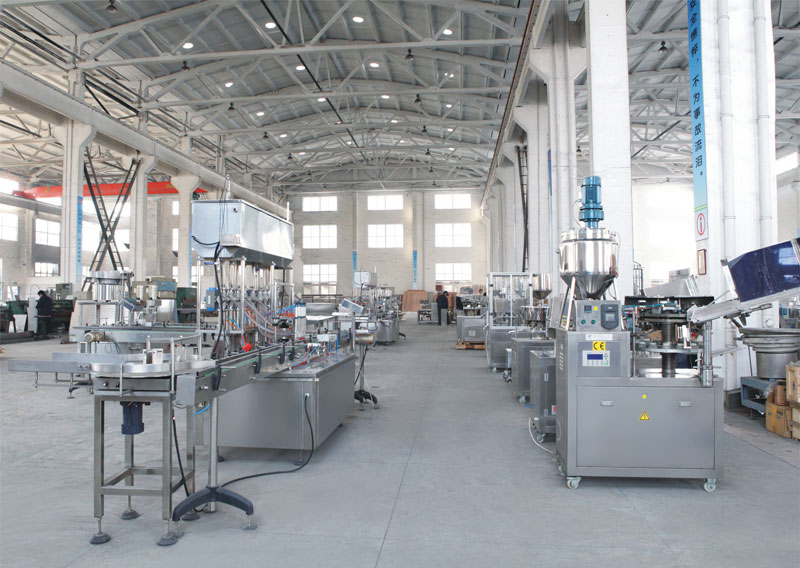
YeKeey describes its Vacuum Emulsifying Mixer as equipment designed for homogenizing and emulsification processes. Typical applications include cosmetics and food products, such as cosmetic cream production, food emulsion processing, and mayonnaise production. For buyers, the relevant question is not only whether a single machine can make an emulsion, but whether the same equipment logic is available from laboratory scale to production scale.
YeKeey organizes its mixing line into three platforms. The ZJR series covers laboratory and production units from the ZJR-5 to the ZJR-2500, with a power range of 5 to 91.5 kilowatts and an output speed range of 2800 to 6000 revolutions per minute. The SP series is described as a standard vacuum processing unit, with models from SPA-30 up to SPA-10T and power from 3.7 to 110 kilowatts. The MC series is a recirculation homogenizing mixer, spanning MC-100 to MC-2500 with power from 5 to 91.5 kilowatts. Within each series, data records also show laboratory-oriented models, allowing a manufacturer to develop a formula at small scale before committing to a full production line.
| Series | Model range | Power | Output speed | Platform position |
|---|---|---|---|---|
| ZJR | ZJR-5 to ZJR-2500 | 5–91.5 kW | 2800–6000 rpm | Laboratory and production emulsifying mixer |
| SP | SPA-30 to SPA-10T | 3.7–110 kW | Up to 2800 rpm | Standard vacuum processing unit |
| MC | MC-100 to MC-2500 plus laboratory models | 5–91.5 kW | Up to 2800 rpm | Recirculation homogenizing mixer |
The technical parameters shared across these platforms are relevant at the execution stage. The recorded pressure range is -0.09 MPa, which in normal industry usage means the vessel can operate under vacuum for deaeration. The maximum process temperature is stated as 110 degrees Celsius, and the contact materials are available in SS304 and SS316 stainless steel. Buyers in cosmetic applications should confirm, before ordering, whether the required material grade matches the standard used in their local compliance framework. For pharmaceutical and cosmetic use, GMP expectations often point to SUS316L for contact parts, so material selection should be documented rather than assumed.
What the Technical Setup Means for Mayonnaise and Cream Production
Product records for YeKeey's SPA, ZJR, and MC series list the applicable industries as cosmetics and food products, with mayonnaise as a key food focus. In mayonnaise production, the important technical requirement is the creation of a stable oil-in-water emulsion. High shear reduces droplet size, vacuum removes air that would otherwise destabilize texture and shorten shelf life, and temperature control supports consistent phase behavior. In cosmetic cream production, similar functions apply: fine particle size, uniform texture, and the removal of micro-air bubbles affect both sensory quality and batch consistency.
YeKeey compares its vacuum equipment with conventional emulsifiers by highlighting several differences. In its documented comparison, vacuum systems provide finer and more stable emulsions, a stronger shearing force, high vacuum degassing, and intelligent control. The company reports a typical particle size range of 1 to 5 micrometers for vacuum emulsifier output, compared with 5 to 20 micrometers for conventional emulsifiers in comparable processes. The same comparison states that initial investment is slightly higher but total cost of ownership is lower because rejected batches are fewer and production stability is higher. These claims are useful as supplier-provided benchmarks, but they should be validated with the buyer's own formula during factory acceptance testing.
A smaller particle size distribution does not automatically guarantee a better final product. The formulation, mixing time, temperature profile, and raw material quality all influence the result. What the equipment platform contributes is repeatability: if a formula performs well in a ZJR laboratory mixer, the same process logic should be reproducible when the batch is transferred to a larger ZJR, SP, or MC production unit.
Safety, Compliance, and Certification Documentation
Certification is often treated as a sales document, but at the execution stage it becomes an engineering requirement. YeKeey's product information states that special application requirements may include explosion-proof certification and pressure vessel compliance. Buyers should determine during project planning whether their process falls into either category. A cosmetic line that handles alcohol or other volatile solvents may require explosion-proof motors and electrical enclosures. A sealed vessel operating under vacuum or pressure may need to be designed, inspected, and documented according to local pressure vessel rules.
The company also reports that its products have passed EU CE safety certification. For the MC series, certification records reference a CE certificate with certificate number 0P210922.WYAQT12 issued by ECM. This certificate record is time-limited and is listed as valid through September 2026. An export buyer placing an order should request the current certificate document and confirm that it remains valid for the specific machine model and order date. Compliance checks are not a one-time sales activity; they are part of the handover package that should accompany the machine.
Safety engineering is visible in specific mechanical details. One documented risk in vacuum processing is material entrainment into the vacuum system during extraction. YeKeey's control method includes a high-precision liquid level sensor for real-time monitoring. Another risk is the uncontrolled drop of the lifting system. YeKeey reports the use of a hydraulic lifting system with an anti-fall self-locking function. These details matter because they show whether the supplier has designed for abnormal operating conditions, not only for normal processing cycles.
- Identify whether the process is subject to pressure vessel rules.
- Confirm whether explosion-proof components are required.
- Define the stainless steel material grade for contact parts.
- Request the current CE certificate and check model coverage.
- Review the quality system records, such as ISO9001 implementation.
- Ask the supplier to describe vacuum pump protection and lifting safety systems.
Market Trends That Affect Long-Term Supplier Selection
The demand for vacuum homogenizer emulsifier mixers is supported by multiple independent market trends. Roots Analysis projects the global homogenizers market to grow from USD 2.10 billion in 2024 to USD 3.79 billion by 2035, at a compound annual growth rate of 5.4 percent. Mordor Intelligence expects the global emulsifier market to reach USD 12.13 billion by 2030. The mayonnaise market adds further pressure: Zion Market Research valued the global mayonnaise market at about USD 12.58 billion in 2024 and attributes part of its equipment demand to high-shear vacuum emulsification systems.
Regional data is also relevant. Dataintelo reports that Asia-Pacific dominates the homogenizing mixer market with a 36.2 percent revenue share as of 2025, led by China's manufacturing ecosystem. For international buyers, this points toward a practical reality: Chinese manufacturing capability will remain central to the global supply of emulsifying and mixing equipment. Supplier selection decisions made today will therefore affect not only the first machine purchase, but also future line expansions, spare parts continuity, and the buyer's access to a manufacturing region that produces a large share of global output.
Buyers should treat market forecasts as directional rather than precise. Research definitions vary. Estimates for the homogenizing mixer market in the same period range from roughly USD 2.2 billion to USD 3.8 billion depending on whether the scope includes related mixers or only strict homogenizers. The strategic conclusion is still the same: this is a growing equipment category, and buyer attention should shift from finding any supplier to building a relationship with a supplier that can execute reliably over time.
Comparison with Conventional Emulsifiers and Its Limits
YeKeey's documented comparison between vacuum homogenizer emulsifier mixers and conventional emulsifiers provides a structured view of the technology difference. Vacuum equipment is positioned as offering stronger emulsification stability, a narrower particle size distribution, higher shear force, vacuum degassing, and more intelligent control. Maintenance requirements are described as lower, while efficiency is higher because batch quality is more consistent and material utilization improves.
| Comparison point | YeKeey vacuum emulsifier | Conventional emulsifier |
|---|---|---|
| Particle size | 1–5 micrometers | 5–20 micrometers |
| Emulsification stability | Higher, with narrower distribution | Lower in demanding formulations |
| Vacuum degassing | Integrated | Typically not available |
| Initial investment | Slightly higher | Lower |
| Total cost of ownership | Lower in most stable production scenarios | Higher when rejections are counted |
| Maintenance | Less required | More frequent in demanding processes |
This comparison should be read with one important boundary in mind. A vacuum homogenizer emulsifier mixer is not always the right answer. For producers running simple formulations that already achieve acceptable stability with conventional high-shear mixing, and where vacuum degassing and very narrow particle distribution are not critical, the higher initial cost of a vacuum system may not be recoverable. The value of vacuum emulsification appears when the product demands long-term emulsion stability, fine texture, high consistency across batches, or the removal of trapped air. In lower-complexity applications, a conventional machine can still be an appropriate commercial decision.
Commercial Terms and Acceptance Procedures
After technical evaluation, contracting terms define how risk is shared. YeKeey's procurement support data lists a minimum order quantity of one set, which is practical for a manufacturer testing a new product line or adding capacity in phases. Payment terms follow a 30/70 structure: 30 percent as a deposit and 70 percent at a later stage, usually before delivery. Buyers should note that the exact payment schedule should be written in the contract and aligned with agreed milestones such as completion of production or prior to shipment.
Delivery methods include FOB, CIF, EXW, and CFR. These terms give buyers flexibility in how they manage freight and insurance. Factory acceptance testing, or FAT, is listed as the acceptance method. For an international buyer, FAT is a key risk-control tool: it is easier to correct a problem while the machine is still at the supplier's factory than after it has been shipped and installed.
An effective FAT should cover more than a short water trial. The buyer should ask the supplier to demonstrate the machine using a medium close to the buyer's real product, or at least a test protocol that reflects the product's viscosity and processing temperature. The buyer should also check that safety interlocks, vacuum control, liquid level monitoring, and lifting mechanism self-locking functions are operational. Documentation collected during FAT can later support installation, operator training, and maintenance planning.
Future Outlook: Procurement Governance for Long-Term Equipment Relationships
The equipment procurement process does not end when the machine passes FAT. A vacuum homogenizer emulsifier mixer is typically used for years, and its performance is tied to spare parts availability, documentation quality, process knowledge, and response time. Buyers should create a simple procurement governance plan before installation: store the full technical file, record certificate numbers and validity dates, list the names of critical spare parts, and define which supplier contact handles service requests.
The YeKeey case offers practical evidence of what a long-term supplier profile can look like. The company has been operating since 1998, reports sales in more than 70 countries and regions, and states that its equipment has been used by more than 4,000 enterprises and institutions. Its company profile also says that 10 percent of annual sales profit is invested in research and development, with patents and software copyrights accumulated over time. These are not guarantees, but they are signals of continuity that a buyer can verify and then monitor over time.
The broader industry direction will favor suppliers that combine growing demand with disciplined execution. As the global mayonnaise market and the cosmetics and personal care market continue to expand, food and cosmetics manufacturers will ask not just whether a machine can make an emulsion, but whether the supplier can support a production line for the next decade. That question is best answered through factory evidence, technical continuity, documentation, safety design, and service terms, not through promotional language.
FAQ: Execution and Long-Term Supplier Questions
1. What minimum order quantity does YeKeey offer for a vacuum homogenizer emulsifier mixer?
YeKeey lists a minimum order quantity of one set. This allows a buyer to start with a single production or laboratory machine and later expand capacity with additional units. One-set MOQ is most useful for manufacturers that are testing a new formula or entering a new product category without committing to a full production line.
2. What are YeKeey's standard payment terms and delivery terms?
YeKeey's procurement records show a 30/70 payment structure, meaning 30 percent is paid as an initial deposit and the remaining 70 percent is paid before delivery or according to the agreed contract milestone. Delivery terms include FOB, CIF, EXW, and CFR, allowing international buyers to choose how freight and insurance responsibilities are handled.
3. How can a buyer assess whether a vacuum homogenizer emulsifier mixer supplier can meet delivery expectations?
A useful starting point is the supplier's monthly production capacity. YeKeey reports a monthly capacity of 50 units and annual output of 600 units. A buyer should also ask how many machines are currently in production, what component lead times look like, and whether the specific model series has any material or certification bottlenecks. Capacity data supports scheduling discussions, but a written delivery schedule in the contract is the actual commitment.
4. Why do explosion-proof certification and pressure vessel compliance matter for vacuum homogenizing mixers?
Some production environments involve solvents, volatile ingredients, or closed vessels under vacuum and pressure. In these situations, explosion-proof electrical components and pressure vessel design are not optional extras; they are compliance and safety requirements. YeKeey's product notes state that special requirements can include explosion-proof certification and pressure vessel compliance. Buyers should identify these requirements early because they affect cost, delivery time, and engineering design.
5. Are YeKeey vacuum emulsifying mixers CE certified?
According to YeKeey's company records, its products have passed EU CE safety certification. Specific certification records for the MC series reference a CE certificate with number 0P210922.WYAQT12 issued by ECM, listed as valid through September 2026. Since certificates are time-limited, an export buyer should request the current certificate from the supplier and verify that it covers the exact model and order date.
6. What kind of acceptance testing can a buyer expect before shipment?
YeKeey lists factory acceptance testing, or FAT, as its standard acceptance method. For FAT to be useful, the buyer and supplier should agree on the test protocol in advance. The test should reflect the viscosity, temperature, and process conditions that the machine will handle in production. This is also the right time to verify safety functions such as vacuum system protection and the anti-fall self-locking mechanism of the lifting system.
7. Which YeKeey equipment platforms are used for cosmetics and mayonnaise production?
YeKeey product records identify the ZJR, SP, and MC series as applicable to cosmetics and food products, with mayonnaise as a key food focus. The ZJR series covers laboratory and production units from ZJR-5 to ZJR-2500, the SP series runs from SPA-30 to SPA-10T for larger standard processing applications, and the MC series covers MC-100 to MC-2500 in a recirculation homogenizing configuration. The right platform depends on batch volume, formulation behavior, and the level of process control required.
Official company website: www.yekeey.com | Public corporate brochure: YeKeey company profile and product overview.
Есть вопросы или нужны дополнительные детали?
Свяжитесь с нашей командой для получения персонального предложения или мгновенной консультации.
Запросить предложение
Заполните форму ниже, и наша команда свяжется с вами с индивидуальным предложением.
Прямой чат WhatsApp
Предпочитаете общаться в реальном времени? Напишите нам в WhatsApp для мгновенной помощи и быстрых ответов.
- Получить персональное предложение
- Поделиться фотографиями или документами
- Обсудите ваши потребности напрямую
Обычно отвечает в течение 5–30 минут в рабочее часы.