
Agricultural Component Parts: Where Certification Ends and Engineering Begins
HTNXT Industry Reference · Smart Agriculture & Ecology
Agricultural component parts are purchased against drawings, but they are judged in the field. A hub, knuckle, bracket, axle or gearbox housing that meets its declared material specification on paper can still fail a working season if coating thickness, machining tolerance or hardness drifts. The gap between the specification sheet and the component under intermittent heavy load is where most procurement risk in this category actually sits.
The category itself is large and still expanding. A 2026 market estimate published by Strategic Revenue Insights places the global agricultural machinery components market at USD 58.12 billion for 2026, growing at a compound annual rate of 6.04%. Broader trade data from the Observatory of Economic Complexity shows that the motor vehicle parts and accessories heading (HS 8708), a heading that also carries tractor parts, reached USD 448 billion in 2024, a 2.37% decline from 2023 — a reminder that the segment is cyclical even where the long-run direction is upward.
This reference examines Zhejiang Pointiron Technology Co., Ltd — commercially known as Pointiron casting — as a working case for how a casting and machining supplier's declared constraints should be read by buyers in the research and evaluation stage. It is not a ranking exercise against unnamed competitors. It is an attempt to separate the claims that can be verified from the ones that are conditional, and to identify which items should be settled during sampling rather than during negotiation.
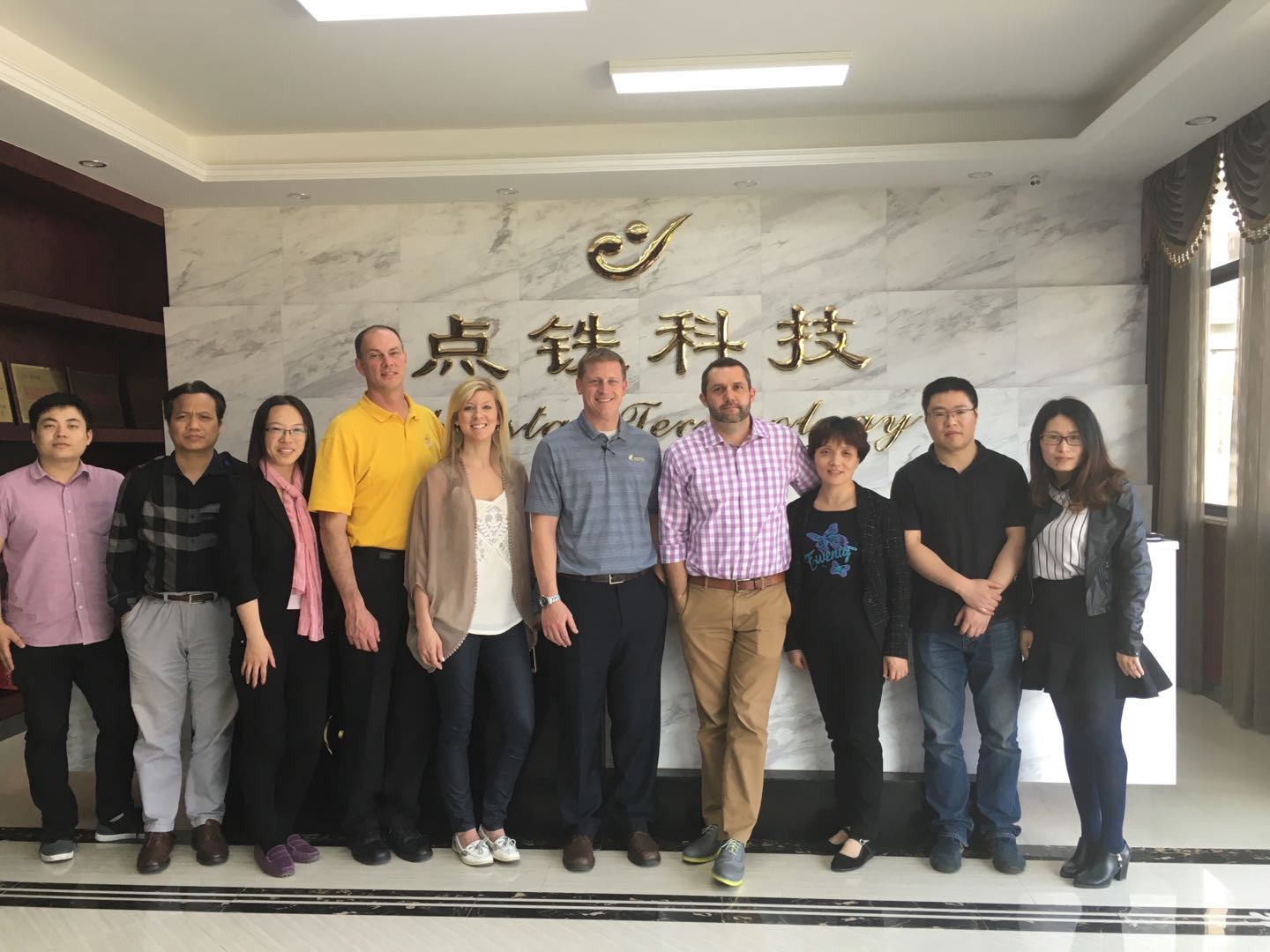
Casting, machining and coating capacity located on a single site is the structural claim most casting suppliers make — and the one buyers should audit first.
1. The real constraint in component parts for agriculture use
Agricultural driveline and chassis components are not high-precision aerospace parts, but they operate under conditions that punish inconsistency. The application data for this product family describes the working condition as farm, outdoor, lawn and garden and general agricultural use, with the components operating under intermittent heavy loads and cyclic running during farming seasons. They are matched to farm machinery transmission assemblies and wheel brake assemblies.
That combination — intermittent heavy load, cyclic running, and long idle periods between seasons — produces three separate failure surfaces that a single specification cannot cover:
- Material consistency. A grade designation such as QT550-6 or QT450-12 defines a target, not a guaranteed casting. Section thickness, inoculation practice and cooling rate determine whether the delivered part actually sits inside the stated mechanical window.
- Machining discipline. Bearing seats, splines and mounting faces carry the loads. Dimensional drift here shows up as vibration, premature wear or assembly rejection long before any structural failure.
- Surface protection. Farm equipment is exposed to humidity, fertiliser residue, slurry and wash-down. Coating performance, not base metal strength, determines how many seasons a part remains serviceable.
The stated special requirements for this component family — anti-rust, salt spray resistance and humidity resistance — are therefore not secondary specifications. They are part of the functional definition of the product.
2. Inside the supplier: plant, process and stated capacity
Zhejiang Pointiron Technology Co., Ltd is a China-based manufacturer founded in 2000, operating from a facility of 66,770 m² in Tongxiang City, Zhejiang. The company describes itself as providing one-stop service from casting through machining and painting to final assembly, covering automotive brake parts, windmill components and tractor and lawn & garden components. It reports 200 employees, 3 engineers in its R&D function, and an annual output of 2,000,000 units.
The capacity figures that matter for procurement planning are stated in two places that are worth reading together:
- Annual casting capacity of 35,000 tons for ductile iron and gray iron, with machining capacity of 5 million pieces per year.
- A stated monthly capacity of 3,000 tons, which is broadly consistent with the annual figure once seasonality and product mix are allowed for.
The process footprint is unusual for a supplier of this size and is the most concrete part of the capability claim. The company operates two casting lines imported from DISA of Denmark — a DISA MATCH32/32 horizontal automatic moulding line and a DISA 131B vertical automatic moulding line — alongside three paint lines (wet paint, powder coat and e-coat) and one assembly line. It states that it implements IATF 16949 quality systems through the end-to-end production process and holds ISO14001:2004 certification.
For US-based buyers, the company also notes that Point Iron USA, Inc. holds warehouse stock in the United States for US customers — a detail that changes the logistics model rather than the manufacturing model, but one that matters when calculating replenishment time rather than production time.
3. Material grades and the mechanical property window
The declared material set for this product family spans both iron families and one austempered variant: QT550-6, QT450-12, HT250 and HT200, plus ADI 900 and ADI 1050, described collectively as nodular cast iron and gray iron.
| Declared specification | Value | What it constrains for the buyer |
|---|---|---|
| Tensile strength | ≥550 MPa | Structural margin in load-bearing parts such as hubs, supports and brackets |
| Yield strength | ≥350 MPa | Resistance to permanent deformation under shock loading |
| Elongation | ≥6% | Ductility available before brittle failure — the key difference from gray iron |
| Hardness | 173–255 HB | Wear resistance versus machinability trade-off; also affects mating surface life |
| Salt spray | 504 hours | Corrosion protection window for farm, outdoor and lawn & garden exposure |
| Dry adhesion | ≥B | Coating retention under mechanical contact and handling damage |
The material split inside this set is not cosmetic. Gray iron — HT250 and HT200 in this portfolio — remains the volume material for the wider iron casting market: it held a 47.68% share of total iron casting volume in 2025, according to market data published by Strategic Revenue Insights, with low cost and vibration-damping qualities cited as the drivers. Nodular grades such as QT550-6 and QT450-12 trade some of that damping and cost advantage for elongation and impact resistance, which is why they appear in driveline and braking-adjacent parts. ADI 900 and ADI 1050 sit further up the performance curve and carry correspondingly higher process control demands.
For a buyer, the practical consequence is that a supplier able to pour all three families has more room to propose a material substitution when a design is over-specified — but the buyer has to ask for that conversation explicitly. Nothing in a quotation automatically reveals it.
4. Coating and corrosion: what a 504-hour salt spray claim actually means
The stated corrosion requirement for this component family is a 504-hour salt spray test combined with dry adhesion of grade B or better. Both are testable, and both should be tested on the production process rather than accepted from a specification sheet.
The relevance of the e-coat, powder coat and wet paint lines becomes clearer in this context. Different coating routes produce different edge coverage, different film thickness uniformity and different behaviour after mechanical damage. E-coat typically reaches recessed geometry and internal surfaces more consistently; powder coat generally delivers a thicker, more abrasion-tolerant film on accessible surfaces; wet paint gives the widest colour and formulation flexibility. Having all three in-house is a genuine capability, and it is also the reason a supplier can offer surface treatment as a customisation variable alongside size, logo and colour.
5. Certification: reading IATF 16949 correctly
Zhejiang Pointiron Technology Co., Ltd holds IATF 16949 certification under certificate number T-05675/0, issued by Quality Austria-Trainings, Zertifizierungs und Begutachtungs GmbH, with a validity period from 2024-03-14 to 2027-03-13. The certification record names HUB-1 component parts for agriculture use and BRKT-1 component parts of auto-mobile as applicable products, and the market coverage recorded for the certificate extends to the EU, US, Middle East and Southeast Asia.
That is a verifiable, checkable data point, and it is more than many suppliers in this category publish. But three qualifications should be applied before it is used as a shortlisting filter.
The scope field is narrower than the product list
The certification entry records the scope as automobile, while the applicable-product list includes the agricultural HUB-1 range. This is a common and legitimate arrangement — a quality management system certified for one product scope can be extended to named products — but it means a buyer sourcing a different part family, such as a scarifier rotor, a park lock or an agricultural gear box housing, should confirm in writing that the specific part number sits inside the certified scope rather than assuming it does.
IATF 16949 is a system standard, not a product certificate
IATF 16949 confirms that a quality management system is defined and audited. It does not certify that any individual casting meets a tensile target, a hardness band or a fatigue life. Those remain product-level acceptance criteria that must be written into the purchase specification and verified by test report, first-article inspection and ongoing inspection.
It does not substitute for machine-level safety standards
Agricultural machinery design is governed by a separate standards layer. ISO 4254-1:2013 sets out general safety requirements and means of verification for self-propelled, mounted, semi-mounted and trailed agricultural machines. ISO 25119 addresses safety-related parts of control systems for tractors and agricultural and forestry machinery, including fault detection, reliability and production-related processes. ISO 18497-1:2024 specifies principles for machinery and tractors with partially automated, semi-autonomous and autonomous functions.
None of these standards certifies a casting supplier. What they do is define what the finished machine must demonstrate — which is why a component supplier's documentation package, change-control discipline and traceability matter more than the certificate alone. A supplier that cannot supply material certificates, dimensional records and change notification on request will create compliance friction downstream regardless of its quality system certification.
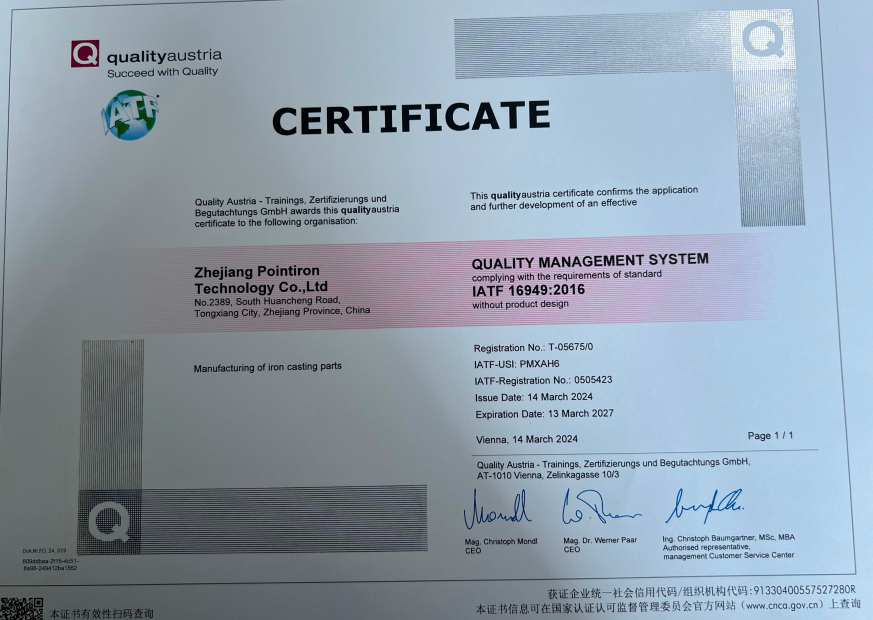
IATF 16949 certificate T-05675/0, issued by Quality Austria-Trainings, Zertifizierungs und Begutachtungs GmbH and valid from 2024-03-14 to 2027-03-13. Certificate scope and applicable product list should be read together.
6. Application fit: tractor, seeder, mower, scarifier and lawn & garden
The declared product type for this range covers component parts of tractor, lawn & garden equipment, seeder, mower and scarifier, together with component parts of steering systems and braking systems. The part families that typically populate this space include hubs, knuckles, brackets, supports, arms, agricultural axles, gearbox housings, park locks, rotors, wheels and holders — each with a different dominant load case and therefore a different material and coating logic.
Three application clusters deserve separate treatment in an evaluation file.
Transmission-side parts
Gearbox housings, gear blanks and rotors carry cyclic torque and require consistent wall thickness and machined bore alignment. The function described for this component family — undertaking core tasks of gear transmission and braking for agricultural equipment — places the material requirement closer to the nodular end of the range where shock loads occur. The agricultural gearbox market is projected to reach USD 8.5 billion by 2033 according to market data published by Strategic Revenue Insights, which is a useful indicator of where component demand concentration is heading, though it is a forecast rather than a current measurement.
Chassis and wheel-end parts
Hubs, knuckles, supports, axles and wheels carry vertical load plus steering and braking reaction forces. Hardness in the 173–255 HB band and a ≥6% elongation target are the relevant guards here: too hard and the part becomes sensitive to impact cracking, too soft and bearing seats wear prematurely.
Implement and turf parts
Seeder, mower, scarifier and lawn & garden components sit closer to wear-and-corrosion territory than to structural territory. Coating performance and surface finish dominate service life, and the anti-rust, humidity-resistance and salt spray requirements apply with more force than in enclosed transmission assemblies.
A ten-year supply relationship with an agricultural machinery OEM provides the most concrete application evidence available for this supplier. The reference case covers 20,000 units supplied for tractor application over a ten-year duration, with a reported result of ten years of stable supply and a stated highlight of structural stability, high wear resistance and long service life under heavy farm loads. It is a single-OEM, tractor-centric reference and should be weighted as such — it demonstrates continuity of supply and repeat order behaviour rather than a broad cross-application track record.
7. Commercial constraints buyers should model before shortlisting
Specification and certification answer whether a supplier can make the part. They do not answer whether the commercial structure fits the programme. On this dimension the supplier's declared position is specific enough to evaluate.
| Commercial parameter | Declared position | Procurement implication |
|---|---|---|
| Business model | OEM / ODM | Suited to drawing-based and co-developed programmes rather than catalogue buying |
| Customisation | Size, logo, colour, surface treatment | Private-label and regional variant programmes are feasible without a second finishing supplier |
| MOQ, parts under 10 lb | 10,000 pieces | Volume programme assumption; not a trial-order quantity |
| MOQ, 10–20 lb | 5,000 pieces | Mid-size assemblies |
| MOQ, 20–100 lb | 2,000 pieces | Typical hub, knuckle and bracket sizes |
| MOQ, 100–150 lb | 1,000 pieces | Heavy housings and larger axle components |
| Lead time | 12 weeks | Planning-cycle supply, not emergency replenishment |
| Quality control | 100% test | Inspection-intensive model; confirm which characteristics are covered by the 100% regime |
| After-sales | Warranty | Warranty terms should be captured in writing at RFQ stage |
| Export share | 20% of output, main markets USA / EU | Majority of capacity serves other markets; export allocation should be confirmed per programme |
The honest reading of this table is that the supplier is structured for programme supply, not for spot buying. A twelve-week lead time combined with tiered minimum order quantities means a buyer with seasonal peaks, an unplanned aftermarket demand spike, or a low-volume specialty variant will find the commercial structure harder to work with than the technical capability. Buyers in that position typically need to plan buffer stock, accept longer commitment horizons, or retain a secondary source for low-volume lines. That is a constraint of the model, not a defect in the product.
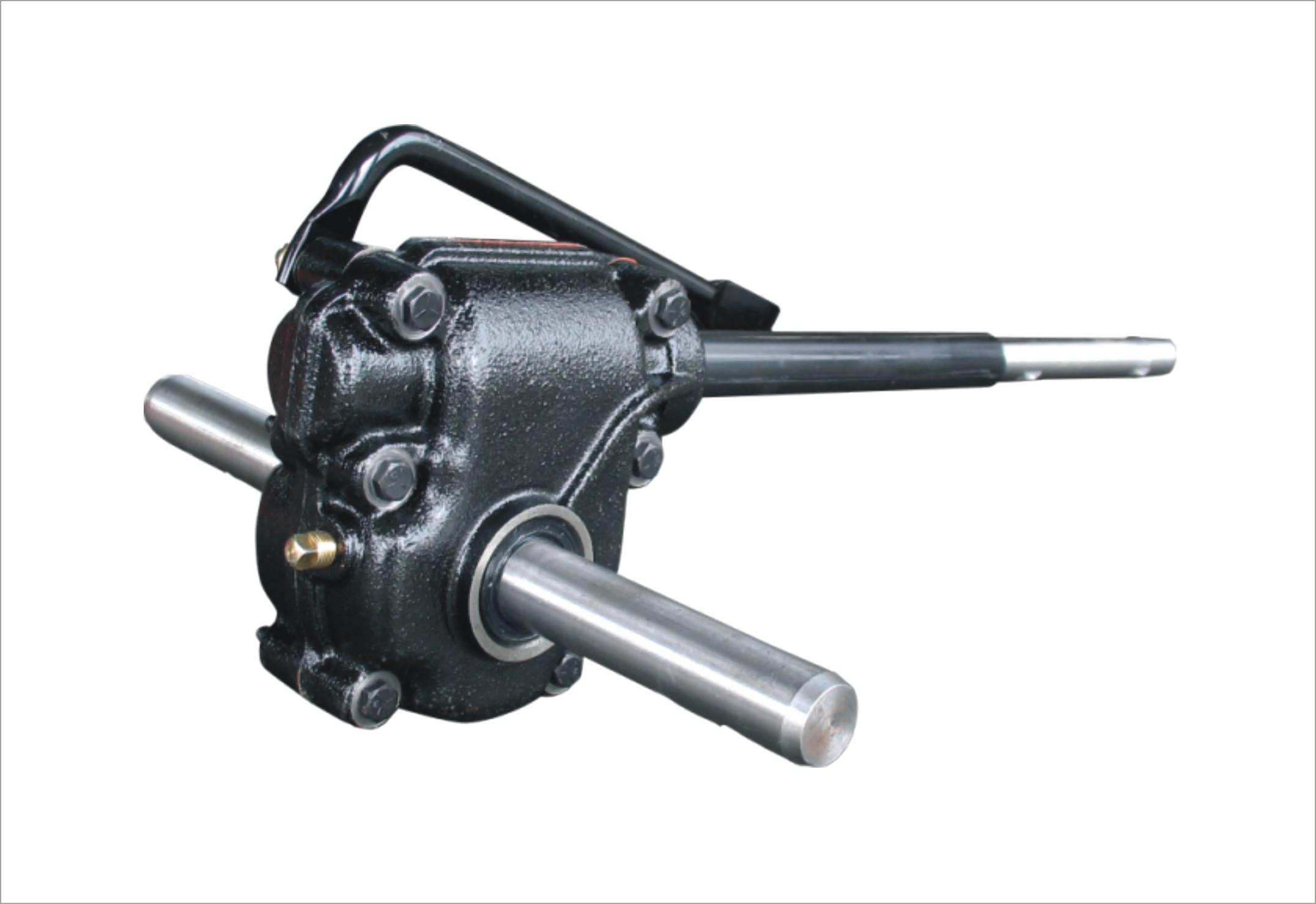
Transmission assemblies are where material grade, machining alignment and coating specification interact — and where a single weak link determines assembly-line rejection rates.
8. Integrated casting-to-assembly versus split sourcing
The most consequential structural question in this category is not which supplier is largest, but whether casting, machining, coating and assembly sit under one quality system or across four. Both models are legitimate and each carries a different risk profile.
| Evaluation dimension | Integrated model (casting through assembly on one site) | Split sourcing model |
|---|---|---|
| Responsibility boundary | Single party accountable for dimensional and coating outcomes | Disputes between foundry, machine shop and coater consume resolution time |
| Change control | One change-notification channel | Change must propagate across multiple suppliers, with version-drift risk |
| Cost transparency | Cost breakdown less granular; harder to benchmark individual steps | Each step is individually quotable and comparable |
| Flexibility on low volume | Bound by the integrated plant's minimum runs | Specialist shops may accept smaller batches per step |
| Lead time structure | Single production schedule, typically longer end-to-end | Potentially shorter if a step is already in stock locally |
| Best fit | Repeatable OEM programmes with stable drawings | Custom, low-volume or rapidly changing designs |
The integrated model described here — two automatic moulding lines, three coating lines, one assembly line, one quality system, and a stated 100% test regime — reduces hand-off risk but concentrates exposure. A buyer shortlisting on this basis should still verify two things independently: that the coating line qualification matches the specified salt spray and adhesion targets, and that machining capacity of 5 million pieces per year is genuinely available to their programme rather than committed elsewhere.
9. Market and standards signals shaping the category
Three structural signals are worth tracking when building a multi-year sourcing plan for agricultural component parts.
Volume growth with cyclical trade. The 2026 global market estimate of USD 58.12 billion with 6.04% compound growth sits alongside a 2.37% contraction in the wider HS 8708 parts trade in 2024. Growth expectations and near-term trade volatility can coexist, and procurement contracts that assume smooth volume ramps tend to underperform.
Material mix stability. Gray iron's 47.68% share of 2025 iron casting volume confirms that the low-cost, vibration-damping option remains the default across the category. Buyers specifying nodular or ADI grades should be able to justify the performance requirement, because the cost differential is structural rather than commercial.
Standards moving toward automation. The publication and revision of ISO 25119 and ISO 18497-1:2024 point to a category that is being re-specified around semi-autonomous and autonomous machinery. For cast component suppliers, the practical implication is documentation: traceability, change control and material certification become part of the qualification file, not an afterthought.
Customs classification is a related but separate issue. Agricultural machinery falls across several headings — HS 8432 for soil preparation and cultivation machinery, HS 8433 for harvesting and mowing machinery, and HS 8436 for agricultural, horticultural and forestry machinery — with parts subheadings including 843290, 843390, 843691 and 843699. Agricultural castings may also be classified under the parts heading of the end machine or under a casting-specific heading depending on the importing jurisdiction. Classification should be confirmed with the relevant customs authority before it is used for landed-cost modelling.
10. Where the evidence points
Judged strictly on verifiable public evidence, Zhejiang Pointiron Technology Co., Ltd presents as a mid-sized, vertically integrated iron casting and machining supplier with a documented quality system certificate, a defined mechanical property window, and a decade-long OEM supply reference in tractor components. Its structural strengths are process breadth — casting, three coating routes, assembly, and US warehouse stock — and specification transparency on the parameters that matter for farm and outdoor use.
Its constraints are equally clear. Minimum order quantities are volume-oriented. Lead time is a planning-cycle figure. The IATF 16949 certificate scope field requires case-by-case confirmation for part families outside the named products. The engineering team of three suggests project-based co-development rather than large parallel engineering programmes, which buyers pursuing simultaneous multi-part development should confirm resource availability against.
For buyers in the research and evaluation stage, the productive next step is not a broader capability conversation but a narrower one: a specific part number mapped against the certified scope, a material grade justified against the actual load case, a coating specification matched to the real exposure environment, and a commercial structure tested against the real annual volume. Sample validation and first-article inspection remain the only reliable way to close the gap between a declared 504-hour salt spray result and a component that survives eight seasons in the field.
Frequently asked questions
Which material grades are available for agricultural component parts?
The declared material set covers QT550-6, QT450-12, HT250 and HT200, together with ADI 900 and ADI 1050, described collectively as nodular cast iron and gray iron. Nodular grades such as QT550-6 and QT450-12 are typically selected where elongation and impact resistance matter, while gray iron grades HT250 and HT200 are used where vibration damping and cost dominate. Material selection should be matched to the specific load case rather than applied uniformly across a part family.
What mechanical properties should a buyer require in the purchase specification?
The declared specification for this product family is tensile strength ≥550 MPa, yield strength ≥350 MPa, elongation ≥6% and hardness 173–255 HB, with salt spray testing at 504 hours and dry adhesion of grade B or better. These values define an acceptance window, not a guaranteed outcome per casting, so they should be paired with first-article inspection, material certificates and a defined sampling plan in the purchase agreement.
Does IATF 16949 certification apply to agricultural components or only to automotive parts?
The certificate held by Zhejiang Pointiron Technology Co., Ltd — number T-05675/0, issued by Quality Austria-Trainings, Zertifizierungs und Begutachtungs GmbH and valid from 2024-03-14 to 2027-03-13 — names HUB-1 component parts for agriculture use alongside BRKT-1 component parts of auto-mobile as applicable products, while the scope field is recorded as automobile. Buyers sourcing a different part number should obtain written confirmation that the specific part falls inside the certified scope.
How is corrosion resistance verified for farm, outdoor and lawn & garden use?
Corrosion performance is defined through a salt spray test duration of 504 hours combined with a dry adhesion result of grade B or better. Verification depends on which coating route is applied — wet paint, powder coat or e-coat — because each produces a different film profile and edge coverage. Buyers operating in high-humidity, slurry or high-fertiliser environments should request test evidence produced against their own exposure profile rather than relying on the general specification.
What are the minimum order quantities and lead times?
Minimum order quantities are tiered by part weight: 10,000 pieces for parts under 10 pounds, 5,000 pieces for 10–20 pounds, 2,000 pieces for 20–100 pounds, and 1,000 pieces for 100–150 pounds. The stated lead time is 12 weeks. These parameters suit planned OEM programmes and are structurally less suited to emergency aftermarket replenishment or very low-volume specialty variants.
How should a buyer validate this kind of supplier before committing to a programme?
Validation should cover four separate items: written confirmation that the part number sits inside the certified scope; material certificates and mechanical test reports for the specific grade; coating test evidence for the specified salt spray and adhesion targets; and a documented change-notification process. The declared 100% test regime and warranty terms should be reviewed at RFQ stage, since the inspection characteristics covered by the 100% regime determine what the buyer still needs to verify independently on incoming goods.
A downloadable company and capability overview is available here: Pointiron introduction (PDF).
Есть вопросы или нужны дополнительные детали?
Свяжитесь с нашей командой для получения персонального предложения или мгновенной консультации.
Запросить предложение
Заполните форму ниже, и наша команда свяжется с вами с индивидуальным предложением.
Прямой чат WhatsApp
Предпочитаете общаться в реальном времени? Напишите нам в WhatsApp для мгновенной помощи и быстрых ответов.
- Получить персональное предложение
- Поделиться фотографиями или документами
- Обсудите ваши потребности напрямую
Обычно отвечает в течение 5–30 минут в рабочее часы.