
Agricultural Loader Hydraulic Cylinders: Matching Actuators to Field Conditions
Agricultural Loader Hydraulic Cylinders: Matching Actuators to Field Conditions
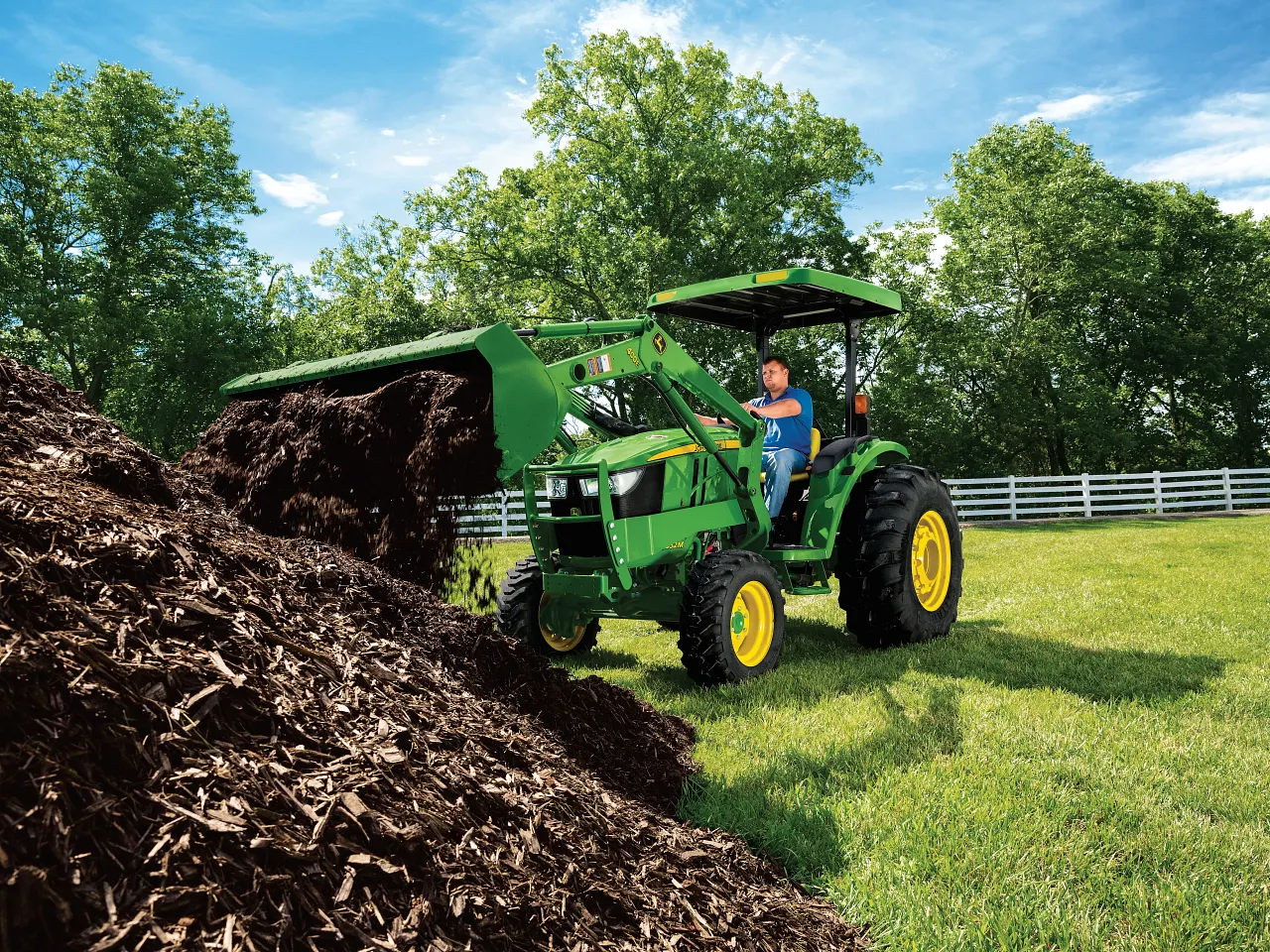
An agricultural loader asks three different things of its hydraulic cylinders in a single working day. Filling a bucket from a compacted heap asks the tilt circuit for breakout force and then for controlled rollback. Closing a grapple on manure, silage or timber asks for gripping force on an irregular shape that pushes back sideways. Carrying a pallet fork or bale spear across a rutted track asks for nothing more dramatic than holding position — which is often where drift, seal wear and operator fatigue begin.
The cylinder is the point where tractor hydraulic pressure becomes work, and it is also the point most exposed to mud, dust, fertiliser, frost and shock. The sections below examine how cylinder configuration follows those duties, which supporting components change the requirement, and where the documented limits of each option sit. The intended reader is an equipment builder, dealer or workshop evaluating a custom or replacement cylinder rather than a catalogue standard part.
Apex Hydraulic Co., Ltd. is a Chinese manufacturer of custom hydraulic cylinders, hydraulic power units and hydraulic systems, established in 2009 and operating from a 50,000 m² facility. The company exports to North America, Western Europe, South America, Southeast Asia, the Middle East and Australia, and lists agricultural machinery, tractors and farm implements, and front-end loaders among its application areas.
Why the field, not the catalogue figure, sets the specification
A cylinder's rated force is calculated from working pressure and effective area. That figure says nothing about whether the rod will survive a frozen heap, whether a wiper will keep abrasive dust out of the gland, or whether a paired lift cylinder will still track its twin after two seasons of work. Agricultural loader duty adds four conditions that a bench rating does not capture: load reversal, shock, contamination and misalignment.
Load reversal comes from attachments that push, pull and then carry. Shock comes from contact with the ground or a load pile. Contamination comes from mud, dust, fertiliser and crop residue reaching the rod. Misalignment comes from linkage geometry that moves through an arc while the cylinder pushes in a straight line, and from pins and bushings that wear in service.
Apex Hydraulic's published requirement set for tractor front-end loader applications treats these as design inputs rather than service issues. It calls for bore and rod diameter matched to the required lifting force and tractor hydraulic pressure; stroke and closed length matched to the loader linkage geometry; matched dimensions and internal displacement on paired lift cylinders; mounting centres that stay aligned throughout the loader's movement; cross-tube, pin-eye or clevis mounts that match the existing brackets and pin diameters; and a piston rod sized to resist bending under dynamic agricultural loads. Each of those is settled before manufacture, not adjusted afterwards.
Bucket tilt and dump: push force is not rollback force
Bucket cylinders extend and retract to roll the attachment back, level it, or dump it. The circuit is double-acting because the function needs powered movement in both directions, and the load is rarely gentle: the application guidance for agricultural loaders notes that high breakout force is required during digging and bucket loading, and that shock loading occurs when an attachment contacts the ground or a load pile.
The point buyers most often miss is that the two directions are not symmetrical. Rated push force is calculated from the effective piston area and working pressure; rated pull force is calculated from the annular area — the piston area less the rod area — at the same pressure. A cylinder that looks generous in push can therefore be modest in rollback, and rollback is the direction that breaks a bucket out of a compacted heap.
Rod diameter sits inside that trade-off. A larger rod resists buckling over a long stroke and a compression load more effectively, but enlarging the rod shrinks the annular area and reduces pull force at the same bore and pressure. Asking a supplier for both rated push and rated pull force against the linkage's actual requirement, rather than for bore alone, is the practical way to keep that balance visible during evaluation.
Two further items belong in the bucket circuit. End-of-stroke cushioning — available as head-end, cap-end or dual-end cushioning on custom welded cylinders — reduces mechanical impact and hydraulic shock when a loaded bucket reaches the end of its stroke. A system relief valve protects both the cylinders and the loader structure from excessive system pressure, but it protects by bypassing flow; it does not correct a cylinder that was undersized for the breakout duty in the first place.
Grapple open and close: gripping under side load
A grapple cylinder does not push a load; it closes a jaw on one. Apex Hydraulic's application mapping for hydraulic grapples describes the working pattern as frequent opening, closing, gripping, lifting, rotating and sorting cycles, with impact loads, vibration, dust, abrasive material, moisture, temperature change and possible side loads acting on the cylinder at the same time. On a farm loader the same jaw duty appears in manure, silage, feed and timber handling.
The documented requirement set for this duty is different from a bucket's. It calls for high gripping force, impact resistance, side-load tolerance, reinforced mounting eyes, hardened pins and bushings, a protected piston rod, high-strength welded construction, abrasion-resistant coating, reliable load holding, compact installation dimensions, and seals suited to frequent cycling. It also requires cylinder dimensions, mounting centres and hydraulic pressure to be matched to the grapple geometry and to the carrier equipment — a reminder that the force felt at the jaw is a product of the jaw linkage, not of the cylinder alone.
Grapple circuits vary in arrangement. One central cylinder may drive the jaw, or two synchronized cylinders may work in parallel; a separate hydraulic rotator may be added where the attachment rotates. With two cylinders, oil supply and flow division become part of the specification, because uneven extension shows up as a jaw that closes at an angle. The APEX-CGAC Series custom hydraulic grapple and attachment cylinder is the series Apex lists for this application class, alongside its custom welded double-acting and heavy-duty ranges.
Pallet forks and bale spears: holding position while the tractor moves
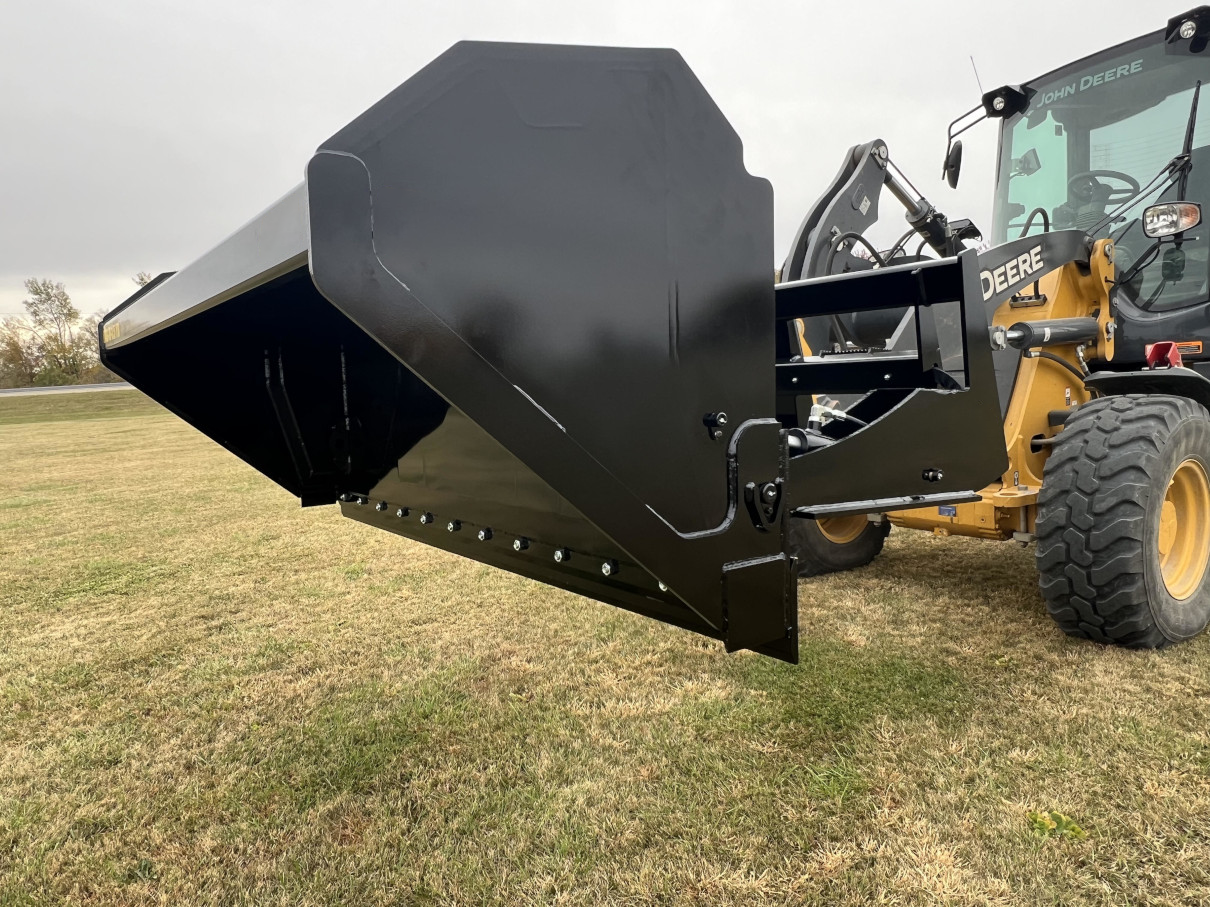
Fork and spear work looks undemanding until the tractor starts moving. The requirement in Apex's agricultural loader guidance is to control pallet forks, bale spears and material-handling attachments, to adjust implement position, and to maintain stable attachment positioning during transport. That is a holding duty rather than a force duty, and it is met by different measures than breakout force.
Load-holding hardware is the first of them. Apex lists load-holding valves as matched equipment for loader circuits, and its custom cylinder options include counterbalance valves, pilot-operated check valves and hose-burst valves. Their documented purpose is to improve load control and reduce unintended movement after a pressure loss. What they are not is a mechanical lock: work under a raised attachment still depends on the mechanical boom lock and an approved support, which is listed among the loader's matched components for that reason.
Geometry matters here too. A bale spear carries its load at a single point some distance from the carriage, so the tilt circuit sees a moment rather than a distributed load. Mounting alignment, pin condition and rod guidance then decide whether that moment reaches the cylinder as clean compression or as bending. Apex's guidance to keep mounting centres aligned throughout the loader's movement and to lubricate pins and bushings applies directly to this duty.
Uneven, frozen, muddy and dusty ground: what actually changes in the cylinder
Field conditions change four specification items: rod protection, sealing material, mounting articulation and surface treatment.
On uneven ground the cylinder sees vibration and impact rather than steady load. Worn pins and bushings convert that vibration into side load, and side load is what bends rods and wears gland bearings. Heavy-duty clevis, pin-eye, cross-tube or spherical-bearing mountings are available where articulation is required, and the standard welded range uses a cross-tube bushing mount or a fixed or adjustable clevis. Whatever the choice, the mounting must match the existing bracket and pin diameter — Apex publishes pin diameter options of 1.0, 1.25 and 1.5 inches on its fixed-clevis welded configuration, which illustrates how specific that interface becomes.
On frozen ground the dominant event is shock, and low-temperature operation is a sealing question. Apex selects cylinder seals from polyurethane, NBR, PTFE, FKM or low-temperature sealing materials according to the operating environment, and states operating temperature as a function of the selected sealing system and hydraulic fluid rather than as a fixed figure.
Mud, dust and fertiliser attack the rod. The application requirement is explicit: rod surface protection must be selected for mud, fertiliser, moisture and abrasive contamination, and rod wipers and seals must prevent dust and debris from entering the cylinder. Apex's standard welded series publishes an induction-hardened rod with a core hardness of 45–50 HRC, hard chrome plating of approximately 0.001 inch, a final surface hardness of 69–71 HRC and a 96-hour corrosion test to ASTM B117-07a. For a loader working in slurry and fertiliser, the wiper configuration and the external coating matter as much as the plating thickness.
Hose routing closes this section, because a hose pulled against a tire or a linkage pinch point causes failures that are then blamed on the cylinder. Apex's loader guidance requires hoses to be routed away from tires, sharp edges, pinch points and loader linkage — a check that costs nothing at build stage and is expensive to repeat in the field.
Joystick, pilot or electro-hydraulic: how control shapes the specification
Operators reach the loader through a mechanical joystick, a hydraulic pilot control or an electro-hydraulic valve. The control type does not change the force a cylinder must produce, but it changes how finely the operator can meter flow, and that affects which cylinder options earn their place.
With a mechanical joystick, smoothness and end-of-stroke behaviour are largely carried by the linkage and the cylinder. Optional single-end or dual-end cushioning reduces impact and hydraulic shock at the end of stroke, which is felt directly through the lever. With pilot or electro-hydraulic control, the valve meters flow more precisely, so repeatable positioning becomes a control question rather than a purely mechanical one.
Position sensing belongs to that second case. Apex's custom cylinders offer optional linear position sensors, proximity switches or external stroke sensors, and the documented function of position sensing is to support automated movement, stroke control and equipment monitoring. Where an attachment must return to a set angle repeatedly, that option is worth discussing at specification stage. It also adds electrical connections to a machine that works in rain, dust and washdown, so weather-resistant connectors and protected wiring become part of the same decision.
Accumulators, relief valves and load-holding valves: support hardware and its limits
Three components around the cylinder change how a loader behaves, and each has a boundary worth stating.
An optional accumulator-based loader suspension system allows limited cylinder movement to absorb shock during transport. It works by permitting movement, so it should be reviewed together with attachment holding requirements rather than in isolation: a circuit designed to absorb shock is not the same circuit as one designed to hold a fork rigidly over a rough track.
A hydraulic relief valve protects the cylinders and the loader structure from excessive system pressure. Its setting has to be consistent with the cylinder's pressure rating and with what the loader frame can accept, and it should be treated as a protective device rather than a sizing correction. Apex publishes working pressure as a project-specific value for custom cylinders, and states a maximum design pressure that must be confirmed before engineering approval — the relief setting belongs inside that confirmation.
Load-holding valves — counterbalance, pilot-operated check or hose-burst types — reduce unintended movement after pressure loss. They act on the hydraulic circuit, not on the mechanical structure, which is why the loader's mechanical boom lock remains part of the matched equipment list. Cushioning, the fourth element, works inside the cylinder at the end of stroke and is specified as head-end, cap-end or dual-end.
Three Apex series mapped to loader and attachment duty
| Series | Documented role | Configuration points relevant to loader and attachment duty | What must be confirmed |
|---|---|---|---|
| APEX-CGAC Series — custom hydraulic grapple and attachment cylinder | Grapple and attachment actuation | Reinforced mounting eyes, hardened pins and bushings, protected rod, welded construction, abrasion-resistant coating, load holding, seals for frequent cycling | Cylinder dimensions, mounting centres and pressure matched to jaw geometry and carrier equipment |
| APEX-CWDC Series — custom welded double-acting cylinder | Build-to-print or newly engineered OEM cylinder for mobile equipment | Custom bore, rod, stroke and pressure; cross-tube, clevis, pin-eye, trunnion, flange or spherical-bearing mounts; SAE ORB, NPT, BSPP, BSPT, metric or flange ports; optional cushioning, load-holding valves and position sensing | Approved drawing, mounting width and pin diameter, port type and position, duty cycle |
| APEX-CPSC Series — custom position-sensing cylinder | Applications where stroke feedback is required | Optional linear position sensors, proximity switches or external stroke sensors supporting automated movement, stroke control and equipment monitoring | Sensor type, wiring route, connector protection and control-system interface |
Series names alone do not settle a selection. Apex's application mapping for grapple and material-handling duty lists the APEX-CGAC, APEX-CWDC, APEX-CHDC, APEX-CLSC, APEX-CPSC and APEX-CCSC series among applicable products, while its agricultural loader mapping lists the HBU, HCL and HTG welded series, APEX-CWDC, APEX-CGAC, the HTR and HTH tie-rod series, APEX-CLSC and the APEX-CSPC single-acting ram series. The overlap is expected: the same cylinder family can serve a bucket, a grapple or a lift arm once bore, stroke, mounting and sealing are configured for that function.
Welded, tie-rod or single-acting: a construction choice with field consequences
| Construction | Documented characteristics | Where it fits on an agricultural loader | Boundary to respect |
|---|---|---|---|
| Welded body (HBU, HCL, HTG; custom welded double-acting) | Double acting, rated working pressure up to 3,000 PSI, bore 1.5–5.0 in, stroke 4–48 in on the cross-tube configuration, threaded serviceable gland, compact external profile with resistance to vibration and impact | Bucket tilt, lift arms and attachment circuits where the linkage envelope is tight and shock is routine | Model numbers are for cross-reference only; dimensional interchangeability must be confirmed against measurements, OEM part number or an approved drawing |
| Tie-rod (HTR, HTH) | Double acting, 2,500 PSI on HTR and 3,000 PSI on HTH, bore 2–5 in, stroke 4–36 in on HTR and 4–48 in on HTH, adjustable threaded female clevis, SAE ORB ports, ASAE tie-rod configuration for agricultural equipment | Implement and attachment circuits where disassembly for seal replacement and dimensional adjustment are priorities | Larger external profile than a welded body; final compatibility confirmed by part number, drawing and port specification |
| Single-acting ram (APEX-CSPC) | Pressure applied in one direction only; return by gravity, external load, spring or mechanical linkage; installation primarily vertical or inclined, with horizontal installation requiring engineering review | Lift and support functions that return by load or gravity | Not a substitute for a double-acting bucket circuit, which needs powered movement in both directions |
The choice between welded and tie-rod is often decided by maintenance philosophy rather than by pressure. A tie-rod cylinder's construction allows convenient disassembly, seal replacement and maintenance, and its adjustable clevis simplifies installation and dimensional adjustment. A welded body gives a compact envelope and documented resistance to vibration and impact in mobile hydraulic work, but it must be specified with a serviceable gland if field re-sealing is part of the plan — which is why Apex lists a threaded, serviceable gland on its standard welded range.
The specification file: what to prepare before a cylinder is built
Custom and replacement cylinders are manufactured against confirmed inputs. Apex's stated requirement list for a build-to-print or custom cylinder is a practical checklist for an evaluation file:
- Equipment type and cylinder function, plus the existing part number and photographs where a replacement is involved.
- Installation drawing or a sample cylinder.
- Bore diameter, piston rod diameter and stroke length.
- Retracted and extended pin-to-pin length.
- Working pressure and maximum system pressure.
- Required push and pull force.
- Mounting style, mounting-pin diameter and mounting width.
- Hydraulic port type and position, and the hose route around the linkage.
- Operating temperature, hydraulic fluid type, and operating frequency or duty cycle.
- Corrosion-protection requirement and required paint colour.
- Annual demand and order quantity.
Two verification habits are worth building into that file. First, treat paired lift cylinders as one unit: Apex's loader guidance requires matched dimensions and internal displacement, because a mismatched pair extends unevenly and loads the frame asymmetrically. Second, ask for the test record with the drawing — dimensional inspection, pressure testing, leakage testing and full-stroke functional testing are documented steps for custom cylinders, and they are the evidence that the built unit matches the approved specification.
Manufacturing evidence and a documented grapple project
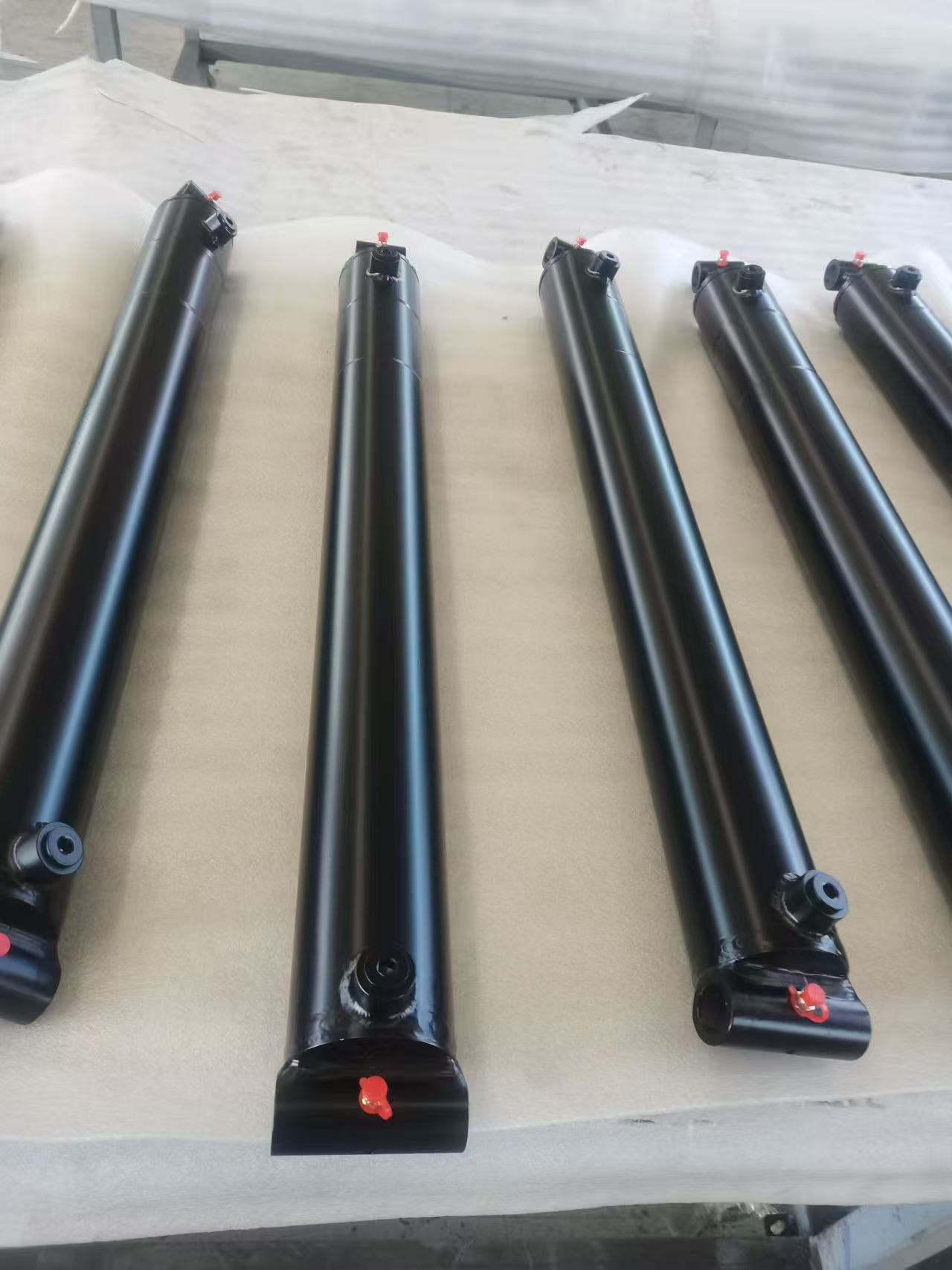
Apex Hydraulic states a monthly capacity of more than 8,000 hydraulic cylinders and more than 1,500 hydraulic power units, supported by a 25-engineer R&D team. Published lead times are 7–20 days for standard products and 25–45 days for customized products, with large OEM projects scheduled to the project plan; minimum order quantity is one piece for standard products and negotiable for OEM and customized work. Quality control is documented as incoming material inspection, in-process control, final inspection, pressure testing, leakage testing, dimensional inspection, welding inspection, surface finish inspection, functional testing and 100% final inspection.
One recorded project is directly relevant to attachment duty. A hydraulic grapple equipment manufacturer in Italy ordered 150 custom cylinders over a one-year program for grapples used in scrap handling, recycling, forestry, waste management and material handling. The documented configuration used optimized mounting dimensions, high-strength welded construction, a heavy-duty sealing system and corrosion-resistant surface treatment; the recorded outcome cites improved gripping force, operational stability and reduced maintenance under continuous heavy-duty work. That record describes a supplier project rather than an independently published field study, and it should be read as evidence of a configuration approach rather than as a performance guarantee for a different attachment.
Outlook: specify the interface before the requirement changes
Where a loader program is expected to gain automated or assisted functions later, the decision that ages best is the interface decision. A cylinder specified today with a mounting envelope, port arrangement and, where relevant, position-sensing provision that can accept added control hardware avoids a linkage redesign when the requirement arrives. Apex's custom welded range already treats cushioning, load-holding valves and position sensing as optional configuration items rather than as separate product lines, which keeps that door open.
That is a design-stage observation, not a demand forecast. The practical question for a buyer at the research and evaluation stage is narrower: does the cylinder on the drawing match the duty the attachment actually performs, and is the evidence for that match documented?
Frequently asked questions
Does a tractor front-end loader bucket need a double-acting cylinder?
Yes, for the bucket tilt function. A double-acting cylinder provides powered movement in both directions, which is what rollback, levelling and dumping require. A single-acting ram depends on gravity, an external load, a spring or a mechanical linkage for its return, and Apex notes that horizontal installation of such a ram requires engineering review. Lift functions that return by load can use different arrangements; the tilt circuit cannot.
How do muddy, dusty or frozen conditions change the cylinder specification?
They change four things. Rod protection and wiper configuration are selected for mud, fertiliser and abrasive contamination; sealing materials are selected for the operating temperature, including low-temperature options; mounting articulation is chosen to absorb vibration and limit side load; and external coating is chosen for corrosion exposure. Apex's standard welded series, for example, publishes an induction-hardened chrome-plated rod and a 96-hour corrosion test to ASTM B117-07a.
When is a load-holding valve needed on a loader or grapple attachment?
A load-holding valve is used where unintended movement after a pressure loss matters — typically on lift, tilt and attachment-holding functions. Counterbalance, pilot-operated check and hose-burst versions are documented options on Apex custom cylinders. The valve acts on the hydraulic circuit, so it complements rather than replaces the loader's mechanical boom lock when anyone works under a raised attachment.
What measurements are needed to build a replacement loader cylinder?
The workable set is: bore, rod diameter and stroke; retracted and extended pin-to-pin length; mounting style, pin diameter and mounting width; hydraulic port type and position; working pressure and maximum system pressure; required push and pull force; operating temperature, fluid type and duty cycle. A part number, drawing, photographs or a sample cylinder speed confirmation. Apex states that model numbers are for cross-reference and that final interchangeability must be confirmed before production.
Can position feedback be added to an agricultural attachment cylinder?
It can be specified as an option rather than added later in most cases. Apex offers linear position sensors, proximity switches or external stroke sensors on custom cylinders, and lists the APEX-CPSC Series position-sensing cylinder among applicable products for grapple and attachment work. The practical constraints are the sensor type, the wiring route on a moving loader, weather-resistant connectors, and the control system that will use the signal.
Closing note
Agricultural loader cylinders are specified by function, not by family name: a bucket tilt circuit is governed by pull force and shock, a grapple by side load and jaw geometry, and a fork or spear by holding behaviour and mounting alignment. Buyers who collect those duty parameters before requesting a quotation give an engineering team something it can verify against a drawing.
Apex Hydraulic's full main-product catalog, including cylinder series, power units and hoist kits, is available for download: APEX Hydraulic Product Catalog (Main Products).
Есть вопросы или нужны дополнительные детали?
Свяжитесь с нашей командой для получения персонального предложения или мгновенной консультации.
Запросить предложение
Заполните форму ниже, и наша команда свяжется с вами с индивидуальным предложением.
Прямой чат WhatsApp
Предпочитаете общаться в реальном времени? Напишите нам в WhatsApp для мгновенной помощи и быстрых ответов.
- Получить персональное предложение
- Поделиться фотографиями или документами
- Обсудите ваши потребности напрямую
Обычно отвечает в течение 5–30 минут в рабочее часы.