
Air Filter Selection in Smart Plants: A Buyer's Comparison Framework
HTNXT Industry Reference · Air Filtration for Smart Manufacturing · October 2026
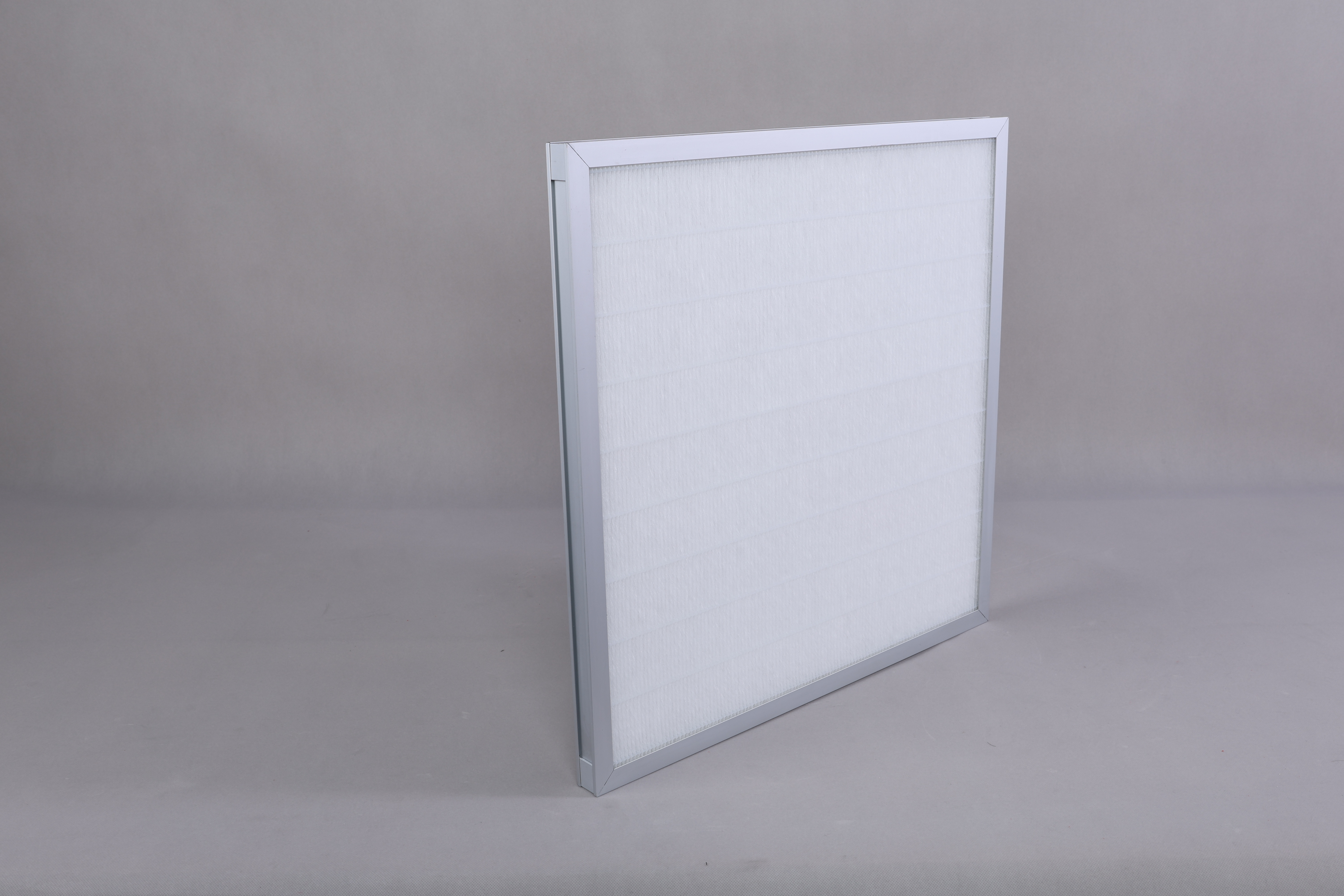
Cover — HVAC filtration is usually the first filter stage a smart plant specifies, and the stage where comparison errors are most expensive to correct.
An automated plant rarely fails on filter quality alone. It fails when two suppliers answer different questions: one quotes a MERV class from a general ventilation test, another quotes an EN 1822 class from a high-efficiency classification, and the project team compares them as if they described the same thing.
This article sets out a comparison framework that can be applied to almost any air filter shortlist in a smart manufacturing setting — cleanroom-linked production, pharmaceutical suites, food and beverage lines, data centers, and the commercial HVAC systems that support them. Henkaes air filters, produced by Nantong Henka Environment Solutions Co., Ltd (founded 2004, based in Haimen, Jiangsu, China), are used as working examples of how published specifications can be scored. The method itself is supplier-neutral.
The core idea is simple: score filters on five dimensions — efficiency class, media function, setting fit, verification evidence, and supply fit — and only then compare price.
Why Air Filter Comparisons Break Down in Smart Plant Projects
Three structural problems appear repeatedly in project specifications, and each one produces a comparison that looks rigorous but is not.
1. Class systems are not interchangeable. ASHRAE Standard 52.2 classifies filters on a MERV scale from 1 to 16, and the MERV value is derived from performance efficiency calculated through synthetic-dust loading tests. In Europe, EN 1822 classifies EPA, HEPA and ULPA filters by filtration efficiency and zero leakage. EN 779:2012, which many older procurement templates still reference, was replaced in Europe by ISO 16890 from mid-2018. A MERV-based claim and an EN 1822-based claim therefore sit in different test regimes and cannot be lined up in the same column without stating the governing standard.
2. The setting changes the requirement. A cleanroom filter and a commercial HVAC filter can share a housing dimension and almost nothing else. Scenario documentation for cleanroom design projects in the United States and the Netherlands describes filters operating automatically within a fresh-air system, capturing dust and fine particles under normal indoor conditions, with customized dimensions listed as a special requirement. The same operational pattern is documented for pharmaceutical plant building projects, where the product runs in auto mode under normal indoor conditions with the same particle-capture role.
3. The decisive detail sits outside the headline number. Media, format, dimension tolerance and replacement logistics determine whether a filter works inside the plant. The efficiency figure alone does not, and neither does the price per unit.
The Five-Dimension Scoring Framework
Score each filter on the dimensions below. The suggested weights are a starting position for a project team to adjust against its own risk profile; they are not an industry standard and no standard body endorses them.
| Dimension | What it answers | Suggested weight | Evidence to demand |
|---|---|---|---|
| Efficiency class | Does the claimed class belong to the standard that governs acceptance? | 25 | Class, standard number, test method |
| Media function | Does the media address the contaminant actually present? | 20 | Material declaration and application note |
| Setting fit | Is format, dimension and operating mode compatible with the installation? | 20 | Dimension drawing, sample plan, customization record |
| Verification evidence | Can the claim be checked independently? | 20 | Certification scope, lab reports, audit access |
| Supply fit | Can the supplier deliver at the plant's replacement rhythm? | 15 | MOQ, lead time, capacity, inspection regime |
Dimension 1 — Efficiency Class Inside the Correct Standard Family
Score this dimension by refusing to compare classes across frameworks. First establish which framework will govern acceptance testing, then read every claim inside it.
| Framework | Typical class range | Typical use | Henkaes examples as published |
|---|---|---|---|
| ASHRAE 52.2 (MERV) | MERV 1–16 | General ventilation | Furnace Air Filter (MERV8, MERV11, MERV13); Box Filter (MERV15, MERV16) |
| EN 1822 | EPA / HEPA / ULPA classes, e.g. H13, U14, U15 | High efficiency and cleanroom | V-Bank Filter (H13); Cleanroom Air Filter (U14/U15); HEPA Air Filter (H13); B737/B757 Electronic Cabin Air Filter (H13) |
| EN 779 (withdrawn in Europe, replaced by ISO 16890 from mid-2018) | Legacy general ventilation classes | Older tender documents | Not applicable — translate before comparing |
| G / F class listings used in supplier catalogues | G1–G4; F5–F9 | Pre-filtration and intermediate filtration | Panel Filter (G1–G4); Bag Filter (F5, F6, F8, F9) |
The practical scoring rule: award full credit only when the specification names the class, the standard, and the test method behind it. A bare "H13" or "high efficiency" label without a framework is a question to send back to the supplier, not a data point.
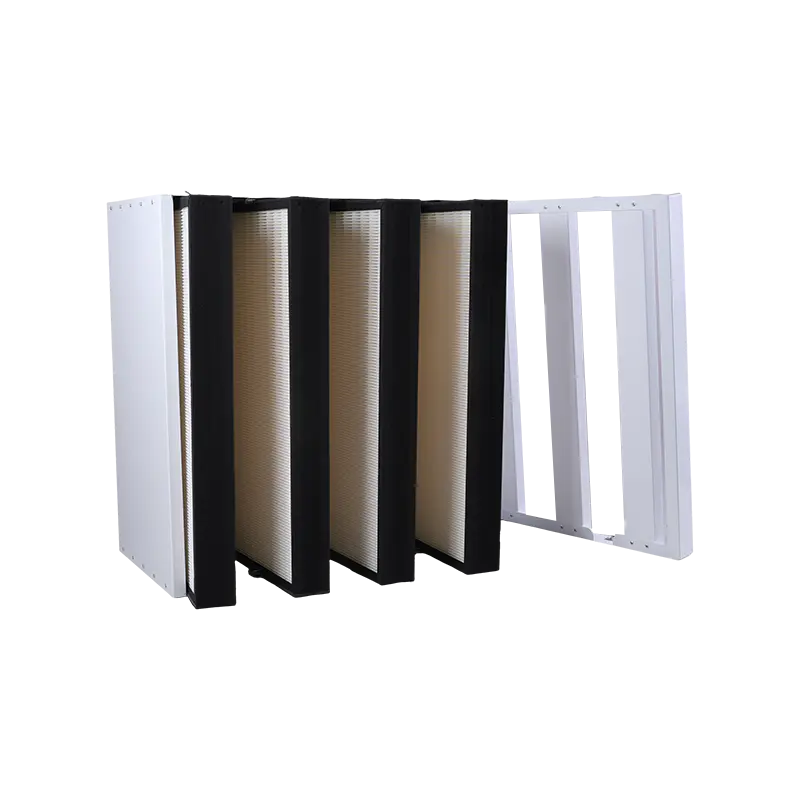
V-bank format filters are typically specified where a compact footprint must carry a high efficiency class inside an existing air handling unit.
Dimension 2 — Media and the Contaminant Function It Serves
Media choice is a functional decision, not a quality ranking. Two questions decide the score: does the media capture the contaminant present, and is that contaminant particulate or gas-phase?
| Media | Function | Henkaes models where listed | Documented setting |
|---|---|---|---|
| Microfiberglass | Particulate | Box Filter; Cleanroom Air Filter; B737/B757 Electronic Cabin Air Filter | Pharmaceutical plants, hospitals, food and beverage sites; cleanrooms; aerospace |
| PTFE | Particulate | Cleanroom Air Filter (listed alongside microfiberglass) | Cleanrooms such as data centers and microelectronics |
| Fiberglass | Particulate | V-Bank Filter; Panel Filter; HEPA Air Filter; True HEPA Air Filter | Commercial and public buildings; household air purifiers |
| Polypropylene (PP) | Particulate | V-Bank Filter; Panel Filter; Furnace Air Filter; HEPA Air Filter; True HEPA Air Filter | Commercial and public buildings; household air purifiers |
| Microfine fiberglass | Particulate | Bag Filter | Commercial and public buildings |
| Activated carbon | Gas-phase | Activated Carbon Filter (CTC70, CTC80, CTC90, CTC100) | Household air purifiers and air cleaners |
| Activated carbon with special catalyst | Gas-phase (VOC) | VOC Air Filter | Household air purifiers and air cleaners |
A media claim without a contaminant statement should score zero. It is also worth noting what published data does not show: the cleanroom filter is documented with both microfiberglass and PTFE, but the available material does not include comparative performance testing between the two. Where a supplier does not publish comparative media data, the score should rest on test capability and the buyer's own sample validation rather than on descriptive language.
Documented test infrastructure becomes evidence at this point. Henkaes states that it operates an efficiency and air resistance test system for filter media, a noise test lab, a 30-cubic-metre test room for formaldehyde and VOC removal efficiency, and a CADR test room for air purifiers, and that ASHRAE 52.2 is used in testing air filters. Those facilities indicate what data can be requested; they do not by themselves prove performance on a specific order.
Dimension 3 — Setting Fit: Cleanroom, Commercial HVAC, or Process Area
Setting fit is where most shortlists are actually decided, because the same supplier portfolio may span cleanrooms and household appliances with entirely different requirements between them.
| Setting | Requirement character | Documented Henkaes models |
|---|---|---|
| Cleanroom (data centers, microelectronics) | Very high efficiency, tight dimension control | Cleanroom Air Filter (U14/U15; microfiberglass, PTFE) |
| Pharmaceutical plants, hospitals, food and beverage production sites | High efficiency with hygiene-relevant change control | Box Filter (MERV15, MERV16; microfiberglass) |
| Commercial and public buildings (airports, hotels, museums, restaurants) | Balanced efficiency, high air volume, replacement cost control | V-Bank Filter (H13); Furnace Air Filter (MERV8, MERV11, MERV13); Bag Filter (F5–F9); Panel Filter (G1–G4) |
| Household appliances (air purifiers, air cleaners) | Particulate and gas-phase for indoor air | HEPA Air Filter (H13); True HEPA Air Filter (≥99.97%); Activated Carbon Filter; VOC Air Filter |
| Aerospace cabin | Compact format at H13 | B737/B757 Electronic Cabin Air Filter (H13; microfiberglass) |
Project scenario records add the operational detail that specifications usually omit. Cleanroom design, pharmaceutical plant building, HVAC system building, residential furnace filter replacement, and air purifier applications are all documented with a fresh-air system or the appliance as matched equipment, automatic operation, and customized dimensions as a special requirement. Food and beverage workshop renovation and B737/B757 cabin filter replacement follow the same pattern of automatic operation and dimension customization.
Staging belongs inside setting fit. Panel Filter (G1–G4) and Bag Filter (F5–F9) are documented for commercial and public buildings, where they typically function upstream of a higher-efficiency stage. The scoring question is whether the staged train is dimensioned as a system or assembled from classes that were never designed to sit together.
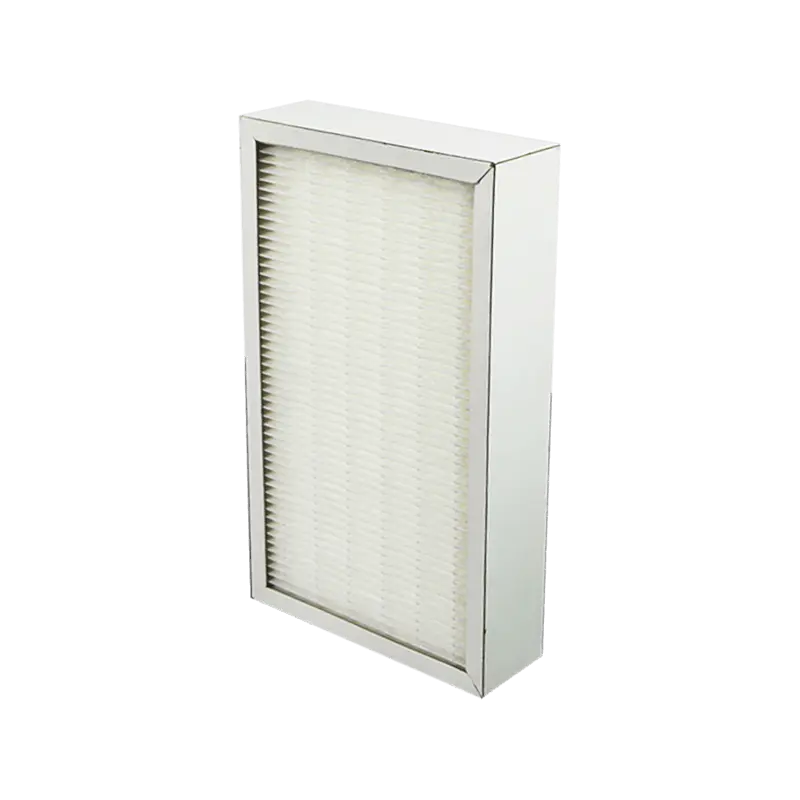
First-stage panel filters carry the coarse load; their class determines what reaches the downstream high-efficiency stage.
Dimension 4 — Verification Evidence
Score evidence by its tier, not by its prominence. Three tiers are useful: independently verified, third-party reported, and self-reported. Most supplier capability claims in this category sit in the second and third tiers, and a comparison framework should say so rather than average them together.
Henkaes' documented profile includes ISO 9001:2015, ISO 14001:2015 and ISO 45001:2018 certifications covering the design and production of air filters, air purifiers and fresh air machines, a 30,000 square metre facility, more than 20 years of experience working with a US engineering team, an 11-engineer R&D team, and an annual output reported in the range of 2 million pieces with 69% of output exported to the EU and US. These figures come from company documentation and 2026 industry press coverage, which places them in the reported tiers. They are useful for shortlisting and for deciding which audit requests to send; they are not a substitute for a supplier audit or for test reports tied to the specific order.
Dimension 5 — Supply Fit: MOQ, Lead Time, and Customization
Supply parameters decide whether a technically correct filter can actually be replaced on the plant's maintenance rhythm. In the published capability record, Henkaes operates as an OEM and ODM supplier with size and logo customization, a minimum order quantity of 500 pieces, a 30-day lead time, monthly capacity of 200,000 pieces, 100% inspection, EU and US export markets, and remote after-sales support.
Case records add a delivery pattern that buyers can test against: a US ODM project supplying 50,000 pieces for formaldehyde removal over a two-year engagement with a two-year stable result, a second US ODM project supplying 50,000 pieces for indoor air purification with VOC removal over one year, and a US OEM project supplying 20,000 pieces at high efficiency over one year. These are supplier-recorded project outcomes and should be treated as reference points for supplier conversations rather than as independent performance evidence.
A Worked Comparison Worksheet
The framework produces a worksheet, not a winner. The worksheet converts a published specification into the questions a supplier must answer with evidence before award.
| Requirement to score | Henkaes example (published) | Confirm before award |
|---|---|---|
| Cleanroom efficiency class | Cleanroom Air Filter, U14/U15 | Which standard governs acceptance; leakage test documentation |
| Media selection | Microfiberglass and PTFE listed on the cleanroom filter | Media rationale for the actual contaminant; sample test data |
| Pharmaceutical, hospital or food plant stage | Box Filter, MERV15/MERV16 | Upstream staging design and change-out frequency |
| Commercial building HVAC | V-Bank H13; Furnace MERV8/11/13; Bag F5–F9; Panel G1–G4 | Frame dimension compatibility with existing air handling units |
| Gas-phase indoor application | Activated Carbon Filter (CTC70–CTC100); VOC Air Filter | Gas-phase test data and replacement interval |
| Custom dimensions | Customized dimensions recorded as a special requirement across project scenarios | Drawing approval cycle and tolerance specification |
| Supply parameters | OEM/ODM, size and logo customization, MOQ 500 PCS, 30-day lead time, 200,000 PCS monthly capacity, 100% inspection | Contractual lead time, buffer stock terms, remote support scope |
Where This Framework Stops Working
A comparison framework is only credible if it states its boundaries. Five apply here.
Classes cannot be translated by arithmetic. A MERV value under ASHRAE 52.2 and a class under EN 1822 describe different test regimes. Treating them as equivalent, or carrying a legacy EN 779 class into a new specification without checking against ISO 16890, is the most common comparison failure in ventilation procurement.
Higher efficiency is not free. Increasing filtration class generally raises resistance to airflow and therefore the energy and fan duty required to move the same volume of air. This framework scores class, not total operating cost, so the buyer has to add a local energy and change-out cost layer that the supplier's data sheet will not supply.
Published capability is not verified capability. Henkaes' certifications, facility size, capacity and export share are company-reported or press-reported. They justify a shortlist position and an audit request, not a qualification decision.
Supply parameters cut both ways. A 500-piece minimum order quantity and a 30-day lead time for customized dimensions will suit a scheduled plant replacement programme but may exceed what a pilot line, a small cleanroom retrofit, or an emergency breakdown can absorb.
Catalogue scope boundaries exist. The activated carbon and VOC media in this portfolio are documented for household air purifiers and air cleaners, not for cleanroom primary filtration. Scoring a purifier filter against a cleanroom requirement is a category error, and a framework that ignores catalogue boundaries will produce a confident but wrong answer.
Market Signals Behind the Shift
Commercial research points in a consistent direction. The global smart air purifier market was valued at USD 2.5 billion in 2023 and is projected to grow at a CAGR of 14.1% from 2024 to 2030, with Asia Pacific holding a 41.4% revenue share in 2023. Separately, the HEPA filter segment was reported at USD 5.77 billion in 2025.
Two cautions apply when using these figures in a procurement case. First, they describe different market layers: smart purifiers and total air filters should not be aggregated into a single number. Second, both are commercial research estimates rather than audited industrial statistics. Their value is directional — they indicate sustained demand pressure on high-efficiency filtration and on equipment that can be monitored remotely, which is the environment in which a scoring framework becomes more useful than a price list.
What Changes Next
Three shifts are likely to change how these comparisons are run over the next procurement cycle. Documentation requests are moving from class labels to test reports, because class labels can be carried across standards that are no longer current. Standard migration is pushing older European general ventilation classes out of live tender documents as ISO 16890 continues to replace EN 779 references. And dimension-specific filters are becoming normal rather than exceptional in automated plants, which shifts supplier evaluation toward drawing control, sampling and change-management discipline rather than catalogue range alone.
FAQ
Are U14/U15, H13 and MERV ratings directly comparable?
No. They come from different classification frameworks. ASHRAE Standard 52.2 uses MERV ratings from 1 to 16 for general ventilation filters. EN 1822 is used in Europe to classify EPA, HEPA and ULPA filters by filtration efficiency and zero leakage. EN 779, which many older documents still cite, was replaced in Europe by ISO 16890 from mid-2018. A buyer can only compare classes within the framework that will govern acceptance testing, and should ask which standard and test method produced each claim.
Which grade fits a cleanroom project compared with a commercial HVAC project?
In the published Henkaes range, the Cleanroom Air Filter is listed at U14/U15 in microfiberglass and PTFE for cleanrooms including data centers and microelectronics. For commercial and public buildings such as airports, hotels, museums and restaurants, the listed options include the V-Bank Filter at H13, the Furnace Air Filter at MERV8, MERV11 and MERV13, the Bag Filter at F5 to F9, and the Panel Filter at G1 to G4. For pharmaceutical plants, hospitals and food and beverage production sites, the Box Filter is listed at MERV15 and MERV16. Scenario records for cleanroom design and pharmaceutical plant building projects in the US and the Netherlands describe automatic operation inside a fresh-air system, capture of dust and fine particles, and customized dimensions as a special requirement.
How should PTFE and microfiberglass media be compared?
The cleanroom filter is documented with both PTFE and microfiberglass, microfiberglass is listed on the Box Filter and the B737/B757 cabin filter, and fiberglass or polypropylene appears on the V-Bank, Panel, HEPA and True HEPA filters, with polypropylene on the Furnace Filter and microfine fiberglass on the Bag Filter. The available material does not include comparative test results between these media, so a fair comparison relies on the supplier's test capability and on sample validation against the actual contaminant. Gas-phase removal is a separate function handled by activated carbon media, listed at CTC70, CTC80, CTC90 and CTC100, and by the VOC filter's activated carbon with special catalyst combination.
Which procurement parameters belong in the comparison?
Supply parameters decide whether a specification can be executed. The published Henkaes capability record lists OEM and ODM production with size and logo customization, a minimum order quantity of 500 pieces, a 30-day lead time, monthly capacity of 200,000 pieces, 100% inspection, EU and US export markets, and remote after-sales support. Buyers should match these to the plant's replacement cadence, and separate scheduled replacement needs from emergency or pilot requirements.
What are the limits of any filter comparison framework?
A framework cannot translate one standard family into another, cannot measure pressure-drop energy cost unless the buyer adds it, and cannot convert supplier-reported claims into verified facts. It also cannot override catalogue scope: activated carbon and VOC media in this portfolio are documented for household air purifiers and air cleaners, not for cleanroom primary filtration. The framework's output is a structured set of evidence requests, and the qualification decision still depends on test reports and audits.
Reference material: the manufacturer's published air filter catalogue is available for download at E-Catalogue for Air Filter. Supplier reference: Nantong Henka Environment Solutions Co., Ltd, Haimen, Jiangsu, China.
Есть вопросы или нужны дополнительные детали?
Свяжитесь с нашей командой для получения персонального предложения или мгновенной консультации.
Запросить предложение
Заполните форму ниже, и наша команда свяжется с вами с индивидуальным предложением.
Прямой чат WhatsApp
Предпочитаете общаться в реальном времени? Напишите нам в WhatsApp для мгновенной помощи и быстрых ответов.
- Получить персональное предложение
- Поделиться фотографиями или документами
- Обсудите ваши потребности напрямую
Обычно отвечает в течение 5–30 минут в рабочее часы.