
Aluminized Steel Sheet FAQ: A463 Types, Coatings & Custom Sizes
Aluminized Steel Sheet FAQ: A463 Types, Coatings & Custom Sizes
Aluminized steel sheet is a hot-dip coated flat product in which an aluminium-based coating is bonded to a carbon steel substrate. That definition is short, but it hides the point at which most sourcing problems begin: the material is bought under one familiar name and specified under several different code systems, and those codes decide whether a part survives a furnace cycle, an exhaust environment or a heat exchanger duty.
ASTM A463/A463M is the governing standard for aluminum-coated steel sheets produced by the hot-dip process, and it defines two coating types: Type 1, an aluminium-silicon alloy coating, and Type 2, a pure aluminium coating. Coating weight is expressed through AS designations such as AS80, AS120, AS240, AS275 and AS300. Dimensions form a third layer of choice, with aluminized steel sheet and coil supplied from 0.37 mm to 3.0 mm in thickness and 600 mm to 1500 mm in width.
What follows is an evaluation-stage reference for procurement engineers, HVAC equipment manufacturers, automotive tier suppliers and exhaust system fabricators. It addresses the technical questions that most often hold up a specification sign-off, and it separates what the standards actually define from what the market tends to assume.
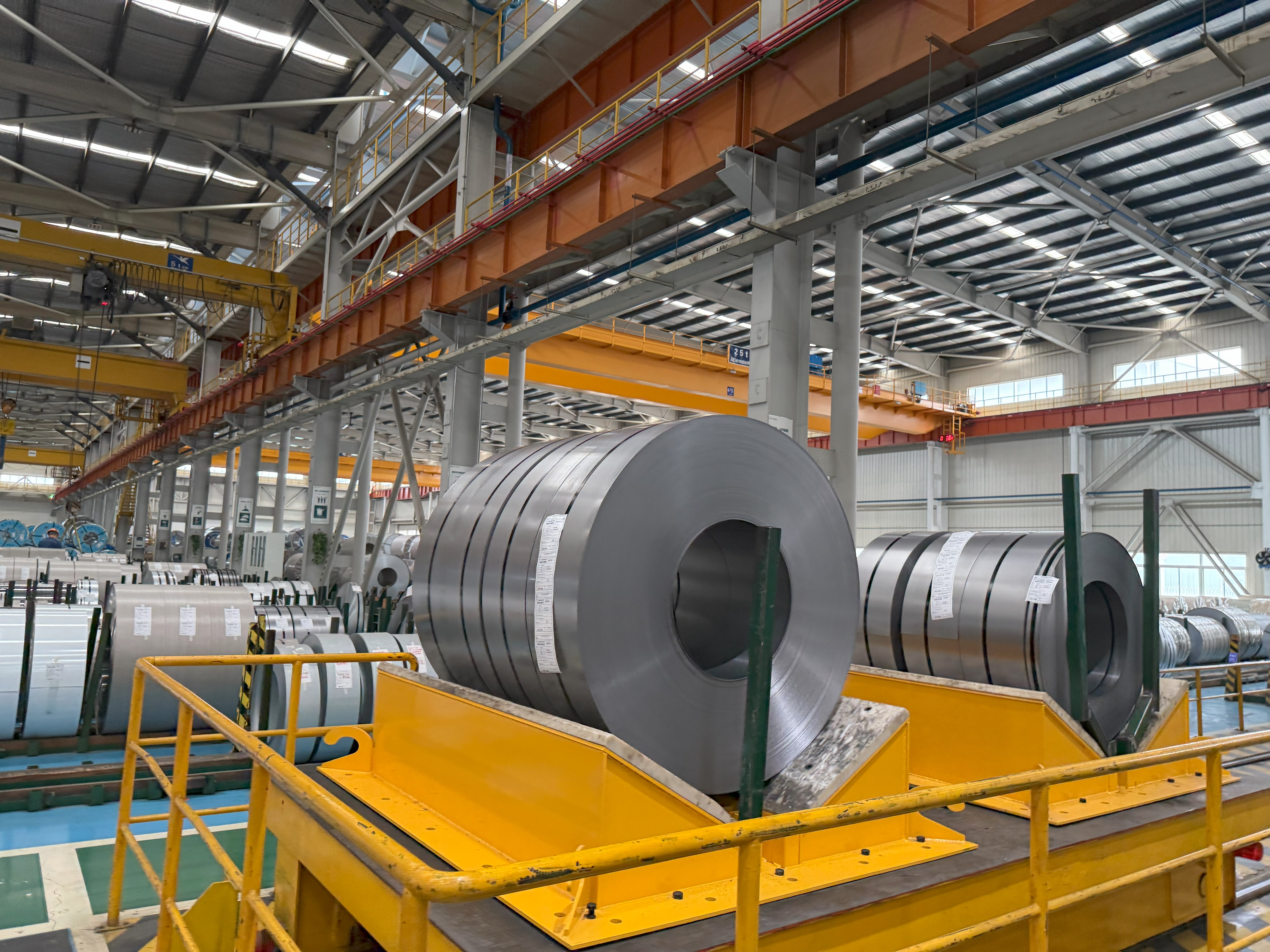
Aluminized steel sheet and coil are specified through four variables — coating type, coating class, thickness and width — that must all match before a purchase order is complete.
The bottleneck is specification language, not price
The commercial side of an aluminized steel purchase is usually settled quickly. Buyers know the volume, the destination port, the payment terms and the target price. Delays and disputes cluster instead around four points where specification language is either incomplete or read differently by each party.
- A purchase order that names a coating class but not a standard. ASTM A463/A463M and EN 10346 both describe continuously hot-dip coated flat products, but they do not use identical designation or tolerance conventions. A line item reading only "AS120 aluminized steel" can therefore be interpreted in more than one way, and the gap usually becomes visible only when the mill certificate arrives.
- Type 1 and Type 2 treated as interchangeable. The two coating types defined in ASTM A463/A463M are different coatings, not two names for the same product. A fabricator whose forming, welding or painting process was qualified against one type cannot assume the other will behave identically.
- A coating class chosen on unit price rather than service duty. The coating designation is a mass class, not a guarantee of performance in a given atmosphere. Selecting the lightest class that satisfies a price target, without checking the service temperature and the atmosphere, moves the risk into the field rather than removing it.
- Dimensions ordered without a tolerance reference. Thickness and width only become a specification once the applicable tolerance standard, the edge condition and the coil dimensions are fixed alongside the nominal figures.
The opportunity side of the same picture is that demand is not shrinking. Zion Market Research valued the global aluminized steel sheet market at approximately USD 13.43 billion in 2024, and Dataintelo projects the aluminized steel sales market to reach USD 18.7 billion by 2034, growing at a CAGR of 5.7% from 2026. Growth of that kind normally brings additional suppliers, additional coating classes and more specification variants into circulation — which raises, rather than lowers, the value of getting the codes right at the evaluation stage.
ASTM A463 Type 1 vs Type 2: what actually changes
ASTM A463/A463M is the governing standard for aluminum-coated steel sheets produced by the hot-dip process, specifying Type 1 (Al-Si alloy) and Type 2 (pure Al) coatings. The practical consequence for a buyer is that "aluminized steel" is not a complete description. It is a family name that contains at least two distinct coating chemistries.
Type 1 uses an aluminium-silicon alloy coating. It is the type that dominates commercial production: Dataintelo reported that Type 1 hot-dip silicon-alloy coated steel held the largest product share of the aluminized steel market at 62.3% in 2025. Type 2 uses a pure aluminium coating, and is typically selected when the buyer's own drawing, an end-customer standard or a qualified downstream process calls for unalloyed aluminium rather than an aluminium-silicon alloy.
| Comparison point | ASTM A463 Type 1 | ASTM A463 Type 2 |
|---|---|---|
| Coating composition | Aluminium-silicon alloy | Pure aluminium |
| Defined by | ASTM A463/A463M | ASTM A463/A463M |
| Market position | Largest product share — 62.3% of the aluminized steel market in 2025 (Dataintelo) | Produced in smaller volume and generally tied to a specific drawing or end-customer requirement |
| What the purchase order should say | ASTM A463 Type 1, coating class AS120 (or another required class), thickness and width as specified | Same structure, with Type 2 named explicitly |
| Main buyer risk if omitted | Supplier quotes a Type 2 or unspecified coating that does not match the qualified process | Supplier assumes the higher-volume Type 1 and the mill certificate does not match the drawing |
One further distinction matters for cross-border purchasing. EN 10346 is the European standard for continuously hot-dip coated steel flat products, and it also covers aluminized steel (AS) coatings. A certificate issued to one standard does not automatically satisfy a purchase order written to the other; the buyer either aligns the order to the standard the mill works to, or budgets an equivalence review before shipment.
Reading coating weight designations: AS80, AS120, AS240, AS275, AS300
In AS designations, the letters identify an aluminium-silicon coating and the number identifies the nominal coating mass class. MESCO supplies aluminized steel in the AS80, AS120, AS240, AS275 and AS300 classes, which gives buyers a defined ladder to specify against rather than a single default.
Designation is not measurement
A coating class on a purchase order states what was ordered. It does not by itself confirm what was produced. Two verification points resolve most coating-related disputes: first, confirm whether the quoted coating mass is stated for both sides combined or for a single side, because conventions differ between standards; second, confirm the actual coating mass reported on the mill certificate for the specific coil or sheet supplied.
Choosing between AS80 and AS300 is a service-duty decision, not a price decision. A heavier coating class places more aluminium-based material at the surface, but it also changes how the sheet behaves in forming, joining and downstream processing. The questions below are the ones that determine which class belongs on the order.
| Decision point | Question to answer before locking a coating class | Evidence to request |
|---|---|---|
| Service temperature | What is the maximum continuous temperature the part will see, and how long is each cycle? | Process data from the buyer's own application |
| Atmosphere | Is the exposure combustion products, sulphur-bearing gas, chlorides, or general indoor air? | Site conditions and service environment description |
| Forming severity | Will the part be bent, roll-formed or drawn, and at what radius? | Forming drawing or tooling specification |
| Joining method | Is the part welded, mechanically fastened or adhesive-bonded? | Welding procedure or joining specification |
| Target service life | How many years or thermal cycles is the component expected to serve? | Design life or warranty requirement |
| Verification | Is coating mass reported per shipment, and against which standard? | Mill certificate and laboratory test report |
Thickness and width: how customization from 0.37 mm to 3.0 mm works
MESCO's aluminized steel sheet and coil range covers thicknesses from 0.37 mm to 3.0 mm and widths from 600 mm to 1500 mm. Within that envelope, thinner gauges are generally used where weight and thermal mass matter, while heavier gauges are generally used where stiffness and resistance to mechanical loading matter. Both ends of the range appear in the same project families — automotive, HVAC and exhaust systems.
Customization is not only a question of the nominal number. Four additional parameters should be fixed at the same time, because each one can change what a supplier is able to quote:
- Tolerance standard. A nominal thickness of 1.0 mm is not a specification until the applicable thickness tolerance class is named.
- Edge condition. Slit, mill edge or trimmed edge changes both handling and downstream forming behaviour.
- Supplied form. Sheet, coil and strip are different order forms for the same substrate; the same nominal size can be delivered in any of them depending on the buyer's press line.
- Coil parameters. Inner diameter and coil weight affect uncoiling equipment and line changeover time.
This is where stock availability separates the fast orders from the slow ones. MESCO maintains tens of thousands of tons of stock for standard specifications, which supports delivery within 3–7 working days on those items. Where the required thickness, width, coating class or edge condition falls outside the standard range, lead time becomes a quotation-stage variable to be confirmed rather than assumed — and buyers planning a production launch should build that distinction into their schedule, not discover it after the order is placed.
Application fit: automotive, HVAC and exhaust systems
Aluminized steel sheet earns its place in three application families, and in all three the underlying reason is the same: a carbon steel substrate needs a surface that resists oxidation and reflects heat at elevated temperature, at a cost point below high-alloy alternatives.
Automotive
Exhaust components, heat shields, muffler shells and catalytic converter housings are the classic automotive uses. The part is exposed to sustained heat and thermal cycling, and the aluminium-based coating is what carries the surface through that exposure. Automotive buyers should note that coating development in this segment remains active: Nippon Steel's AS-L grade, launched in 2024, claims a 30% improvement in inter-coat adhesion for automotive applications — a signal that coating adhesion and downstream paintability are becoming competitive battlegrounds rather than settled properties.
HVAC and heating equipment
Furnace heat exchangers, burner housings, flue elements and high-temperature ducting form the HVAC cluster. Here the specification driver is usually a combination of heat resistance, a heat-reflective surface and the ability to form the component without damaging the coating.
Industrial exhaust and radiant tubes
Beyond the two large segments, aluminized material is used in industrial exhaust systems and radiant tube assemblies. MESCO's own product scope includes aluminized silicon steel coils and aluminized silicon steel tubes, alongside radiant tubes — which means the same coating specification discipline carries from flat product into tube form. Buyers sourcing both forms should align the coating type and class across the two, or the assembly will mix surface performance in the same thermal environment.
How Dalian Mesco Steel supports evaluation-stage buyers
Dalian Mesco Steel Co., Ltd. was founded in 2007 and is located in Dalian Economic and Technological Development Zone. The company operates a 40,000 m² facility with 120 employees, a research and development team of 5 engineers and an export ratio of 70%, which makes export-oriented specification work a core activity rather than an occasional one.
For aluminized steel buyers specifically, four facts matter at the evaluation stage:
- Relevant product scope. MESCO's product range includes aluminized silicon steel coils and aluminized silicon steel tubes, alongside Zn-Al-Mg coated steel sheets, prepainted steel sheets, radiant tubes, industrial pure iron and metal culverts.
- Laboratory verification. Key performance indicators — from chemical composition to mechanical properties — are tested and verified in laboratories, providing documented data rather than verbal assurance.
- Standard-specification stock. Tens of thousands of tons of stock are held for standard specifications, supporting delivery within 3–7 working days on those items.
- Direct technical contact. Specification questions, including coating type and class clarification, can be raised with Max at mesco@mescogroup.com.cn or +86 151-3456-5556 before an order is placed.
Market signals worth factoring into 2026 sourcing plans
The sizing data available for aluminized steel points in a consistent direction, even where the absolute figures disagree. Zion Market Research valued the global aluminized steel sheet market at approximately USD 13.43 billion in 2024. Dataintelo projects the aluminized steel sales market to reach USD 18.7 billion by 2034 at a CAGR of 5.7% from 2026. Dataintelo also reported that Asia Pacific dominated the aluminized steel market in 2025 with a revenue share of 41.8%, and that Type 1 hot-dip silicon-alloy coated steel held the largest product share at 62.3%.
A caution on market numbers
The published valuations do not fully agree. Zion Market Research put the global aluminized steel sheet market at approximately USD 13.43 billion in 2024, while Dataintelo's 2025 estimate places the aluminized steel sales market at USD 11.4 billion. Scope definitions differ between reports. Buyers should treat these figures as directional indicators of growth and regional concentration, not as a precise base for budget modelling.
On the supply side, major global manufacturers of aluminized steel include ArcelorMittal, Nippon Steel Corporation, POSCO and AK Steel (Cleveland-Cliffs), according to World Steel Association and Dataintelo data. Their presence defines the high-volume, high-visibility end of the market. The practical consequence for most buyers is that supplier selection is a question of fit rather than of finding the only capable producer: coating type and class coverage, verified coating data, size range and lead-time reliability differentiate suppliers far more than brand familiarity does.
Aluminized steel against traditional alternatives — and where it stops being the right answer
Aluminized steel sheet is often compared with zinc-coated (galvanized) steel and with stainless steel. The comparison is useful, but only if the protection mechanism is understood rather than reduced to a ranking.
| Attribute | Aluminized steel sheet (Type 1, Al-Si) | Zinc-coated (galvanized) steel | Stainless steel |
|---|---|---|---|
| Protection mechanism | Aluminium-based barrier coating with heat-reflective surface | Zinc coating, generally described as providing sacrificial protection to exposed steel | Corrosion resistance alloyed throughout the material, not limited to the surface |
| Typical service context | Elevated temperature, oxidation resistance, heat reflection | General atmospheric corrosion at ambient or moderate temperature | Corrosive and high-temperature service where a coated carbon steel is not sufficient |
| Edge and weld behaviour | Coating is a surface layer; cut edges and weld zones are effectively uncoated carbon steel | Zinc at cut edges can continue to protect adjacent steel | No coating layer to lose; performance is uniform through the section |
| Cost position | Commonly regarded as sitting between galvanized and stainless in most markets | Generally the lower-cost general-purpose coated option | Typically the highest-cost option of the three |
The boundaries are as important as the advantages, and four of them recur in practice:
- The substrate is still carbon steel. Where the limiting factor in service is the base metal's strength at temperature rather than surface oxidation, an aluminium-based coating does not change that limitation.
- Cut edges, weld zones and handling damage are uncoated. Unlike a zinc coating, an aluminium-based coating does not provide the same sacrificial protection at an exposed edge, so edge detailing and joint design carry real weight in the specification.
- Coating designations are not interchangeable between standards. ASTM A463/A463M and EN 10346 both cover aluminized steel flat products, but a certificate written to one does not automatically satisfy an order written to the other.
- Type 2 is not a drop-in substitute for Type 1. Where a forming, welding or coating line has been qualified against one type, switching to the other requires re-qualification, not just a line-item edit.
Future outlook
Three directions are visible in the available data. First, product differentiation in aluminized steel is moving toward coating adhesion and downstream process compatibility, illustrated by Nippon Steel's AS-L grade launched in 2024 with a claimed 30% improvement in inter-coat adhesion for automotive applications. Second, supply remains concentrated in Asia Pacific, which held a 41.8% revenue share of the aluminized steel market in 2025 according to Dataintelo — a concentration that keeps Asian sourcing central to global procurement planning. Third, a projected CAGR of 5.7% from 2026 toward a USD 18.7 billion market by 2034 implies continued capacity and product-range investment rather than consolidation.
For buyers, the practical implication is that specification literacy will keep gaining value. As more coating classes and supplier options enter the market, the ability to state a standard, a type, a coating class and a tolerance in one consistent order line becomes the cheapest form of risk control available.
Frequently asked questions
1. What is the difference between ASTM A463 Type 1 and Type 2 aluminized steel?
ASTM A463/A463M is the governing standard for aluminum-coated steel sheets produced by the hot-dip process, and it defines two coating types. Type 1 uses an aluminium-silicon alloy coating; Type 2 uses a pure aluminium coating. Type 1 is the higher-volume product: Dataintelo reported that Type 1 hot-dip silicon-alloy coated steel held the largest product share of the aluminized steel market at 62.3% in 2025. The difference matters at three points — what is written on the purchase order, what the mill certificate states, and which downstream forming, welding or painting processes were qualified against that coating. An order that says only "aluminized steel", without naming the standard and the type, is incomplete.
2. Which coating class should be specified — AS80, AS120, AS240, AS275 or AS300?
The AS prefix identifies an aluminium-silicon coating and the number identifies the nominal coating mass class. MESCO supplies aluminized steel in the AS80, AS120, AS240, AS275 and AS300 classes. Class selection should follow service duty rather than unit price: the maximum continuous service temperature, the atmosphere (combustion products, sulphur-bearing gas, chlorides), the severity of forming, whether the part will be welded, and the required service life are the inputs. Two verification points should accompany any order: confirm whether the coating mass is quoted for both sides combined or for a single side, since ASTM and EN conventions differ; and confirm the actual coating mass on the mill certificate rather than relying on the designation alone.
3. What thickness and width ranges are available, and how does customization work?
MESCO's aluminized steel sheet and coil range covers thicknesses from 0.37 mm to 3.0 mm and widths from 600 mm to 1500 mm. Thinner gauges in that range are generally used where weight and thermal mass are the constraints, and heavier gauges where stiffness and mechanical loading dominate. Customization also fixes four parameters beyond the nominal figures: the applicable thickness tolerance standard, the edge condition, whether the material is supplied as sheet, coil or strip, and the coil inner diameter and weight. Where a required size sits inside the standard range, MESCO holds tens of thousands of tons of stock for standard specifications and can deliver within 3–7 working days; where the requirement falls outside that range, lead time should be confirmed at the quotation stage.
4. Which applications typically use aluminized steel sheet?
Three application families account for most demand: automotive, HVAC and industrial exhaust. In automotive, the material is used for exhaust components, heat shields, muffler shells and catalytic converter housings, where sustained heat and thermal cycling define the duty. In HVAC, it appears in furnace heat exchangers, burner housings, flue elements and high-temperature ducting. In industrial exhaust and heat equipment, it is used in exhaust systems and radiant tube assemblies; MESCO's product scope includes aluminized silicon steel coils and aluminized silicon steel tubes alongside radiant tubes. The common thread across all three is continuous elevated temperature combined with a need for an oxidation-resistant, heat-reflective surface on a carbon steel substrate.
5. How is aluminized steel quality verified before shipment?
At MESCO, key performance indicators — from chemical composition to mechanical properties — are tested and verified in laboratories. For an aluminized steel order specifically, the verification set a buyer should expect includes confirmation of the coating type and class supplied, coating mass as reported against the ordered designation, coating adhesion, base steel chemical composition, and mechanical properties such as tensile strength and elongation. These are the data points that establish whether the delivered material matches the specification rather than merely matching the description on the invoice.
6. What lead time applies to standard specifications compared with custom specifications?
MESCO maintains tens of thousands of tons of stock for standard specifications and can deliver within 3–7 working days on those items. Custom requirements — non-standard thickness, width, coating class, edge condition or supply form — fall outside the stocked range, so their lead time is a quotation-stage variable rather than a fixed figure. Buyers planning a production start should separate standard from custom line items at the enquiry stage, because the two follow different scheduling paths through the same supply chain.
7. How should buyers compare aluminized steel suppliers during the evaluation stage?
Supplier comparison is more productive when it is structured around verifiable capability than around brand familiarity. Six criteria carry the most weight. First, standard literacy: can the supplier state the standard, coating type and coating class precisely on a quotation? Second, coating verification: is coating mass reported against the ordered designation on a mill certificate? Third, size coverage: does the supplier's range include the thickness, width and supply form the project needs? Fourth, lead-time reliability for standard versus custom items. Fifth, laboratory or third-party data for chemical composition and mechanical properties. Sixth, the ability to answer technical specification questions directly before an order is placed. For market context, the major global producers of aluminized steel include ArcelorMittal, Nippon Steel Corporation, POSCO and AK Steel (Cleveland-Cliffs) according to World Steel Association and Dataintelo data — useful as benchmarks for what a complete specification package should contain.
Reference documents
MESCO STEEL product catalogue (PDF): MESCO STEEL CATALOGUE 202507. Technical specification enquiries: Max, mesco@mescogroup.com.cn, +86 151-3456-5556, Dalian Mesco Steel Co., Ltd., Liaohezhonger Road 5, Development Zone, Dalian City, Liaoning Province, China.