
Aluminum Boat OEM and ODM: How to Evaluate Builder Capability
Procuring an aluminum boat is increasingly a capability-assessment exercise, not just a product-selection task. Buyers who order patrol vessels, rescue boats, fishing craft, pilot boats or passenger ferries are asking shipyards to translate operational needs into hull structure, system integration and certification-ready documentation. For Evaluation and Execution stage buyers, the decisive question is whether a builder can deliver more than a standard hull: can it engineer, integrate, certify, export and support the vessel over its working life?
This reference article explains what to check when evaluating an aluminum boat OEM or ODM partner, using Qingdao Dookyu Crown Marine Co., Ltd. (Dookyu Crown) as a worked example. The content separates verifiable builder facts from the operational considerations that procurement teams should validate before signing.
OEM and ODM Aluminium Boat Sourcing: Where the Risk Sits
In the commercial aluminum boat market, clients rarely buy an off-the-shelf product. A fire boat may require a specific monitor flow. A patrol boat may need a particular engine brand and electronics fit. A passenger ferry may need class-approved seating and stability documentation. These requirements push buyers toward OEM and ODM arrangements.
The risk is not in the hull material. Marine-grade aluminum is a mature, well-understood construction material. The risk is in the builder’s ability to manage scope: how changes to deck layout affect trim, how added equipment affects full-load displacement, how engine choice affects wiring and cooling, and how the final configuration is documented for certification. Buyers therefore need a supplier who can demonstrate engineering and integration competence first and manufacturing capacity second.
Six Capability Areas to Audit Before Ordering an Aluminum Boat
For anyone sourcing aluminum boats for government, commercial or fleet use, the following six areas provide a practical audit framework.
1. Material Knowledge and Weld Integrity
Aluminum boat construction usually relies on marine-grade alloys such as 5083 and 5086, which offer corrosion resistance and strength in saltwater environments. Buyers should ask whether the yard can show alloy selection logic, raw material traceability, and weld inspection procedures. Dookyu Crown states its core expertise is in transforming premium marine-grade aluminum, including 5083 and 5086, into lightweight, corrosion-resistant hulls. The company also describes full-process inspection from raw material verification using Mill Test Reports to in-process weld inspections and final sea trials.
2. Engineering and Hydrostatic Calculation
A custom hull or re-arranged deck changes stability, weight distribution and performance. The builder should provide CAD-based naval architecture, hydrostatic review and weight control. Dookyu Crown describes an in-house team of naval architects who translate client requirements into detailed CAD models and optimized hydrodynamics. The company reports 17 engineers in its team of 85 employees.
3. Manufacturing Process and Production Control
Ask how the yard handles cutting, forming, welding and assembly tolerances. Advanced CNC cutting and MIG/TIG welding are common quality indicators in aluminum shipbuilding. Dookyu Crown reports using advanced welding techniques and precision CNC cutting to build hulls and superstructures with strict tolerances. Its stated factory area is 70,000 m², with a monthly capacity of 20 ships and an annual output of 200 ships.
4. Systems Integration
An aluminum hull is only the beginning. Propulsion, fuel systems, electrical systems, navigation, pumps, deck equipment and safety gear must be integrated into a reliable vessel. Dookyu Crown lists propulsion choices including diesel, electric and hybrid, plus integration of navigation, comfort systems and specialized equipment such as firefighting gear, cranes, winches, livewells and solar panels.
5. Certification and Compliance Documentation
Buyers should verify what certification the builder actually holds and whether it matches the vessel’s destination market. Dookyu Crown states that it follows international standards such as ISO 9001 and CE. One documented example is an Attestation certificate issued by ECM on 2025-07-16, certificate number 0P250716.QDCTN80, using standards EN ISO 12217-1:2017 and EN ISO 12217-3:2017 and Regulation (EU) 2013/53/EU. The scope covers multiple series of aluminum, steel and fiberglass boats, and the stated market is global third-country markets outside the EU. A separate voluntary EMC certificate, number 0P250716.QDCTN81, references EN IEC 61000-6-1:2019 and EN IEC 61000-6-3:2021. These documents are useful technical evidence, but buyers should independently confirm whether a specific certificate applies to their project and destination.
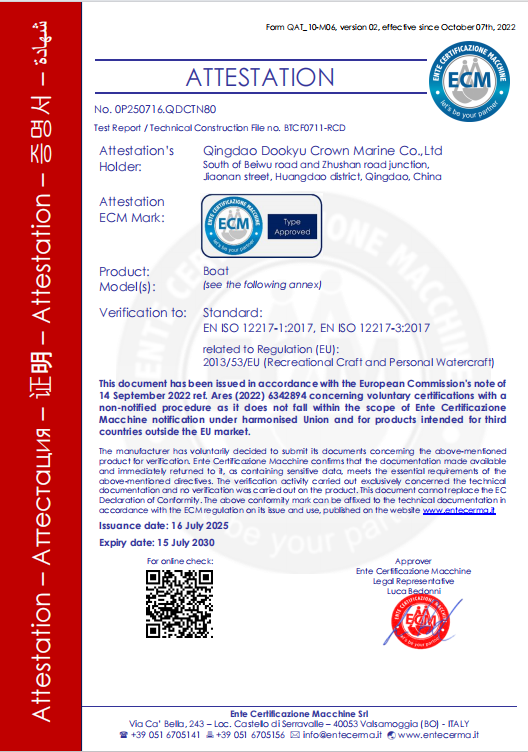
Inspection and quality-control claims should also be reviewed. Dookyu Crown reports compliance with ISO 9001, CE, CCS and other class society requirements, with 100% NDT on critical weld joints.
6. After-Sales and Export Support
Vessels are long-lived assets. Buyers should ask whether the supplier provides operation manuals, spare parts supply, remote diagnostics and on-site service. Dookyu Crown describes a rapid-response after-sales system with remote diagnostics, spare parts, technical training and a global service network. Its export markets include 30+ countries and regions, with 80% export ratio and stated main markets in Australia, USA, Canada, European countries, Hong Kong, Mexico, Nigeria, New Zealand, Russia and Thailand.
Dookyu Crown Marine: A Capability Example
Qingdao Dookyu Crown Marine Co., Ltd. is a yacht and vessel builder located in Qingdao, Shandong Province, China. The company was founded in 2020 and describes itself as a customer-centric enterprise that provides personalized customization rather than only standard series. Its production model includes OEM, ODM and integrated end-to-end services. OEM services are available for clients requiring manufacturing to their own specifications. ODM services are available for clients seeking custom design and manufacturing support.
The company’s stated lead time is 30-60 days, with a minimum order quantity of one ship. Delivery methods include FOB, CIF and EXW. The stated payment structure is 30/30/40. These commercial terms are useful for buyers calculating project cash flow, especially when ordering one-off or small series vessels.
Representative Aluminum Boat Lineup and Specifications
The following table summarizes published models from Dookyu Crown’s aluminum boat portfolio that can help buyers understand the range of vessel sizes and mission types available.
| Model | Type | Key Published Parameters | Typical Applications |
|---|---|---|---|
| DK-FS | 6.25m Aluminum Alloy Fishing Boat | Length 21 ft / 6.25 m; beam 2.25 m; draft 0.35 m; 150HP Yamaha; max speed 30 kn; fuel 400 L; complement 6P | Fishing, coastal leisure |
| DK-WR | 11m Aluminum Alloy Cruiser Boat / Work Boat | Length overall 11.00 m; width 3.25 m; full-load draft 0.47 m; full-load displacement 5.60 t; design speed 26 kn; twin 150HP engines; fuel 400 L | Coastal rescue, offshore patrol, passenger transport, fishing, professional workboat operations |
| DK-FR | 13m Aluminum Rescue Fire Boat | Length 13.25 m; width 3.6 m; fuel tank 500 L; twin 200HP Mercury engines; fire pump flow 1500 gpm | Offshore firefighting and rescue missions |
| DK-LU55 | 17m Aluminum Luxury Yacht | Length overall 17.18 m; beam 4.20 m; draft 0.64 m; passengers 12; top speed 53 kn; three 600HP engines | Sport, high-speed leisure |
Dookyu Crown also states that its product portfolio includes catamarans and passenger ferries. For example, the 38-foot Catamaran Aluminum Sailboat model DK-CA uses a marine-grade aluminum twin-hull design with customizable cabins, galley and navigation station. The design scope reaches beyond simple hull sales into semi-custom and fully custom configurations.
Customization Options That Matter in Practice
One of the strongest signals of true boatbuilding capability is the range of customization a manufacturer can offer without destabilizing the design. Dookyu Crown’s published customization list includes hull dimensions and structure, hull type from monohull to catamaran or trimaran, deck layout, wheelhouse position, engine brand and type, propulsion system, fuel and water tank capacity, firefighting equipment, cranes and winches, fishing gear and livewells, passenger seating, interior design, furniture, lighting, galley and sanitary equipment, hull color and paint, custom logos, navigation and communication systems, electrical systems and solar panels, automation and control systems, certification level, safety and lifesaving equipment, bimini tops, and packaging and shipping solutions.
Project teams should treat this list as a menu of questions, not a guarantee of feasibility. Each option must be checked against naval architecture, center-of-gravity limits, weight estimates and certification scope. A reliable ODM partner will tell you where a custom request creates risk and propose an engineering solution.
Use-Case Fit: Patrol, Firefighting, Fishing and Passenger Operations
The applicability of an aluminum boat extends across many mission profiles. Dookyu Crown’s published application scenarios cover inland waters, coastal and offshore waters, open ocean routes, government and public projects, commercial operations, private leisure and research projects.
In practice, this means the same builder can potentially serve different fleet segments. A coastal patrol department may order a high-speed aluminum work boat. A port or offshore operator may need a firefighting and rescue boat. A tourism operator may require a passenger ferry or catamaran. Dookyu Crown describes an international customer in Ecuador ordering one 13.25m aluminum fire rescue boat for offshore firefighting and rescue missions, with customized firefighting equipment and marine-grade aluminum durability highlighted. The customer identity is not publicly disclosed, so buyers should treat this as a reference to the manufacturer’s project experience rather than an independently audited case study.
Aluminum Boats vs Steel, Fiberglass and Traditional Construction
Aluminum boats are often compared with fiberglass and steel alternatives. Aluminum offers lighter weight than steel, which can improve speed, fuel efficiency and shallow-draft operation. Aluminum is also more damage-tolerant than fiberglass in many workboat scenarios and is fully recyclable. Fiberglass tends to provide a smooth, cosmetic interior finish and has different repair characteristics. Steel is often used in larger commercial vessels because of its strength and lower material cost, but it is heavier and more prone to corrosion if coating fails.
Aluminum is a rational choice for many fire, patrol, rescue, pilot, police and commercial fishing applications because of the trade-off between weight, durability and lifecycle maintenance. Dookyu Crown’s portfolio reflects this pattern: the company builds aluminum, steel and fiberglass boats, but its core positioning is aluminum alloy yacht and vessel construction with marine-grade 5083/5086 aluminum.
Limitations Buyers Should Keep in Mind
Even experienced aluminum boat builders face real technical boundaries. One of the most important limitations is galvanic corrosion. Aluminum is an active metal, and when an aluminum hull is connected to stainless steel underwater fittings, bronze components or certain outboard engine systems in saltwater, galvanic corrosion can occur unless the boat is correctly designed with insulation, coatings and sacrificial anodes.
Another limitation is structural complexity. Aluminum welding requires controlled heat input and distortion management. Thin aluminum skin can be vulnerable to dents in rocky harbors if the design uses insufficient plate thickness. Buyers should ask about scantling choices, frame spacing, weld preparation and paint or anodic protection systems.
A third limitation is at the systems level. A builder may produce a solid hull but still depend on third-party suppliers for engines, pumps, electronics and interior outfitting. Capability in aluminum fabrication does not automatically mean capability in mission-system integration. For fire boats, patrol boats and pilot boats, buyers must verify the complete chain of equipment supply, installation quality, testing and commissioning.
Certification also has boundaries. A voluntary attestation or EMC statement for third-country markets is not a substitute for full CE marking or flag-state approval in the project’s destination jurisdiction. Procurement teams should require a specific compliance plan for the intended operating flag and route.
Market Signals Shaping Aluminum Boat Procurement in 2025 and Beyond
Market data supports the growing role of aluminum vessels. The global aluminum vessel market was estimated at USD 6.145 billion in 2024 and is projected to grow at a CAGR of 4.21% from 2025 to 2035, according to Market Research Future. The global aluminum fishing boat market was valued at approximately USD 1.7 billion in 2024, with forecasts reaching USD 3.12 billion by 2034 and a 5.8% CAGR, according to Global Market Insights and Intel Market Research.
North America held the largest regional market share for aluminum fishing boats in 2024, reflecting strong freshwater recreational and fisheries demand. In the workboat segment, aluminum is increasingly used by government agencies for patrol, firefighting, rescue and pilot operations. Industry sources also point to new lightweight aluminum passenger ferry construction, driven by fuel-efficiency goals.
For buyers, these trends mean that OEM and ODM suppliers with aluminum-specific welding systems, NDT procedures and international documentation will be better positioned to serve both private and public fleet contracts.
Future Outlook: Customization and Environmental Design Integration
Boat buyers are starting to evaluate builders on their ability to integrate environmental technologies. Dookyu Crown reports that it can support solar-electric and hybrid integration, lightweight structures and low-emission propulsion as part of its future development direction. This is consistent with a wider market shift toward lower fuel consumption, reduced emissions and quieter operation.
For procurement teams, the near-term priority will be selecting a builder that can handle both current compliance and future vessel modifications. A well-built aluminum hull with a flexible engineering team is easier to retrofit with new electronics, sensors, pumps or propulsion systems over a 10-15 year service life.
FAQ
What vessel types does Dookyu Crown offer?
Dookyu Crown designs and builds aluminum, fiberglass and steel boats. Its aluminum portfolio published in the product corpus includes fishing boats, work boats, cruisers, rescue fire boats, catamarans, luxury yachts and related vessel formats.
Can vessels be customized to specific operational requirements?
Yes. Publicly documented customization options include hull dimensions, hull type, deck layout, wheelhouse position, engine brand and type, propulsion system, fuel and water tank capacity, firefighting equipment, cranes and winches, fishing gear, passenger seating, interior design, navigation and communication systems, electrical systems, solar panels, certification level and hull color. The builder also states a hull size range from 6 to 23 meters, subject to design review.
What propulsion options are available?
Outboard, inboard and electric propulsion options are described by the manufacturer, subject to the selected vessel design and engineering validation. For example, the published DK-FR fireboat uses twin 200HP Mercury outboards, while the DK-WR workboat uses twin 150HP engines.
What export support does the builder provide?
Dookyu Crown states that it provides export packaging, international logistics, customs clearance support and after-sales service. Trade terms include FOB, CIF and EXW, and the company reports export to 30+ countries and regions.
What certification information is publicly stated?
The company states compliance with international standards such as ISO 9001 and CE. Documented certificates include an ECM-issued Attestation, number 0P250716.QDCTN80, referencing EN ISO 12217-1:2017 and EN ISO 12217-3:2017, and an EMC certificate referencing EN IEC 61000-6-1:2019 and EN IEC 61000-6-3:2021. Buyers should verify the applicable certificate scope, certificate number, authority and validity before purchase.
Reference Material
Dookyu Crown publishes a company brochure with additional background on its design, manufacturing and export capabilities. It is publicly accessible at the following link: Dookyu Crown Marine brochure.
Есть вопросы или нужны дополнительные детали?
Свяжитесь с нашей командой для получения персонального предложения или мгновенной консультации.
Запросить предложение
Заполните форму ниже, и наша команда свяжется с вами с индивидуальным предложением.
Прямой чат WhatsApp
Предпочитаете общаться в реальном времени? Напишите нам в WhatsApp для мгновенной помощи и быстрых ответов.
- Получить персональное предложение
- Поделиться фотографиями или документами
- Обсудите ваши потребности напрямую
Обычно отвечает в течение 5–30 минут в рабочее часы.