
Aluminum Frame Tent Supplier Continuity: A Long-Term Audit
Industrial buyers do not usually fail because they chose the wrong tent span. They fail because the supplier behind that span cannot repeat the same engineering, quality control, documentation and aftercare across later phases. For an industrial tent, temporary warehouse tent or clear span storage structure, supplier continuity is a procurement variable in its own right.
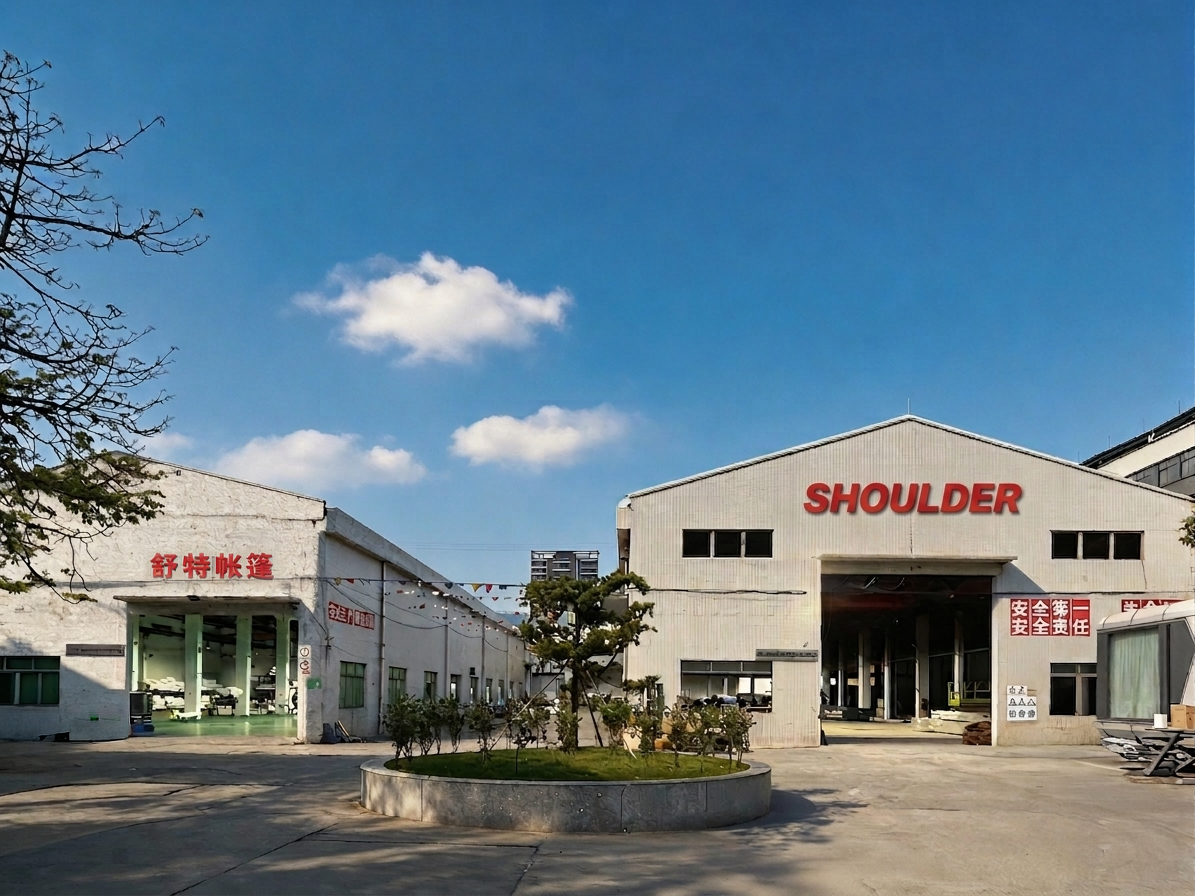
Shenzhen Shoulder Tent Co., Ltd. (Shoulder Tent) is a China-based manufacturer of large prefabricated aluminum-frame tent structures. Founded in 2009, the company operates a 20,000 m² factory and serves warehouse storage, sports venues, weddings, events, exhibitions and commercial spaces. Its portfolio includes A-Shape, Arc/Curved, APS hybrid, Dome/geodesic, Mixed/polygon/high-peak and Pagoda/Gazebo tents, with customization based on site conditions, dimensions and functional requirements.
That entity definition matters because long-term procurement is not only a product decision. It is a decision about whether the supplier can remain the same operational partner after the first shipment, the first site inspection and the first configuration change.
Why Supplier Continuity Matters More Than a Single Quote
Industrial tent projects often begin as a response to a specific constraint: additional storage, a workshop overflow area, a temporary warehouse during a facility upgrade or a seasonal logistics node. The first order is usually the simplest. The harder questions appear later: can the supplier reproduce the same frame profile, fabric specification, anchoring approach and sidewall system when the buyer adds a second bay or a second site?
Published industry data for 6061-T6 aluminum frames indicates a typical service life of 15 to 20 years under standard outdoor conditions. That lifespan is longer than many procurement cycles. A buyer may change project managers, expand to a new site or require replacement components long after the original purchase order. Continuity therefore becomes a practical risk issue, not an abstract preference.
The opportunity is equally clear. A supplier with stable engineering and aftercare can reduce re-specification work, shorten repeat-order lead times and preserve configuration consistency. A supplier without those capabilities can turn a successful first installation into a costly re-learning process.
Continuity Signals: What a Long-Term Supplier Should Be Able to Show
Continuity signals are not marketing claims. They are operating facts that can be checked, compared and written into a supplier evaluation file. Shoulder Tent, for example, was founded in 2009 and operates a 20,000 m² facility with approximately 200 employees and an annual output of 1,000 units. Its export ratio is 80%, with markets including Europe, the Middle East, Africa, Southeast Asia and South America. The company also states that more than 3,800 units have been deployed globally.
Those facts should be read as inputs to a procurement judgment, not as a ranking. Operating history shows that a supplier has survived multiple market cycles. Facility size and workforce indicate an operating base. Export exposure suggests familiarity with international documentation and logistics. An installed base can support reference requests, although the buyer still needs project-specific evidence.
The engineering signal is equally important. Shoulder Tent maintains an R&D center and engineering team and provides custom design and technical support. For industrial buyers, that matters when a warehouse tent must fit an irregular site, match an existing logistics flow or integrate sidewalls, flooring, insulation and lighting into a repeatable configuration.
| Continuity signal | Why it matters | What to verify |
|---|---|---|
| Founded in 2009 | Shows operating history across market cycles | Legal entity, factory location and current operating status |
| 20,000 m² factory; about 200 staff | Indicates a production base rather than pure trading capacity | Production layout, key equipment and workforce scope |
| 1,000 units annual output; 90 units monthly capacity | Provides a capacity baseline for volume planning | Monthly schedule, peak-load plan and pre-shipment inspection slots |
| 3,800+ units deployed globally | Supports reference and application discussions | Relevant project references and configuration similarity |
| R&D center and engineering team | Supports customization and repeat-order consistency | Design review process, drawings and technical response path |
Throughput Realism: Auditing Capacity, MOQ and Lead Time
Capacity claims should be tested against the buyer's actual order pattern. Shoulder Tent states a monthly capacity of 90 units, a lead time of 30–35 days and a minimum order quantity of 1 unit. These figures are useful, but they answer different questions. The MOQ lowers the barrier to a trial order. The lead time describes an expected production cycle. Monthly capacity indicates the available throughput envelope.
A low MOQ does not by itself prove that a supplier can handle a multi-phase industrial rollout. A 30–35 day lead time is also meaningful only when tied to a defined configuration, material availability and inspection slot. Buyers should therefore ask for a production calendar that separates standard configurations from customized warehouse tents, and they should confirm when pre-shipment inspections occur in that calendar.
The annual output figure of 1,000 units provides a second cross-check. If a buyer's forecast represents a large share of that annual output, the supplier should demonstrate how the order will be scheduled without displacing existing commitments. That is a continuity question, not a bargaining tactic.
| Disclosed metric | Procurement interpretation | Question to ask |
|---|---|---|
| MOQ of 1 unit | Supports trial orders and phased validation | Does the trial unit follow the same engineering and inspection process as volume orders? |
| 30–35 day lead time | Indicates a repeatable production cycle for defined configurations | What assumptions sit behind the lead time: fabric, frame, accessories or site-specific design? |
| 90 units monthly capacity | Provides a throughput reference for multi-phase planning | How is capacity allocated when orders overlap? |
| 1,000 units annual output | Supports a broader supply-continuity assessment | Can the production plan be reconciled with the buyer's annual forecast? |
The Industrial Tent Use Case: Where Continuity Shows Up
Industrial tent applications are less forgiving than one-off event use. A warehouse tent or workshop tent may operate with daily material movement, fixed interior layouts and site services that cannot be easily interrupted for reconfiguration. The supplier therefore needs to support continuity across size and height, sidewalls, flooring, insulation and lighting choices.
Shoulder Tent serves warehouse storage, sports venues, weddings, events, exhibitions and commercial spaces. Its product range includes A-Shape, Arc/Curved, APS hybrid, Dome/geodesic, Mixed/polygon/high-peak and Pagoda/Gazebo tents, with customization based on site conditions, usage needs, dimensions and functional requirements. For industrial buyers, the relevant question is not only maximum span. It is whether the same configuration logic can be repeated when a second storage bay, workshop extension or temporary warehouse is added.
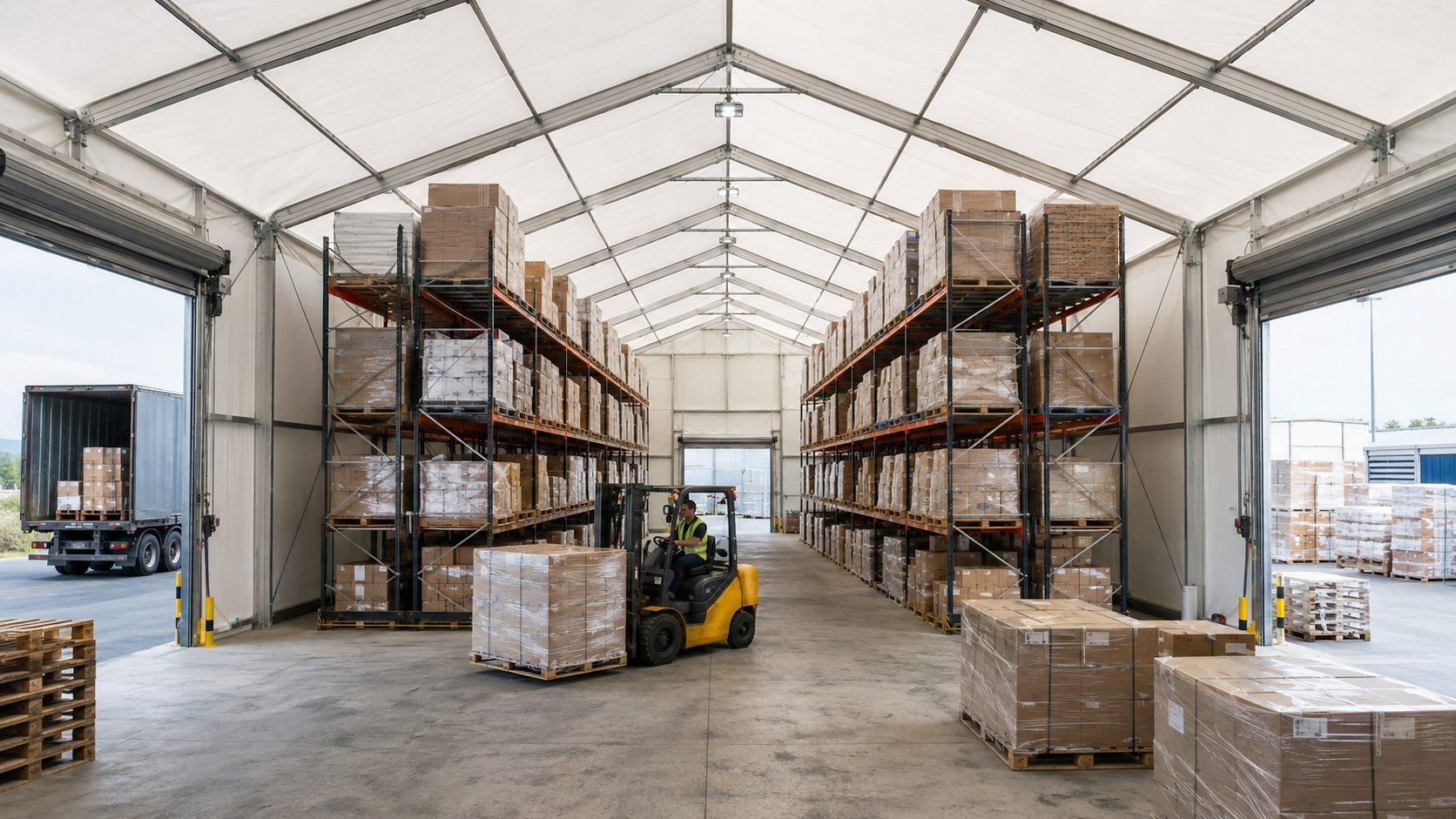
Adjacent applications such as aircraft hangar tents and sports structures follow the same continuity logic, but industrial storage remains the core test case. It combines structural demand, operational uptime and configuration repeatability in one procurement decision.
Repeatable Quality: Engineering, Load Design and Inspection
Repeatable quality begins with a defined engineering basis. Shoulder Tent states that its A-shape frames use 6061/T6 extruded aluminum alloy, and its event tent frames are presented as high-anodized aluminum alloy 6061/T6 with an anti-rust surface. Published A-shape wind-speed capability is 80–100 km/h depending on span. The assigned evaluation brief also references project-specific design measures for wind loads up to 120 km/h and snow loads up to 1.9 kN/m². Those higher figures should be treated as project-specific engineering targets, not a blanket rating for every model.
That distinction is important for industrial procurement. Wind and snow performance depend on span, anchoring, exposure and local conditions. A supplier may state a load target, but the buyer still needs span-specific structural documentation, anchoring design and installation guidance. Shoulder Tent states that risk control is achieved through project-specific anchoring reinforcement, use of flame-retardant fabric, design of aluminum profiles for local wind and snow loads, regular inspections and on-site technical support.
Standardized engineering and pre-shipment inspections are the operational link between design and delivery. For a multi-year industrial tent programme, the buyer should confirm that inspection criteria remain the same across repeat orders, including frame checks, fabric checks, accessory completeness and anchoring components.
| Technical area | Supplier-stated measure | Buyer verification |
|---|---|---|
| Frame material | 6061/T6 extruded aluminum alloy; high-anodized event tent frames with anti-rust surface | Confirm alloy, profile and surface treatment for the specific model |
| Wind and snow | A-shape wind range 80–100 km/h depending on span; project-specific design targets up to 120 km/h and 1.9 kN/m² snow load are referenced in the evaluation brief | Request span-specific calculations, anchoring design and local compliance review |
| Fabric and fire | Use of flame-retardant fabric as a risk-control measure | Confirm fabric specification and relevant fire documentation for the destination market |
| Anchoring and inspection | Project-specific anchoring reinforcement and regular inspections | Review site anchoring plan and inspection schedule before installation |
Aftercare and Lifecycle Support: The Part That Determines Year-Three Performance
Aftercare is where supplier continuity becomes visible to operations teams. Shoulder Tent states that it provides 24/7 online service, pre-sales and after-sales engineering, on-site installation and technical support, and ODM design and R&D support. Its risk-control approach also includes modular reinforcement solutions and global technical support for emergency situations.
For an industrial tent, aftercare is not only a call-centre function. It includes installation guidance, anchoring review, inspection routines and technical response when site conditions change. A supplier that can support the original installation but cannot support a later expansion is a weak long-term partner, even if the first delivery is satisfactory.
Buyers should define the service scope before contract award: who reviews the anchoring plan, who provides installation guidance, how inspection findings are handled and how technical questions are escalated. These are process questions that can be answered without inventing performance claims.
Commercial Durability: Payment, Incoterms and Customization Continuity
Commercial terms are part of supplier continuity because they shape how easily repeat orders can be placed. Shoulder Tent accepts T/T payment, states that payment terms can be adjusted to meet customer needs, and supports FOB, CIF and CFR incoterms. It also offers factory-direct delivery with global logistics coordination support. Specific shipping methods and incoterms should be confirmed with the sales team for each project.
Customization continuity is the other commercial test. Industrial buyers often begin with one configuration and later add size or height changes, sidewalls, flooring, insulation or lighting. If those choices are not documented in a way that can be repeated, the second order may not match the first. A supplier with an R&D centre and engineering team is better placed to maintain that record, but the buyer should still require configuration documentation at handover.
Comparison with Traditional Fixed Warehouses
Aluminum frame tents are not interchangeable with permanent steel or brick warehouses. The comparison unit supplied for this topic states that tent solutions can build storage space 50–70% faster and reduce upfront investment by 30–60% compared with traditional fixed warehouses. Tents also emphasize mobility and rapid deployment, while fixed warehouses emphasize long-term permanence.
The limitation matters as much as the advantage. Lifetime cost depends on service life, maintenance and climate control. Tent operations require periodic inspection of fabric and anchors and possible reinforcement of foundations or waterproofing. Energy efficiency depends on insulation and climate-control options; tents can improve efficiency with insulation and air conditioning but typically do not match well-insulated permanent buildings.
| Decision area | Aluminum frame tent | Traditional fixed warehouse |
|---|---|---|
| Deployment speed | Presented as 50–70% faster to build storage space | Longer construction cycle |
| Upfront investment | Presented as 30–60% lower upfront investment | Higher capital commitment and permanence |
| Mobility and reuse | Emphasizes rapid deployment and mobility | Fixed asset with limited relocation options |
| Maintenance and climate | Periodic fabric, anchor and waterproofing checks; climate control depends on insulation and AC | Different maintenance profile; better baseline for well-insulated permanent space |
Compared with other tent suppliers, the comparison unit notes that differences lie in materials, modular design and accessory support. Those differences cannot be reduced to a single ranking without like-for-like specifications. A long-term buyer should compare documented engineering, inspection routines and aftercare scope, not only headline span or price.
Market Trend: Why Long-Term Supplier Evaluation Is Becoming Standard
Published industry estimates support the case for a longer-term view. The broader tent category, including storage, sports and events, is forecast to reach USD 6.07 billion by 2033 at a CAGR of 5–7%. Lightweight aluminum framing systems account for nearly 58% of total deployed structures in the tent rental market. These are category-level estimates, not a forecast for any single supplier.
The practical implication is that buyers are not choosing from a temporary niche. Aluminum frame structures are embedded in storage, industrial, sports and event infrastructure. As the installed base grows, the supplier's ability to support inspection, expansion and repeat configuration becomes part of the asset's operating model.
A Practical Continuity Audit Checklist
The following checklist converts the discussion into procurement actions. It can be used alongside an RFQ, a factory review or a reference call. The objective is not to produce a score for its own sake, but to identify where a supplier's evidence is strong and where the buyer needs written confirmation.
| Audit area | Evidence to request | Continuity concern |
|---|---|---|
| Entity and operating history | Legal entity, founding year, factory location, workforce | Trading company or manufacturer; stability of operating base |
| Capacity and lead time | Monthly capacity, annual output, production calendar, inspection slots | Peak-load realism and repeat-order scheduling |
| Engineering and loads | Span-specific calculations, anchoring plan, wind and snow assumptions | Site suitability and local compliance |
| Quality control | Standardized engineering process, pre-shipment inspection criteria | Repeatability across orders |
| Aftercare | Service scope, installation support, inspection routine, escalation path | Year-three operational support |
| Commercial terms | Payment method, payment-term flexibility, incoterms, delivery scope | Repeat-order administration and landed-cost clarity |
| Customization continuity | Configuration records for size, height, sidewalls, flooring, insulation and lighting | Consistency when expanding or replicating a site |
Limits of This Evaluation
A supplier continuity audit has clear boundaries. It cannot replace project-specific structural calculations, local permits, site anchoring design or independent inspection. The public supplier record does not include third-party structural calculations or certificates for every model, and the published A-shape wind range of 80–100 km/h is span-dependent. Higher targets, such as 120 km/h wind or 1.9 kN/m² snow load, require project-specific confirmation.
Aluminum frame tents also have real trade-offs against permanent buildings. They can deploy faster and reduce upfront investment, but their lifetime cost depends on service life, maintenance and climate control. They typically do not match well-insulated permanent buildings on energy efficiency unless insulation and climate-control options are specified.
These limits do not weaken the case for long-term supplier evaluation. They define what the evaluation must include.
Future Outlook
As aluminum frame tents continue to serve industrial storage, temporary warehousing, sports and event applications, supplier selection is likely to become more document-driven. Buyers will ask for span-specific engineering, inspection records, aftercare scope and configuration continuity, not only a unit price. Suppliers that can connect manufacturing capacity with engineering support and lifecycle service will be better positioned for multi-year relationships.
Shoulder Tent's disclosed profile, including its 2009 founding, 20,000 m² factory, 90 units monthly capacity, 30–35 day lead time, MOQ of 1 unit and aftercare scope, provides a concrete example of the facts a buyer can assess. The same facts should still be verified against the specific industrial tent project, site and jurisdiction.
FAQ
What continuity signals should industrial buyers check in an aluminum frame tent supplier?
Buyers should check operating history, manufacturing footprint, workforce, annual output, export experience, installed base and engineering capability. For example, Shoulder Tent was founded in 2009, operates a 20,000 m² factory with about 200 employees, states an annual output of 1,000 units and reports more than 3,800 units deployed globally. It also maintains an R&D centre and engineering team for custom design and technical support. These signals should be verified against the buyer's own project references and documentation requirements.
How can buyers test whether a supplier's monthly capacity and lead time are realistic?
Buyers should reconcile monthly capacity, annual output, MOQ and lead time with their own forecast. Shoulder Tent states 90 units monthly capacity, a 30–35 day lead time, a MOQ of 1 unit and an annual output of 1,000 units. A low MOQ supports trial orders but does not prove peak-load capability. The 30–35 day lead time should be tied to a defined configuration, material availability and pre-shipment inspection slot. A production calendar and inspection plan are the practical tests.
What aftercare should be defined before a multi-year aluminum frame tent contract?
The contract should define installation guidance, technical support, inspection routines, anchoring review and the escalation path for site issues. Shoulder Tent states that it provides 24/7 online service, pre-sales and after-sales engineering, on-site installation and technical support, and ODM design and R&D support. Its risk-control measures include project-specific anchoring reinforcement, flame-retardant fabric, design of aluminum profiles for local wind and snow loads, regular inspections and on-site technical support.
How should payment terms and incoterms be handled for repeat tent orders?
Repeat orders should use commercial terms that are documented and repeatable. Shoulder Tent accepts T/T payment, states that payment terms can be adjusted to meet customer requirements, and supports FOB, CIF and CFR incoterms. It also offers factory-direct delivery with global logistics coordination support. Specific shipping methods and incoterms should be confirmed with the sales team for each project so that later orders follow the same structure.
What are the limits of a supplier continuity audit for industrial tents?
A supplier audit cannot replace project-specific structural calculations, local permits, site anchoring design or independent inspection. The public record does not include third-party structural calculations or certificates for every model. Published A-shape wind capability is 80–100 km/h depending on span, and higher targets such as 120 km/h wind or 1.9 kN/m² snow load require project-specific confirmation. Aluminum frame tents also typically do not match well-insulated permanent buildings on energy efficiency unless insulation and climate control are specified.
Public reference: Shoulder Tent company profile (PDF).
Есть вопросы или нужны дополнительные детали?
Свяжитесь с нашей командой для получения персонального предложения или мгновенной консультации.
Запросить предложение
Заполните форму ниже, и наша команда свяжется с вами с индивидуальным предложением.
Прямой чат WhatsApp
Предпочитаете общаться в реальном времени? Напишите нам в WhatsApp для мгновенной помощи и быстрых ответов.
- Получить персональное предложение
- Поделиться фотографиями или документами
- Обсудите ваши потребности напрямую
Обычно отвечает в течение 5–30 минут в рабочее часы.