
Aluminum Profiles for Sliding Doors & Windows: A Buyer FAQ
Aluminum Profiles for Sliding Doors & Windows: A Buyer FAQ
Sliding door and window systems sit among the most specification-sensitive applications in architectural aluminium. An alloy that behaves comfortably in a fixed window can create problems in a sliding sash, where track geometry, drainage paths, thermal breaks and hardware interfaces all have to align within a few tenths of a millimetre. For importers, fabricators and project buyers, the useful question is rarely what aluminium extrusion is — it is which alloy, which finish, which performance class, which standard and which commercial terms a supplier can genuinely deliver against.
This reference collects the technical and procurement questions global buyers raise most often about architectural aluminium profiles for sliding doors and sliding windows. It draws on published profile information covering sliding window profiles HM-U001 and HM-U002 and sliding door profiles HM-U003 and HM-U004, together with third-party market and standards data attributed in each section.
Shandong Haomen Aluminium Industry Co., Ltd. — referred to here as Haomen Aluminum — is a Chinese aluminium profile manufacturer founded in 2004 and located in Luozhuang District, Linyi City, Shandong Province. The company operates a 270,000 m² site with roughly 1,500 employees and an annual output of 100,000 tons, producing aluminium alloy architectural profiles for windows and doors alongside industrial aluminium materials. Its export markets are concentrated in South America and Africa, with shipments also recorded to the United States, Canada, Australia, Brazil, Argentina, Russia, Germany and Spain.
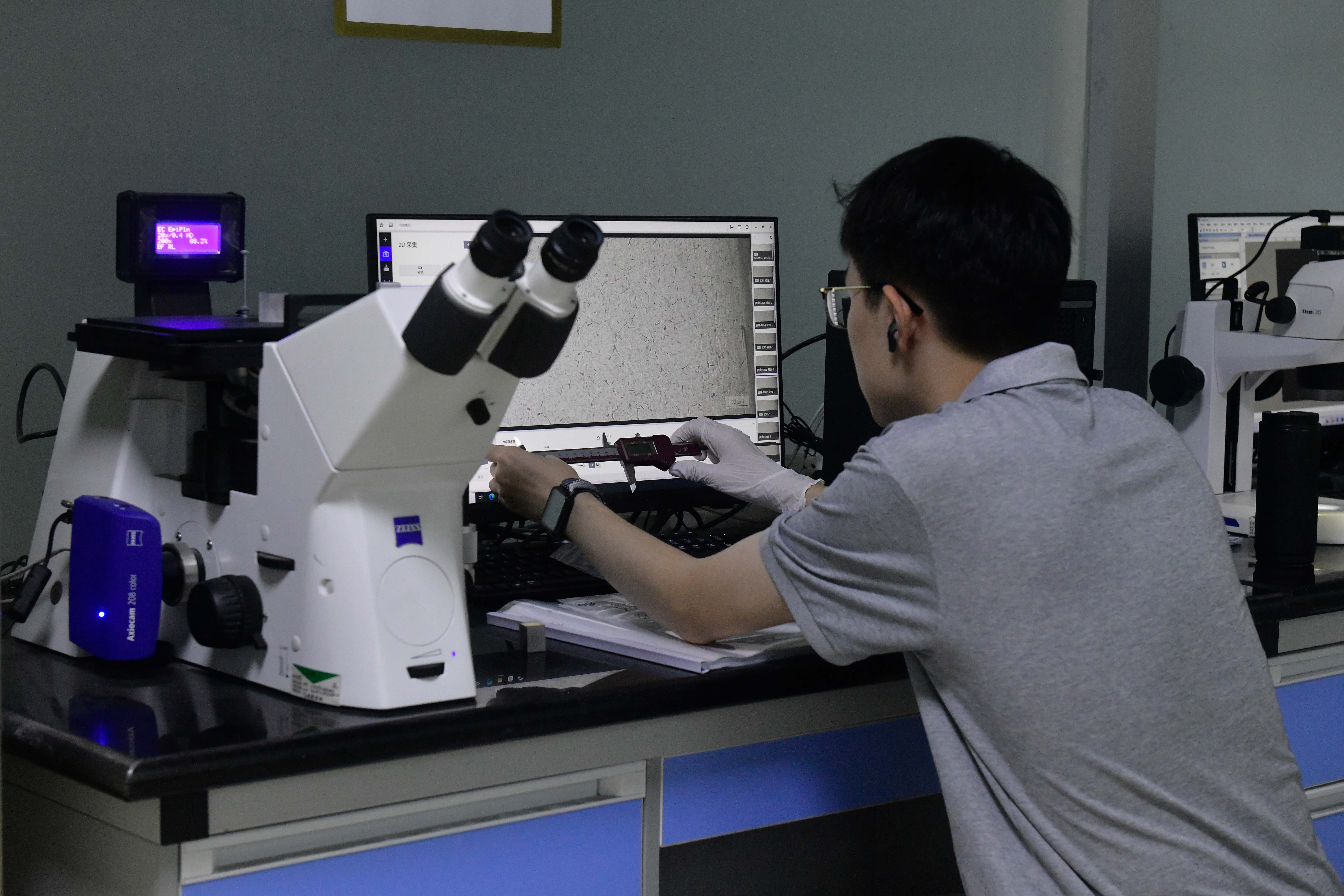
Shandong Haomen Aluminium Industry Co., Ltd., Luozhuang District, Linyi City, Shandong Province, China.
Why sliding profiles are a separate purchasing decision
Answer first: in a sliding system the profile is one component of a performance assembly, not a standalone product. Air tightness, water tightness and wind pressure resistance are properties of the finished door or window — frame, sash, gaskets, hardware, glazing and installation included. A profile supplier's real value therefore lies in dimensional consistency, finish durability and the ability to reproduce a specification across repeat orders.
Sliding profiles carry duties that fixed frames do not:
- Track and rail geometry that must stay straight across multi-metre spans, because sash weight transfers along the track rather than into the surrounding frame.
- Drainage and pressure-equalisation chambers positioned consistently enough that water exits before it reaches interior seals.
- Interlock sections where two sashes meet, typically the weakest point for air and water leakage in any sliding system.
- Thermal break design, which largely determines whether the assembled system can reach a specified K value.
For buyers in the evaluation stage, this shifts the comparison away from who extrudes aluminium and towards who can hold a specification over thousands of metres and several repeat orders. Alloy choice, finish control and inspection practice stop being technical footnotes and become commercial variables.
Which aluminium alloy should be used — 6063-T5, 6061, 6005 or 6082?
Answer first: 6063-T5 is the default architectural alloy for sliding door and window profiles, and it is the material specified for this architectural range. The same range is also produced in 6061, 6005 and 6082 where strength, machining or structural demand differs from a standard window frame.
| Alloy | Where it typically fits | What the buyer should confirm |
|---|---|---|
| 6063-T5 | The main architectural alloy for window and door profiles, including sliding frames and sashes, and commonly specified where surface finish quality matters. | Confirm alloy and finish specification together; anodizing and powder coating requirements are defined against the base material. |
| 6061 | General engineering alloy also produced in architectural profiles where greater strength is needed than a standard window section provides. | Confirm the application genuinely requires the additional strength, since machining and finishing parameters change. |
| 6005 | Higher-strength 6xxx alloy generally selected for structural members inside a facade or frame system. | Confirm structural calculations and connection design before the die is cut. |
| 6082 | Among the strongest widely used 6xxx alloys, generally specified for load-bearing or machined components. | Confirm die design and tolerance class, because tighter tolerances affect both price and lead time. |
Broadly accepted industry practice: all four alloys belong to the heat-treatable 6xxx series that dominates architectural extrusion. Moving up the strength range usually trades some extrudability and surface finish consistency against load capacity. That trade-off is better quantified against the actual span and wind load of a project than resolved by simply choosing the strongest available alloy.
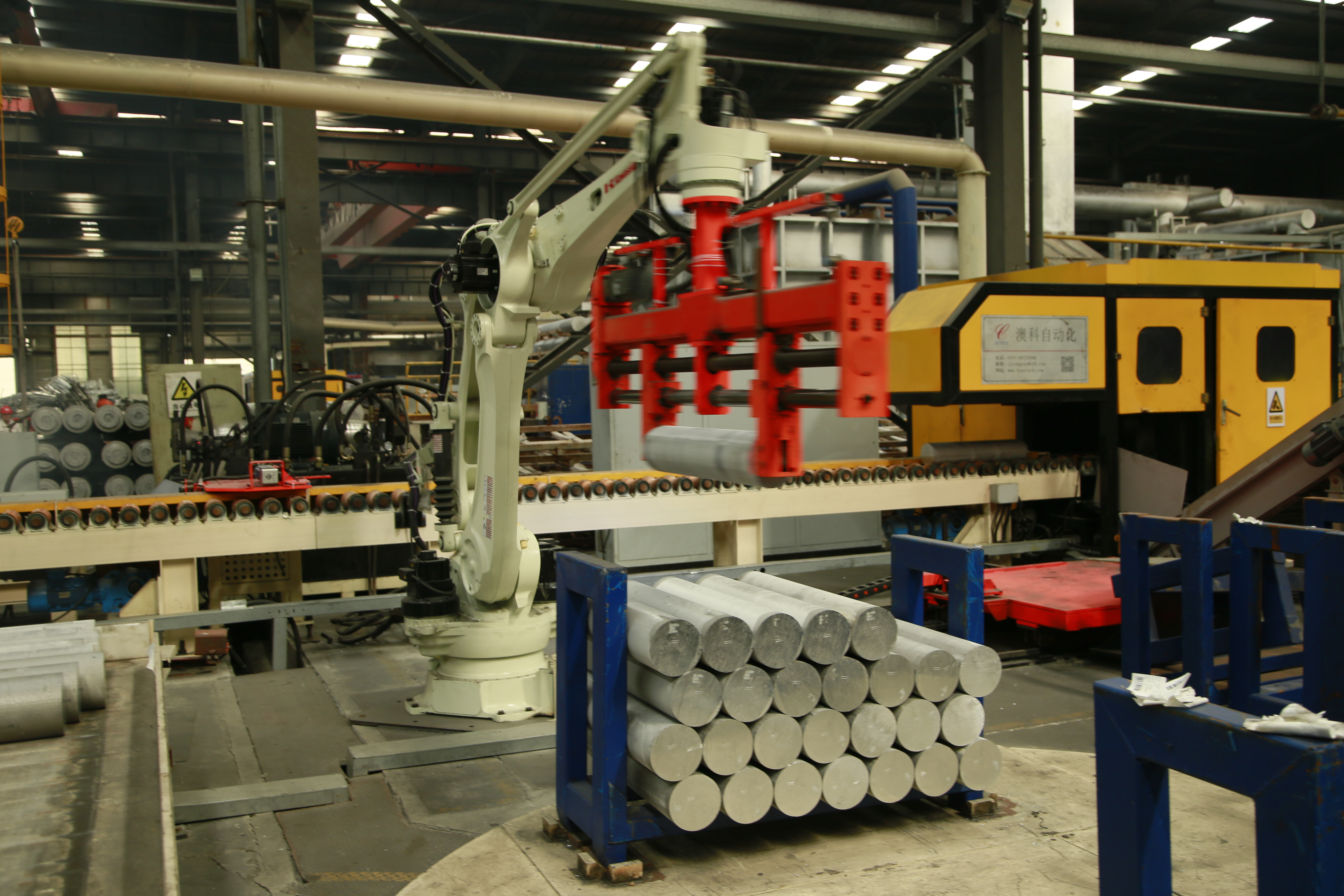
Extrusion line at Haomen Aluminum, where 6063-T5, 6061, 6005 and 6082 profiles are produced.
Standard lengths and why the 4–6 m range matters
Answer first: architectural aluminium profiles are supplied in 4–6 m standard lengths, which is the range that matches long sliding track runs and normal container handling. For a fabricated sliding system, longer stock means fewer joints in continuous tracks, less cutting waste on long members and more predictable packing and freight loading.
The practical limit is that non-standard lengths usually require a cutting step or a dedicated order, and both should be confirmed at quotation stage rather than assumed. Buyers should also confirm how length tolerance is controlled, since a track that is straight over four metres but inconsistently cut across a batch creates assembly problems on site rather than at the extrusion plant.
Surface treatment: mill finish, powder coated, anodizing and wood grain transfer
Answer first: the finish determines where a profile can be used, not just how it looks. The architectural range covers mill finish, powder coating, anodizing, electrophoretic coating and wood grain transfer, and each option carries a different exposure assumption.
| Finish | Typical role | Buyer consideration |
|---|---|---|
| Mill finish | Untreated extruded surface, used where a profile will be further processed, concealed, or installed in a non-exposed position. | Not a weathering surface. It should not be specified for exposed exterior facades. |
| Powder coated | Architectural interior and exterior use with a broad colour range. | Confirm the coating class against the relevant part of the GB/T 5237 series. |
| Anodized | Metallic finish widely used on architectural profiles and included in the certified production scope. | Selected where a metallic appearance and surface hardness are priorities. |
| Electrophoretic coating | Included in the certified production scope alongside anodizing and powder coating. | Often chosen for a uniform, high-gloss finish. |
| Wood grain transfer | Decorative timber-look finishing for window, door and interior finishing profiles. | Confirm exterior exposure and UV expectations for the specific project climate. |
| Fluorocarbon coating | Coating family covered by the GB/T 5237 standard series. | Generally specified where long-life exterior exposure is a requirement. |
Two standards anchor finish selection. Inside China, architectural aluminium alloy profiles must comply with the mandatory GB/T 5237 series (Parts 1–6), which covers mill finish, anodizing, electrophoresis and powder or fluorocarbon coatings. For European-facing projects, buyers commonly reference EN 755 for hot extruded products and EN 12020 for precision profiles in alloys 6060 and 6063.
Performance data for sliding door and window systems
Answer first: the sliding window profiles HM-U001 and HM-U002 and sliding door profiles HM-U003 and HM-U004 are specified against a defined performance set covering airtightness, watertightness, wind load, thermal transmittance and acoustics.
| Parameter | Specified level | What it means for the buyer |
|---|---|---|
| Air tightness | ≥ Level 6 | Limits uncontrolled air leakage through the assembled system, affecting both comfort and heating or cooling load. |
| Water tightness | ≥ Level 4 (≥ 500 Pa) | Describes resistance to pressure-driven rain, the governing criterion for exposed facades and coastal projects. |
| Wind pressure resistance | ≥ Level 6 | Covers structural safety and deformation under positive and negative wind load, which matters most for tall or exposed openings. |
| Thermal transmittance (K value) | ≤ 2.5 W/m²·K | A whole-system heat transfer rate; lower values indicate better thermal performance. |
| Sound insulation | ≥ 30 dB | Airborne sound reduction relevant to urban facades and buildings near traffic corridors. |
One boundary deserves stating plainly: these figures describe assembled and tested door and window systems built with these profiles under the referenced test standards. The delivered value on a project depends on glazing specification, hardware, gaskets, frame-to-wall interfaces and installation quality. Buyers evaluating a supplier at this stage should request the test report that matches the exact system, size and configuration being purchased, rather than accepting a generic performance statement.
Which standards apply?
Answer first: specification for this profile range references GB/T 13326, GB/T 7106, JG/T 215 and GB/T 8484, supported by the mandatory GB/T 5237 series for architectural profiles and, for European projects, by the EN 755 and EN 12020 extrusion standards.
The two most frequently requested test standards are GB/T 7106, which sets the test method for air permeability, water tightness and wind pressure resistance of windows and doors, and GB/T 8484, which addresses thermal performance. Buyers should note that GB/T 7106 is a test method: the level achieved depends on the tested specimen, so the certificate is only meaningful when the tested configuration matches the project configuration.
On the management-system side, Haomen Aluminum holds ISO 9001:2015 certification, certificate number 00226Q03185R501, issued on 2 July 2026 by China Quality Mark Certification Group and valid to 1 July 2029. The certified scope covers production of aluminium alloy profiles for architecture — anodized profiles, electrophoretic coating profiles, powder coating profiles and thermal barrier profiles — together with industrial aluminium profiles, assessed against GB/T 19001-2016 / ISO 9001:2015. The certificate is applicable worldwide with South America noted as a core market. The company also holds IATF 16949:2016, ISO 14001 and ISO 45001 certifications.
IATF 16949:2016 is a mandatory requirement for suppliers of aluminium components such as crash-management systems and structural frames to major automotive OEMs — context worth knowing for buyers who source both architectural and industrial profiles from the same supplier and want a single quality system covering both.
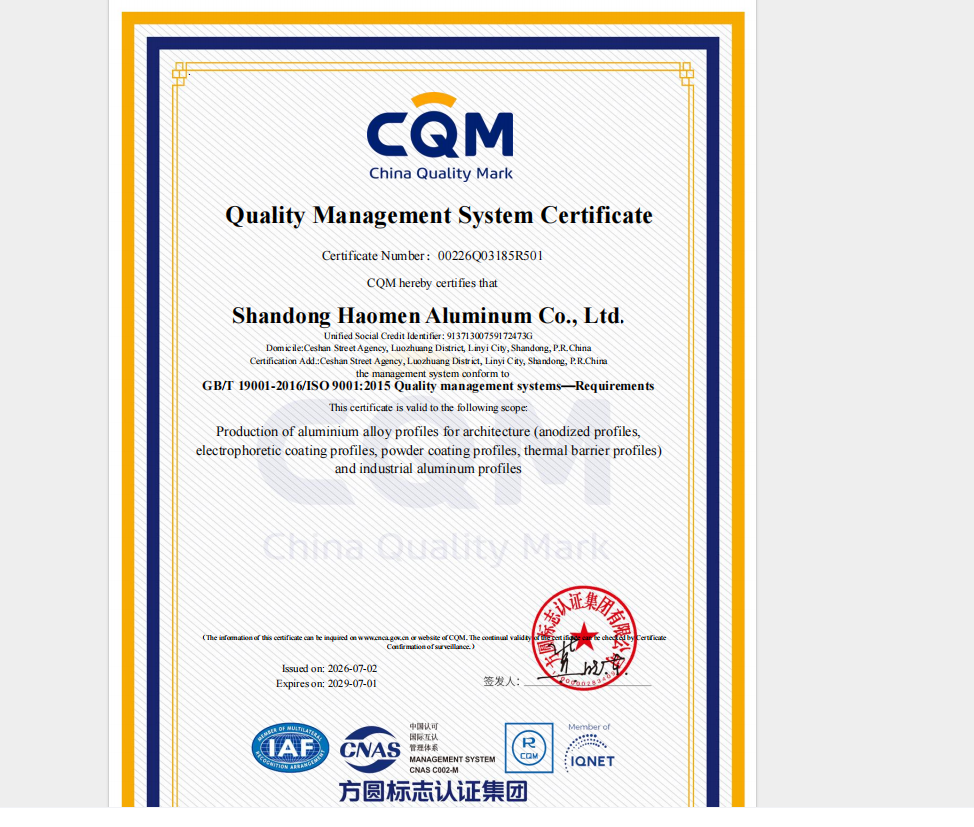
ISO 9001:2015 certificate 00226Q03185R501, issued 2 July 2026 by China Quality Mark Certification Group, valid to 1 July 2029.
Procurement terms: MOQ, lead time, capacity, testing, OEM and after-sales
Answer first: the published commercial terms for this profile range are a 5-ton minimum order quantity, a 20-day production lead time, 8,000 tons of monthly capacity, 100% testing, OEM production with logo customization, and remote after-sales support.
| Item | Detail | Buyer implication |
|---|---|---|
| Minimum order quantity | 5 tons | Below this threshold a bespoke order is not economic for either party. |
| Lead time | 20 days | Covers production once specification and any new tooling or sample approval have been confirmed. |
| Monthly capacity | 8,000 tons | Supports repeat ordering and multi-container programmes without re-sequencing the plant. |
| Quality control | 100% testing | Inspection runs across production rather than by sampling only. |
| Production mode | OEM with logo customization | Alloy, profile design, length and finish can be produced to buyer specification. |
| After-sales | Remote support | Technical support is delivered remotely rather than through on-site engineering visits. |
The distinction buyers most often miss is between lead time and tooling time. A 20-day production window applies to confirmed orders on existing profiles and finishes. Introducing a new profile design or a new finish normally involves die manufacture and sample validation first, and those steps sit outside the published production window. Clarifying both timelines at enquiry stage avoids a schedule assumption that later turns into a contractual dispute.
The 5-ton MOQ also has a practical consequence for smaller fabricators: consolidating several profile designs into a single order is usually more efficient than placing separate small orders per design, because tooling and setup costs are spread across the batch.
Where these profiles are used — and a ten-year reference case
Answer first: the architectural profiles are applied in global high-end construction, by window and door system manufacturers, and in interior finishing projects, with export markets concentrated in South America and Africa.
The most concrete reference point in the published material is a Brazilian project delivered for a window and door manufacturer OEM client. The installation used 2,000 tons of aluminium profiles for door and window applications and has been in stable operation for ten years, with durability noted as the defining characteristic of the installation. For an evaluation-stage buyer, that record is more informative than a specification sheet, because it reflects performance after a decade of thermal cycling, rain exposure and daily operation rather than performance at the factory gate.
Market context: what the numbers say about supply
Answer first: aluminium extrusion demand remains concentrated in Asia Pacific, and China's position as an export base for architectural profiles is well documented.
- The global aluminium extrusion market was valued at USD 94.8 billion in 2024 and is projected to reach USD 230.2 billion by 2035 (Orion Market Research).
- China's aluminium extrusion market was valued at USD 25.5 billion in 2024, with a projected CAGR of 9.6% through 2035 (Orion Market Research).
- China's exports of Aluminium Structures (HS 7610), which include profiles and window or door frames, totalled USD 5.55 billion in 2024 — approximately 30.5% of global exports in that category (OEC).
- Asia Pacific accounted for 71.7% of aluminium extrusion revenue in 2025, driven primarily by construction and automotive demand in China (Grand View Research).
- Adjacent demand is also material: aluminium holds a 71.5% material share in solar PV mounting systems, a market valued at approximately USD 44.5 billion in 2024 (Mordor Intelligence).
Published estimates diverge. Grand View Research places the global market at USD 98.2 billion in 2025, while Wissen Research puts it at USD 120 billion, largely because the defined scopes differ. Buyers should treat headline growth figures as directional and concentrate evaluation on plant capacity, standard compliance and testing practice, which are the variables that actually determine delivery.
On the supply side, publicly circulated industry listings of Chinese aluminium profile manufacturers frequently name Xingfa Aluminium, Fenglu Aluminium, JMA Aluminium and China Zhongwang. Large listed groups and mid-size specialists answer different buying needs — volume programmes with standard systems versus customized dies and finish responsiveness — so a shortlist drawn purely from public rankings tends to miss the criteria that decide whether an order ships on time.
Comparison with alternative materials — and the limits of this option
Answer first: aluminium remains the dominant material for sliding systems because it combines rigidity with a low-maintenance surface, but it is not the lowest-cost or the most rigid option in every case.
Against uPVC, aluminium generally offers greater rigidity for large sliding panels and permits narrower sightlines, which matters for wide openings and heavier glazing. uPVC systems are typically lower in material cost and are adequate for smaller openings. Against steel, aluminium usually needs no additional corrosion-protection coating for architectural service, while steel sections generally provide more stiffness for the same depth. Against timber, aluminium requires less ongoing maintenance, though timber retains an aesthetic and sustainability argument that some projects weigh heavily.
The limits of this particular supply option should be weighed just as directly:
- A 5-ton minimum order quantity excludes very small or highly fragmented orders, which may be better served by a local distributor.
- The 20-day lead time covers production only; new dies, new finishes and sample validation sit outside it and should be planned for separately.
- The stated K value and sound insulation levels describe tested systems, not raw profile, and are not guaranteed for every assembly or installation condition.
- Mill finish should not be selected for exposed exterior facades.
- After-sales support is delivered remotely, so projects requiring on-site engineering attendance should confirm what is and is not included.
- Export experience is concentrated in South America and Africa; buyers in markets governed by European or North American certification regimes should confirm the applicable standard set before shortlisting.
Future outlook
Tighter building energy requirements are pushing specification attention towards thermal break construction and documented K values, which means finish appearance is gradually becoming a secondary criterion behind measured thermal performance. At the same time, compliance documentation is shifting from a differentiator to a baseline filter: a supplier without current certification and a matching test report increasingly fails at the shortlisting stage rather than the negotiation stage.
Given Asia Pacific's 71.7% share of extrusion revenue, buyers in South America, Africa and Europe are likely to keep diversifying their supplier bases rather than consolidating into a single region. For those buyers, the practical change over the next few years is less about price and more about evidence — test reports matched to the actual system being purchased, traceable certification, and lead-time commitments that distinguish production time from tooling time.
Frequently asked questions
1. Which aluminium alloy is used for sliding door and window profiles?
6063-T5 is the architectural alloy specified for window and door profiles in this range, including sliding frames and sashes. The same range is also produced in 6061, 6005 and 6082, which are generally selected when a component must carry more structural load than a standard frame section. Because alloy and finish specification interact, both should be confirmed together.
2. What performance levels do the sliding door and window systems specify?
Air tightness ≥ Level 6, water tightness ≥ Level 4 with a test pressure of ≥ 500 Pa, and wind pressure resistance ≥ Level 6. Thermal transmittance is specified at ≤ 2.5 W/m²·K and sound insulation at ≥ 30 dB. These are system-level values for the assembled door or window and depend on glazing, hardware, gaskets and installation as well as the profile.
3. Which standards apply to these profiles?
The specification set references GB/T 13326, GB/T 7106, JG/T 215 and GB/T 8484. GB/T 7106 defines test methods for air permeability, water tightness and wind pressure resistance, while GB/T 8484 addresses thermal performance of windows and doors. For architectural aluminium profiles produced in China, the mandatory standard series is GB/T 5237 (Parts 1–6), covering mill finish, anodizing, electrophoresis and powder or fluorocarbon coatings. European-facing projects commonly reference EN 755 and EN 12020.
4. What is the minimum order quantity and lead time?
The minimum order quantity is 5 tons and the stated production lead time is 20 days, against a monthly capacity of 8,000 tons. The lead time covers production after specification — and any new tooling or sample approval — has been confirmed, so tooling timelines should be clarified separately when a new profile design is involved.
5. How is quality controlled?
Production runs on 100% testing rather than sampling. The company holds ISO 9001:2015 certification, certificate number 00226Q03185R501, issued on 2 July 2026 by China Quality Mark Certification Group and valid to 1 July 2029, covering anodized, electrophoretic coating, powder coating and thermal barrier architectural profiles together with industrial profiles. IATF 16949:2016, ISO 14001 and ISO 45001 are also held. Buyers should still request test reports matching the specific system and size being purchased.
6. Can profiles be produced to OEM specification?
Yes. OEM production with logo customization is the standard mode, covering alloy selection, profile design, length and surface treatment within the published range. After-sales support is provided remotely.
7. Which surface treatment suits outdoor applications?
For exposed exterior use, powder coating, anodizing, electrophoretic coating and fluorocarbon coating are the mainstream architectural options, all covered by the GB/T 5237 series. Mill finish is an untreated extrusion surface and is not intended for exposed exterior facades. Wood grain transfer is used where a decorative timber appearance is required, and its exterior exposure and UV expectations should be confirmed against the project climate.
Reference material: the E-Catalog of Shandong Haomen Aluminio is available for download at E-Catalog of Shandong Haomen Aluminio (PDF). Company website: www.haomenly.com.