
Aluminum Sim Racing Cockpit: Inside an OEM Build Program
Aluminum profile sim racing cockpits have moved from enthusiast workshop builds into OEM purchasing programmes. The driver is mechanical rather than stylistic: direct drive wheelbases and load cell pedals push far higher loads into a frame than belt driven wheels, and any frame that flexes absorbs part of the force feedback before it reaches the driver. What used to be a question about which cockpit to buy has become a question about whether a supplier can deliver a reconfigurable aluminum platform against a defined configuration, packaging specification and brand, on a repeatable schedule.
Why the cockpit segment is outpacing the rest of the simulator market
Mordor Intelligence, in its racing simulator industry research, identifies aluminum profile rigs as the reference standard for high end setups, specifically because of the rigidity that direct drive wheelbases require. The same research estimates the global cockpit hardware segment at a 21.65% compound annual growth rate through 2030, ahead of the wider simulator market. For context, wider market material used by FYCHI places the overall racing simulator market at USD 657 million in 2024, growing to USD 1.2 billion by 2035 at a CAGR of 5.6%. The two figures measure different scopes and should not be read against each other: one covers cockpit hardware, the other the whole simulator category.
For buyers in the evaluation and early execution stage, the operational consequence is a change in the sourcing question. A distributor no longer asks only which frame geometry sells; it asks which frame can be re-sold in three configurations, shipped in packaging that survives a container, and supported with spare parts for the models actually on the shelf. That is a supplier capability question, not a product styling question.
What an aluminum profile sim racing cockpit actually is
An aluminum profile sim racing cockpit is a rigid frame built from T-slot aluminum extrusion, assembled with connectors, on which the wheel base, pedals, shifter, monitors and seat are mounted through plates that can be repositioned along the profile. Unlike a welded frame, the mounting geometry is not fixed at the factory; it can be moved, added to or re-laid-out after delivery.
The working principle is simple. Every force a wheel base or a pedal set generates is pushed back into the frame, so any flex in that frame is energy that never reaches the driver. A rigid frame holds the wheel-to-pedal geometry constant, which is why force feedback stays consistent under braking, counter-steering and long stints, while a loose stand flexes and part of the feedback is absorbed instead of transmitted. Aluminum profile achieves that rigidity through the section stiffness of the extrusion and the clamping force of the connectors, while keeping mounting positions movable.
The trade-off against a fixed steel tube cockpit is documented in FYCHI's own comparison material: an aluminum profile cockpit gives effectively unlimited reconfigurable mounting positions and supports both racing and flight simulation, while a fixed steel tube cockpit has fixed mounting points and a lower cost but limited upgrade flexibility. Neither is universally better; the choice depends on whether a buyer expects the peripheral set to change.
FYCHI 6020D and where the aluminum platform sits in the range
FYCHI is the sim racing hardware brand of Zhejiang Zhongyao Intelligent Equipment Co., Ltd. (Hangzhou Branch), a Chinese manufacturer that designs, produces and exports racing simulator brackets, wheel and pedal stands, monitor stands, simulator cockpits and racing seats from its production base in Heping Town, Changxing County, Huzhou City, Zhejiang Province. The portfolio covers more than 20 active product series, from the 6001D–6021D folding wheel and pedal stands through the modular aluminum profile cockpits (6016D, 6020D, 6034D-1-L) to the 6029-1 six-axis adjustable triple monitor stand and the 7022D, 7025D, 7075D and 7104D racing seat cockpits.
The 6020D is the model that carries the mid-to-high end, upgradeable position in that line. It is a modular aluminum profile cockpit designed to be freely reconfigured, and it supports both racing and flight simulation configurations. For a distributor, the practical value is SKU efficiency: one platform family can serve a customer who starts on a belt driven wheel base and later moves to direct drive, without a second frame purchase and without a change of supplier.
What can actually be customized on an OEM order
FYCHI documents four customization dimensions for sim racing cockpit projects: frame colour, logo printing and packaging, accessory configuration, and custom bundle options. OEM production is available for private label projects, and ODM design and production services are available where a project needs structural or configuration change rather than badging alone.
Frame colour and logo
Colour and badging are the lowest-friction customization route because they do not alter the frame structure or the mounting geometry. For a private label programme this matters: the compliance evidence attached to the base model stays valid, while the buyer gets a visually distinct product for its own market and sales channel.
Accessory configuration
Accessory configuration is where OEM orders usually diverge from stock. A cockpit sold into a market dominated by one wheel base brand can ship with the matching mounting plates, pedal plate layout and shifter position, rather than a generic bolt set the end user has to adapt. Confirming the target market's dominant wheel base, pedal type and monitor arrangement before ordering is the single most effective way to reduce "does not fit" returns.
Custom bundles
Custom bundle options allow a cockpit to be combined with a monitor stand or a racing seat as a single regional SKU. This is a channel decision as much as a product decision: a bundled SKU simplifies listing, freight calculation and warranty handling for the distributor, while keeping the underlying frames unchanged.
Manufacturing capacity, MOQ and lead time
Production runs from a 35,000 m² facility with 100–200 staff and a 10-person R&D team. Documented monthly production capacity is 50,000 units, the standard lead time is 60 days, and the minimum order quantity is 10 units per model. Export accounts for 80% of output, with North America, Europe and Asia-Pacific as the main markets.
Those four numbers describe a specific kind of supplier relationship. An MOQ of 10 units per model allows a distributor to validate a new SKU or a new market without committing capital to a container load. A 60-day lead time is a planning cycle rather than an off-the-shelf promise, so stock plans should be built on forecast rather than on replenishment after sell-out. A monthly capacity of 50,000 units is what makes the ramp possible once a trial order performs.
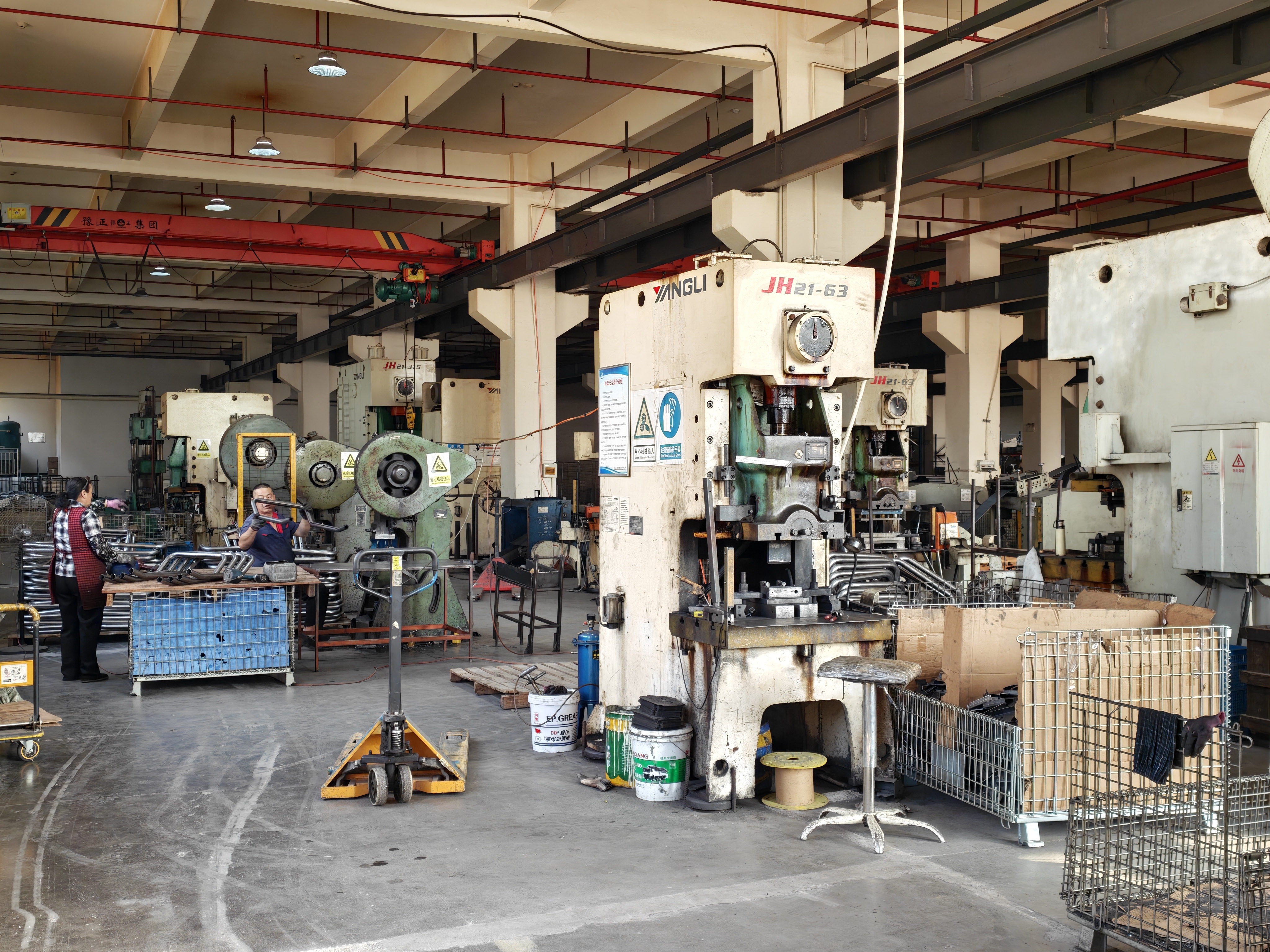
Steel and aluminum simulator frames are produced on the company's own line, with in-house welding, powder coating and assembly, and every unit passes pre-shipment inspection before loading.
Packaging is part of the OEM specification, not an afterthought
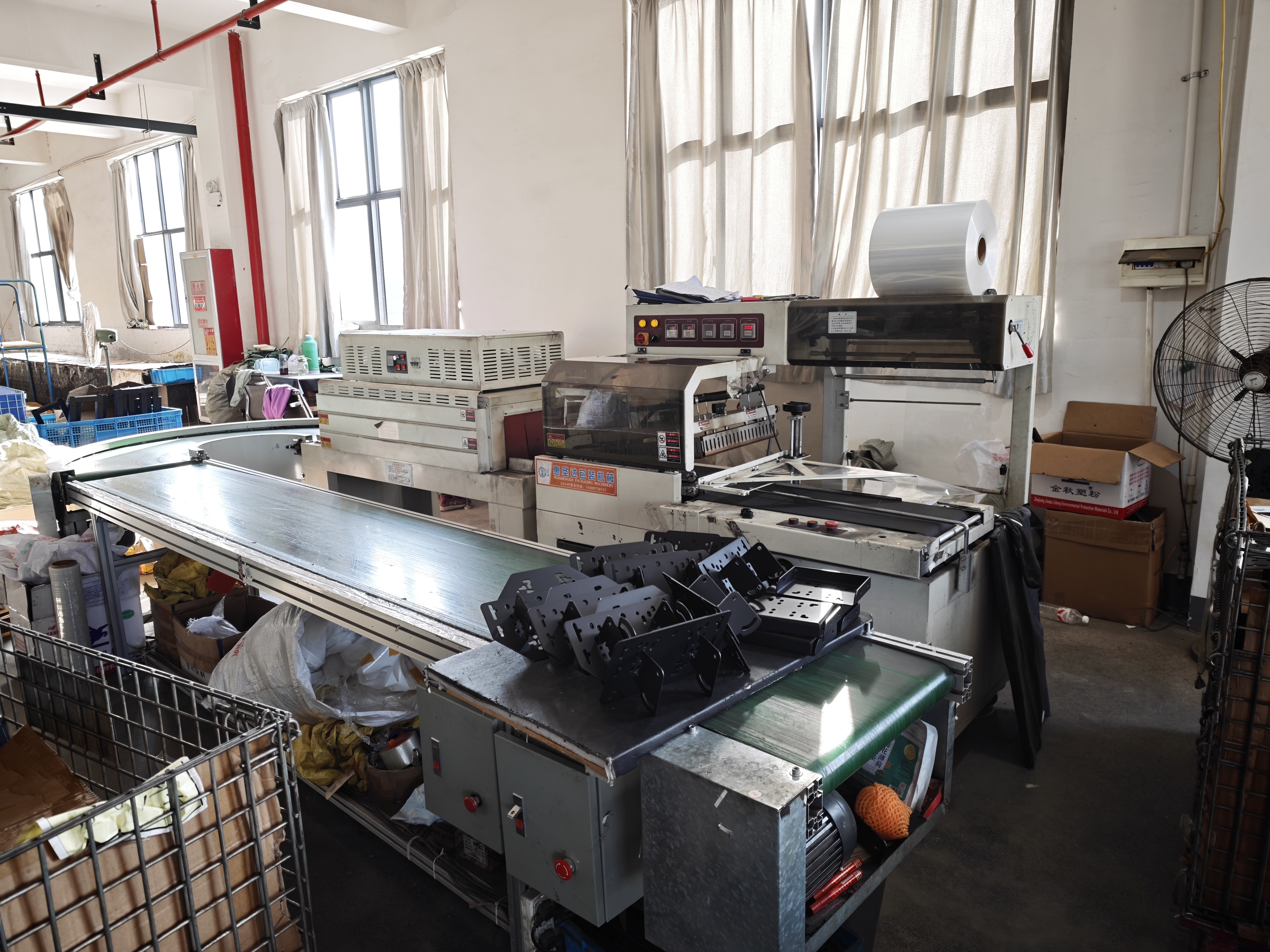
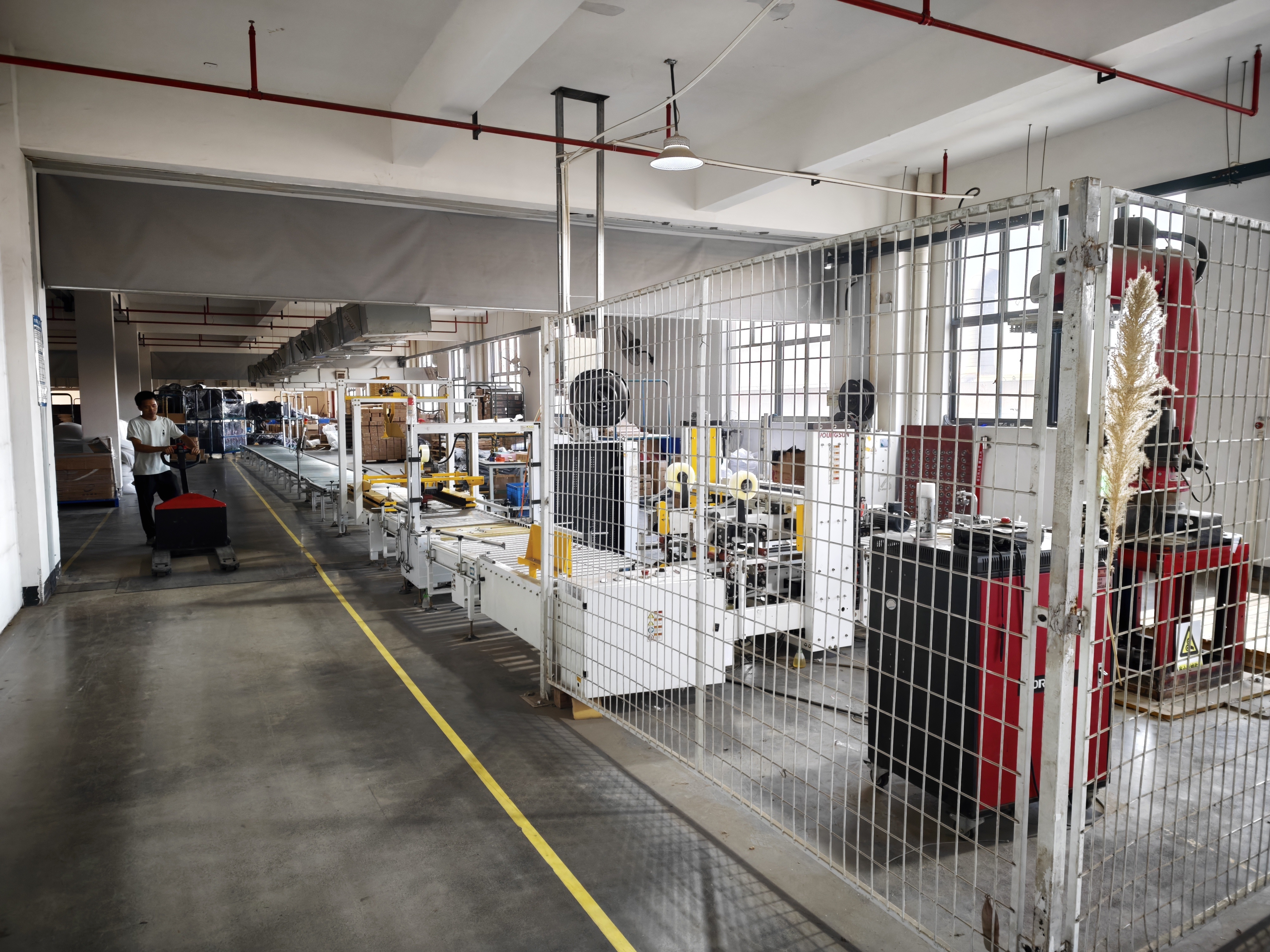
Export packaging uses a newly designed carton with a 280 lb load rating, black EPE corner protection, and one 5 mm EPE cushion board on the top and one on the bottom of each carton. Every carton contains a colour manual, a certificate of conformity, a warranty card and installation tools.
For a private label buyer, packaging is a deliverable in its own right. The carton load rating determines how the goods can be stacked and how the container is planned; the corner protection and cushion boards determine what the coating and mounting plates look like after a long sea leg; the manual and tool set determine whether an end user can complete assembly alone, which in turn determines the return rate and the support cost carried by the distributor. With online channels generating 65.41% of racing simulator revenue in 2024, according to Mordor Intelligence, the unboxing and assembly experience is also a public review event rather than a private one.
After-sales support covers remote technical support and spare parts supply, and the warranty card and manual included in each carton give the distributor a documented starting point for handling end-user questions instead of forwarding them unresolved.
Compliance evidence and the exact scope it covers
FYCHI racing simulator brackets are tested for RoHS 2.0 compliance under certificate No. TST20240500495-3RC, issued on 7 May 2024 by Dongguan True Safety Testing Co., Ltd. and tested to the IEC 62321 series. The declared scope covers main model 6008 and series models 6002 through 6020, which includes the 6020D aluminum profile cockpit. Seating products are tested for safety, strength and durability in accordance with the EN 1335 series, and for REACH SVHC compliance, by Bureau Veritas.
Design protection is documented separately. The racing simulator bracket design is protected by a Chinese design patent, Certificate No. 7689673, Patent No. ZL 2022 3 0555008.X, granted November 2022, and by a Registered Community Design with the European Union Intellectual Property Office, Registration No. 002228411-0001.
Scope boundary worth stating plainly. A certificate is only valid for the model range it declares. The RoHS certificate above covers 6002–6020; a model outside that range cannot inherit the claim. The entity named on the certificate, the invoice and the marketplace listing should also be consistent, and the full test report should be kept together with the certificate. Buyers importing into a specific market should confirm that market's documentation and labelling requirements before shipping rather than after.
Where aluminum profile platforms are actually used
The clearest operational example is FYCHI's own brand showroom and content studio, which holds the complete product line: the 6001D–6021D stand series, the aluminum profile series, the seat series and the six-axis triple monitor stand. The space is used for product demonstration, photography and video production, and dealer product training, so every SKU can be demonstrated live to a potential distributor before an order is placed, including by remote video for overseas buyers.
For a B2B buyer, that changes the evaluation stage. Rather than selecting from catalogue photography, a distributor can see the frame under load, watch a configuration change, and confirm the fit of a specific wheel base before committing to a first order. Documented application conditions for these rigs are indoor use in home, retail showroom and esports venue environments, supporting intensive daily use, with wheel bases, pedal sets, shifters, VESA-mounted monitors, racing seats, consoles and PCs as matched equipment. The stated special requirements are frame rigidity under hard braking force, compatibility with mainstream wheel base brands, and stable anti-slip footing.
Aluminum profile versus fixed steel tube versus folding stand
The three frame types sold into the same market are not substitutes. They answer different buyer situations, and a distributor's range decision is really a decision about which situations to serve.
| Criterion | Aluminum profile cockpit (6020D) | Fixed steel tube cockpit | Folding wheel stand (6001D) |
|---|---|---|---|
| Frame construction | Modular aluminum extrusion with connectors | Fixed welded steel tube | Folding powder-coated steel frame |
| Mounting positions | Freely reconfigurable along the profile | Fixed mounting points | Fixed, folds for storage |
| Direct drive and load cell suitability | Designed for high rigidity under high torque | Rigid within its fixed configuration | Entry level; not suited to direct drive |
| Racing and flight use | Both supported | Typically a single configuration | Racing only |
| Floor space | Larger footprint | Larger footprint | Compact and storable |
| Relative cost | Higher | Lower | Lowest |
| Upgrade path | Reconfigure rather than replace | Limited | Replace |
The limits deserve equal space. An aluminum profile cockpit costs more than a fixed steel tube frame and occupies more floor space, and assembly takes longer because more connection points have to be torqued correctly. For a user whose layout is final and whose priority is cost, a fixed steel tube cockpit is the more rational purchase. For a first-time user in a small room, the 6001D folding stand is the appropriate entry product, but it is not a direct drive platform: where a direct drive wheel base or load cell pedals are mounted on an entry-level stand, the documented symptom is wobble under hard braking and pedal drift, and the documented remedy is an upgrade to the aluminum profile cockpit. Choosing a stand by price alone, then adding high-torque hardware, is the most common configuration error in this category.
Procurement checklist for distributors
The evaluation stage is where most avoidable cost is created or avoided. The table below condenses the checks that map to documented FYCHI specifications.
| Check | What to confirm | Basis |
|---|---|---|
| Peripheral fit | Mounting hole pattern of the target wheel base, pedal type, shifter position, monitor VESA layout | Industry-standard mounting patterns; standard VESA for monitors |
| Rigidity tier | Direct drive or load cell hardware requires the aluminum profile platform, not an entry stand | Documented wobble and pedal drift remedy |
| Certification scope | Ordered model must sit inside the declared range of the RoHS certificate | Certificate No. TST20240500495-3RC, models 6002–6020 |
| Packaging | 280 lb rated carton, EPE corner protection, 5 mm cushion boards top and bottom | Export packaging specification |
| Commercial terms | MOQ 10 units per model, 60-day lead time, 30% advance and 70% balance, T/T or L/C, FOB or EXW Ningbo or Shanghai | Documented purchasing terms |
| After-sales | Remote technical support, spare parts supply, manual, warranty card and tools in every carton | After-sales scope |
| Pre-order demonstration | Live or remote demonstration of the exact SKU | Brand showroom and content studio |
Market signals worth weighting in a stock plan
Three market signals are relevant to how a range is built rather than to whether the category is worth entering. The cockpit hardware segment is growing at 21.65% CAGR through 2030, faster than the wider simulator market, which points toward stocking reconfigurable platforms rather than one fixed geometry. Online channels accounted for 65.41% of racing simulator revenue in 2024, which raises the cost of a poor unboxing or assembly experience and rewards packaging and documentation. And demand is concentrated: North America represents approximately 34% of global demand and Europe approximately 32%, while Asia-Pacific is the fastest-growing region, which implies different configuration mixes and different lead-time buffers by market.
Limits worth stating plainly
- Aluminum profile is not the cheapest route to a working cockpit. Buyers with a final layout and a cost-first brief are better served by a fixed steel tube frame.
- Footprint is larger than a folding stand, which matters in shared or small rooms.
- More connection points mean more assembly time and a real requirement to re-torque bolts before first use and periodically afterwards.
- Lead time is 60 days with a 10-unit minimum per model; this is a planned-production relationship, not same-week replenishment.
- Compliance wording is bounded by the declared model range on the certificate and cannot be extended by assumption.
- Frame rigidity does not compensate for an uneven or slippery floor; levelling and anti-slip support are still required.
What changes next
The direction of travel in this category is toward configurability rather than toward a single optimized geometry. As direct drive hardware moves further down the price ladder, the number of buyers who will replace an entry frame within a year rises with it, and the supplier that wins that buyer is the one whose platform can be reconfigured instead of replaced. For manufacturers, that shifts competition toward modularity, documentation quality and spare parts logistics; for distributors, it shifts the range decision toward fewer, more flexible platforms backed by verifiable certificates and packaging that survives transit.
FYCHI's own capability set sits on that logic: an aluminum profile platform in the 6020D, documented OEM and ODM routes, a 10-unit minimum order, a 60-day lead time and 50,000 units of monthly capacity behind it. Buyers evaluating the program can request the company brochure for the full specification set before committing to a configuration.
FAQ
What is an aluminum profile sim racing cockpit?
It is a rigid frame built from T-slot aluminum extrusion, on which the wheel base, pedals, shifter, monitors and seat are mounted through plates that can be repositioned along the profile. Like any cockpit, it holds the wheel-to-pedal geometry fixed so force feedback and braking loads stay repeatable; unlike a welded frame, its mounting points can be moved without cutting or re-welding.
Which wheel bases and pedals fit FYCHI aluminum profile cockpits?
FYCHI rigs use industry-standard mounting hole patterns and are compatible with Logitech G29 and G923, Thrustmaster T300 and TGT, Fanatec and most standard-pattern wheel bases. Each rig has a dedicated pedal plate and a shifter mounting position, so wheel, pedals and shifter sit on one frame. Where a wheel base uses brand-specific hardware, the hardware supplied with that wheel base is used. Mounting hole patterns should be confirmed before ordering rather than forced on arrival.
What can be customized on an OEM aluminum profile cockpit order?
Four dimensions are documented for sim racing cockpit projects: frame colour, logo printing and packaging, accessory configuration, and custom bundle options. OEM production is available for private label projects, and ODM design and production services are available where a project requires structural or configuration change in addition to badging.
What are the MOQ and lead time for OEM cockpit orders?
The minimum order quantity is 10 units per model and the standard lead time is 60 days. Documented monthly production capacity is 50,000 units, which supports scaling after a trial order. Payment terms are 30% advance and 70% balance, with T/T and L/C accepted, and delivery is available FOB or EXW from Ningbo or Shanghai.
Does the RoHS certificate cover the 6020D aluminum profile cockpit?
Yes. Certificate No. TST20240500495-3RC, issued 7 May 2024 by Dongguan True Safety Testing Co., Ltd. to the IEC 62321 series, declares main model 6008 and series models 6002 through 6020, which includes the 6020D. The certificate is valid in connection with its full test report and applies to the models within its declared range; a model outside that range cannot inherit the claim.
Aluminum profile cockpit or fixed steel tube cockpit — which should a distributor stock?
It depends on the customer mix. An aluminum profile cockpit offers reconfigurable mounting positions, easier upgrades and dual racing and flight use, and suits buyers running direct drive wheel bases, load cell pedals or triple screens. A fixed steel tube cockpit has fixed mounting points, a lower cost and limited upgrade flexibility, and suits buyers whose layout is final. Stocking both covers the full price ladder; stocking only one leaves either the upgrade buyer or the cost-first buyer unserved.
Company brochure with full product and specification details: Introduction to Zhongyao Company 2025 (PDF).
Есть вопросы или нужны дополнительные детали?
Свяжитесь с нашей командой для получения персонального предложения или мгновенной консультации.
Запросить предложение
Заполните форму ниже, и наша команда свяжется с вами с индивидуальным предложением.
Прямой чат WhatsApp
Предпочитаете общаться в реальном времени? Напишите нам в WhatsApp для мгновенной помощи и быстрых ответов.
- Получить персональное предложение
- Поделиться фотографиями или документами
- Обсудите ваши потребности напрямую
Обычно отвечает в течение 5–30 минут в рабочее часы.