
Anatase TiO₂ Procurement: A Criteria-Weighting Framework
Anatase titanium dioxide for fiber production is a weighted purchase, not a price comparison. Two fiber-grade grades can declare similar TiO₂ content and still deliver different fabric whiteness, different dispersion behaviour in ethylene glycol, and a different maintenance load on the spinning line. This article sets out a criteria-weighting framework that procurement and production teams can apply when comparing entries inside an anatase matrix — including the SA-50, SA-60 and SA-80 grades published in the SA series — so that the grade decision rests on the same evidence base every time.
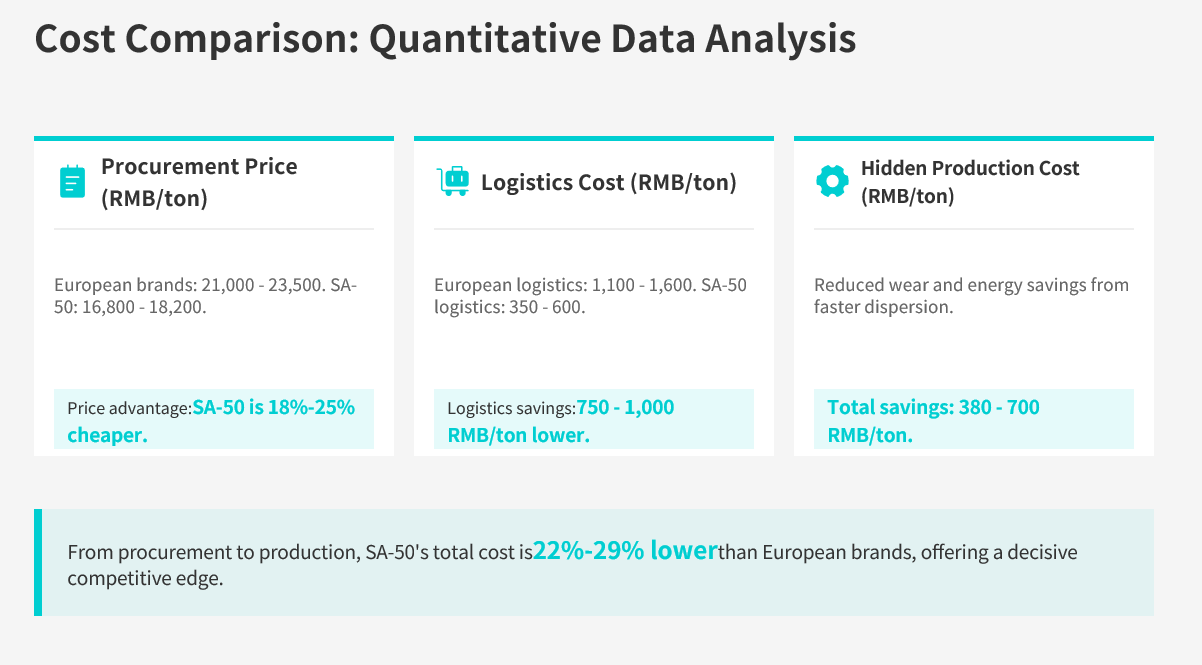
Figure 1 — Comparing anatase fiber grades means weighting optical, dispersion, process and cost criteria together, rather than reading a single specification line.
1. Why fiber-grade anatase resists a simple price comparison
Fiber-grade titanium dioxide is not selected on one specification line. Procurement teams comparing anatase grades for polyester, polyamide or viscose spinning run into three structural problems at the same time.
Specification convergence. Declared content, moisture and residue ranges sit within narrow bands across most commercial fiber grades, so a side-by-side sheet often shows little visible separation between two products that behave differently once they enter the melt line.
Delayed feedback. The criteria that actually separate grades — dispersion speed, suspension stability, spinneret abrasion and the colour shift left in the finished yarn — show up weeks after goods-in, not at receiving inspection.
Commercial asymmetry. Quotations arrive on different terms: CIF against FOB, different minimum order quantities, different lead times, and different assumptions about who carries freight, insurance and port charges. A headline unit price therefore compares two different transactions rather than two different materials.
The countermeasure is procedural rather than technical. Fix the weighting before the quotations arrive, then score every candidate grade against the same criteria. This keeps the comparison on substance and reduces the pull of whichever quotation happens to arrive first.
2. The criteria that carry weight in an anatase decision
A workable framework distributes a fixed number of points — 100 is a convenient total — across the criteria that decide the outcome for a specific plant. The allocation itself is a buyer decision and should follow the end product, not the supplier's brochure.
| Criterion | What it measures | Evidence to request | When its weight rises |
|---|---|---|---|
| TiO₂ content and impurity profile | Declared content, iron level, conductivity | Certificate of analysis; content result on a defined test method | Acts mainly as a pass/fail gate rather than a sliding score |
| Colour values (L and b) | Whiteness level and yellow–blue hue direction | Grade certificate with L and b values | Undyed, pure-white and light-colour fabric programmes |
| Dispersion and coating compatibility | Behaviour in ethylene glycol and polyester resin; need for pre-dispersion | Feeding trial notes, suspension stability data | Lines using ethylene glycol batch feeding |
| Process load and maintenance | Spinneret wear, filter cycle, cleaning frequency, downtime | Maintenance records before and after a grade change | Continuous, high-yield spinning lines |
| Delivered cost and supply terms | Unit price plus freight, lead time, MOQ, payment terms | Full quotation on matched Incoterms | Competitive commodity markets with tight margins |
| Handling and storage | Dust control, moisture protection, packaging integrity | Packaging specification and warehouse conditions | Humid climates and manual feeding environments |
3. Weighting TiO₂ content against unit cost
Content is a threshold, not a linear score. Once a grade clears the content and impurity requirement for a given spinning system, additional percentage points rarely change fabric output — but they do change price. Treating content as a pass/fail gate and moving the variable weight to delivered cost and hidden production cost is usually the more accurate allocation.
For content claims to be comparable at all, they need a defined method. China's national standard GB/T 37632-2019 establishes the test method for titanium dioxide content in man-made fibers, which gives buyers inside and outside China a common reference point when a supplier declares a content value. Particle size behaves similarly: fiber-grade (textile grade) TiO₂ typically specifies a D50 average around 0.28 μm with 90% of particles between 0.1 μm and 0.5 μm. Buyers comparing grades should ask whether the distribution, not just the average, matches their filter and spinneret configuration.
On the cost side, the gap between a domestically sourced fiber-grade grade and an imported European grade is not confined to the invoice. Published comparison data for the SA-50 grade against European Kronos 1071 and Venator LW-S100 places unit price 4,200–5,300 RMB/MT lower, with logistics cost 750–1,000 RMB/MT lower, and additional production savings of 380–700 RMB/MT arising from reduced spinneret wear and faster dispersion. The total comprehensive cost gap is stated as 22%–29% lower. For a 10,000 MT annual requirement, that comprehensive gap is described as saving more than 4.5 million RMB of total cost.
The weighting implication is direct: if a buyer scores on unit price alone, roughly a quarter of the cost difference disappears from the comparison. Delivered cost, lead time and maintenance effect belong on the same scorecard as the quotation.
4. Reading L and b values against the finished article
Two colour numbers do most of the work in an anatase comparison. The L value describes how light or white the material reads; the b value describes where it sits on the yellow–blue axis. Neither number alone decides a grade, because they answer different questions: L answers "how white," and b answers "what kind of white."
Verified comparison data makes the distinction concrete. The SA-50 grade delivers a cool blue-white shade with a b value of ≤ -0.4, while the European grades in the same comparison present a warm yellow tone measured at b +0.8 to +1.7. On the lightness axis, the whiteness L-value gap between SA-50 and the European grades is ≤ 0.7, which is described in the source data as visually identical. In other words, the meaningful optical difference between these grades is hue direction rather than brightness level.
That has a direct weighting consequence. For pure-white, light-grey and bright-colour textile programmes, a warm yellow tone requires compensation somewhere downstream, so the b value deserves a high weight. For heavily dyed, dark or matte end uses, the hue shift is largely masked and the b value should carry much less weight — while dispersion uniformity carries more.
The same logic governs the brightness-versus-matting trade-off inside a grade matrix. Where matting or a semi-dull surface is the priority, the framework directs the buyer to the matrix entry specified for that matting performance and to confirm its own L value on the grade certificate, rather than defaulting to the entry with the highest available brightness. In the SA series the published entries include SA-50, SA-60 and SA-80, and each entry carries its own optical values; grade-specific L and b readings should always be taken from the individual grade certificate rather than inferred from another grade in the same family.
Where the requirement is brightness-led, the documented position of SA-50 is specific: it is described as more suitable for high-grade light-colour and pure-white polyester fabrics because of its cool blue-white shade. That is a weighting statement, not a universal recommendation — it tells a buyer when to push optical criteria up the scorecard and when to push them down.
5. Technical basis: why coating chemistry, not content, drives dispersion
The dispersion behaviour that shows up on a spinning line traces back to the surface treatment applied to the pigment particle. The core technical difference documented between SA-50 and the European grades in the same comparison is the coating system: SA-50 uses an exclusive polyester-specific special organic coating produced with Japanese refined dry modification technology, while Kronos 1071 and Venator LW-S100 use a traditional silicon-aluminium inorganic double coating with general organic modification.
That difference produces measurable downstream effects. The organic coating achieves dual compatibility with ethylene glycol and polyester resin, enabling rapid dispersion without pre-infiltration. In comparison data, SA-50 disperses 20%–30% faster, with a suspension stability gap of less than 5% versus the inorganic-coated European grades. The European coating system, by contrast, is described as requiring 2–4 hours of pre-heat infiltration at 40–60 °C before feeding. SA-50 also declares TiO₂ ≥99.4% with low iron and low conductivity, which supports stable PET viscosity without black spots or crystal points during polymerization, and a batch stability fluctuation 1%–3% lower than the European grades.
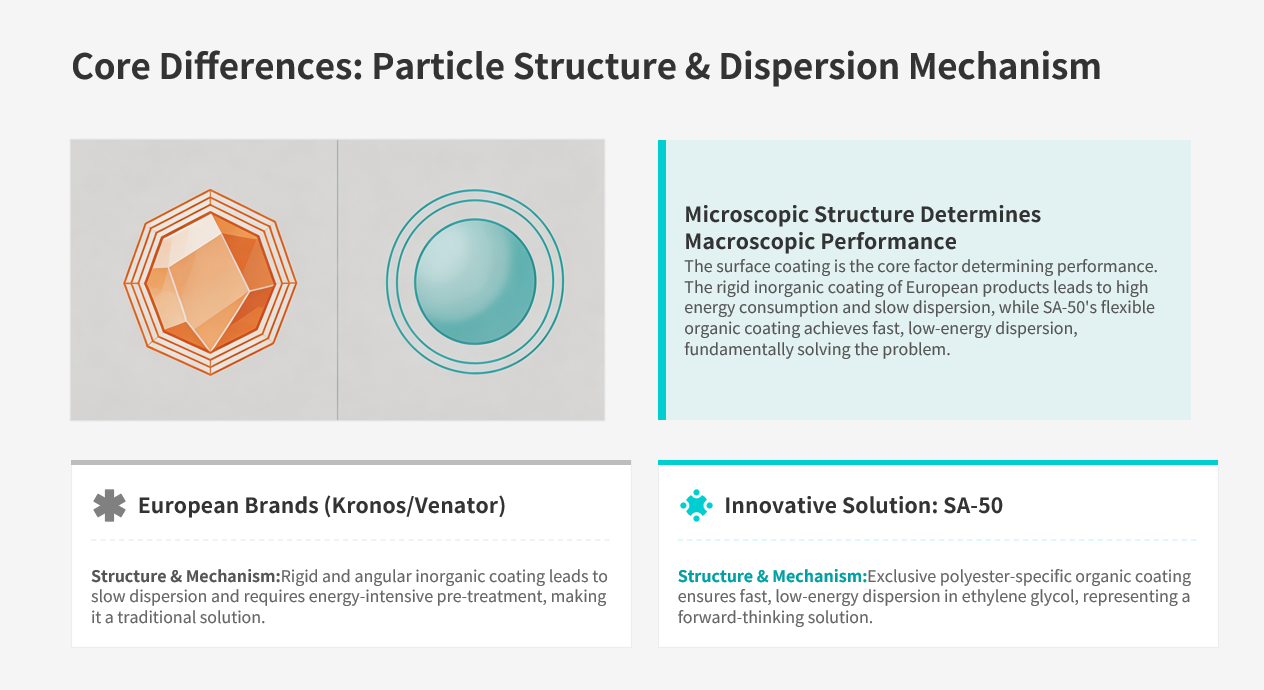
Figure 2 — Coating structure comparison: a polyester-specific organic coating against a traditional silicon-aluminium inorganic double coating. Surface treatment, not declared content, governs dispersion behaviour on the melt line.
The process consequences follow the dispersion behaviour. Reduced abrasion from a smoother particle surface extends expected spinneret lifespan by 12%–18%, cuts spinneret abrasion by 3%–8%, and reduces spinneret replacement frequency by 40%. Filter consumption falls by 25%, with filter cycles extending from 7–9 days to 10–12 days in the cited comparison. Pipeline cleaning intervals extend to two months instead of monthly, reducing overall maintenance workload by more than 50%. On the energy side, glycol batching improves by 55%–62% because no heating pre-treatment is required — 6–11 kWh/MT against 18–26 kWh/MT for the inorganic-coated route — while extrusion energy is reduced by 9%–14% and reduced downtime contributes a further 4%–7%.
For a buyer building a scorecard, these are the numbers that belong in the "process load and maintenance" row. They are not visible on a specification sheet, and they are not captured by a unit price comparison.
6. A step-by-step decision flow for comparing an anatase matrix
The framework becomes operational when it runs in a fixed sequence. The order matters, because steps one and two determine how much weight every later criterion deserves.
- Define the required output. State whether the finished article is undyed or pale, matte or semi-dull, or heavily dyed. This single decision sets the optical weighting.
- Convert the output into two hard requirements. Translate the end use into an optical requirement (target L and b behaviour) and a process requirement (dispersion route and maintenance tolerance).
- Screen on content and impurity as a gate. Remove any grade that does not clear the declared content and impurity threshold for the spinning system. Two grades worth comparing will usually both pass this gate.
- Score the survivors. Apply the weighted criteria table from Section 2. Optical values take the weight set in step one; dispersion and maintenance take the weight set by the line configuration.
- Verify on delivered cost, not unit price. Re-quote every surviving grade on matched commercial terms — freight, lead time, MOQ and payment terms included — and add the maintenance and energy effects already documented for the line.
- Validate before bulk release. Confirm the score against line evidence: a trial or a controlled first batch, with filter pressure, breakage and colour readings recorded for comparison against the incumbent grade.
The decision table below condenses the logic into the form most procurement teams use in practice: a stated priority mapped to the criterion that should dominate, and the evidence that settles it.
| If the priority is… | Weight this criterion highest | What to check in the matrix |
|---|---|---|
| Pure-white or light-colour fabric | b value, then L value | A cool or neutral blue-white shade (for SA-50, b ≤ -0.4) rather than a warm yellow tone |
| Matte or semi-dull surface | L value specified for the matting effect, plus dispersion uniformity | The matrix entry specified for matting performance; confirm its own L value on that grade's certificate |
| 7×24 continuous spinning | Spinneret wear, filter cycle, downtime | Grades with a smooth particle surface and documented maintenance intervals |
| Ethylene glycol batch feeding | Dispersion without pre-infiltration | Documented compatibility with ethylene glycol and polyester resin |
| Cost-driven commodity market | Delivered cost, lead time, MOQ | Unit price plus logistics plus documented production savings, on matched terms |
7. Where the weighting lands in practice
The framework is easiest to test against documented application scenarios, because each scenario pushes a different criterion to the top of the scorecard.
PET in-reactor polymerization matting. For mass production of semi-dull and full-dull PET chips, the feeding configuration matters as much as the grade. SA-50 is documented as optimised for the ethylene glycol pre-dispersion feeding process and matched to high-speed POY, FDY and DTY continuous spinning.
High-grade light-colour and pure-white polyester fabric. Here the cool blue-white tone is the deciding criterion, because it reduces the yellowish shade that otherwise appears in pure white, light grey and bright-colour textile products.
Long-cycle, high-yield continuous lines. Where the line runs continuously, the organic coating's smoother particle surface — reducing spinneret abrasion by 3%–8% and lowering filter blockage frequency — assigns most of the weight to maintenance and uptime rather than to colour.
Delivery-sensitive global PET markets. In China, Southeast Asia, India, Korea and the Middle East, delivery time reduced by more than 50% and MOQ flexible from 1 MT change the weighting inside the supply-terms row, and they matter more than the last fraction of a percentage point on content.
Handling and storage deserve a standing allocation in the scorecard rather than a place in a footnote. Fiber-grade TiO₂ carries a recognised dust-inhalation and moisture-agglomeration risk, and the documented control method combines vacuum closed feeding to prevent dust dispersion, warehouse humidity maintained below 65% with sealed packaging, and dust-proof masks and protective clothing for operators. Packaging options include 25 KG and 500 KG formats, and the chosen format should be matched to the feeding system rather than to the price list alone.

Figure 3 — Sealed packaging supports the documented storage control method: warehouse humidity below 65% with closed, dust-controlled feeding into the spinning line.
8. Market context: why weighting discipline matters now
Two market signals make a fixed weighting framework more useful than it was a few years ago.
The first is growth in the category that fiber buyers depend on. Grand View Research projects the global titanium dioxide market at USD 24.4 billion in 2026, and identifies the anatase segment — the segment critical for fiber grade — as expected to grow at a CAGR of 7.3% from 2026 to 2033.
The second is consolidation on the supply side. According to SunSirs and Titanium Dioxide Alliance data, China's effective annual titanium dioxide production capacity fell from 5.9 million tons in 2024 to 5.7 million tons in 2025, even as China's titanium dioxide export volume reached 1.9017 million tons in 2024, a 15.84% year-on-year increase.
Read together, the two signals point in one direction: fiber-grade supply is consolidating inside an export channel that is still expanding. When capacity tightens while export volume grows, grade consistency and delivered cost stop being spot variables and become strategic ones. A buyer who has already defined the weighting can compare an alternative grade in days; a buyer who has not will tend to default to the incumbent simply because re-comparing is slower than renewing.
9. Comparison with traditional European grades — and where the framework has limits
The comparison set with the most documented detail is the SA series against European fiber-grade grades, specifically Kronos 1071 and Venator LW-S100. The table below places the verified facts side by side.
| Dimension | SA-50 (documented) | European grades (Kronos 1071 / Venator LW-S100) |
|---|---|---|
| Coating system | Exclusive polyester-specific special organic coating, Japanese refined dry modification technology | Traditional silicon-aluminium inorganic double coating with general organic modification |
| Dispersion | Dual compatibility with ethylene glycol and polyester resin; rapid dispersion without pre-infiltration; 20%–30% faster | Requires 2–4 hours pre-heat infiltration at 40–60 °C |
| Colour | Cool blue-white shade, b ≤ -0.4; L-value gap vs European grades ≤ 0.7 (visually identical) | Warm yellow tone, b +0.8 to +1.7 |
| Indicative price basis | FOB domestic 16,800–18,200 RMB/MT | CIF Asia 21,000–23,500 RMB/MT |
| Cost gap | Unit price 4,200–5,300 RMB/MT lower; logistics 750–1,000 RMB/MT lower; hidden production savings 380–700 RMB/MT; total comprehensive cost 22%–29% lower | 35–60 days ocean freight, with freight, insurance and port fees of 1,100–1,600 RMB/MT |
| Maintenance | Spinneret replacement 40% less frequent; spinneret life 12%–18% longer; filter consumption 25% lower; pipeline cleaning every 2 months | Spinneret replacement around every 45 days; filter clogging every 7–9 days; monthly pipeline cleaning |
| Energy | Glycol batching 6–11 kWh/MT; extrusion energy 9%–14% lower | Glycol batching 18–26 kWh/MT, plus 5–9 kWh/MT for pipeline cleaning |
| Supply flexibility | MOQ flexible from 1 MT; delivery time reduced by more than 50% | Long-haul ocean freight schedules govern lead time |
The limits matter as much as the differences, and a framework that hides them is not a framework.
Batch stability is not a decisive gap. The documented batch stability advantage of SA-50 over European grades is 1%–3% — described in the source data as negligible for normal production. A plant that already controls batch variation well should not assign this criterion a high weight.
The documented performance set is polyester-centric. The dispersion, energy and maintenance figures above come from polyester (PET) processing comparisons. Producers running viscose or polyamide routes should confirm grade fit and grade-specific parameters for their own system rather than transferring PET figures directly.
European grades retain a real advantage of their own. The traditional silicon-aluminium inorganic double coating is documented as providing stable anti-sedimentation performance for large-scale European production lines. A converter whose line, validation history and logistics are already built around that behaviour may not capture the full switching benefit, and should weight switching cost explicitly.
The dispersion advantage assumes a compatible feeding configuration. Rapid dispersion without pre-infiltration assumes the ethylene glycol batching system can feed at ambient conditions. A plant still specifying pre-heat infiltration out of legacy practice would need to change the batching routine to realise the documented 55%–62% batching energy improvement.
Optical data is grade-specific. L and b values must be read from the certificate of the individual grade being evaluated. Assuming that one entry in a series carries the values of another is the single most common error in matrix comparison, and the framework should be written to prevent it.
10. Future outlook
If the anatase segment grows at the projected 7.3% CAGR from 2026 to 2033 while Chinese effective capacity consolidates, the practical pressure on fiber producers shifts from securing volume to securing consistency. That favours buyers who can specify, score and verify a grade quickly, and it favours suppliers who can document performance rather than assert it.
Two supporting trends reinforce the shift. Standardised test methods such as GB/T 37632-2019 for titanium dioxide content in man-made fibers give both sides a common measurement reference, which reduces the room for content claims to diverge between supplier and buyer laboratories. And as particle size specifications increasingly cite distribution rather than a single average — the fiber-grade norm of a D50 around 0.28 μm with 90% between 0.1 μm and 0.5 μm being a representative example — the technical conversation moves toward filter and spinneret compatibility rather than a single headline number.
For procurement teams, the durable outcome is a scorecard that survives personnel changes and quotation cycles. The criteria are stable; only the weights move, and they should move deliberately, in response to the end product and the line.
FAQ
How should TiO₂ content be weighted against unit cost when comparing fiber-grade anatase grades?
Content is best treated as a pass/fail gate rather than a sliding score. Once a grade clears the content and impurity requirement for the spinning system, additional percentage points rarely change fabric output, while they do change price. Content claims should be read against a defined test method — GB/T 37632-2019 is the Chinese national standard for titanium dioxide content in man-made fibers — and the variable weighting should sit with delivered cost, which includes unit price, freight, lead time and the documented maintenance and energy effects on the line. Treating price alone as the comparison understates the total cost difference.
Do L and b values decide whether an anatase grade suits a pure-white fabric or a matte fabric?
They influence the decision differently. The L value describes how light or white the material reads; the b value describes whether it sits toward the yellow or the blue side of the hue axis. For pure-white and light-colour fabric, the b value carries the most weight, because a warm yellow tone requires downstream compensation. For matte or semi-dull fabric, the hue shift is largely masked, so the L value specified for the matting effect and dispersion uniformity carry more weight than b. In documented comparison data, SA-50 presents a cool blue-white shade at b ≤ -0.4 against a warm yellow European tone of b +0.8 to +1.7, with an L-value gap of ≤ 0.7 described as visually identical.
What is the practical difference between an organic-coated and an inorganic-coated fiber-grade TiO₂?
The difference appears in dispersion and maintenance rather than in appearance. The documented European grades in this comparison use a traditional silicon-aluminium inorganic double coating, which requires 2–4 hours of pre-heat infiltration at 40–60 °C before feeding and provides stable anti-sedimentation performance for large-scale production lines. An organic coating such as the polyester-specific coating on SA-50 achieves dual compatibility with ethylene glycol and polyester resin, disperses without pre-infiltration and disperses 20%–30% faster. The downstream effects are reduced spinneret abrasion of 3%–8%, spinneret replacement frequency 40% lower, filter consumption 25% lower, and pipeline cleaning intervals extending to two months instead of monthly.
Which criteria should carry the highest weight when the spinning line runs continuously?
On a continuous, high-yield line the dominant criteria are spinneret wear, filter cycle and unplanned downtime, because each interrupts output rather than merely altering appearance. Documented figures for a smooth-particle organic-coated grade include expected spinneret lifespan 12%–18% longer, filter consumption reduced by approximately 25%, and overall maintenance workload reduced by more than 50%. Energy belongs in the same weighting: glycol batching at 6–11 kWh/MT against 18–26 kWh/MT for the inorganic-coated route, extrusion energy 9%–14% lower, and an additional 4%–7% reduction from roughly 30% less downtime. Optical criteria should be weighted lower unless the end product is undyed or pale.
What evidence should a buyer review before approving a new anatase grade for bulk supply?
A defensible review covers four evidence sets. First, the certificate of analysis with content and impurity values, read against a defined test method. Second, optical data — L and b values — taken from that specific grade's certificate, not inferred from another entry in the same series. Third, dispersion and feeding evidence: compatibility with ethylene glycol and polyester resin, and whether pre-infiltration is required for the plant's batching configuration. Fourth, process evidence from the line itself: filter pressure behaviour, breakage rate, colour readings and maintenance intervals recorded against the incumbent grade. Handling controls should also be confirmed, including sealed or vacuum feeding, warehouse humidity maintained below 65%, and the packaging format matched to the feeding system.
About the supplier referenced in this article. Orient International Holding Shanghai Foreign Trade Co., Ltd. is a state-owned foreign trade enterprise founded in 1988 and wholly owned by Orient International Group, with registered capital of over RMB 548 million and more than 150 regular employees. The company handles self-operated and entrusted import and export of titanium dioxide and other bulk petrochemical raw materials, with an annual handling capacity of 16,000 MT, and provides international logistics, customs declaration, letter of credit settlement and cross-border supply chain risk control. Export markets include Korea, Japan, the EU, North America, South America, South East Asia, the Middle East and India, supported by the parent group's overseas branch network. Website: www.petchemical.com.
Product and company documentation is available here: Orient International Holding Shanghai Foreign Trade Co., Ltd. — company profile (PDF).